Leave a comment

CULTURE VULTURES

Prayers at the Wailing Wall

I am sitting in the Den, looking out of the window at the trees in our orchard, and thinking about the way we are shaped by our particular culture. I am not just thinking of my own inherent ‘Englishness’ but of the way I have also changed in the two years I have been living in rural Dorset, resulting in me becoming far more relaxed and laid back about things. Spending a month living in Israel-Palestine during our recent sabbatical also proved to be something of a ‘culture shock’ with its varied, very different, and at times conflicting cultural identities. Pride in our ‘cultural roots’ is big at the moment. In some ways this is good, but in other ways it is perhaps not so good. On one hand it has fed the unhealthy rise in ‘nationalism’ we are plagued with today, and amongst Christians it has been used to justify all kinds of unhelpful views and behaviour patterns. One of the things that our sabbatical in the Holy Land indelibly impressed upon me is the conviction that, rather than allow ourselves as Christians to be shaped by the various cultural patterns and forces around us, we should discern, take on board, be shaped by that particular culture that is ‘Christian culture’!

The word culture has many different meanings. For some it refers to an appreciation of good literature, music, art, or food.  For a biologist, it is probably a colony of bacteria or other microorganisms growing in a nutrient medium in a laboratory Petri dish.  For anthropologists and other behavioral scientists, however, culture is the full range of learned human behaviour patterns.  The term was first used in this way by the pioneer English Anthropologist Edward Tylor in his book, Primitive Culture (1871).  Tylor suggested that culture is ‘that complex whole which includes knowledge, belief, art, law, morals, custom, and any other capabilities and habits acquired by man as a member of society.’  Culture, of course, it is not limited to men – women possess and create it as well.  Culture is a powerful human tool for survival, but it is a fragile phenomenon.  It is constantly changing, can be easily distorted or even lost altogether, and in most cases cannot be relied upon because it exists primarily only in our minds.

What struck me in a major way during our time in the Holy Land was the way in which – even as Christians – our beliefs, convictions, and behaviour patterns are shaped by our cultural identities … even if that culture is not necessarily Christian and, indeed may actually militate against Christian culture?!  A comparison between the evangelical Arab Christians and the Messianic Jews serves as an example of the way in which we are shaped by our respective cultures. Thus, the evangelical Arab Christians we met, and enjoyed wonderful Christian fellowship with, displayed a number of the characteristics associated with Arab culture. They are very relational people (rather than institutional), family orientated – the family always comes first whatever the circumstances. They are very laid back – everything is done (and it does eventually always get done) in the ‘Arab way’ and according to ‘Arab time’. They are also governed by the ‘honour-shame’ concept that in Arab society is the primary device for gaining control over children and maintaining social order. In contrast, the Messianic Jews we also met, and enjoyed Christian fellowship with, displayed many of the characteristics associated with Jewish culture. The Jewish ‘chutzpah’ or ‘in your face-ness’ (which is seen as a virtue by many Jews) is there in bucket loads, which means that Messianic Jews are very confident people who really do believe that they are right (even when they are wrong). They are very activist and hard working, determined to get things done – another Jewish trait – and the Messianic Jewish Congregations we came across were a hive of activity with a lot of community based stuff going on. They are also more Zionist than the Zionists, strongly believing that ‘the Land’ belongs to the Jews by right – although interestingly they display here that, in addition to their inherent Jewish culture, they are very influenced by American culture (perhaps not that surprising since many of the first Messianic Jews came from the USA), particularly the ‘dispensationalist views’ held by many fundamentalist American Christians.

I am not seeking to be critical of either Arab Christians or Messianic Jews in highlighting the above cultural characteristics. There is a lot to be said for being relational and family orientated, relaxed and laid back rather than taking ourselves too seriously, concerned about doing the right thing, being confident and hard working, holding to what we perceive to be God’s promises to us. Nevertheless we still need to continually question how much who we are, what we believe, how we behave, both as individual Christians and as local congregations, is shaped by our cultural influences rather than by the grace of God? Do we simply accept our cultural shaping rather than question it? What is good about the effect our cultural influences have on us, and what is not so good?  Is it possible to be too family orientated, too laid back, too concerned about being seen to do the ‘right thing’? Is it possible to be over-confident, too active and ‘works’ driven, too sure that we are right (especially when we are wrong)?

And, of course, we Brits are equally guilty of being shaped by our cultural influences rather than the grace of God? Take our approach to corporate worship for example. Some Christians adopt a ‘reserved’ approach to worship, which they justify on the grounds of showing respect for God  – ‘worship the Lord in the beauty of holiness’ – when, in reality, it is probably has more to do with our ‘Britishness’ than anything else? Other Christians are all for ‘contemporary praise and worship’ claiming that this is more ‘Spirit led’ – ‘worship the Lord in Spirit and in truth’ – when in reality it  probably owes its popularity as much to the cultural influence of the American music scene in recent decades as it does to the influence of God the Holy Spirit?

A ‘culture vulture’ is someone who steals traits, language and/or fashion from another ethnic or social group in order to create his or her own identity. The point I am trying to make here, is that we are all ‘culture vultures’ in one way or another – more than perhaps any of us are prepared to admit. We are all the products of our cultural influences and this affects what we believe, how we worship, what we teach, how we behave, and so on. Some of these cultural influences may accord with Christian culture, but others may not – indeed some may ‘ape’ Christian virtues in a way that results in warped Christian values that may be actually damaging to us and to our work and witness.

This problem is not new. Paul writes to the Philippian Church – a church, in a city deliberately built as a Roman Colony to mirror Roman culture in every way – and reminds them they are ‘a colony of heaven’ (Philippians 3:20). In other words they are to be aware of the danger of being ‘Roman Christians’ – allowing their faith and practice to be shaped by their Roman cultural identity – and rather be shaped by their Christian cultural identity. They are to become a man or a woman ‘in Christ’ (2 Corinthians 12:2)! Time for us all to stop being ‘culture vultures’ of one form or another, and learn to become the people and churches that God wants us to be in Christ!

Jim Binney

3 Comments

SNAKES AND LADDERS

The Immovable Ladder

I am reflecting on our recent visit to the Church of the Holy Sepulchre in Jerusalem, and particularly on what has become known as ‘the immovable ladder of the Church of the Holy Sepulchre’?! I really, really dislike the Church of the Holy Sepulchre! It is the most awful place and I only go there a) because we are part of a group and our group are touring the various religious and historical sites, and b) because although I have been before, I have never actually been into the actual Sepulchre itself – a fact I am determined to resolve on this particular visit. What I do ‘enjoy’ about this site, however – indeed what I find very amusing in one way, although totally heartbreaking in another – is standing in the courtyard in front of the main entrance to the Church and looking up at the high windows. There, placed by one of two of the windows, is a wooden ladder – left behind by some workmen – that has been there for almost 200 years because of an unresolved dispute.

The ‘immovable ladder’ is a religious symbol of all that is wrong with the Christian Church today.  It is a powerful and iconic symbol of the divisions and religious disputes within the Church of Christ. Allegedly the site of the death and resurrection of Jesus Christ, the Church of the Holy Sepulchre is one of the holiest places in Christianity and has been the site of pilgrimages since the 4th century. Sadly, even this most venerated shrine has not escaped the negative effects of sinful human nature –  vanity, pride and envy.

Even from its earliest days Christianity was subject to splintering – spawning numerous denominations and groups, all claiming to be the ‘true followers’ of Jesus Christ. The most prominent of these fought bitterly over the centuries for the dominance over the holy places in Palestine. During the time of Muslim dominance over the area – a government equally hostile to all Christian denominations – no one group could achieve a clear advantage over the others. As the disputes rolled on, the methods of gaining advantage became ever more dubious including outright bribery, blackmail, and the use of force. Even today, the current situation is an uneasy status quo, a kind of an fragile compromise.

The care of the Church building is shared by no less than six denominations. The primary custodians are the Greek Orthodox, Armenian Apostolic and Roman Catholic churches, with lesser duties shared by Coptic, Ethiopian and Syriac Orthodox churches. The whole edifice is carefully parceled into sections – some commonly shared, others belonging strictly to a particular denomination. A set of complicated rules governs the transit rights of the other groups through each particular section on any given day, and especially during the religious festivals. Some of the sections of the church however still remain hotly disputed to this day.

Arguments and violent clashes are not uncommon. In November 2008 the internet was flooded with videos of a fistfight between Armenian and Greek monks in one such dispute. A small section of the roof of the church is disputed between the Copts and Ethiopians. At least one Coptic monk at any given time sits there on a chair placed on a particular spot to express this claim. On a hot summer day he moved his chair some 20 cm more into the shade. This was interpreted as a hostile act and violation of the status quo. Eleven were hospitalized after a fight resulting from this ‘act of provocation’?!

This state of affairs makes any agreement about renovations or repairs on the edifice impossible. The church is in a state of decay as a result. The famous ‘immovable ladder’ is a bizarre outcome of this religious stubbornness pushed to extremes. Some time in the first half of the 19th century, a builder placed a ladder up against the exterior wall of the church in order to make some repairs. This led to a dispute between the Greek Orthodox and the Roman Catholics, resulting in the repairs grinding to a halt. The builder was unable to complete his work, never got paid, and eventually walked off the site leaving his ladder behind him.  The ladder remains there to this day. No one dares touch it, lest they disturb the status quo, and provoke the wrath of others.

I know that it has become popular today, to blame the devil for everything. I recall a cartoon showing the devil standing outside a church crying. When someone asked him why he was crying, he pointed at the church building and replied, ‘Its those people in there – they blame me for everything!’ Actually a lot of what goes on in our world, and in the Church, is not the devil’s fault. All that old serpent often does is simply sit back and watch us make a real ‘pig’s ear’ of things all on our own!? The scandal of the disunity amongst professing Christians at the Church of the Holy Sepulchre is a classic example of this … as is the ongoing disunity amongst professing Christians in every other part of the world today.

In his Second Letter to the CorinthianChurch, Paul reminds Christians of every generation that God has ‘reconciled us to himself in Christ, and entrusted to us the ministry of reconciliation’ (2 Corinthians 5:18). In other words, it is not enough simply for us to be reconciled to God in Christ ourselves, but we are to go out into this broken, and hurting, and divided world and effect reconciliation wherever we can! Not simply reconciling men and women to God in Christ, but reconciling men and women to each other through Christ! Sadly, instead of modeling reconciliation the Church models division! How can we expect the world to take our message seriously when we don’t take it seriously ourselves.

Personally I am sick and tired of the way we continually tear apart the body of Christ with our self-righteous pontifications on the ‘soundness’ of ourselves, and the ‘unsoundness’ of others, instead of working hard for the unification of the Church. I am coming round to the view Richard Baxter, the 17th century Puritan (under whose ministry Kidderminster experienced a significant spiritual awakening), expressed when he advocated that the basis of Christian unity should be minimalistic – simply belief in ‘the Apostles’ Creed, the Ten Commandments, and the Lord’s Prayer’. Why are we charismatic evangelicals so reluctant to associate with other Christians who don’t think quite like us? Are we so arrogant that we think we alone ‘have got it right’? Are we so afraid that our concept of ‘the truth’ will be diluted by mixing with our fellow Christians who may see things somewhat differently to us?

When Julia and I eventually return to the Ministry we hope that it will either be in a Baptist Church that really wants to work with the other Christian Churches in the area, or with a Local Ecumenical Project. It really is ‘the only way to go’! When I was a child I loved to play ‘Snakes and Ladders’ – it was a great game for kids – but ‘when I grew up I put the ways of childhood behind me’ (1 Corinthians 13:11). It really is the time for us Christians to stop playing silly games!

Jim Binney    

Leave a comment

A DYNAMIC BAPTISM

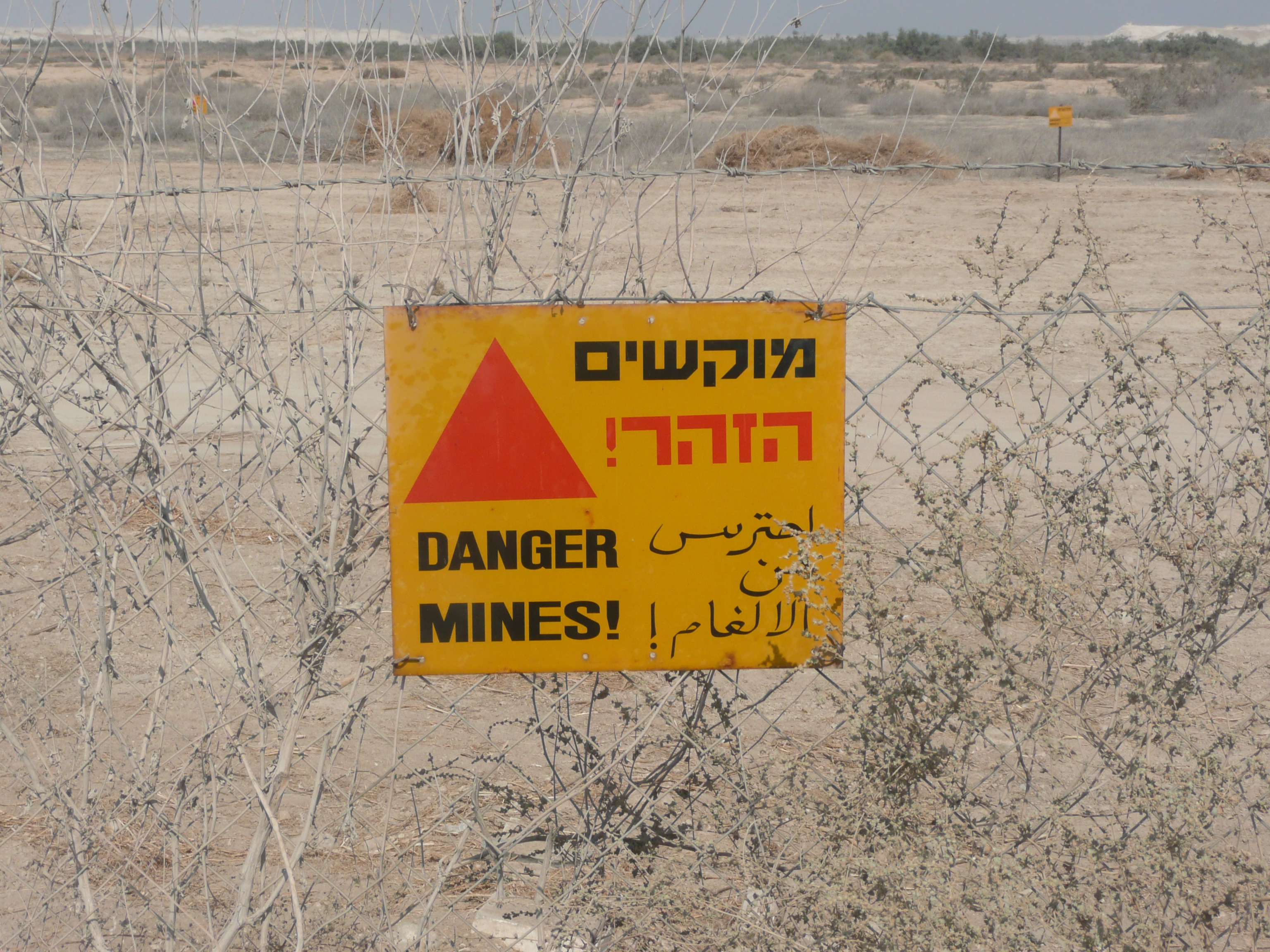
Mine Field at Qasr el-Yahud Baptismal Site

It is early morning and I am sitting in the kitchen, drinking coffee and eating ‘first breakfast’ (readers of The Lord of the Rings will understand). The rest of our household are still all asleep – even Reggie Doggie! I am watching the rain absolutely pouring down outside. It is such a contrast to the weather we enjoyed in the Holy Land – wall to wall sunshine for the whole month. There is a ‘river’ flowing down the street outside the front of our cottage, and the stream at the bottom of our garden has overflowed and our back garden is flooded again. New readers to our blogs need not worry, however. The road outside the front of our cottage regularly turns into a ‘river’ when it rains torrentially like it has been raining here all night, and our back garden regularly turns into a lake – more so this year because it has been so wet in the UK and the water table is extremely high. We ourselves are quite safe, however. Our cottage is stone built, raised up on a mound well away from the stream, and has been here for several hundred years. We have plenty of food in the house even if getting out and about may be a little difficult for a day or two if the rain continues.

As I sit here watching the torrential rain and the flooding, I find myself reflecting on our sabbatical time in Israel-Palestine once again. Admittedly my initial thoughts are to do with the contrast in weather, but I suddenly find myself thinking about baptism. It is the ever growing ‘lake’ or ‘baptismal pool’ that is in our garden rather than the incessant ‘pouring’, that triggers this off you will understand!? I find myself thinking about two baptismal sites on the River Jordan we visited while we were there.

The Yardenit Baptismal Site is the site that most of the tourists are taken to. It is very commercialised and it is very crowded the day our group go there. The visitors centre is run by the nearby Kibbutz Kinneret and includes a souvenir shop, a restaurant, showers, changing rooms and several baptismal pools. There is no charge for entering the site but you have to wear a baptismal robe in order to be baptised … and these can be purchased from the shop of course?! There are lots of people getting baptised, and there appears to be a lot of self-baptising going on as well?! I see one young woman standing in the River Jordan, repeatedly crossing herself, muttering a short prayer, holding her nose, and then plunging herself under the water. She does this again and again and again. Is this a new kind of ‘baptismal formula’ I wonder? Last time I was here I stopped to talk to a couple who had just been baptised and were on their way back to the changing rooms. They told me they were Southern Baptists from the USA. I asked them if this was the first time they had been baptised. ‘Oh no!’ they replied, ‘We come to Israel every other year and this is the fifth time we have been baptised!’ I asked them what they thought this had to say about their theology of baptism? They looked at me blankly!

The Qasr el-Yahud Baptismal Site is considered more authentic, but until recently it has not been easy to get to. It is situated further down the River Jordan and is actually on the border between Israel and Jordan. It was closed for many years after the Six Day War – a fact that led to the Kibbutz Kinneret developing the Yardenit Baptismal Site into the commercial success that it has become. It is still not easy to get to and our minibus has to turn down a long narrow road, through an Israeli Check Point, and through a mine field – yes, you read it correctly, through a mine field – in order to get to the Baptismal Site! The River Jordan is very narrow here – Jordan itself is literally only a dozen yards away across the river. Indeed it is suggested that this is not only the place where Jesus was baptised, but the place where the people of Israel crossed over the River Jordan into the land of Canaan when they finally completed their wilderness wanderings (Joshua 3). There are baptismal sites on both sides of the river here with people being baptised in both sites – they literally meet each other in the middle of the river. There are armed Israeli soldiers on our side of the river, and armed Jordanian soldiers on the other side of the river making sure that no one illegally crosses into either country disguised as a ‘baptismal candidate’. It is less crowded than the Yardenit Baptismal Site, and the baptisms that are going on seem more ‘civilised’ somehow … despite the large notices warning baptismal candidates not to trespass into the mine field!

As I sit looking out of our kitchen window at the pouring rain and the by now quite large ‘baptismal pool’ that is continuing to slowly but surely take over our back garden, I find myself reflecting on both the incongruity and the prophetic symbolism of having a baptismal site right next to a mine field!? In the New Testament Christian baptism was seen as the ‘rite of passage’ whereby a man or a woman confessed their faith in, and commitment to, Jesus Christ as Lord and Saviour. On the Day of Pentecost 3,000 people responded to Peter’s exhortation to ‘repent and be baptised’ and were immediately baptised in the ceremonial cleansing pools surrounding the great steps that led to the Temple complex. Baptism in the embryonic Christian Church of those days was for those who had reached the age of maturity where they were capable of knowing what they were committing themselves to (Acts 2:37-39). In this same passage Peter links two baptisms – baptism in water and baptism with the Holy Spirit – when he promises those who do repent and are baptised ‘the gift of the Holy Spirit’ (Acts 2:37-39). Jesus himself promised his disciples – every disciple – that they would be ‘baptised with the Holy Spirit’ (Acts 1:5) and went on to define this ‘baptism’ as a baptism of ‘power’ (Acts 1:8)! Clearly in the New Testament, commitment to Christ, baptism in water, and being filled with the Holy Spirit are all closely connected, both in time and in experience. Interestingly, the Greek word for ‘power’ used here in Acts 1:8 is ‘dunamis’ – a word from which we get our English words ‘dynamic’, ‘dynamo’ and ‘dynamite’! I find myself thinking about the events that marked my own embryonic Christian experience – more than 50 years ago now – my conversion, my baptism, my experience of being filled with the Holy Spirit! I find myself asking myself the question, ‘Is my faith and Christian witness as dynamic today as it was then?’ Perhaps having a baptismal site next door to a mine field is not so incongruous after all?

Jim Binney

Leave a comment

RENEWED VISION

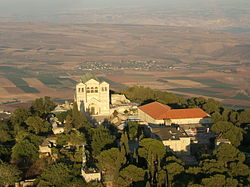
Mount Tabor

I am sitting in Specsavers Opticians in Weymouth waiting for Julia. She is having her eyes tested. I am anticipating a big bill for new spectacles. There is nothing wrong with her eyesight, although she does wear spectacles for reading, but she got a letter through the post offering her an eye test for only £5 and Julia has never been one to resist a ‘bargain’. The eye test itself may only be a fiver but they are not daft, these people. They know how to ‘use a sprat to catch a mackerel’ … and Julia used to be in the fish business?!

While I am sitting here I am reflecting on our recent visit to the Holy Land and, since I am in an opticians, I am thinking especially about the time we spent on the top of Mount Tabor – where the Transfiguration of Jesus possibly took place. I am thinking of the cartel that prevents pilgrims and tourists alike from driving to the top of the mountain deliberately necessitating the use of an expensive taxi system to complete the journey. I am thinking about that crazy journey, at breakneck speed up the mountain to the summit, with our taxi driver holding his mobile phone in one hand as he chatted away nonstop and the steering wheel in the other, as he negotiated the steep, tight bends. At least last time we did this same journey eight years ago, the taxi driver cartel used great big Mercedes taxis built like army tanks, which made the journey fun. This time the Mercedes taxis are all gone and we are all ferried up the mountain in a fleet of minibuses. I am thinking of the fascinating Franciscan Church of the Transfiguration on the summit of Mount Tabor, and the beautiful gardens surrounding it with its quiet places to sit and prayerfully meditate, and the viewing platform with its amazing views over the surrounding countryside.

Most of all I am reflecting on what happened, possibly right here on this very spot, 2000 years ago before these buildings and gardens and viewing platform were built. I am thinking about an event, recorded in all three of the Synoptic Gospels, in which Jesus was ‘transfigured’ or ‘transformed’ in such a way that his divinity shone through his humanity (Matthew 11:1-9; Mark 9:2-8; Luke 9:28-36). Perhaps for the first time, the disciples who are with Jesus on this occasion – Peter, James and John – recognise who Jesus really is! This incident – which involves the appearance of Moses and Elijah (the two preeminent figures of Judaism) together with a voice from heaven confirming that Jesus himself is indeed the Son of God – shakes up the disciples. One would like to think that this incident transformed the disciples but it becomes clear, as the story unfolds, that they still have a long way to travel on their faith journey. Nevertheless the Transfiguration is seen as a pivotal moment, and the setting on the mountain as the point, where human nature meets God – the meeting place for the temporal and the eternal, with Jesus himself as the connecting point, the bridge between heaven and earth.

As I am sitting here in Specsavers Opticians, thinking subliminally about the value of having clear vision, reflecting on the effect that the Transfiguration must have had on those first disciples and what this means for me, pondering those two vitally important theological questions: ‘What kind of God?’ and ‘So what?’, I suddenly become aware of a conversation that is going on right next to me between another optician and a man and his wife. The man’s eye test has thrown up a problem. He is suffering from a loss of vision and now has to go to the eye hospital for a more thorough examination. Apparently he has had a steady degeneration of vision over several months, but being a ‘man’ he didn’t bother to say or do anything about it – he just ‘soldiered on’!? It was his wife who noticed it. At first she said nothing, not wanting to upset her husband, but in the end she could keep quiet no longer. She is the one who made her husband do something about it – which is why he is here at the opticians. The optician is quite positive. The problem is serious, if it had been allowed to continue it could have led to blindness, but they have caught it in time. With corrective treatment now, clear vision can be restored and renewed!

The relieved couple leave the shop, the optician returns to his consulting room, and I am left sitting reflecting on the story I have just overheard, and the way it uncannily fits into my reflection on our time at Mount Tabor, and the Transfiguration, and the significance of what the disciples saw. It leaves me with various questions: How do I see Jesus? How does this affect my life? Is my vision as sharp and as focussed as it should be? Are there new things that God wants me to see that I am not seeing because … well because I am a ‘man’ and ‘soldiering on’ in my own way?

I am still reflecting on all these things when Julia returns from her eye examination. Of course, according to the optician, she does need new spectacles – not for distance, not for reading, but for watching TV – whatever will they come up with next?! We fall about laughing and go for a coffee – we have the new eye prescription – and we can get a new pair of spectacles from ‘Specs-by-Post’ for a fraction of the price!

Jim Binney

3 Comments

DISTINCTIVE VOICES

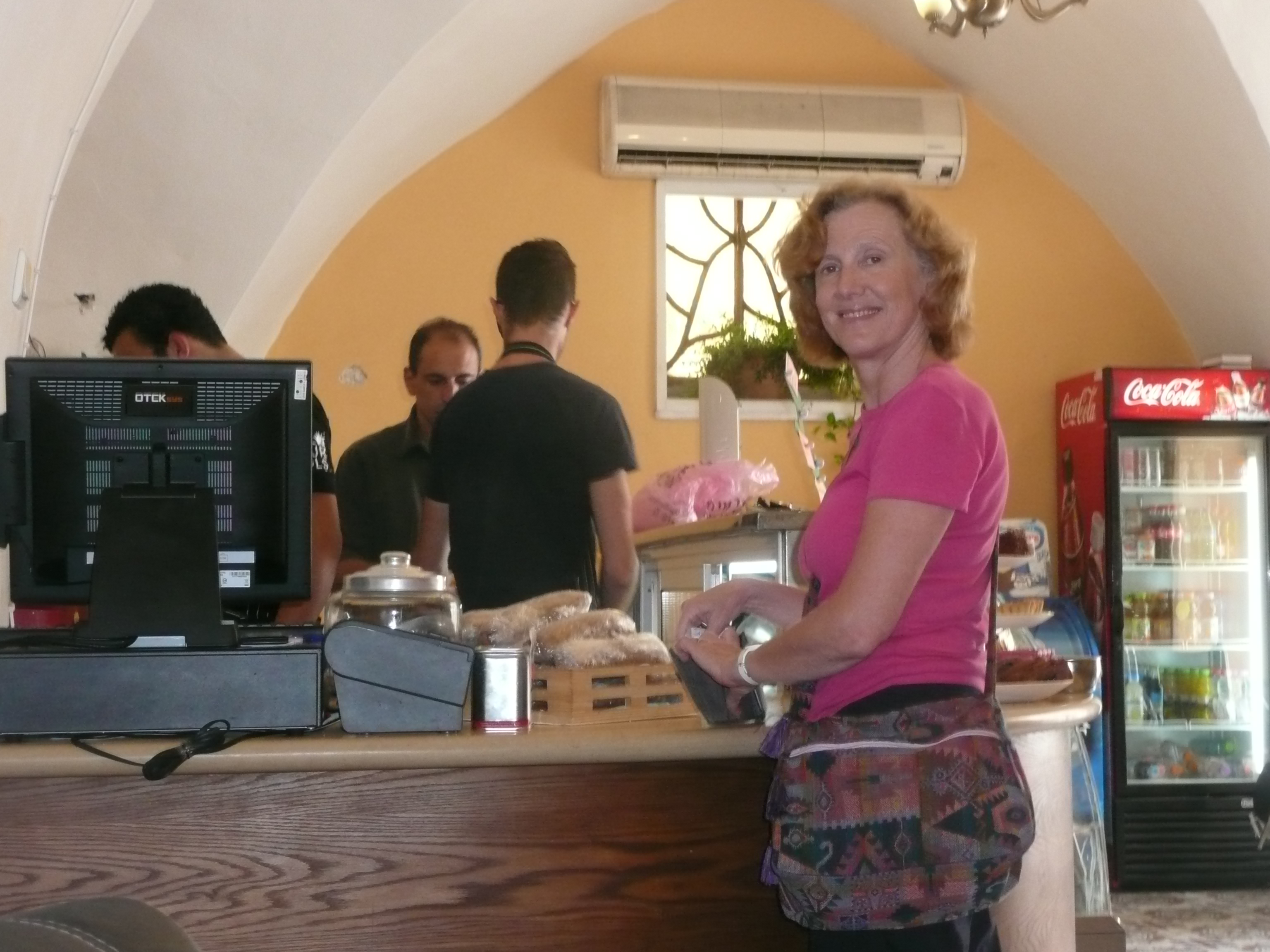
Julia in Christchurch Coffee Shop, Jerusalem

I am sitting in the Coffee Shop in Christchurch in Jerusalem. Julia is queueing up for coffee and cake. I am sitting in a comfortable easy chair resting my tired legs after walking half way round the walls of this amazing city. I am feeling quite relaxed and mellow. Our time in Israel-Palestine is drawing to a close, and I am reflecting on all the things we have seen and done and learned during our month here. There is a lot of activity going on around me – people queueing for coffee, or sitting at tables chatting away, or walking around looking for seats – but none of this really disturbs me. I am glad to be sitting in a comfortable seat after all the walking. I am anticipating the coffee and cake that will be with me shortly. I am basking in the sheer joy of having had this wonderful opportunity to be here in the Holy Land for a whole month, and having received so much as a result of being here.

Suddenly I am aware of a very distinctive voice. It has a deep, melodic resonance to it. It is so different to the cacophony of other voices all around me. It takes me a couple of minutes to locate the source of this wonderful voice that has an amazing musical tone to it, even though it is speaking not singing. Eventually I manage to join voice to person. It belongs to a very ordinary looking man indeed – not very tall, slightly built, not particularly attractive to look at – but what a voice! It is a voice that, at one and the same time, draws you to it, compels you to listen, and in an inexplicable way does you good on the inside as you listen. I can’t help myself. As this man is speaking I just have to listen. When Julia arrives back at our cosy spot in the corner I ignore her – I don’t even realise that she has returned – even the presence of the much anticipated coffee and cake doesn’t distract me from listening to this marvellous voice.

As I think of this man with this remarkable voice I ponder the fact that in the midst of our ‘crowded world’ there is a ‘voice’ – a remarkable voice – that we all can hear if we take time to listen?! Jesus spoke on one occasion of people who would become ‘familiar with his voice’ or who would come to ‘listen’ to his voice (John 15:16). It is noticeable that the majority of people in the Christchurch Coffee Shop are apparently too busy to appreciate this wonderful voice – they are too busy queueing up at the counter, searching for seats, eating and drinking, talking to each other or chatting on their mobile phones. Just like so many in Jesus’ day who heard him speak, saw what he did, but completely failed to recognise who he was or the vital importance of what he had to say. They simply ‘didn’t recognise him’ (John 1:10). Just like so many of us today really – too busy to take time out to listen for God’s voice? And yet, how much we do need to listen to what God has to say to us through Jesus? How much we need, like Mary of Bethany, to take time out from the demands of the day, albeit for just a few moments, and simply ‘sit at Jesus’ feet listening to what he has to say’ (Luke 10:39). Hopefully there are at least a few other people here in this Coffee Shop who are equally fascinated by this man’s voice as I am … and who are equally fascinated by the words of Jesus!?

As I sit reflecting in this way I am also reminded that although we ourselves may simply be ‘ordinary people’ with nothing special to commend us, other than our simple faith in Jesus Christ as Lord and Saviour, we too still have a voice. Part of being a Christian is that we are called to ‘hold forth the word of life’ to others (Philippians 2:16) – indeed to ‘speak the very words of God’ (1 Peter 4:11). This does not mean being ‘shouty Christians’ but speaking with a deep, melodious, interesting, and attractive voice … just like this man in the Christchurch Coffee Shop.

As I continue to reflect, this very ordinary man with the amazing voice eventually leaves. I hear his voice as it disappears in the distance. I want to get up and run after him. I have so many questions I want to ask him: Who are you? What do you do with your life? What was that you were saying to your friends … I only managed to catch bits of your conversation? Where did you get your wonderful voice? But it is too late – I can’t get through the crowd, my old legs won’t move fast enough to catch up – and by the time we leave Christchurch Coffee Shop he is nowhere in sight! I am reminded of an old poem about Jesus seeking to speak to us:

He came to you, for in is gentle voice he’d much that he would say –
Your ears were tuned to earth’s discordant note and so – he went away.

He came, and in his hand he had a task that he would have you do.
But you were occupied with other things, and so you missed that too.

He would have touched you, and his touch could thrill, and give you quickening power –
But earthly things enveloped, and you could not feel him in that hour?!

Or can we? I came away from my unexpected reflection over coffee and cake, grateful that God still speaks today, grateful that Jesus still walks with us on life’s journey, grateful that if we are prepared to listen he still has something helpful, perhaps challenging, to say to us today.

Jim Binney

1 Comment

TIME FOR A SABBATICAL?

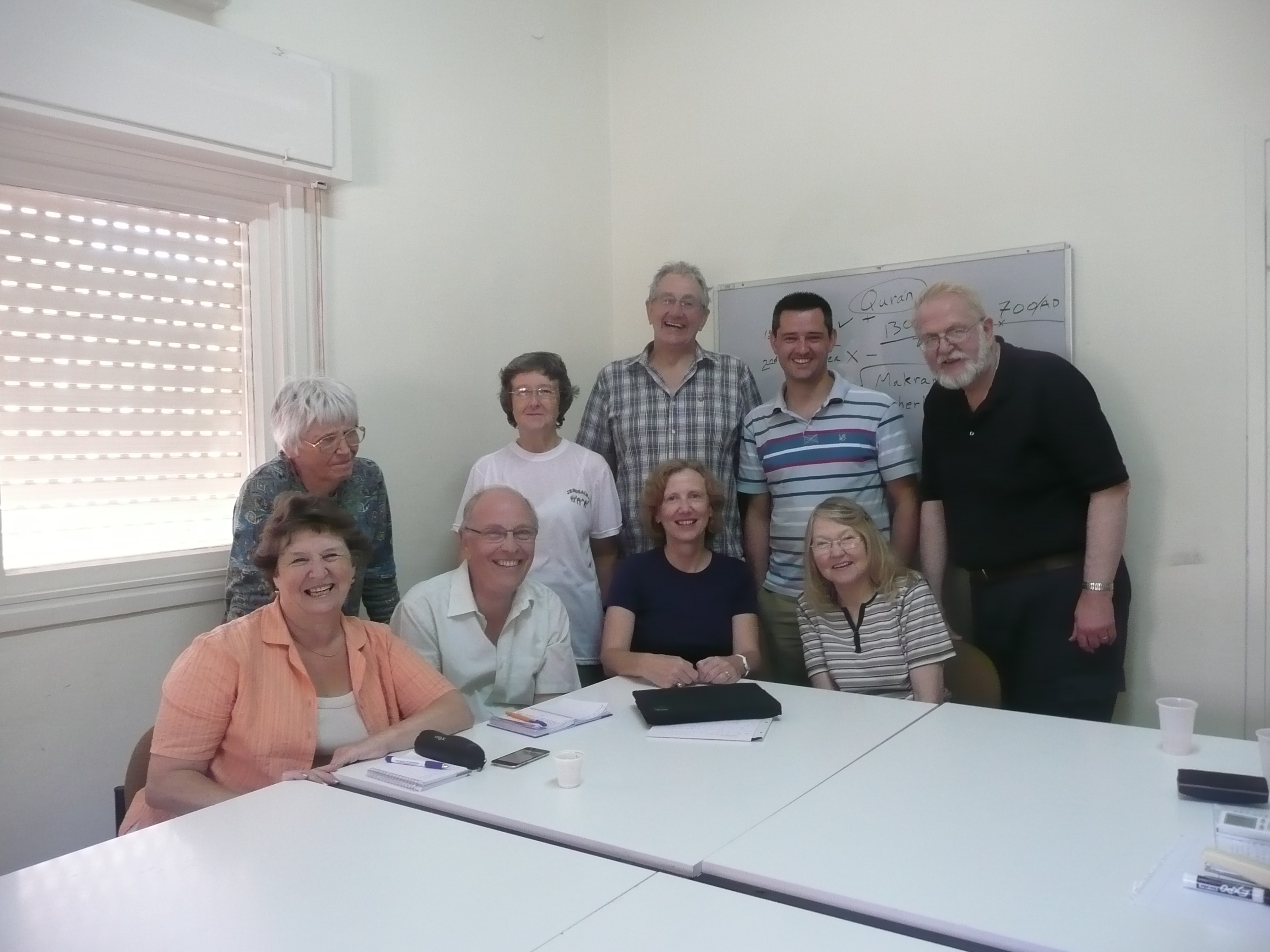
Members of Our Sabbatical Group

In 2004 Julia and I made our first visit to the ‘Holy Land’. It was an eight day ‘pilgrimage’ organised by the church we belonged to at the time and very much like all the other ‘church tours’ you see charging round all the ‘holy sites’ –  and some of the not so ‘holy’ –  at break neck speed. We saw just about everything that there was to see then, but hardly had time to really take anything in. Nevertheless it was still very wonderful to ‘walk where Jesus walked’ and to be able to absorb something of the atmosphere of this remarkable land where Jesus lived and taught and died and rose again!

That visit, eight years ago, wetted our appetite. Ever since then we have wanted to return. Indeed, we have tried unsuccessfully to do so several times since that first visit. We didn’t want to just ‘do the tourist thing’ again, however. We wanted to visit for a longer time in order to try and get behind the veneer and get to grips with what is really going on. There is a real cacophony of voices today, both in society and in the church, expressing every kind of opinion as to the ‘absolute truth’ of what is taking place in the middle east. It is all very confusing and we wanted to find out, first hand, what really was happening. We had developed a heart for the various peoples of this land and we needed to know more in order to pray more intelligently and help (if we could) more definitively.

When we heard about the Nazareth Evangelical Theological Seminary Sabbatical Programme, therefore – the opportunity to spend a whole month in Israel-Palestine visiting the key sites, exploring the issues with people who really did understand the situation, and engaging in ministry with some of the key players – we immediately saw this as a God-given opportunity. We had some money put aside to fund such a visit and, although it would cost us around £3,000 each. this was not an exorbitant amount given the fact that we would be there for a whole month and that everything – travel, accommodation, food, teaching, trips – was covered. I already knew several of the NETS staff through my connection with Spurgeon’s College, so I knew we would be in safe hands. Given the cost of our previous eight day trip this was definitely a good deal.

The Sabbatical turned out to be all that we hoped for … and more. The flights were easy even though we were flying by EasyJet. The accommodation was more than adequate – even though we were mostly staying in guest houses and budget hotels rather than luxury hotels. Saint Margaret’s in Nazareth had a marvellous courtyard, Villa Nazareth (where Julia and I stayed for a few nights) was delightful, and the Ritz Hotel in Jerusalem was great.  The food was an interesting new experience. It was plentiful, different – lots of different salads and lots of chicken – but delicious, and we all got addicted to Arabic coffee!  The various sites we visited were amazing – both the ‘holy sites’ and the historic sites – and it was so good to have plenty of time to explore them properly with excellent guides from NETS.  The Christian fellowship we enjoyed, both with the staff members at NETS and the various Christian congregations we were able to visit and worship with, was great. The teaching we received was first rate – somehow managing to combine a high academic standard but presented in an interesting and informative way with plenty of time for questions and discussion. It was so good to have a variety of people, coming from different corners, to share their personal insights with us in our teaching sessions. In this way we were given a wide understanding of the issues confronting all those who live in and around ‘the Holy Land’. We learned so much through this Sabbatical, and returned home much better informed although with few answers and very much aware of how complicated the situation really is.

Both Julia and I would heartily recommend this Sabbatical to everyone who really wants to get to grips with the Israel-Palestine situation. This would be a great trip for anyone who can make the time and raise the money to go. It would be a great trip for any Pastors who have a ‘sabbatical’ coming up and haven’t yet decided what to do with it. In fact why not suggest to your church that they send your Pastor on this NETS Sabbatical, and pay for him or her to go of course?!  Your church would ultimately benefit from it. Or why not go yourself? I can guarantee that it will be memorable and beneficial … and maybe even life-changing! You can find more information about the NETS Sabbaticals at http://www.nazarethseminary.org and about NETS itself.

Jim Binney                            

Leave a comment

Sunday 28 October: LIVING IN LA LA LAND

La La Land

We land at Luton Airport at 1.00 a.m. Israeli time … 12.00 midnight UK time. We both put on jumpers and coats etc. before we disembark from the plane. The temperature has gone from hot and sunny and 33 degrees in Israel to cold and wet and 7 degrees here in the UK. It has been a pleasant flight and we have been well looked after by the flight crew. I have been critical of easyJet in the past but I have to admit that both outward bound and inward bound flights have been excellent.

I am not too sure about Luton Airport, however? We walk miles to the customs point and then to the baggage collection point, retrieve our cases, and then wait for ages in the freezing cold for the airport bus to take us to the car park so we can retrieve our little Corsa. It is still there, and it starts first time despite just standing there for a month in the cold and the wet. We plug in the SatNav so that we can find our way to our hotel. The SatNav has hardly any power left in it … and we can’t find the lead anywhere … we have just enough power for our SatNav to intermittently give us a vague sense that we are heading in the right direction.

We only manage to get as far as the exit to the car park, however, before we encounter problems. The car park barrier sensor doesn’t recognise our car and refuses to open automatically. Julia goes to the car park barrier machine to try and get some help. It is all gobbledegook … even our handful of Arabic and Hebrew words can’t help us … and we are in the UK anyway? Another car pulls up behind us and starts hooting us … it’s 1.00 a.m. and she is hooting us … it is a deserted car park and she is hooting us? The really annoying lady driver gets out of her car and marches over tutting all the time. She must work here and is in a hurry to get home. She pushes certain buttons for us and Julia eventually gets through to someone official who opens the barrier for us. The SatNav flickers dimly on and off but eventually we find our way back to the Premier Inn that we first stayed in a month ago the night before we left for Israel-Palestine. It is nearly 2.00 a.m. and there is a party going on in the foyer … the guy on duty obviously has all his mates in to keep him company?!

We stagger to our room and collapse on our bed. We realise, of course, that it is actually only 12 midnight because of the time zone change and the clocks going back an hour this weekend in the UK. We are still on Israeli time, however, and we are too tired to go to sleep straightaway but eventually we go to bed and fall into a deep sleep … only to be woken up again at 4.45 a.m. by an ‘alarm call’ … someone has booked an early morning call because he has an early flight, but its not us? We hope that whoever the call was meant for gets his plane in time? We eventually get back to sleep again and wake up late. Its o.k. though because we are booked in to the Beefeater Restaurant next door for breakfast … and they don’t stop serving breakfast until 11.00 a.m.

We like Beefeater breakfasts. You an eat as much as you like. I have a large bowl of fruit salad to start with, plus orange juice and coffee, and then a huge ‘Full English’ breakfast. I sit looking at it for a few moments because I really don’t know where to start? After four weeks of having virtually the same thing for breakfast – the Arabs are keen on various salad stuff – I am torn between the fried egg and the pork sausage and the bacon, none of which I have had for a whole month! The bacon wins!

While we are in the Beefeater Restaurant we find ourselves near a table where there are four young British-born Pakistanis discussing Islam. One of them is slightly older than the others and is obviously the teacher. They are listening intently to everything he has to say. We wonder if they are aware of the other side of Islam … the ‘dark side’ that stems from the later Median period rather than the earlier Meccan period in Mohammed’s life? We doubt it. Moslem propagandists tend to initially only talk about the softer side of Islam – the family values, the charitable works etc. – and leave the others side – the subjugation of women, the violence to non-Islamic believers, their declared political agenda to slowly but surely take over country by country – until later. We also wonder if a group of young Christian people would ever get together to discuss Christianity so deeply and intently in a restaurant somewhere in the same way. It also serves as a reminder to us of the relevancy of everything that we have learned during our time in Israel-Palestine.

La La Land is a fictional, nonphysical place where people out of touch with reality live and where nonsensical ideas come from. It is often used sarcastically pertaining to where one’s mind has gone. In many ways Israel-Palestine is La La Land. After a month living there attempting to get to grips with what is really happening, we return understanding the situation much better than we did before, but none the wiser as to how to resolve the situation. It is extremely complex … more complex than you would ever believe. Don’t believe anyone who tells you that the Jews are right, or the Palestinians are right, or even that the Zionists or evangelical Christians who advocate dispensational views are right … it is far more complicated than that?! Israel-Palestine really is La La Land … but then so is the UK. Even more sad, is the fact that so many evangelical Christians seem to be living in La La Land when it comes to understanding what is happening in ‘the Holy Land’ today?! Time for us evangelicals to read more widely, think more deeply, pray more fervently … and spout more cautiously, I suspect!

After a yumacious breakfast we load our car and drive home to Rodden. We stop for coffee at Fleet Services … after such a big breakfast we don’t really need any lunch … and Julia’s mother is preparing a nice evening meal for us to enjoy when we get back to Chipps Barton. We stop off at Southampton Services … and decide that we do need some lunch after all … so pig out on hamburgers and French fries?! We arrive home in good time to have a bit of a rest before dinner … and who should be there to greet us but Reggie Doggie! ‘At last you have come back!’ he barks … and wags his tail so enthusiastically that it almost falls off!

Jim Binney

1 Comment

Saturday 27 October: NEARER TO GOD IN THE GARDEN

Today is our last day here in Israel-Palestine. We are awake early and finish our packing before going down to breakfast. Our flight home is not until 7.20 p.m this evening, although we have to be at the airport by 4.30 p.m. The big at taxi is coming to pick us up at 3.00 p.m. so we plan to make best use of our remaining time here. We can leave our cases in a secure room until the taxi comes for us, which leaves us free to do what we want for a few hours.

We are planning to visit the Garden Tomb which is only a short walk from our hotel. It is an alternative to the Church of the Holy Sepulchre as a possible site for the crucifixion and burial of Jesus. Julia and I have been before – eight years ago when we were last in Jerusalem. We love this place. Whether or not it is the actual site of the death and resurrection of Jesus, we cannot say. But then, neither can we be sure that the Church of the Holy Sepulchre is the genuine site either. The Garden Tomb has a lot to commend it. It is a next to rocky mound that really looks like ‘the place of the skull’ (John 19:17) which we know was used as a place of execution long before even the Romans arrived in Palestine. The garden itself would appear to have once been some kind of vineyard, and seemingly once belonged to a rich man who had a tomb built for himself within the garden. The whole place has such a wonderful atmosphere, and conveys a very real sense of the events of that first Easter, which is a direct contrast to the abject awfulness of the Church of the Holy Sepulchre.

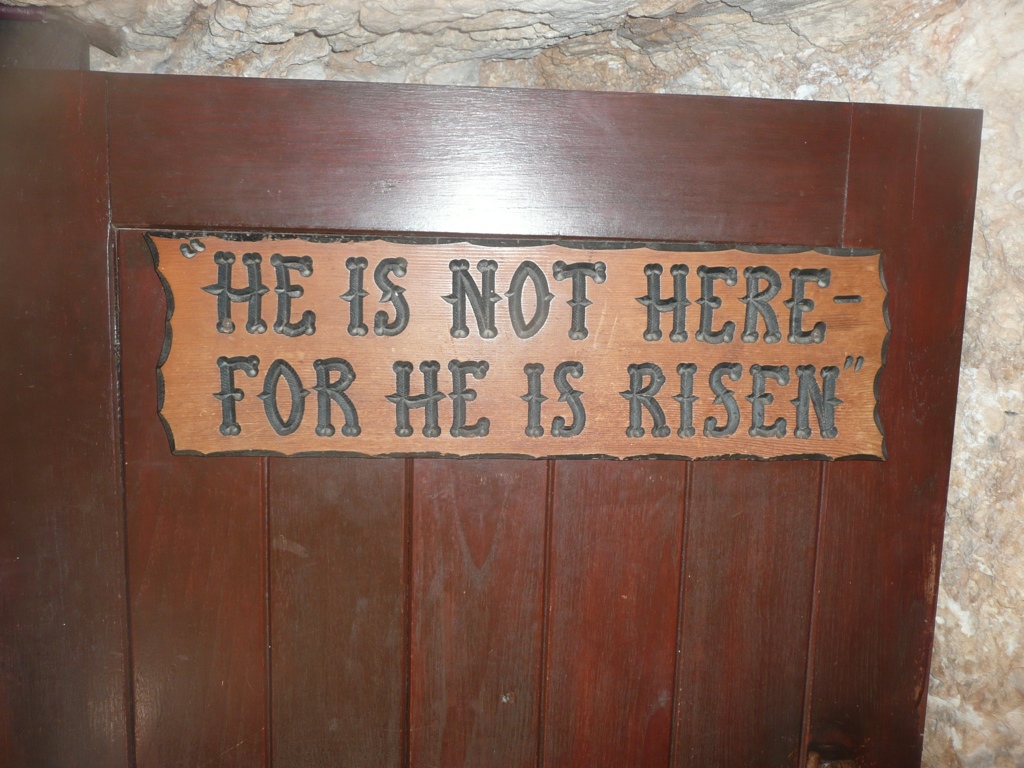
We walk to the Garden Tomb in blazing hot sunshine and discover that there are lots and lots of people there already. In addition to the various tours that have booked in for today the Garden Tomb is having an open day so that anybody can pop in whenever they feel like it. Apparently a lot of Jewish people come in on these occasions, and it is the same today. We are made very welcome, and we have a very good guide who takes us around and explains things to us. He takes over to the far corner of this compact, but beautifully laid out, site where we have an excellent view of ‘skull hill’ as he calls it. It is right next door to the Garden Tomb site, at the back of the bus station, and it really does look like a skull. Our guide explains that where the bus station now is, the main road used to pass by, and that Jesus would not have been crucified at the top of ‘skull hill’ but at the bottom where passers by would have clearly seen how Rome punished criminals. From ‘skull hill’ we are taken to the site of the empty tomb. Our guide tells us again the familiar story of that first easter morning … and then we all go in and see for ourselves that the tomb is indeed empty! As the sign on the door reminds us, ‘He is not here for he is risen!’

We then take ourselves off as a group to a quiet corner of the site and share Communion together. Phil leads us in a very thoughtful and helpful way, and it is a wonderful way to conclude our sabbatical time together. After Communion we spend some time simply walking reflectively and prayerfully round this beautiful site. We go into the Garden Tomb shop to buy last minute presents if we need to. We don’t need to … but then we see a beautiful olive wood flask of anointing oil that would be great for the Prayer Team to use at Dorchester Baptist Church when we pray for the sick … It would be better than the WD40 we normally use?! I jest of course! We take the flask to the pay desk .. and on the way we pass a stand with lots of beautiful handwoven bags on it … and of course Julia just has to have one! In fairness it is really nice and looks great with her ‘outfit of the day’.

After everyone has finished in the shop we go our various ways. Most of the group go to the American Colony Hotel for coffee, but Julia and I head back to the old city. We walk round the walls to the Jaffa Gate. We are heading for Christchurch where, we are told, we can get a really good cup of coffee, at a reasonable price, in a nice setting. We went to the American Colony Hotel yesterday so we don’t want to go again today. We want to use the little time we have remaining to see some of the things we have not seen. We find Christchurch … and the Orthodox Synagogue in the Jewish Quarter … and the Cardo, an ancient Roman street. I am stopped twice by people who ask me directions. They think I am Jewish … it is the sun tan and the nose that does it, I guess. The first person who stops me asks me for directions in Hebrew. Since my knowledge of Hebrew only runs to ‘Amen’ I am unable to help her. The second person is an American tourist who asks me if I speak English? I tell him that I do. He is impressed how good my English is for a Jewish person. He becomes even more convinced that I am Jewish when I tell him that I can’t really explain the directions to the Western Wall, although I obviously know where it is, but I will ask my wife and she will explain how to get there to him!

After a lovely walk through the Souk back to our hotel, we eat our picnic lunch, retrieve our luggage, and board the big taxi. The driver gets us to the airport in record time, even though we don’t really have to be there until 4.30 p.m. We drive along by ‘the wall’ and note that on the Jewish side is has been rather nicely faced with variated brick? But whatever it looks like on her outside it is still a wall that divides these two communities that both have a claim to the land.

We have along wait at the airport, firstly to have our baggage checked, and then to check in. Our plane has been delayed on it inbound flight so we will be running some 20 minutes late. We are flying by easyJet again and we don’t have ‘speedy boarding’ again, and when we eventually get to the boarding gate we are right at the back of the queue. But there is no need to worry … Chris and Margaret have ‘speedy boarding’ and they ‘reserve’ two seats for us when they get on board the plane. We have a pleasant flight, largely spent watching a soppy movie I have downloaded … Snow White … just the thing for a five hour flight! We gain an hour on the way back to the UK because we are changing time zones … we gain another hour because the clocks go back tonight. If we had been any nearer to the UK we may well have arrived back before we started?!

Jim Binney

Leave a comment

Friday 26 October: A HOUSE OF PRAYER AND A PRAYERFUL HOUSE

A House of Prayer for All Nations

Today is Eid al-Hada or Greater Eid, in the Moslem calendar, and the beginning of an important four day religious holiday for Moslems to honour the willingness of the Prophet Abraham to sacrifice his young firstborn son Ishmael (not Isaac you will note) as an act of submission to God, and his son’s acceptance of the sacrifice, before God intervened and provided a ram for the sacrifice instead. Our hotel is an Arab hotel, situated just outside the old city walls, and the Moslem Arab staff rush us through breakfast because they want to get home as quickly as possible to spend the day with their families. If they can afford it families get together and sacrifice a sheep and have a family meal together. They have big extended families over here. I guess it will be the Christian Arab members of staff who will be on duty at dinner in our hotel this evening?

This morning the various members of our group are all doing different things. Some are going to the Yad Vashem, Israel’s official memorial to the holocaust victims. Julia and I have been there before. It was a very moving experience, especially the Children’s Memorial – a darkened room lit by a solitary candle reflected by mirrors, in which the names of the hundreds of child victims of the holocaust are read out one after the other in perpetuity. Others are going to walk across Jerusalem, through the Souk (market) to the Jewish quarter to visit the alleged tomb of King David and the Upper Room. Julia and I are too tired to join either group – my legs will fall off if I do any more major walking, and Julia went with Phil and a few others to a concert at the King of Kings Centre, the home of the Jerusalem Messianic Jewish Congregation. The ‘Liturgi-Kal’ Concert Choir (the choir that Phil normally sings with) was performing ‘The German Requiem’ by Johannes Brahms, accompanied by the ‘Barrocade’ Chamber Orchestra conducted by David Loden. Apparently it was a wonderful evening.

After breakfast Julia and I spend some time talking and praying in our room before deciding to go out for a short walk in the immediate vicinity. We want to visit Saint George’s Anglican Cathedral, and the Jerusalem House of Prayer (that we have heard so much about from various people), and also have a coffee at the American Colony Hotel (that has also been recommended to us). They are both ‘just round the corner’ more or less so it won’t necessitate any strenuous walking for either of us.

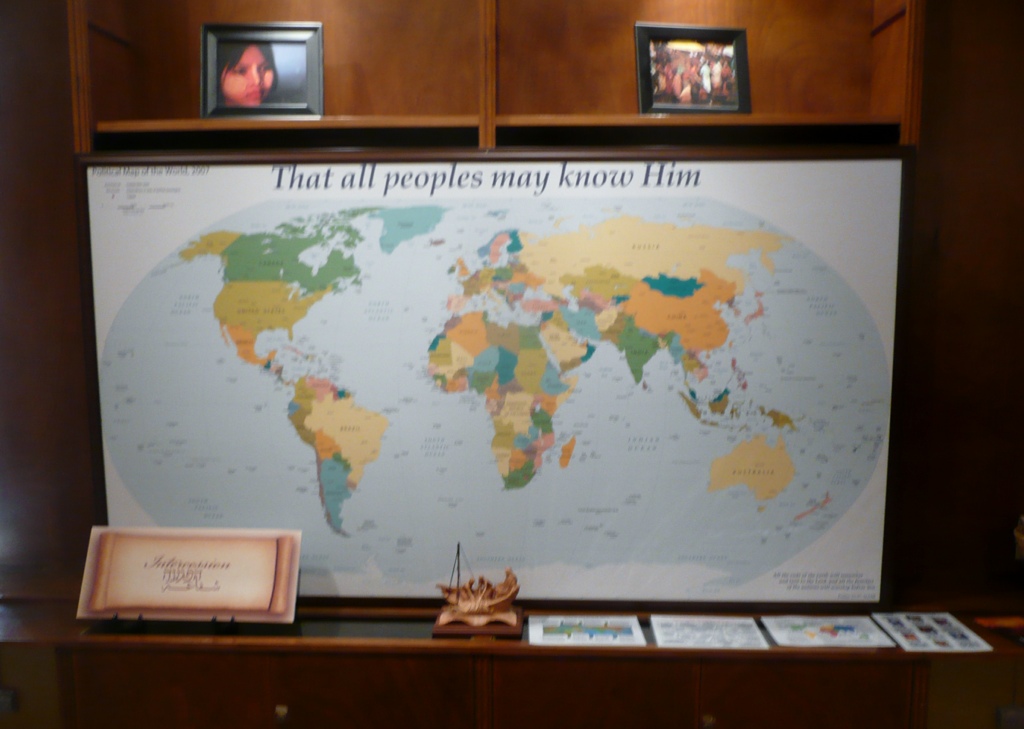
Jerusalem is very quiet today we notice as we leave our hotel. Since it is Eid al-Hada, almost all the shops, restaurants, and cafes are shut, and there is hardly any traffic on the usually crowded roads. The Jewish Sabbath also starts later on today so things will only get even quieter as the day progresses. On the way to the Cathedral we pass the hotel we stayed in eight years ago. It has a new posh name but looks just the same. We find the Jerusalem House of Prayer and ring the door bell. We are warmly welcomed by the resident staff, who show us around and tell us the history of the building and this wonderful work. We join with them in prayer for their immediate neighbours – Orthodox Jews, Arab Moslems and Arab Christians – and then we spend a wonderful hour or so in prayer and meditation in their wonderful Interactive Prayer Room. It turns out to be another of the many highlights of our month in Israel-Palestine (www.jerusalemprayercenter.com).

When we leave the Jerusalem Prayer Centre we call in at Saint George’s Anglican Cathedral. We worshipped here eight years ago and it looks just the same. We have a chance to look around a bit more this time than we did then … and are delighted to find a rather splendid baptismal pool designed for ‘adult baptisms’! From there we walk down to the American Colony Hotel. It is rather posh but really nice. We sit in their open air Garden Restaurant and enjoy an excellent cup of coffee. The American Colony Hotel has a fascinating and moving history. The American Colony was a colony established in Jerusalem in 1881 by a Christian utopian society lead by Anna and Horatio Spafford. Spafford is perhaps best remembered for writing the lyrics of the hymn ‘It is well with my soul’ which has brought comfort to many people over the years. He wrote it the night that he received the tragic news that his four young children had all been drowned when the ship they were travelling on sunk on a journey to Europe (although thankfully his wife survived). There is so much more to the Spafford’s story than this, however, and it worth looking up on the Internet. Although the magnificent house where the Spafford’s lived in community with the other members of the ‘American Colony’ (which also included a number of Swedes) is now a luxury hotel, the hotel still proudly retains the name and is happy to hand out booklets about their remarkable Christian heritage to guests and members of the public alike. We really like the American Colony Hotel … perhaps May could arrange for us to stay here next time we come to Israel?

Jim Binney

Leave a comment

Thursday 25 October: CATCH A FALLING STAR …

Final Resting Place of the Natal Star

Today we are off to Bethlehem via the Mount of Olives, the Garden of Gethsemane, the Church of All Nations, and Saint Pierre en Gallicante. I hope that we do not have as much walking to do as we did yesterday. My legs are still aching although I feel much fitter after the best part of a month here in Israel-Palestine. I appear to have lost some weight. Julia reckons it is to do with ‘lack of booze and all the exercise’. I get the feeling she has a ‘cunning plan’ to keep me on track when we get back to the UK at the weekend? I expect it will involve the exercise bike we bought before we came away? But first it is another of the splendid ‘Arabic Full English Breakfasts’ that our hotel provides … just to fortify me for the day ahead you understand?!

Our minibus arrives at 9.00 a.m. and we all climb aboard and take our usual seats. It doesn’t matter what bus we use we all always sit in the same seats … typical Brits you say! The minibus is a local bus but it has been organised from the Nazareth end by Azar … it belongs to a relation I think … it is the ‘Arab way’ of course. We drive up to the viewing point above the Mount of Olives where we enjoy first hand the marvellous view over the old city of Jerusalem, the Temple Mount, and the particularly prominent golden Dome of the Rock. We are directly opposite the Golden Gate of the city … the gate that some Jews and Christians believe the Messiah will enter Jerusalem through when he comes (or comes again of course). The Moslems have bricked it up and turned the ground in front of it into a cemetery, to prevent the Messiah entering? I find this very interesting because if they are so sure that they are right, and we are wrong, why be so afraid that you have to brick up the Golden Gate to prevent Messiah entering? You would have thought that they would have left it as it was in order to prove that they are right and we are wrong. We take lots of photographs and just drink in the splendour of the view before getting back on board our bus and descending to the Mount of Olives.

Our destination is the Garden of Gethsemane and the Church of All Nations situated on the Mount of Olives. There is a beautifully preserved small garden right by the church featuring a number of olive trees that are at least 2,000 years old. No one can say for certain that Jesus and his disciples spent time at this particular spot but if it was not here then it would have been somewhere very much like here and near here. Despite the coach loads of tourists there is a tranquility about this place that I love. Julia and I have been here before, and we are glad to be back. We visit the Church of All Nations. It is quite pleasant. Mass is being celebrated. We sit for a while enjoying the atmosphere, but then go outside again to spend more time in prayerful reflection in this wonderful Garden where Jesus and his disciples also spent quality time.

From the Mount of Olives we drive around the city walls to the Church of Saint Peter in Gallicantu (as it is known in English). It is thought to be the site of the house of Caiphas the High Priest and the place where Jesus was held and tried before his crucifixion, and where Peter denied Christ three times (Luke 22:54-65). The church is quite modern but down in the basement there is an ancient deep pit thought to be the place where Jesus was held. We go down into the pit and I read the passage from Luke to the group. We then sing the first verse of the hymn, ‘Man of Sorrows, wondrous name’. It sounds terrific! For a small group we have what seems a full range of voices amongst us. If anything it is even better than our ‘performance’ in the Crusader Church of Saint Anne at Bethesda yesterday. There is another group following us who listen while we sing. When we have finished there is a moment of prayerful, pregnant silence. ‘Beautiful! Just beautiful!’ says one of this other group as we pass her on the way up from the pit!

Outside again we stand in the quadrangle that overlooks the old city right by the ancient steps that Jesus himself would have descended when we he was sent by Caiphas to Pilate. Last time Julia and I were here eight years ago we walked down these steps, but now they are roped off and all we can do is take photographs. There is a wonderful bronze statue here in the quadrangle depicting Jesus denying Christ. It is a very powerful piece of art and I spend some time simply sitting looking at it and allowing God to speak to me through it. We stop for coffee at the church restaurant and buy an olive wood rosary for a friend in the shop, and then pause at the viewing point with its amazing panoramic views over Jerusalem, before heading back to our minibus and continuing our journey to Bethlehem.

Bethlehem is in the West Bank so we drive to ‘the wall’ that the Jews have built to isolate the West Bank from Israel, and through the Israeli check point in the wall to Bethlehem. Bethlehem has a large Arab Christian populace (although the majority of Arabs there are Moslems these days) but it has suffered considerably as a direct result of the wall being built. There is considerably unemployment and the town is dependent on the tourist trade. We leave our minibus at the bus station and walk the short distance to Manger Square and the Church of the Nativity. Julia and I have not been here before so we are really looking forward to our visit. The approach to the church is striking, and we enter through a very small door. It is an extremely old church but (like so many churches built over significant sites in the Holy Land) split on denominational lines. There is the Armenian bit, and the Greek Orthodox bit, and the Roman Catholic bit. The main bit is Greek Orthodox. It is built over a crypt said to be the site where the natal star fell, and Jesus was born. There is a huge queue waiting to go down to the crypt and, recalling the horrendous queue to see the Holy Sepulchre we endured yesterday, our hearts fall. But one of the guides, who speaks English, sidles up to us and says he can get us in to the crypt the back way … and he is as good as his word! In fact for a ‘small donation’ he gets us into all sorts of nooks and crannies which normally would be closed for lunch at this time.

The crypt with its site where the star fell, and the site where the manger stood, is disappointing. The cell where Saint Jerome (c.347-420) translated the Bible into Latin and thus produced the Vulgate version of the Bible is much more interesting. Famously he used the word ‘penance’ instead of ‘repentance’ but I guess maybe he saw being stuck down a dark hole for 35 years translating the Bible into Latin as some form of penance?! We sit in the cloisters of the Roman Catholic section of the Church of the Nativity and eat our picnic lunch, and then we are joined by Azar’s brother-in-law, Paul, who takes us in our minibus to a workshop that makes many of the olive wood Holy Land articles that you can buy in the various gift shops around Israel-Palestine. It is run by an Arab Christian family and we have a fascinating guided tour of the workshop … and then buy loads of stuff from him because his prices are so reasonable compared to the gift shops for tourists! It is a ‘win win’ situation for everyone!

Jim Binney