2 Comments

HUMBILITY

Humbility

There is an amusing and poignant story told of Charles Haddon Spurgeon, the famous 19th century Baptist Pastor, and a member of his congregation. Apparently this lady approached him after a morning service and told him, ‘Mr Spurgeon, I am pleased to tell you that I haven’t sinned for six months!’ Spurgeon smiled knowingly at her and responded, ‘Thank you for sharing this feat with me … you must be very proud?’ ‘Oh! I am!’ she replied. Pride, of course, is one of the so-called ‘seven deadly sins’ and, although we cannot really classify sins, I suspect that ‘pride’ and particularly ‘spiritual pride’ is the sin that God hates the most.

God hates pride simply because it was pride that caused Lucifer to rebel in the first place and start this whole sorry mess we are in. Ezekiel 28:11-19 and Isaiah 14:12-15 paint a powerful picture of a prominent angelic creature – possibly an arch-angel – who, before the creation of the human race, rebelled against the Creator and became Satan, the chief antagonist of God and humankind. According to the creation narrative it was Satan, in the form of a snake, who tempted our first parents into sin, again through the sin of pride (Genesis 3:1-13). It is because pride is so subtle, and so dangerous, that the Apostle Peter exhorts us to ‘clothe yourselves with humility towards one another, because God opposes the proud but shows favour to the humble … humble yourselves, therefore, under God’s mighty hand, that he may lift you up in due time’ (1 Peter 5:5,6).

Jesus himself, told a story about two people – a Pharisee and a tax collector – who both went up to the Temple in Jerusalem to pray (Luke 18:9-14). All prayer was considered efficacious but especially that prayed in the Temple. Devout Jews prayed three times a day in the Temple – at 9.00 a.m., 12 noon, and 3.00 p.m. The problem with praying in the Temple in this way was that it led to some people praying ostentatiously – praying in such a way that their prime motive was to be seen to be praying rather than simply praying for the sake of praying to God. In this way they fell foul of the temptation of pride. Thus the Pharisee in the story – the Pharisees were a politico-religious sect or faction among the adherents of Judaism at the time of Christ known for their rigid religious zeal and legalism – prays, ‘God, I thank you that I am not like other people – robbers, evildoers, adulterers – or even like this tax collector. I fast twice a week and give a tenth of all I get’ (Luke 18:11,12). We can picture this as we read this prayer – the loud voice to attract the attention of bystanders, the prolonged sideways glance at the tax collector in question when it comes to the appropriate words in his prayer. In contrast the tax collector – well aware of what the general public thought of him, and probably very self-conscious about actually being there in the Temple to pray even though his sense of contrition had driven him there in the hope that praying in the Temple would make his prayer more efficacious – finds a gloomy corner somewhere where he will not be noticed, shies away from even looking up to heaven, beats his breast, and simply prays, ‘God, have mercy on me, a sinner’ (Luke 18:13). Jesus tells us that it was the tax collector who went home justified before God rather than the Pharisee, and draws a significant moral from the story – ‘All those who exalt themselves will be humbled, and those who humble themselves will be exalted!’ (Luke 18:14).

In one of my former churches there was a guy who simply could not pronounce the word ‘humility’. Whenever he tried to say it, it always came out as ‘humbility’! Even though this word does not exist in the Oxford English Dictionary, I rather like it. It seems to me to capture the very essence of humility. I was therefore recently pleased to discover the word in the Urban Dictionary where it is defined as ‘the act of being humble while having a sense of humility’… in other words ‘actually being genuinely humble when you display or talk about humility’. It is far too easy for us – even as Christians – to be like Charles Dickens’ fictional character Uriah Heep, notable for his cloying humility, obsequiousness, and insincerity, making frequent references to his own ‘humbleness’!? Arrogance, pride, especially perhaps spiritual pride, pride about our own humility even, are huge barriers to experiencing the blessing of God … which is why the Lord responds to Solomon’s prayer for God’s blessing to be upon the people at the dedication of the Temple with the words, ‘If my people, who are called by my name, will humble themselves and pray and seek my face and turn from their wicked ways … then I will hear from heaven, and I will forgive their sin and I will heal their land’ (2 Chronicles 7:14).

It was Bishop Samuel Wilberforce (1805-1873) – one of the greatest orators of his day – who exhorts us to ‘Think as little as possible about yourself. Turn your eyes resolutely from any view of your influence, your success, your following. Above all speak as little as possible about yourself. Guard especially against those little tricks by which a vain man seeks to bring around the conversation to himself and gain the praise or notice which his thirsty ears drink in so greedily.’ Wilberforce goes on to support his statement by reminding us of Jesus’ exhortation to believers not to bask in the adulation that comes from our fellow human beings but rather to seek the glory and approval of God (John 5:44).

Humble yourselves
Under God’s mighty hand,
So that he will lift you up.
Humble yourselves
Under God’s mighty hand.
So that he will lift you up.

~ Dave Bilborough (based on 1 Peter 5:6)

Jim Binney
Leave a comment

BEAUTY FOR BROKENNESS

150680_10151199127967097_1630710424_n

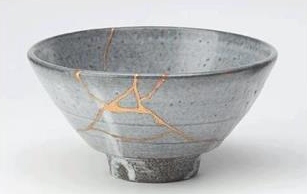
I recently saw a photograph of a broken pot that had been mended using the kintsukuroi method. Kintsukuroi is the Japanese art of repairing broken pottery with gold or silver lacquer. It enshrines the belief that the piece in question can actually be made even more beautiful for having been broken. I am used to mending broken pots – my mother-in-law is a potter and our large garden is full of her creations that sometimes get broken by either the elements or wild animals. I have become an expert in the use of ‘super glue’ … but none of my repaired broken pots are as magnificent as those put back together again with the use of kintsukuroi.

There is a story in the Bible – a story concerning an incident that occurred towards the end of Jesus’ earthly life, shortly before his arrest, trial, crucifixion and death – involving a broken jar and a broken woman, and something very wonderful about the way in which Jesus fixes broken people. The incident was obviously so intriguing that each of the four Gospel Writers has a version of it (Matthew 26:6-13; Mark 14:3-9; Luke 7:37,38; John 12:1-8), although there is some debate as to whether or not there are actually two similar incidents referred to rather than just the one?

Jesus and his disciples had been invited to a meal at the home of a Pharisee, Simon the Leper – probably a well-known victim of leprosy who possibly had been healed by Jesus at some time or other. Whilst they are enjoying their meal the dinner party is gate-crashed by a woman. Luke tells us that she was a ‘woman who had lived a sinful life’ (Luke 7:37). This is code language for someone who had earned her living as a prostitute. There is some speculation as to who this particular woman actually was? John tells us that her name was ‘Mary’ leading to speculation (since the meal was in Bethany and Martha was the cook) that she was Mary of Bethany or Mary Magdalene or even that they were one and the same? It is suggested that Mary Magdalene was formerly a prostitute until her life was transformed after an encounter with Jesus. We certainly know that she had serious problems. We are told that Jesus delivered her from demonic influence (Mark 18:9; Luke 8:2) which at the very least is indicative of a set of complex illnesses and possibly more.

Having gate-crashed the party this woman does something both extraordinary and immensely significant. She produces a small but very expensive alabaster jar containing an equally expensive perfume called nard (Mark 14:3) and then proceeds to break the neck of the expensive jar and anoint Jesus with the equally expensive perfume. The alabaster jar containing the nard would have been a sealed unit so that the only way to release the perfume would have been to break the neck of the jar. The jar and its contents would have been very precious to the woman not just in terms of monetary value but sentimental value as well since it was most probably a family heirloom passed down the generations. But for the perfume to be released it was necessary for the jar to be broken.

This extravagant gesture was highly significant not only because, coming as it did so close to Jesus’ arrest, trial, and crucifixion, it was indicative (as was the gift of myrrh by the Magi at Jesus’ birth) of his sacrificial death on the behalf of sinful people such as ourselves, but for all that it testified to concerning the woman herself.  Here was a woman who’s life had been broken, for one reason or another, and yet she was at one and the same time someone who’s life, through the touch of Jesus Christ, had been enabled to release something beautiful and fragrant into the world as a result of that brokenness! We do not know if that brokenness was initially self-inflicted or as a result of damage done to her by others. We do not know if her ‘demons’ came from within or without or both? What we do know is that this extravagant gesture was symbolic of all that had happened in her own life.  She had been broken but Jesus had fixed her, and despite her brokenness – perhaps even as a result of her brokenness – something even more beautiful and fragrant and valuable had been released into the world, rather like a kintsukuroi pot!

All of us, in one way or another, are ‘damaged goods’. Perhaps the most damaged of all are the people who don’t think they are damaged?! Some of us have been seriously ‘broken’ at some time in our lives – broken health, a broken relationship, a broken marriage, a broken heart, broken in spirit, and so on. Sometimes this damage has been self-inflicted, and sometimes it has been inflicted upon us by others, or even just by an unfortunate set of circumstances in which we have found ourselves at the time? Sometimes our ‘demons’ have risen from within, and sometimes they have afflicted us from without like those ‘fiery darts’ the Apostle Paul warns us of in his Letter to the Ephesians (Ephesians 6:16). Most of us are all too aware of our imperfections and we do not need to be continually reminded of them by the church or anyone else for that matter? What we really need to know is, ‘Is our brokenness terminal … or can we be mended?’

The great message of this particular story is that with God there is always a way out, always a way back, always a way up! Even if we are seriously ‘broken’ – whether through our own fault or the fault of others – we can not only be ‘fixed’ but actually be made even more beautiful, even more fragrant, even more valuable, for having been broken in the first place … just like a kintsukuroi pot!

Beauty for brokenness
Hope for despair
Lord, in your suffering
This is our prayer

~ Graham Kendrick

Jim Binney

2 Comments

DEEP CHURCH

Weymouth Beach
On any public beach in the summertime, when the weather is sunny and warm, you will find three distinct groups of people. Firstly, you will see the swimmers – out in the deep water, some with flippers and snorkels, having a wonderful time. Invariably they will greet you with shouts of ‘Come on in! The water’s perfect!’ Secondly, you will find another group of people, some distance from the water – these are the spectators. They are sitting about on deckchairs or blankets, reading or chatting together. For one reason or another they have decided that they will not go swimming or even paddling and so, sensibly, they stay far away from the water. Thirdly, there is a final group made up of those people who are having a miserable time – these are the hesitant. They have come prepared to swim but they cannot bring themselves to make that first plunge into the sea. They run into the waves and then retreat to the shore. They envy their friends out in the deep but are afraid to join them. No doubt you have noticed these unhappy souls who stand shivering and undecided, often ankle deep in the water, but without the courage to plunge right in or the sense to retire?!

It was the late Chuck Colson, I believe, who first suggested that ‘Christianity in north America is 3,000 miles wide, and half an inch deep!’ In some ways this is an unfair criticism. Firstly, because there are plenty of Christians who live in either the USA or Canada who think very deeply about their Faith, and take their commitment to Jesus Christ very seriously. Secondly, such criticism cannot be simply limited to ‘north America’ alone … there are plenty of shallow Christians everywhere else in the world, not least here in the UK?!

Concern about the shallowness of much Christianity today has led to a revival of interest in what has become known as ‘Deep Church’. ‘Deep Church’ is a response to what Andrew Walker, describes as exasperation with the ‘fad-driven one-dimensional spirituality of modern evangelicalism’ and the desire to ‘reconnect with and be deeply rooted in the common historical Christian tradition as well as the evangelical heritage.’

The phrase ‘deep church’ was first used by C S Lewis in a letter to The Times in 1952, in which he urged the Catholic and Evangelical wings of the Church of England to make common cause against the pretensions of modernity and recover the historic foundations and practices of the Christian church. Although Lewis expressed these views over 60 years ago now, many of us share his yearning for such a recovery and its ecumenical implications. Edited by Andrew Walker and Luke Bretherton, Paternoster have published a very interesting book on this subject, entitled Remembering Our Future: Explorations in Deep Church. It is a collection of essays by various authors, setting out the basis of the ‘Deep Church’ initiative and exploring the implications for hermeneutics, worship, making disciples and spirituality. These various contributions are an attempt to update Lewis’ proposal, calling evangelicals (and others) to value afresh the convictions, spirituality and ecclesiastical practices of historic Christianity.

A number of issues are explored including the shape, practice and mission of the church in the emerging culture; the relationship between scripture and tradition; how we are to read scripture today, especially in a multi-faith society; discovering a more catholic, yet Spirit-inspired, approach to worship; recovering proper preparation for baptismal candidates; developing more helpful approaches to spiritual formation and everyday spirituality … and so on. All of these areas seem to me to be very worthy of our consideration if we are serious about wanting to go deeper with God?! The overall thrust is clear! We need to drink deeply and draw gratefully on the historic resources of the church, paying particular attention to the documents and practices of the historic church, whilst at the same time refusing to be bound by narrower traditions that deprive us of a broader and richer heritage.

The Apostle Paul writes to the Christian Church centred in and around the ancient city of Ephesus to assure them, amongst other things, of his prayers for them. In particular he prays that they (and all God’s people right across the world and down through time) will be able to grasp hold of the ‘width, and length, and height, and depth’ of God’s love (Ephesians 3:17-19). Whatever else these few verses may contain, they encourage us to see something of the expansive nature of the Living God and his love for us and the world. Paul’s prayer for us is that we should realise, discover, explore, reach out into, plumb the depths of, the expansive nature of God himself and his love for us all  supremely demonstrated to us in Christ … rather than limit ourselves to simply a fragment of it! ‘Depth’ here is the Greek word bathos which is normally used in the Bible of ‘deep water’ (Luke 5:4) but also metaphorically of the depth of God’s wisdom and knowledge (Romans 11:33), of the deep things of God himself (1 Corinthians 2:10), and of God’s activities and love (as we see here in Ephesians 3:17-19).

When Paul encourages us here to be ‘deep Christians’, to be ‘deep church’, he does not mean ‘deep’ in the sense of being academically incomprehensible. We have probably all listened to sermons that are so complicated that nobody understood them … probably not even the preacher himself (it is usually men who are like this)?! Some of us have attended academic seminars that have been equally incomprehensible to the vast majority of those present. I am not against academics by any means – but the true academic is able to use his or her God-given abilities to take the deep things of God and make them clearer for the rest of us. Like a rock pool, the deep things of God can be both deep and clear at the same time! To be a ‘deep Christian’ or to do ‘deep church’, means to take God, and the things of God seriously. It means to put in the time and effort to prayerfully think through the deep things of God – things revealed in Scripture and tradition, through reason and the Holy Spirit – and to put these things into practice in our daily lives both as individuals and as church!

Deeper, deeper in the love of Jesus
Daily let me go;
Higher, higher in the school of wisdom,
More of grace to know.

Deeper, deeper, blessed Holy Spirit,
Take me deeper still,
Till my life is wholly lost in Jesus,
And His perfect will.

Deeper, deeper! though it cost hard trials,
Deeper let me go!
Rooted in the holy love of Jesus,
Let me fruitful grow.

Deeper, deeper in the faith of Jesus,
Holy faith and true;
In His power and soul exulting wisdom
Let me peace pursue.

Deeper, higher, every day in Jesus,
Till all conflict past,
Finds me conqueror, and in His own image
Perfected at last.

~ Charles P Jones

Jim Binney

2 Comments

MORE LIGHT!

Jesus, the Light of the World

Jesus, the Light of the World

A Pastor accepted a call to a certain Baptist Church in a country town in the Midlands. The buildings dated from Georgian times and the chapel was somewhat dingy, being lit only by an ancient electric central candelabra arrangement. When the Church Secretary telephoned the new Pastor prior to his arrival, to ask if there was anything he wanted doing in the church, the Pastor asked them to buy a new chandelier. When the Pastor arrived a few weeks later, however, nothing had changed, so he asked about the new chandelier. ‘Well …’ said the Church Secretary, ‘firstly, no one in the church could spell ‘chandelier’ so we couldn’t order one! Secondly, even if we managed to get hold of one, there is no one here who could play it! And thirdly … what this church really needs is more light!’

On Sunday the 6th January we celebrated the Feast of Epiphany – the revelation of God Incarnate in the Person of the Infant Jesus, to the Magi, or Wise Men, or Kings from the East. ‘Epiphany’ comes from the Greek epiphainō which means either ‘to give light’ or ‘to make visible’ (looking at it from God’s point of view) or ‘to be enlightened’ or ‘to have light shed on our darkness’ (looking at it from the human point of view). Now the Feast of the Epiphany is both the end of Christmas and the beginning of the Church’s Epiphany Season which she keeps until the Feast of the Presentation (or Candlemas), on the 2nd February. On the Sundays of this Epiphany season it is traditional to move from this first great ‘epiphany’ or manifestation of God’s presence and glory to the Gentiles, to contemplate the other ‘epiphanies’ that mark the beginning of Christ’s Ministry.

For a number of years now I have been an advocate of following the Church Year. If I were to ever return to the ministry I would certainly seek to do this in the church that called me to be their Pastor. We need breadth as well as depth in our preaching programme in church life. Depth comes from opening up the Scriptures in the power of the Holy Spirit in an intelligent, interesting and applied way. Breadth comes from making sure that we preachers cover ‘the whole counsel of God’ (Acts 20:27), and we do this not only by preaching through the whole Bible but also by making sure that we regularly cover the major Christian Festivals and Seasons. Of course preaching alone will not do it! We need to accompany the preaching-teaching programme of the church with daily notes and an efficient small group system within the church where this preaching-teaching is followed through in a meaningful way. The Sunday preaching-teaching is a start, however.

As far as the preaching goes, in order to achieve breadth as well as depth, we need to make best use of the key days in the Church Year such as Christmas, Epiphany, Palm Sunday, Maundy Thursday, Good Friday, Easter Sunday, Ascension, Pentecost Sunday and Trinity Sunday. But we also need to make best use of the Seasons in the Church Year such as Advent, Epiphany, Lent, Easter, Pentecost, and so on. You may think it strange for a Baptist Minister to advocate following the Church Year in this way, but for some years now I have felt that we Baptist Christians have missed a trick or two here. We rightly claim to have a love of the Bible coupled with a desire to open up its teaching for others, but all too often the depth has not been accompanied by the breadth, which has limited the effectiveness of our preaching.

The Season of Epiphany is a classic example for me because it presents us with an opportunity to spend a few weeks exploring the whole concept of ‘epiphanies’ – the way in which God reveals himself to us, the way in which he suddenly breaks into our darkness and confusion. This encourages us all to realise that none of us is beyond the pale, and no situation is hopeless. At any given moment God can break into our situation and reveal himself to us in a new way. We should not be surprised at this because the Apostle John tells, us in the Prologue to the Fourth Gospel that bears his name, that in the Person of Jesus Christ ‘the true light, which enlightens everyone, came into the world’ (John 1:9).

Thus in the Epiphany Story itself (Matthew 2:1-11) we are reminded that God revealed himself to the Magi – Zoroastrian Priests, members of a false religion, people fascinated by astrology and fortune telling – who nevertheless were seeking to walk in the limited light they had received in order to find the Living God for themselves?! As far as we can tell they were genuine ‘God-seekers’ and God honoured that. He gave these ‘star gazers’ the brightest star of all to follow – a star that eventually led them to an even brighter light in the Person of Jesus, the Incarnate Son of God! What we see here, amongst many other things, is that the Gospel contains hope even for heretics?!

In much the same way the various other ‘epiphanies’ that occur during the early ministry of Jesus himself can be profitably explored in a way that enlightens our minds and warms our hearts. Heaven’s opening at Jesus’ baptism (Matthew 3:13-17), the anointing of the Holy Spirit, the voice of God the Father from heaven, were all confirmations to Jesus himself no less, that he was indeed the Son of God, the promised Saviour. The calling of Jesus’ disciples, especially the ‘epiphany moment’ granted to Nathanael (John 1:43-51) in which Nathanael receives the assurance that God already knows all about him and loves him just the same. The first of Jesus’ miracles, the ‘signs whereby he revealed his glory’ (John 2:11) at the Wedding in Cana in Galilee, which brought joy to a dull party and imparted faith into the hearts of disciples. All of these ‘epiphanies’ contain inspirational, encouraging, and faith imparting truth that bless and help us. They are so much more worthy of our prayerful consideration than the ‘You suck, try harder!’ exhortations that one hears so often today from many pulpits!

Light of the world
shine your light into my heart
God of love,
pierce my soul with your mercy

So we might know your glory
So we might see your face
So we can feel your heart beat
And hear you call our name

~ Craig Musseau

Jim Binney

1 Comment

GOLD, CIRCUMSTANCE AND MUD

Epiphany
Epiphany, or Twelfth Night, marks the end of the Christmas season for people in the United Kingdom. It is also an occasion for Christians to celebrate the visit of the Magi (or Wise Men, or Kings) to Jesus shortly after his birth. Some Christians attend special church services on the 6th January or the Sunday nearest to that date. Figures representing the Magi are often placed in some crib scenes on Epiphany. The Festival marking the visit of the Magi to the infant Jesus is called Epiphany because it signifies the manifestation of God in the Person of Jesus to Gentiles as represented by the Magi. The ancient Greek word epiphaneia means ‘manifestation’ or ‘striking appearance’ and is indicative of an experience of sudden and striking realization. So right from the beginning of the Gospel Story we see that the birth of the Promised Messiah or Saviour is good news for everyone and not just for the Jews!

We know very little about the Magi. Matthew is the only one of the four Gospel Writers to describe their visit. (Matthew 2:1-12). He tells us that they came ‘from the east’ to worship the Christ, ‘born King of the Jews’. The Magi are popularly referred to as ‘Wise Men’ and ‘Kings’. The word ‘Magi’ (the actual word Matthew uses in his account) is a term dating from the 6th century BC, to denote followers of Zoroaster, who placed great stress on the ability to read the stars, and manipulate the fate that the stars foretold. It is the root of the word ‘magician’ – a practitioner of magic, including astrology, alchemy and other forms of esoteric knowledge. It is suggested that the Magi who visited the infant Jesus were members of the priestly caste of Zoroastrianism. As part of their religion, these priests paid particular attention to the stars and gained an international reputation for astrology, which was at that time highly regarded as a science.

Tradition identifies a variety of different names for the Magi. In the Western Christian Church they have been commonly known as: Melchior, a Persian scholar; Caspar, an Indian scholar; and Balthazar, an Arabian scholar. According to the Encyclopaedia Britannica, Balthasar was the king of Arabia, Melchior the king of Persia, and Caspar the king of India. In reality, we cannot be sure who they were, or what their background was. What we can be sure of is that, like those Greeks who approached Philip (John 12:20), these ‘wise men’ came seeking Jesus. The Magi or Wise Men or Kings from the East were, according to Christian tradition, a group of distinguished foreigners who visited Jesus after his birth, bearing gifts of gold, frankincense and myrrh. According to the Gospel of Matthew, the Magi found Jesus by ‘following a star’ which thus traditionally became known as the Star of Bethlehem. On finding him, they gave baby Jesus three symbolic gifts: gold, frankincense, and myrrh (Matthew 2:11).

Gold was a gift offered to a king, and Jesus is King of kings! Not just ‘king of the Jews’ (John 19:9) but ‘King of kings and Lord of lords’ (Revelation 19:6). His kingdom, however, was not of this world. He was to reign not by force but by love. To rule over our hearts from a cross not a throne. And his resurrection from the dead confirmed him as King with all authority given to him (Matthew 28:18)!

Frankincense was a gift offered to a priest – it was a sweet perfume used in Temple Services – and Jesus is our Great High Priest. The Writer to the Hebrews tells us that ‘we have a great high priest who has passed into the heavens, Jesus the Son of God’ (Hebrews 4:14). The function of a priest is to represent God to humanity and humanity to God. The Latin word for priest is pontifex which means ‘bridge-builder. This is exactly what Jesus has done for us. Through his death he removed the barrier of sin between us and God, and through his resurrection he opened a new and living way back to God for us.

Myrrh was a gift used in those days to embalm the bodies of the dead – and the very reason Jesus came was to die on Calvary’s cross to redeem us from the power and penalty of our sin. Before he was born he was already ‘the Lamb slain from the foundation of the world’ (Revelation 13:8). And at his birth he was given the name Jesus ‘for he shall save his people from their sins’ (Matthew 1:21).

Epiphaneia can also mean ‘a comprehension or perception of reality by means of a sudden intuitive realization’ or ‘a spiritual flash that changes the way we see ourselves’ (as one writer has put it). Both these definitions would appear to have applied to these visiting Magi. After their visit the Magi leave the narrative by returning another way so as to avoid King Herod (who is determined to involve them in his plot to kill the infant Messiah) and do not reappear. There are many traditional stories about what happened to the Magi after this, with one having them baptised by Thomas on his way to India. It has been suggested that what we have here is the story of the first converts from Zoroastrianism. And of course throughout Scripture and history we have thousands of stories of people, from all walks of life, religious and non-religious, who also have had a similar epiphaneia for themselves, right up to the present day.

Rex Knowles tells how his wife went Christmas shopping one afternoon and left him to look after the children. Suddenly they disturbed his peace by announcing, ‘Daddy, we have a play to put on. Do you want to see it?’ Daddy didn’t but he knew he would have to so he went into the living room and sat down – a one man audience. He saw that it was a Nativity Play. At the foot of the piano stool was a lighted torch wrapped in swaddling clothes lying in a shoe box. Rex (aged 6) came in wearing Daddy’s bathrobe and carrying a mop handle, followed by Nancy (aged 10) who announced ‘I’m Mary and this is Joseph!’ Then Trudy (aged 4) entered with pillow cases over her arms which she waved about saying, ‘I’m an angel!’ Finally in came Anne (aged 8) riding a camel – at least she moved as though she was riding a camel because she had on a pair of her mother’s high heeled shoes. She was bedecked in all the jewellery available and carried a pillow laden with certain items. She bowed before the Holy Family and announced, ‘I am all three wise men! I bring precious gifts: gold, circumstance, and mud!’ That was all. The play was over. But Daddy didn’t laugh. He prayed as he thought how near his little daughter had come to the truth. He thought of the way materialism had gripped him. Of how circumstances were overwhelming him. And how everything seemed to be crumbling around him. That prayer marked a new beginning for Rex Knowles as he allowed Jesus Christ to break into his life anew!

Jim Binney

1 Comment

A GUARANTEED FUTURE

'Hope' by G F Watts

‘Hope’ by George Frederic Watts

George Frederic Watts’ symbolist oil painting Hope shows a scantily clad female  figure (Hope herself) sitting on a globe, blindfolded, clutching a wooden lyre with only one string left intact. She sits in a hunched position, with her head leaning towards the instrument – perhaps so she can hear the faint music she can make with the sole remaining string – a single lonely star blinks hesitantly in the dark night sky.  The desolate atmosphere is emphasised by Watts’ soft brushwork, creating a misty, ethereal scene, in tones of green, brown and grey. A second version of the painting was painted by Watts in 1886, shortly after the death of his adopted daughter Blanche. This second version omits the star – Watts felt that it was too much a symbol of optimism?!  The first version is now held in a private collection, but the second version was presented to the Tate in 1897. It is said that two ladies were overheard discussing the painting one day. ‘Why do you think that it is called Hope?’ asked the one. Looking at the precariously placed figure on the globe, the other replied, ‘Probably because she hopes she won’t fall off!’

The English dictionary defines ‘hope’ as an ‘emotional state that promotes belief in a positive outcome related to events and circumstances in one’s life’. ‘Hope’ it would seem, is a psychological necessity if we are to envisage any kind of real future. Even if there are no rational grounds for it, we still continue to hope. I recall my father taking me to watch Brentford FC when I was about 9 or 10 years of age. I forget who Brentford were playing but with only two minutes of the game left they were losing 1-0. I do remember, however, a very optimistic Brentford supporter shouting out at this point in the game, ‘Come on Brentford! All we need is a goal, and a last minute penalty!’ The sad reality is that all too often ‘hope’ for us is actually transient and illusory. It is hope against hope. Hopeless hope. Fingers crossed, and hope for the best, kind of hope?!

In the New Testament, however, the word for ‘hope’ is very different. It is the Greek word ‘elpis’ signifying ‘a favourable and confident expectation regarding the future’ both in this life and in the life to come. It is this kind of ‘hope’ that the Apostle Paul refers to when he prays for the Christians at Rome (and for every other Christian down through time), ‘May the God of hope fill you with all joy and peace as you trust in him, so that you may overflow with hope by the power of the Holy Spirit’ (Romans 15:13). ‘Elpis’ literally means ‘guarantee’ which led Martin Luther, in his translation of Romans to refer to God here (in Romans 15:13) as ‘the God of the guarantee’.

We can feel confident about the future – whatever it may hold – because we can trust the God of hope, the God of the guarantee! He has a plan for our lives (Jeremiah 29:11), he has a purpose in life for each one of us (Ephesians 2:10), he has our best interests at heart (Romans 8:28) and he will fulfill all his promises to us in Christ (2 Corinthians 1:20). Indeed, as Paul tells us here, it is possible to be so confident about the future that we are ‘filled with joy and peace’ and actually ‘overflow with hope’ ourselves in such a way that it inspires others!

None of us know for certain what the future holds … but we do know who holds the future! Life is not random. The bible tells us that ‘our times are in God’s hands’ (Psalm 31:14,15) and we can be confident that God has a bright and purposeful future for us as we step out into another new year. I appreciate that lots of people today don’t find life easy, ourselves included. Julia and I have no money, we don’t have jobs, we don’t even live in our own home (we live with Julia’s mother in a cottage that belongs to her). I shall be 70 at the end of 2013. I don’t look it! I don’t feel it! And I am really excited about all that God has for Julia and myself in the next thrilling chapter of our lives as, God-willing, we return to some form of ministry together.

The secret, of course, is keeping our eyes firmly fixed on Jesus. In the Gospel Story (Matthew 14:22-33), when the Apostle Peter stepped out of the boat, and found himself walking on the water, he was fine as long as he kept his eyes on Jesus. It was only when he took his eyes off Jesus, and looked at the wind and the waves, that he begun to sink. To his credit, Peter actually did far more walking than sinking because when he began to sink Jesus was able to reach out and catch him. Peter had managed to get all the way from the boat to Jesus without sinking! And if we will keep our eyes on Jesus, we too will be able to walk on the water of our circumstances … however difficult they may seem! As the old poem suggests:

When we look within, we see failure and sin!
When we look around, troubles abound!
But when we look to Thee, the Lamb of Calvary
Hope, and peace, and joy are found!

Jim Binney

1 Comment

THE MOST TREMENDOUS TALE OF ALL

Incarnation

The Incarnation

About 20 years ago I wrote a controversial article entitled ‘Don’t Just Do Something … Stand There!’. The gist of the article was that too many of us are simply too busy for the sake of it. All too often our activity, for all its energy, is fruitless. Like the Seven Dwarves we are ‘busy doing nothing’ in real terms. We are ‘driven people’ … driven by a sense of ‘ought-ness’ self-imposed or imposed on us by others. Finally, after two years of being ‘retired’ and living in rural Dorset, I think I am at last beginning to get the hang of what I was suggesting all those years ago. At long last I am learning to slow down, take life at a more leisurely pace, and enjoy and learn from all that God wants me to see, hear and get involved in.

I seem to have spent so much of my previous life rushing around … I even ate my food as quickly as possible?! This was partly because of spending time in the ‘poor house’ when I was around 8 or 9 years of age – my father lost his job and we were literally put out on the street because we lived in tied accommodation – and in the particular institution where we were housed you had to eat your food quickly before others got it. Only in the last few years – since discovering ‘fine dining’ – have I learned to eat more slowly and savour my food. And of course subconsciously ‘buying into’ the ‘Protestant work ethic’ early on in my Christian journey – the ethic that drives so many of us evangelical Christians – did not help me to stop rushing around either.

One of the things that I have increasingly come to enjoy in recent years is working through the whole Advent-Christmas-Epiphany event in the Christian calendar. This season in the Christian calendar provides us with a wonderful opportunity to spend quality time prayerfully reflecting on the various aspects of this particular chapter in the Christian Story. I love the fact that from the end of November through to the first week in January, we can take time individually as Christians, and corporately as Church, to ‘chew the cud’ of the various aspects of the Advent-Christmas-Epiphany event: the God who comes; the God who speaks; the Forerunner; Mary’s faith; the Incarnation; the visit of the Magi, and so on.

We evangelical Christians don’t always make best use of these few weeks to unpack the biblical record covering this period, in the life and teaching programmes of our churches. How often do we hear sermons today on Biblical Prophecy, the Second Coming of Christ, Mary the Mother of Jesus, John the Baptist, even the significance of the Incarnation itself? The story of the Visit of the Magi usually gets lost somewhere in the mad rush to get into the New Year, and the modern trend for a church ‘Motto Text’ for the year, usually preached on on the first Sunday in the New Year (which is normally Epiphany). As a result, the Visit of the Magi, and the significance of their gifts for the Christ-child,  is usually reduced to a few comments at a Children’s Nativity or a Candlelight Carol Service? But if we don’t give time to these significant themes during the Advent-Christmas-Epiphany period in the Church Calendar … when will we?

I am also, personally, somewhat concerned by our obsession as evangelical Christians with the ‘Easter Story’? Time and again it has been suggested to me (wrongly, I believe) that ‘the Incarnation would have been pointless without the death and resurrection of Jesus Christ!’ Now before I get burnt at the stake for heresy, let me say straight away that the whole of the ‘Passion of Christ’ (not just the events of Easter Sunday, by the way) are also an essential part of the Christian Story, indeed the Christian Gospel! But so is the Incarnation! The Incarnation – the fact that in the Person of Jesus Christ, God became flesh – is also an essential part of the Christian Story, the Christian Gospel. It is essential, and significant, in its own right, and is not just a kind of ‘preliminary’ to the real story, the Easter Story. This, for me, is why learning theology at bible or theological college is so important? This is why it is important for those of us called to preach and teach in the Church  continue to ‘do theology’ today even though we may have left college and are ‘in the ministry’? We are called ‘to proclaim the whole counsel of God’ (Acts 20:27) … not just emphasise the bits we think are important, whilst at the same time ignoring the bits we think irrelevant or haven’t go to grips with yet?

The Apostle John tells us, in the prologue of the Fourth Gospel, that in the Person of Jesus Christ, ‘the Word became flesh and lived among us, and we have seen his glory, the glory as of a father’s only son, full of grace and truth.’ (John 1:14 NRSV). That, my friends, is truth worth getting to grips with … not as a ‘sound bite’ but as an aspect of ‘Incarnational Theology’ that requires thought, prayer, reflection, and response!

‘And is it true? And is it true.
The most tremendous tale of all,
Seen in a stained glass windows’ hue
A Baby in an ox’s stall?
The Maker of the stars and sea
Become a Child on earth for me?’

~ John Betjeman

Jim Binney

4 Comments

NO ROOM AT THE INN

73049_10151312262101211_400406307_n

In the West Bank, Israel’s security barrier has started to resemble the western side of the Berlin Wall in its heyday.  The Israeli side is bleak and clean, but on the Palestinian side graffiti flourishes.  A few years ago the British graffiti artist Banksy stencilled a number of his famous cartoons on the wall and they have subsequently become one of Bethlehem’s tourist attractions. They even help bring a little money into Bethlehem’s tourist economy, which was crushed when Israel built the security wall in 2002. Israel argues that the wall has stopped suicide bombings – before the security barrier was constructed over 800 Israeli civilians were murdered by Palestinian terrorists – but ordinary Palestinians claim their livelihood has been squeezed as a result of the wall.

I have been thinking about this as I continue to sort through the hundreds of photographs we took during our recent sabbatical in Israel-Palestine. I am reflecting on our own visit to Bethlehem, firstly, because it is almost Christmas, and secondly, because the Iona Community recently made use of another Banksy cartoon – depicting Joseph, with the heavily pregnant Mary seated on a donkey, unable to get into Bethlehem because of the wall – on its Facebook page. Their use of this particular cartoon roused up quite a reaction with some people finding it aptly poignant and others politically offensive?! Personally, I thought the cartoon very clever. It makes you think! I recall reading of an incident a few years ago when a BBC correspondent rode a donkey across the Holy Land, following the route taken by Mary and Joseph according to the Gospel of Luke, only to be refused entry into Bethlehem by Israeli soldiers at a Check Point because the ‘donkey did not have the correct paperwork’?!

I also vividly remember our experiences of crossing from Israel into the West Bank on various occasions – including being stopped and searched – and the oppressive nature of the wall itself. I understand the reasons why the Israeli Government erected the wall – militant Islam is the greatest threat to world peace that exists today and civilians being deliberately targeted whilst travelling in buses or sitting in restaurants by Muslim extremists had to be stopped – but it is only a minority of Palestinians who are extremists. The building of the wall may have prevented extremist attacks but it has also had a disastrous effect on the ordinary people of Bethlehem. Present-day Bethlehem is completely surrounded by a wall of separation. Palestinians have to go through a checkpoint and show documentation to go in or out for work, medical care, to visit relatives in other towns, etc. The tourist trade, on which the livelihood of many of the inhabitants of Bethlehem is dependent, has been badly hit, and unemployment is very high. Walking through Bethlehem on the way to Manger Square you cannot help but become aware of the poverty and the pain being experienced by so many ordinary people. Entering the Church of the Nativity we were immediately besieged  by ‘tourist guides’ anxious to secure our business and earn a little more to help keep their families afloat.

For me, there is a huge difference between God’s Old Testament People and the modern secular Jewish State – a fact clearly recognised by the majority of religious Jews (if not by many fundamentalist Christians) who are very critical of the secular Israeli government. But if any appeal is to be made to the Bible, then it needs to be recognised that in the Old Testament, God’s promised protection for Israel was predicated on their obedience to his Law, and that included kindness to the ‘aliens’ or foreigners within their lands. Taking their farms, bulldozing their orchards, and cutting them off from their families is hardly kindness. God calls on his people to ‘Do justice and love mercy’ (Micah 6:8). I wish we could see a bit more of that in the world!

I recall the Bible story that tells us that Joseph and Mary ‘went up from the town of Nazareth in Galilee to Judea, to Bethlehem the town of David’ (Luke 2:4) and wonder if they would not only have difficulty finding accommodation for Mary to have the baby, but actually find it difficult to even get into Bethlehem at all today? Perhaps the Banksy cartoon has a point? I recall a story Dina Donohue tells of Wallace Purling, a rather big, clumsy nine year old who wanted to be a shepherd in the school nativity play but was given the role of the innkeeper instead. Although Wallace was ‘slow in movement and mind’ he was ‘a helpful boy, willing and smiling, and the natural protector of the underdog’. In hindsight, it was probably a mistake to give Wallace the role of the innkeeper, but it is on such ‘mistakes’ that things change, sometimes for the better. Wallace Purling had been chosen to play the innkeeper because, being rather big, his teacher thought him to be exactly right to play the part of someone who could throw his weight around and refuse even a heavily pregnant woman a room! But when Wallace’s big moment came, and faced with the key decision in a story that had become much more than just a ‘nativity play’ for Wallace, he just couldn’t turn Mary and Joseph away. Meant to look stern and mercilessly and turn the holy couple away, Wallace suddenly broke into a bright smile as a great idea crossed his mind – ‘You can have my room!’ he said! A few people thought the nativity play had been ruined but most considered it the best play they had ever seen!

On our way back out of Bethlehem we once again passed the towering security wall. On the Israeli side, the only bit of colour to relieve the unrelenting concrete at the crossing was a monumental banner rich with unintended irony, since no one in the West Bank sees the security barrier as anything but a prison wall. ‘Peace Be With You!’ it said in three languages, and in smaller print: ‘Israel Ministry of Tourism’.

Jim Binney

3 Comments

A WOMAN’S PLACE …

There is a rather poignant Fred Craddock story about a church in interregnum interviewing a prospective Minister, that goes something like this: The chair of the church’s Search Committee said to the minister being interviewed, ‘You preached a really good sermon … as good a sermon as we’ve heard in this church for a long time. You’ve answered all the questions we have put to you really well.  Your theology and your biblical knowledge are really good, and your references are excellent … but we don’t just feel like you’re the one for our church just now!’ ‘Oh! she said.

With all the discussion in the media at present about ‘Women’s Ministry’ (following the failure of the Synod of the Church of England to appoint Women Bishops despite an overwhelming majority in favour), I find myself thinking about it once again as I reflect on the various lessons learned during our time on sabbatical in Israel-Palestine recently. We had a wonderful time, and met some really wonderful people who hopefully will remain life-long friends … but clearly the fact that Julia was an ordained and accredited Baptist Minister, used to exercising a leadership role and a regular preaching-teaching role in the church, was a problem in a culture where women are expected to play a somewhat subsidiary role to men. Nothing was specifically said to us about this, although it was suggested early on in our stay that it was not advisable for us to let slip ‘certain things’ … such as the fact that my first marriage had ended in divorce (albeit 25 years ago) and that Julia was a Pastor used to exercising a primary leadership/preaching/teaching role in the church. Both these matters were absolute taboo for both Evangelical Christian Arabs and Messianic Jews. I suspect even some of the members of staff at the Nazareth Evangelical Theological Seminary struggled with these facts about us as well, although they were too kind to actually say anything to us, and Julia was invited to ‘lead devotions’ one morning (which she did very well by the way, and what she had to say touched a number of lives). In this particular blog I want to concentrate on ‘Women’s Ministry’ and leave the question of ‘divorce and ‘remarriage’ to another day.

Following the somewhat embarrassing debacle for the Established Church, it has been good to see so many Baptist-Christians supporting the appointment of women as bishops in the Church of England.  But before we Baptist-Christians get too carried away with how good we are in this, we need to recognise how far behind the Church of England we are when it actually comes down to the recognition of Women’s Ministry?! I am reliably informed that 33% of clergy in the Church of England are women, whereas only 10% of Baptist ‘clergy’ in the UK are women. And although we have appointed a number of women as ‘suffragan bishops’ in our Baptist Associations, we have only ever appointed two actual woman ‘bishops’?! And, if Julia’s experience of the Baptist Settlement Process is anything to go by … for a female candidate to even get to the stage where she is actually interviewed with a view to the pastorate by a church ‘search committee’ is proving difficult (despite the sterling efforts of our Regional Ministers, our ‘Baptist Bishops’).

I have long been an advocate of Women’s Ministry, but our time in Israel-Palestine witnessing first hand the way in which the place of women is relegated to a subsidiary role in the Church (not just in Islam) – essentially for very backward looking cultural reasons – underlined and affirmed this for me. On returning to the UK I stumbled across Derek and Dianne Tidball’s book (published just this year by IVP), The Message of Women, Reading this helped me to clarify my thinking considerably, not least because I myself have been on a similar journey to Derek who writes very movingly at one point of having ‘come over many years to change position through the reading of Scripture and observation of what God is doing in his church’. Much of what I suggest in the next couple of paragraphs is gleaned from this excellent book.

For me, whether or not women can exercise leadership/teaching roles in the Church essentially revolves (in microcosm) around our understanding of Paul’s teaching in his Letter to the Galatians, when he suggests that in Christ ‘There is no longer Jew or Gentile, slave or free, male or female … for you are all one in Christ Jesus’ (Galatians 3:28). There are two words that are often used to identify two broad perspectives in approaching the role of women in the Bible: complementarians and egalitarians.

Complementarians argue that while men and women are of equal worth and enjoy equal status before God, they were created to fulfil different roles and functions, in other words to complement each other. God made the man to be head of the woman in the family, in the Church (some also say in society as well) and this leads them to have different functions, inherent in Creation. Men alone then should be leader-teachers in the Church, and women learners and active in other ways. It is also often suggested that thus, men should be breadwinners and women homemakers in the family.

Egalitarians affirm that while there are obvious distinctions between men and women (not least biologically) they enjoy full equality before God in Christ. This is not just an equality of spiritual status but also an equality of function. Women, therefore, should not be confined to a domestic role or denied positions of leadership, teaching or authority in the Church. Consigning men and women to different roles in Church or society on gender differences is the result of the Fall and the resulting curse, and essentially socially constructed rather than inherent in Creation. Jesus Christ inaugurated a new age and a new community in which the effects of the Fall are both challenged and overcome. The full reversal may await the Second Coming of Christ, but the Church is called to tread that road now!

My personal conviction is that the egalitarian position is the correct one. Like Derek Tidball I have come to this position over a number of years through the reading of Scripture and observation of what God is doing in his church, not least in the clear way he has chosen to bless the ministry of many women pastors, preachers and teachers, and grow his church numerically and spiritually through their ministry. Of course God has always used women in a significant way, and continues to do so today.

There is a line of women, extending back to Eve,
Whose role in shaping history God only could conceive.
And though, through endless ages, their witness was repressed,
God valued and encouraged them through whom the world was blessed.

So sing a song of Sarah to laughter she gave birth;
And sing a song of Tamar who stood for women’s worth;
And sing a song of Hannah who bargained with her Lord;
And sing a song of Mary who bore and bred God’s Word.

There is a line of women who took on powerful men,
Defying laws and scruples to let life live again.
And though, despite their triumph, their stories stayed untold
God kept their number growing, creative, strong and bold.

So sing a song of Shiprah with Puah at her hand,
Engaged to kill male children they foiled the king’s command.
And sing a song of Rahab who sheltered spies and lied;
And sing a song of Esther, preventing genocide.

There is a line of women who stood by Jesus’ side,
Who housed him while he ministered and held him when he died.
And though they claimed he’d risen their news was deemed suspect
Till Jesus stood among them, his womanly elect.

So sing a song of Anna who saw Christ’s infant face;
And sing a song of Martha who gave him food and space;
And sing of all the Marys who heeded his requests,
And now at heaven’s banquet are Jesus’ fondest guests.

There is a line of women continued down through time
Continuing to persevere in living for their Lord
And though the church moves slowly, and trips over its feet
Yet still they keep on trusting God’s call upon their lives.

So sing a song for Edith [Gates]* who pioneered the way
And sing a song of others who do the same today
And sing of all the women who strive to do their best
As people called to serve God in every time and place.

John L Bell (last verse and chorus by Catriona Gorton)

*Edith Gates was the first woman ordained a Baptist minister in England in the 20th Century, back in 1929, and along with a Congregationalist of roughly the same date, one of the first two in any tradition in the UK.

Jim Binney

Leave a comment

STUCK ON THE CIRCLE LINE?

I am reflecting once again on some of the lessons learned during our recent sabbatical in Israel-Palestine. I am remembering the time Julia and I caught the No. 15 bus back to Saint Margaret’s Guest House in upper Nazareth (where our group was staying) after church one Sunday morning. The No. 15 bus route in Nazareth is a circular route – rather like the Circle Line on the London Underground but with buses not tube trains. It doesn’t matter which side of the road you catch the bus – either way will eventually get you to your chosen destination. Of course if you don’t know where you are going to begin with, or haven’t travelled the route before, or think you know where you are heading but don’t really, you can end up just going round and round in circles!? I am thinking about our nightmare journey that Sunday morning attempting to get back to our hostel at Saint Margaret’s. I recall a friend of mine – who worked in the City – who had a recurring nightmare about being permanently stuck on the Circle Line?!

In my last ‘blog’ I started to write about the way our cultural influences affect what we believe and how we behave as Christians – far more than we are probably prepared to accept? I am still working through the implications of this, and suspect I will be doing so for quite some time to come. My thesis is that we need – both as individuals and as local churches – to re-examine all our beliefs and behaviour patterns to determine what is genuinely born of the Spirit of Christ, what is truly ‘kingdom stuff’, what is truly ‘Christ-cultural’ … and what is actually simply the product of the various secular and ‘religious’ cultural influences around us?

One of the things that forcibly struck me during our time in the ‘Holy Land’ – perhaps especially because I was ‘out of my comfort zone’ and therefore the discrepancy stood out all the more – was the cyclical nature of so much belief and behaviour. ‘Cyclical’ simply means going round and round in the same old circles – rather like a worn old gramophone record suck in the same groove. The more time I spent listening to Arab Muslims, Arab Christians, Orthodox Jews, Zionists, and even many Evangelical Arab Christians and Messianic Jews, the more I heard the same old well rehearsed cyclical arguments used to justify outworn beliefs and behaviour patterns. A visible example of this while we were there were the tee-shirts, with their ‘political’ slogans on sale in many of the market stalls and gift shops, championing the various intransigent views passed down the generations that keep Israel-Palestine perpetually locked in the same negative scenario. One would hope that in the white hot heat of the crucible that is the Middle East situation today, it would be the Christians, particularly the Arab Christians and Jewish Believers – those who have been ‘reconciled to God in Christ and entrusted with the ministry of reconciliation’ (2 Corinthians 5:18) – who would together be at the heart of endeavouring to broker peace and reconciliation between the Jews and the Palestinians? They, of all people, are surely in a unique place to be able to do so? Sadly they are so caught up in cyclical traps of their own that they appear unable to do so.

The unquestioned dispensationalist and Zionist views held by the Messianic Jews, rather than enhancing and commending the Gospel, hinder cooperation between Jewish and Arab Evangelical Christians. The traditional Arab ‘shame-honour’ views held equally strongly by Evangelical Arab Christians, are equally cyclical, and rather than help the cause of the Gospel make it difficult for ‘singletons’, divorced people, and the many casualties of this broken and hurting world to fit in. There is a lot that I respect and admire and love about both the Evangelical Arab Christians and the Messianic Jews, but both groups need to discover prophetic figures within their midsts who will stand up, think ‘outside the box’, challenge the status quo, break the repetitive cycles of purely culturally based belief and behaviour!

Of course we evangelical and charismatic Christians here in the West are often equally bound by our own versions of cyclical belief and behaviour? In a number of ways we mirror both the Messianic Jews and the Evangelical Arab Christians. Probably the majority of evangelical and charismatic Christians in the West subscribe to the same dispensational views as the Messianic Jews, completely unaware that a) such views are less than 200 year old, b) the implications of such views concerning the ‘right’ of Israel as a nation to ‘the Land’ is probably more harmful than helpful, and c) there are other views of the ‘end times’ that may actually have more biblical support behind them? Equally, a growing number of evangelical and charismatic Christians in the West appear to be lining up behind our own version of the ‘honour-shame’ concept, with a seemingly ‘zero tolerance’ approach to ethical problems such as divorce and re-marriage, abortion, and homosexuality – all of which are far more complex issues than many of us are prepared to concede? And I haven’t even got on to some theological matters – such as there being other valid and insightful ways of understanding the atonement as well as penal substitution, or that there may be alternative ways of interpretting those Scriptures that have resulted in the intransigent negative attitude of Anglo-Catholic and Conservative Evangelical Christians to the Ordination of women?

On all of these subjects one gets sick and tired of the same old cyclical arguments getting churned out again and again. In biblical hermeneutics (the science of interpreting scripture), one interesting method is known as the hermeneutic of ‘suspicion and retrieval’. The concept originated with the French philosopher Paul Ricoeur who suggested that when considering any text (including the Biblical text), we need to first be critically aware of our tendency to project our own pre-conceived wishes, concepts, ideas, and views into those texts instead of listening with an open mind and heart to what those texts are truly saying to us. Whenever we read a passage of Scripture, therefore, we need to begin by being ‘suspicious’ of everything we have been taught or believed about that passage and allow God to speak afresh to us by his Spirit. In this way we will be able to ‘retrieve’ what is good and true about what we had previously learned (whilst leaving the dross behind) but see it afresh and anew, whilst at the same time probably learning new things we had not seen before. We too need God to raise up those prophetic voices among us who will be prepared to stand up and be counted, who will ‘think outside the box’, challenge the ‘status quo’, and break the cyclical chains of purely secular and religious cultural beliefs and behaviours that have been handed down to us, many of which are never fully explored because we are trapped in a predetermined cyclical web of handed down cultural belief and behaviour.

In one of my previous churches there was a couple who had gone through the Alpha Course some seven times? They had not simply done it once, and then become helpers. They simply kept on going over old ground again and again. They were spiritual Peter Pans who had never grown up?! Instead of heeding the biblical exhortation to move on from baby milk to solids spiritually (Hebrews 5:11-14) they stayed baby Christians. We ourselves may not be like this couple in this particular way – but maybe we are just like them in our own particular way? Still rehearsing the same old cyclical views and arguments about … well about all sorts of things … without actually having really thought and prayed them through with an openness of heart and mind since the year dot!? We remain trapped on the Circle Line?!

So, after an hour or so we finally manage to catch the No. 15 bus in Nazareth!. Nobody told us that it only runs in one direction on a Sunday, and that therefore we had to get the bus on the other side of the road … but we eventually worked it out for ourselves having watched a couple of buses go by the other way? When we eventually get on the No. 15 it is going a way we have never been before? We don’t know where we are going? We don’t know where to get off? We don’t know how to get to Saint Margaret’s Hostel from the bus stop, even if we knew what stop to get off at? The bus driver has never heard of Saint Margaret’s? We look as though we are just going to be stuck on this particular bus going round and round in circles for ever? Suddenly Julia has a ‘moment of inspiration’! ‘It used to be the old orphanage!’ she tells the bus conductor. ‘Ah!’ he says … and promptly turns off the regular route, takes us down various new roads … and delivers us right to the door!

Jim Binney