Leave a comment

JESUS IS COMING … LOOK BUSY! [2] (Advent 1, 2020)

Today is the first Sunday in Advent. Advent is the season in the Church Calendar when the Church prepares its people for the arrival of Christmas, the coming of Jesus to earth when he was born as a baby at Bethlehem about two thousand years ago. ‘Advent’ is a term from the Latin word adventus meaning ‘arrival’. Advent begins on the Sunday nearest to the 30th November and concludes at midnight on Christmas Eve when we celebrate the birth of Christ as we move into Christmas Day itself. Traditionally, each Sunday in Advent has a different theme reflecting hope, peace, joy, love or centred around reflections on subjects such as The God who Comes (Second Coming), The God who Speaks (Bible Sunday), The God who Disturbs (John the Baptist) and The God of Grace (Mary).

So, although during Advent, Christians across the world prepare for the celebration of the arrival of the Lord into the world through the birth of his Son, Jesus Christ, Advent is also a time to look forward to when Jesus will come a second time, and this (as indicated above) is normally the theme of the First Sunday in Advent. Someone has calculated that whereas the Old Testament contains over 350 prophecies concerning the First Coming of Christ (each of which has been fulfilled in the birth of Jesus by the way), the Bible as a whole contains five times as many prophecies (over 1,500) concerning the Second Coming of Christ!  These, of course, are yet to be fulfilled, but the ‘signs’ are there for all to see, and we all need to be ready! It is clear that when Jesus returns the second time it will not be as a baby born in a manger in order to grow into manhood and then die on a Cross all over again. Jesus himself spelled this all out for us on one occasion telling us, in effect, that when he returns at the End of the Age it will be as King of kings, and Lord of lords, with all his angelic train, coming to usher in the Day of Judgment, to judge the living and the dead, to right all wrongs, and to take all those who have truly committed their heart and lives to him (and demonstrated this by living lives dedicated to the glory of God and the good of others) to be with him in Glory (Mark 13:24-37) His First Coming made this possible for us, and his Second Coming will make it a reality for us!

But how are we to live in the light of the Lord’s Return? A Christian friend of mine has a wonderful T-shirt emblazoned with the logo: ‘Jesus is Coming … Look Busy!’ Contrast this approach with that of John Wesley who, when asked if he would do anything differently if he knew for certainty that Jesus would return today, replied, ‘I would do nothing differently but continue to live each day as I have always lived it … for the glory of God and the good of others!’ The Apostle John put it this way: ‘And now, children, stay with Christ. Live deeply in Christ. Then we’ll be ready for him when he appears, ready to receive him with open arms, with no cause for red-faced guilt or lame excuses when he arrives’ (1 John 2:28 The Message).

Whilst all Christians hold to the doctrine of the Second Coming of Christ, there are various interpretations as to how this will actually come about, usually revolving around us reading the signs of the time of Jesus’ Second Coming and of the end of the age. Thus Matthew tells us that ‘as Jesus was sitting on the Mount of Olives, the disciples came to him privately. “Tell us,” they said, “when will this happen, and what will be the sign of your coming and of the end of the age?”’ (Matthew 24:3). Sadly, this has led, over the years, to a huge amount of speculation on the part of many Christians as to what these various signs may be. Countless sermons have been preached, numerous books have ben written, literally millions of Christians have become obsessed, speculating on the signs of the times. Everything from wars and rumours of wars, earthquakes and comets, the importance of re-establishing of the nation of Israel in Palestine, the alleged heretical nature of Roman Catholicism, the supposed evil nature of the European Community (and therefore why Brexit was God’s will), the identity of the Antichrist (Donald Trump or Joe Biden depending on which way you voted), etc., etc., etc. Contrast this with James’ exhortation about how to really live in the light of the Lord’s Return: ‘Meanwhile, friends, wait patiently for the Master’s Arrival. You see farmers do this all the time, waiting for their valuable crops to mature, patiently letting the rain do its slow but sure work. Be patient like that. Stay steady and strong. The Master could arrive at any time. Friends don’t complain about each other. A far greater complaint could be lodged against you, you know. The Judge is standing just around the corner. Take the old prophets as your mentors. They put up with anything, went through everything, and never once quit, all the time honouring God. What a gift life is to those who stay the course! You’ve heard, of course, of Job’s staying power, and you know how God brought it all together for him at the end. That’s because God cares, cares right down to the last detail. And since you know that he cares, let your language show it. Don’t add words like “I swear to God” to your own words. Don’t show your impatience by concocting oaths to hurry up God. Just say yes or no. Just say what is true. That way, your language can’t be used against you’ (James 5:7-12 The Message).

Back in the late 1970s I was the Pastor of a Pentecostal Church in the Welsh Valleys. Historically this particular church was nicknamed by the locals as the ‘Second Comers’ because of their emphasis on the doctrine of the Second Coming of Christ, particularly in their early days. The founding Pastor of the church, Leonard Jenkins, was an extraordinary man, and there are many fascinating tales about him and his ministry. Apparently one Sunday he was preaching on the Second Coming of Christ, and his text was taken from the Gospel of Matthew: ‘And they will see the Son of Man coming on the clouds of heaven with power and great glory. And he will send out his angels with the mighty blast of a trumpet, and they will gather his chosen ones from all over the world- from the farthest ends of the earth and heaven’ (Matthew 24:30,31).  Each point in his sermon concluded with the words: ‘And the trumpet will sound … and the Lord will return … are you ready?’ He worked the congregation up to a certain pitch with an eloquence that only a Welsh preacher possesses … and he finished his sermon poignantly and powerfully with the (by now) oft repeated words: ‘And the trumpet will sound … and the Lord will return … are you ready?’ Unknown to the congregation, Leonard had hidden away his grandson (who was learning to play the trumpet at school) at the back of the gallery of the church. On cue, when Leonard had uttered his final words of the sermon: ‘And the trumpet will sound … and the Lord will return … are you ready?’ his grandson blew a great blast on his trumpet! Apparently the response was amazing. Half the congregation jumped up on the pews, looking to Heaven, with arms outstretched, crying out, ‘We are ready, Lord! We are ready!’ … and the other half of the congregation were trying to hide under the pews?  My friends, Jesus IS coming again! Are you ready?’

Jim Binney

Leave a comment

LAUNCH OUT INTO THE DEEP (Views from the Abbey 15)

I like swimming … let me rephrase that … I like splashing around, floating on my back, chatting to other people in the sea or swimming pool, etc. I don’t like being out of my depth. As long as I can keep at least one foot on the floor I’m o.k. Julia swims like a fish … I am more like a stork or flamingo, spending most of my time in the pool or sea standing on one leg.

I think my fear of getting out of my depth stems from my childhood when family friends took us to Ruislip Lido and one of them decided that the best way to teach me to swim was to bodily throw me into a deep part of the Lido and see what happened. There was a somewhat popular theory at that time that this was the best way to teach children to swim (‘sink or swim’ was the sound bite of the day). The result was that I nearly drowned and the chap who threw me in had to dive in and save me. This fear was compounded over the years, firstly when I nearly drowned once again whilst swimming in the Thames at Hampton Court when I was a teenager, and then again when I was in my late twenties and persuaded by friends (on a youth group holiday by the sea) to attempt to swim back across the small bay after a walk around the said bay. They soon left me well behind struggling to stay afloat out of my depth. I have never been so grateful for a small rock halfway across to cling to whilst I recovered my breath.

In his Gospel, Luke recounts the story of Jesus calling his first disciples (Luke 5:1-11). The story revolves around a moment (after Jesus had finished teaching the crowds) which had a profound effect on Simon Peter and his business partners James and John. Conscious that they had been out fishing all night and caught nothing Jesus encourages them (despite their failure to catch any fish previously) to ‘Launch out into deep water and let down your nets again’ (v. 4). Against his better judgment (after all this Jesus was a carpenter for goodness sake … what on earth did he know about fishing) Peter humours him and launches out into deep water and lets down his nets. The result is amazing! Luke tells us here that Simon Peter ‘caught so many fish that the nets were threatening to break’ (v. 6) so much so that he had to ‘signal their partners in the other boat to come and help’ (v. 7) land the catch and even then the catch of fish was so large that it almost sank both boats.

However sceptical Simon Peter’s views about Jesus were previously they are changed in a moment. Luke tells us that ‘When Simon Peter saw this astonishing miracle, he knelt at Jesus’ feet and begged him, “Go away from me, Lord, for I am a sinful man!”’ (v. 8). Jesus does not go away, however, but calls Simon Peter (and his friends) to follow him as his first disciples, subtly transforming their God-given skill set in the process: ‘Don’t be afraid – from now on your purpose in life will be catching people not fish’ (v. 10).

There is so much in this story that we could reflect on profitably both as individuals and as a church but the thing I would like us to concentrate on for now is simply this whole idea of launching out into the deep. I shared something of this with Transform Reading (formerly Reading Christian Network) last Wednesday morning because I believe it to be prophetic – God’s ‘now’ word for his Church in these weird days in which God is seemingly forcing us to transition from the old normal to the (as yet unknown) new normal.  It was C H Spurgeon, the great Victorian Baptist preacher, who suggested that (both as individuals and as local churches), ‘We spend too much time in the shallows … we need to launch out into the deep!’ The problem is that many of us – like me with swimming – don’t like to venture out of our depth. So why take the risk?

Firstly, because we have been fishing in the shallows for too long. Peter and companions were experienced fishermen. They couldn’t be faulted for not working hard – they had ‘worked hard all night long’ (v. 7). But for all their experience and hard work they had ‘caught nothing’ (v. 7). The implication here is that they had been fishing in the shallow water near to the shore rather than the deep water further out. There were good reasons for this. The Sea of Galilee was notorious for dangerous storms suddenly coming out of seemingly nowhere so the fishing boats liked to stay within sight of land, within their comfort zone, where things were reasonably ‘safe’. I have heard too many ‘safe’ sermons over the years (and probably preached too many myself) where the people have been comforted rather than challenged, encouraged to feel good about themselves rather than exhorted to step out in faith for God and for good! I have been to too many leadership meetings and church meetings over the years where the discussion has overwhelmingly been about ‘safe’ issues – the minutiae of keeping a church going, marking time, treading water – rather than ‘expect great things from God, attempt great things for God’ (William Carey). The result has been steady numerical and spiritual decline – we have ‘caught nothing’. It was John Wimber who suggested that ‘Faith is spelled R.I.S.K.’.

Secondly, because the deep water is where Jesus wants us to be. Simon Peter and his companions were exhausted after a frustrating, wearisome night of unsuccessful fishing. Simon Peter didn’t even argue when Jesus asked to use one of the boats as a ‘floating pulpit’. He didn’t even argue the toss with Jesus when Jesus asked him to do something that went right against the grain for a seasoned fisherman – get the fishing nets out again (they were already in the process of packing them away), relaunch the boat, row out into risky water away from the safe shallows, cast the nets over the side. But this was just where Jesus wanted Simon Peter to be – looking to Jesus, not relying on Peter’s own ideas and opinions. Jesus knew that this was where there was a huge shoal of fish waiting to be caught. By the way, I would suggest there was nothing particularly supernatural about this – Jesus didn’t ‘magic up’ a shoal of fish out of nowhere – he simply saw (because he had a better viewpoint from where he was standing) where the fish were. If only we too would learn that God knows better than we do what’s best for us?   As God himself tells us: ‘My thoughts are nothing like your thoughts, says the Lord. And my ways are far beyond anything you could imagine.For just as the heavens are higher than the earth, so my ways are higher than your ways and my thoughts higher than your thoughts.’ (Isaiah 55:8,9. When Simon Peter launched out into deep water and let down his nets he caught a huge amount of fish. In the shallows he caught nothing, in the deep water he caught probably more fish than he had ever caught before, more fish than he had ever dreamed possible – ‘they filled both boats so that they began to sink’ (v. 7).

Despite all the negatives that the current pandemic and subsequent lockdown has inflicted upon us – both individually and as a church – I believe (to quote the old advert) ‘The future is bright!’ Whilst God is not the author of the current chaos (as with Creation) he will use it to ultimately bring good out of that which was meant for evil. I don’t know what opportunities/challenges God is setting before you as an individual (that is between you and God) but I do believe that God is already setting before us as a church numerous opportunities/challenges – transitioning into an international, intercultural church and prayer centre, for example – which will necessitate us moving away from the shallows and launching out into the deep! As Mary Bowley Peters (1813-56) wrote many years ago:   

We expect a bright tomorrow,
all will be well.
Faith can sing through days of sorrow,
‘All, all is well.’
On our Father’s love relying,
Jesus every need supplying,
in our living, in our dying,
all must be well.

Jim Binney

Leave a comment

SORTING OUT THE ‘SELFIE’ (Views from the Abbey 14)

The online dictionary defines a ‘selfie’ as ‘a photograph that one has taken of oneself, typically one taken with a smartphone or webcam and shared via social media’. It also adds a rider stating that ‘occasional selfies are acceptable but posting a new picture of yourself every day isn’t necessary’. Apparently the modern selfie has its origins in the Japanese kawaii or ‘cute’ culture, which involves an obsession with beautifying self-representation in photographic forms, which by the 1990s had developed into a major preoccupation among Japanese schoolgirls, who took photos with friends and exchanged copies that could be pasted into kawaii albums.

Today, with the rise of digital photography and smart phone cameras and ‘selfie sticks’ (a device enabling you to use your smart phone at arm’s length) ‘selfies’ have become something of an obsession not just amongst young Japanese girls but across the gender and age groups. Photography is one of my hobbies (as my many Facebook friends know) and my various albums often include the odd selfie or two of Julia and myself. Even with the aid of my selfie stick some of my photos turn out to be somewhat odd, even discomforting, to say the least. Bits of heads missed off, one or other of us looking in the wrong direction, or not smiling when we should have been, and so on. Worst of all, of course, is when the selfie actually exposes the truth – reveals the carefully concealed wrinkles, age lines, grey hair, or that (contrary to popular opinion) we are not always smiling nor at ease with life.

It is said that as human beings (not just as Christians) we have three great enemies: the world, the flesh, and the devil. When the Bible exhorts us ‘don’t allow the world around you squeeze you into its own mould’ (Romans 12:1,2 J B Phillips translation) the Apostle Paul is not referring to the ‘created world’ (kosmos), which according to Genesis 1,2 was a thing of beauty, but to the ‘spirit of the age’ (aeon), which invariably stands opposed to God and his ways. When the Bible encourages us to ‘submit ourselves to God and resist the devil’ (James 4:7-10), James (Jesus’ brother) is not referring to some mythological figure with horns, tail, and trident but to that malevolent evil force, who according to Isaiah 14:12-14 was once a leading archangel named Lucifer (a figure of light and joy) who sadly was not content with his place in the angelic hierarchy but sought to usurp the place of God himself. As a result he was cast out of Heaven, eventually lost all trace of personhood, and degenerated into pure evil. He became known as ‘the devil’ or ‘the satan’ – the source of all evil in our world today and the force behind those wicked ‘principalities and powers’ (Ephesians 6:12) that have seemingly taken control of so many of our institutions today.

As powerful as these two enemies are, however, they are not as dangerous as the third enemy, the flesh. When the Bible urges us to be ‘led by the [Holy] Spirit rather than gratify the desires of the flesh’ (Galatians 5:16), the Apostle Paul is encouraging us to strongly resist the pull of our old selfish adamic nature. ‘Flesh’ is a somewhat antiquated, not to say complicated’ theological term, and the best way to understand its biblical meaning is to spell it backwards and knock off the ‘h’. So FLESH become [H]SELF. Our inherent selfishness or wilfulness is our greatest enemy because (in contrast to the world and the devil) it is internal. Rather than oppose us from without it undermines us from within.

Another way of understanding our inherent selfishness – the ‘lusts of the flesh’ (1 John 2:15-17) or ‘pulling power of the self’ as the Apostle John calls them – is ‘wilfulness’. I have longed believed that our real problem lies not so much with the heart or the mind but with the human will. Let me illustrate. The famous Canadian American Bible teacher, Dr Harry Ironside (1876-1951) had a friend who was a Jewish lawyer. This lawyer was intrigued by the Christian claims about the person of Jesus Christ and told Ironside that if he could be persuaded (remember he had a legal mind) that Jesus had indeed risen from the dead he would become a Christian. The two friends spent six months studying the Scriptures and sifting the evidence for the resurrection of Jesus. After six months the Jewish lawyer agreed that he was now utterly convinced that Jesus had indeed risen from the dead. ‘Right’ said Ironside, ‘so now are you prepared to commit your life to Jesus Christ?’ ‘No!’ replied the lawyer. ‘Why not?’ asked Ironside. ‘Because I simply don’t want to!’ responded the lawyer. In the end, you see, it came down to a matter of human wilfulness.

The term ‘fifth columnist’ is conventionally credited to Emilio Mola Vidal, a Nationalist general during the Spanish Civil War (1936–39). As four of his army columns moved on Madrid, the general was asked which of his columns would capture the city. His answer was that his ‘fifth column’ would take the city, referring to his militant supporters already in the capital intent on undermining the loyalist government from within. The ‘flesh’, our inherent selfish nature’, is a kind of ‘fifth column’ constantly seeking to undermine us – and our usefulness to God and others – from within. Whilst our old, adamic sinful nature has potentially been dealt with on the cross – ‘we have been crucified with Christ’ (Galatians 2:20) – it has been disempowered but not entirely eradicated even for the believer. Left to its own devices it will inevitably rear its ugly head – which is why we see so much selfishness in our world today (despite the valiant efforts of some, evidence by the amazing public support for the footballer Marcus Rashford’s initiative to supply meals for deprived and needy children during the school holidays, for example) both amongst individuals and within institutions. Even in the Church today we seem to spend so much time fighting in the barracks (usually about unimportant things) rather than fighting our real enemies on the battlefield! The secret of sorting out the selfie in us is to ‘starve the old nature’ and ‘feed the new nature’ – the ‘divine nature imparted to us’ when we truly turn to Christ (2 Peter 1:4).

There is a story of a Christian from amongst the indigenous Inuit peoples of the Northern circumpolar region, which embraces parts of Alaska in the US, Siberia in Russia, Canada, and Greenland, who (referring to this constant internal battle between his old adamic nature and the new divine nature he had received in Christ) confessed that he often felt as though he had two dogs fighting within him – a good dog and a bad dog. ‘Which dog wins?’ someone asked him. ‘The dog I feed!’ he replied.

Jesus take me as I am,
I can come no other way.
Take me deeper Into You,
Make my flesh life melt away.

Make me like a precious stone,
Crystal clear and finely honed,
Life of Jesus shining through,
Giving glory back to you.

~ Dave Bryant

Jim Binney

Leave a comment

HOMELESS JESUS (Views from the Abbey 13)

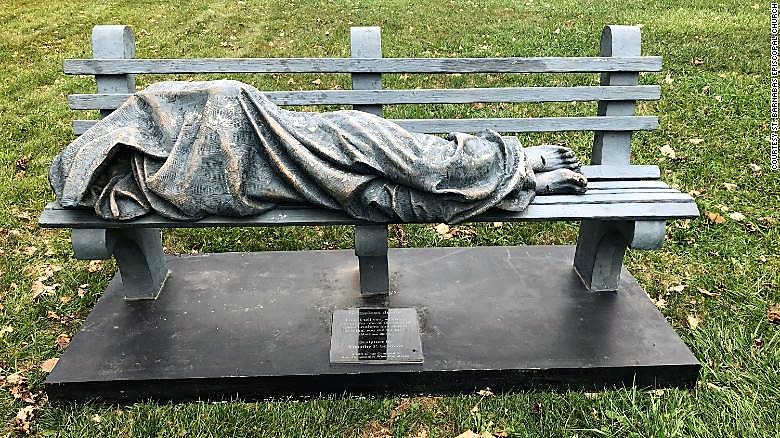
The Rev Alex Martin hoped that the realistic statue of a homeless Jesus sleeping outside his church would inspire conversations about how to care for people in need in his tight-knit Ohio community. It definitely got people talking after someone called the police to complain about a ‘vagrant’ sleeping on a bench outside St. Barnabas Episcopal Church in Bay Village, Ohio, about 20 minutes after the statue was installed.

Homeless Jesus was designed by Timothy Schmalz, a Canadian sculptor and devout Catholic Christian. It depicts Jesus as a homeless person, sleeping on a park bench. His face and hands are obscured, hidden under a blanket, but the crucifixion wounds on his feet reveal his identity.  The statue has been described as a ‘visual translation’ of that passage in the Gospel of Matthew where Jesus tells his disciples, ‘Truly I tell you, whatever you did for one of the least of these brothers and sisters of mine, you did for me.’ (Matthew 25:40). Schmalz intended for the bronze sculpture to be provocative, admitting, ‘That’s essentially what the sculpture is there to do. It’s meant to challenge people.’ He offered the first casts to St. Michael’s Cathedral in Toronto and St. Patrick’s Cathedral in New York, but both churches declined. The reason given (in both cases) was ‘ongoing restoration work’ but one spokesperson for one of the churches confessed that the real reason was because ‘appreciation was not unanimous’.

Eventually (in 2013) the statue found a home outside St. Alban’s Episcopal Church in Davidson, North Carolina.  According to the Rev. David Buck, Rector of St. Alban’s, ‘It gives authenticity to our church. This is a relatively affluent church, to be honest, and we need to be reminded ourselves that our faith expresses itself in active concern for the marginalized of society’. Buck welcomed discussion about the sculpture and considers it a ‘Bible lesson for those used to seeing Jesus depicted in traditional religious art as the Christ of glory, enthroned in finery.’  Alex Martin commented that, ‘People have been grateful to be given an opportunity to have conversations about how we can best serve those who are in great need, conversations about the sacred worth and dignity of all human life, even that which is often cast aside by society.’

Since 2013 well over 100 replica statues have appeared outside various churches all round the world including the UK. One such replica was going to be installed in Westminster outside of the Methodist Central Hall but planning permission was eventually rejected by the local council who said that the statue ‘would not properly reflect the nature of London’. In contrast Manchester welcomed the installation of a replica with the Bishop of Manchester affirming the importance of having Homeless Jesus in the city, reflecting on Jesus saying that ‘turning away from helping someone in need is like turning from Jesus himself’.

We do not have such a statue here in Reading (as yet). Perhaps, if we did it would inspire those who saw it to act and offer practical help.  Seeing Jesus depicted in this way reminds us that Jesus identified with the outcast and marginalised in his own day. In reality we shouldn’t need a statue to prompt us – we have the clear teaching of Scripture, as well as the inner witness of the Holy Spirit who (according to 2 Peter 1:20,21) inspired people of old to write those Scriptures living within us. ‘Seek the welfare of the city where I have sent you … and pray to the Lord on its behalf’ (Jeremiah 29:7) may be Old Testament but its sentiment is very much New Testament and accords with the teaching and example of Jesus himself!

Brother, sister, let me serve you;
let me be as Christ to you;
pray that I may have the grace to
let you be my servant too.

We are pilgrims on a journey,
and companions on the road;
we are here to help each other
walk the mile and bear the load.

I will hold the Christ-light for you
in the night-time of your fear;
I will hold my hand out to you,
speak the peace you long to hear.

I will weep when you are weeping;
when you laugh I’ll laugh with you;
I will share your joy and sorrow,
till we’ve seen this journey through.

When we sing to God in heaven,
we shall find such harmony,
born of all we’ve known together
of Christ’s love and agony.

Brother, sister, let me serve you;
let me be as Christ to you;
pray that l may have the grace to
let you be my servant too.

~ Richard Gillard (b. 1953)

~ Jim Binney

Leave a comment

I WANNA TELL YOU A STORY (2)

Those of us who are of a certain age will remember Max Bygraves (1922-2012) the English comedian, singer, actor, and variety performer who appeared on numerous radio and television shows, made twenty appearances at the Royal Variety Show, had a number of hit records, appeared in various films, and presented numerous quiz programmes, including Family Fortunes, right the way through the years from the 1950s to the early noughties.  His catchphrase ‘I wanna tell you a story’ became an integral part of his act (although it actually  originated with comedian Mike Yarwood impersonating Bygraves).

Everyone loves a good story. From the young child’s: ‘Will you read/tell me a story, daddy?’ to the adult’s enthusiasm about a particular book or film: ‘It’s an age-old  story of love  and betrayal … a  story about theft, fraud and deceit on an incredible scale! From popular comedians like Billy Connolly and Michael McIntyre (who paint real life pictures rather than crack jokes) to inspirational orators or preachers such as Tony Benn or Fred Craddock. Jesus himself was a great storyteller. Most of his preaching and teaching was in parables – earthly stories with a heavenly meaning.

This is not surprising because essentially the whole Bible is a book of stories (and by this I don’t mean fairy stories) rather than a book of rules and regulations. Right the way through from the intriguing Creation Narratives to the mindboggling accounts of the Last Days and the Return of Christ, the Bible is full of stories. From the overarching metanarrative of God’s gracious dealings with humanity from eternity to eternity, to the more personal stories of individuals, families, tribes, nations, and churches. Time and again as we read these stories we are able to make helpful connections. We see how these more personal stories fit into God’s big story. We identify with the individuals or families or churches whose stories we read … and start to believe that God dealt so graciously with them (as he did whenever and wherever those in the story turned to him) he will also deal graciously with us. We see that with God there is always a way out, a way back, a way up, a way forward!

I am a born storyteller (or so I am told). It’s in my nature, it’s in my blood, my DNA. I have always loved stories ever since I was a child. I loved to hear my father speak about his years in the British army (lying about his age and enlisting in order to fight in WWI and then spending 10 years in India following the end of the war) or my mother’s stories of her childhood in Scotland (where she and her two sisters were sent to live with relations – relations who treated them like skivvies – following the early death of her own mother). I have always read vociferously. I love getting into conversation with people (listening to them and not just talking to them). I write numerous stories and blogs … and even poetry and songs on occasion. Prior to Lockdown I was actively looking for a storytelling club that I could join – I have a friend who belongs to such a club (that meets in a pub near to where he lives) and he tells Bible stories (without saying they are Bible stories) because no one knows them anymore?! Interestingly his stories are always well received and he is constantly being told how good they are, how poignant, how intriguing. For me, story is the best way to communicate, to teach, to inspire.

The Psalmist exhorts us ‘Let the redeemed of the Lord tell their story’ (Psalm 107:2 TNIV) and when I speak of Christian storytelling I don’t mean just telling a good story for the sake of telling a good story (as commendable as that may be). We are not to be like some preachers who just tell endless stories unrelated to their message, or be like the fictitious preacher who was once heard to exclaim, ‘I’ve got this great story … if only I can find a text to go with it?!’ Neither are we there to ‘preach AT people’, to force the Gospel on them, but (I would suggest) to share the Good News winsomely, warmly, attractively – ‘evangelism through fascination’ as someone once put it. So there should be a point to our story just like Jesus with his Parables. Just as Max Bygraves took on the persona that Mike Yarwood attributed to him – and adopted the catchphrase that became synonymous with him – so we are (by the grace of God and the help of the Holy Spirit) to take on the persona of Christ. What we communicate to others is not simply the words of Jesus Christ but Jesus Christ himself. We are called to be ‘lights to the world’ (Matthew 5:14) but the real ‘light of the world’ is Jesus himself (John 8:12). Words alone are insufficient in and of themselves. We are to walk the walk and not just talk the talk.

Now, your talent (and everybody as a talent, as Jesus taught us in Matthew 25:14-30) may not be storytelling. Your creativity may lay in other directions – song writing, poetry, music, art, crafts of one kind and another, conversation, hospitality, friendship, and so on – the list is endless. Take a moment to write down what naturally comes to mind as you think about what you are good at or ask someone who knows you really well (and is not a sycophant) to tell you what you are really good at.  Now prayerfully think of ways in which you can use your creativity for the glory of God and the good of others … and then get on and do it!

Teresa of Avila was born in Spain in 1515 and entered a Carmelite convent when she was eighteen, and later earned a reputation as a mystic, reformer, and writer who experienced divine visions. Amongst many other things she wrote Christ Has No Body

Christ has no body but yours,
No hands, no feet on earth but yours,
Yours are the eyes with which he looks
Compassion on this world

Yours are the feet with which he walks to do good,

Yours are the hands, with which he blesses all the world.

Yours are the hands, yours are the feet,

Yours are the eyes, you are his body.
Christ has no body now but yours,
No hands, no feet on earth but yours,
Yours are the eyes with which he looks
Compassion on this world.
Christ has no body now on earth but yours.

~ Teresa of Avila (1515-1582)

Jim Binney

Leave a comment

WESLEYAN QUADRILATERAL [or How to Know the Guidance of God]

Wesley Quad

We are probably all familiar with the old story of the young man driving down to Cornwall for a weekend break and getting lost on the way. Pulling up outside a pub in a small hamlet in the West Country he asked an old boy sitting outside in the sun if he knew the way to Penzance. The old boy thought for a moment and then replied, ‘I do … but if I were you I wouldn’t start from here!’

Of all the questions I have been asked in 50+ years of ministry the most common by far has been to do with knowing the guidance of God. This ranges from the profound – ‘If God truly does have a plan for our lives (Jeremiah 29:11), a purpose for us to fulfil (Romans 8:28; Ephesians 2:8-10), how can we be sure and certain of it?’ – to the intimate and personal – ‘I am in love with Harry … but how can I be sure he is the right one for me?’ or ‘I have been offered a job in Manchester but it involves moving away from my family and friends … should I take it or stay where I am?’ Sadly, all too often, as a Pastor, I have had people come to me asking about guidance when they have actually already made a decision as to what they are going to do – accepted a job, moving away, got engaged, taken a role in the church or community, and so on. In reality they are presenting me with a fait accompli and asking me to pray for God’s blessing on what they have already decided to do. I learned a long time ago that ‘the need doesn’t necessarily constitute the call’ … which is why we need to seek the guidance of God particularly before, not after, we make any major decision to do something.

Knowing the guidance of God is a big subject, and a difficult one. Discerning ‘the mind of Christ’ (Philippians 2:5) is not always easy, and whilst prayer – ‘waiting upon God’ (Isaiah 40:31) for revelation and help – is an essential part of finding God’s guidance, it is not enough and all too often our prayers in this direction seem to remain unanswered. Personally, I have always found what has become known as the ‘Wesleyan Quadrilateral’ helpful.

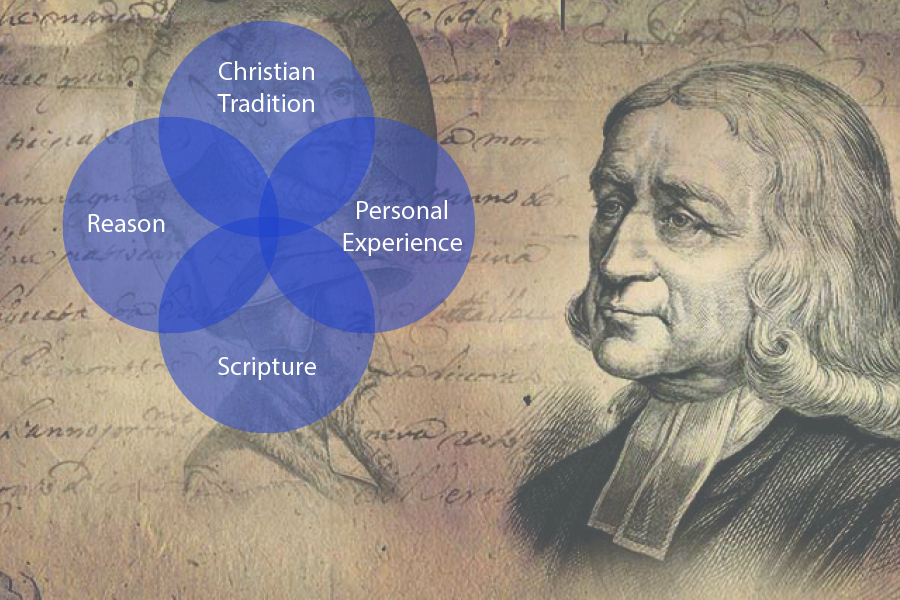
The Wesleyan Quadrilateral is a methodology for theological reflection credited to John Wesley, leader of the Methodist movement in the late 18th century (although the term itself was actually coined by the 20th century American Methodist scholar Albert Outler). After studying Wesley’s work for a number of years Outler concluded that John Wesley used four different sources in discerning the heart and mind and will of God for his life. These four sources were scripture, tradition, reason, and Christian experience.

Wesley believed, firstly, that the living core of the Christian faith was revealed in scripture as the sole foundational source. The centrality of scripture was so important for Wesley that he called himself ‘a man of one book’ Wesley insisted that scripture is the first authority and contains the only measure whereby all other truth is tested. It was delivered by authors who were divinely inspired. It is a rule sufficient of itself. It neither needs, nor is capable of, any further addition (2 Timothy 3:14-17; 2 Peter 1:20,21). Although an evangelical, Wesley was not a fundamentalist (in the modern day meaning of that term) and therefore qualified his understanding of scripture.

Biblical interpretation had to be in keeping with orthodox Christian belief, so tradition became the second aspect of his Quadrilateral. For Wesley Christian tradition supplied a link through 1,700 years of history with Jesus and the apostles … an unbroken chain drawing us into fellowship with those who have ‘finished the race, fought the fight’ (2 Timothy 4:7) and who are now ‘seated with Christ in heavenly places’ (Ephesians 2:6). Wesley is somewhat wary of accepting new interpretations of Scripture that don’t accord with tried and tested traditional interpretations.  When he speaks of tradition, however, he does not merely refer to ancient church tradition and the writings of the great theologians and Church Fathers of days past, but also of the immediate and present theological influences which contribute to a person’s understanding of God and of Christian theology.

Thirdly, every belief must be able to be defended rationally or reasonably.  The Apostle Peter exhorts us to ‘always be able to give a good reason for the hope we have within us’ (1 Peter 3:15). Wesley did not divorce faith from reason. Although scripture is sufficient in and of itself and is the foundation of true religion, Wesley clearly believed that without reason we cannot ‘understand ourselves or explain to others’ the essential truths of Scripture.  One of the more alarming features within evangelicalism today is the advance of ‘conspiracy theory’ over and against scripture – everything from modern Israel’s place in deciding world events, to Covid-19 being a ‘sign of the times’, with the necessity of Brexit (because the EU was endowed with the spirit of the antichrist) in between. It is almost as though the Bible alone is seemingly not as challenging or exciting for some Christians as it should be. God, however, gave us brains and expects us to use them. For me (and I suspect John Wesley) getting to grips with the teachings of the Sermon on the Mount (Matthew 5-7) is more important than the vagaries of the Book of Daniel or the mysteries of the Book of Revelation

Finally, for Wesley faith was more than merely an acknowledgment of ideas and involved experiential faith. In other words, genuine truth should lead to vital personal experience for the Christian. Reason alone is not sufficient to bring us into a vital personal experience of God and his truth – it must be impregnated by the Holy Spirit if we are to understand the mysteries of God. To quote another great saint of God, Martin Lloyd-Jones, what is needed is ‘logic on fire’. Apart from scripture, experience is the strongest proof of Christianity. Having our hearts ‘strangely warmed’ (as Wesley describes his own experience of the evening of 24 May 1738 at a meeting in Aldersgate when he came to living faith himself).

For John Wesley, tradition, reason, and experience, however, are always subject to scripture, which is primary. Wesley believed that the living core of the Christian faith was revealed in Scripture, illumined by tradition, confirmed by reason, but made real and vital in personal experience. When seeking the guidance of God, therefore, on any matter – whether it be the profound or the intimate and personal – applying these four facets, in the context of waiting upon the Lord prayerfully, is key. It is no ’quick fix’ but it is (I believe) a tried and tested way of coming to know the guidance of God.

Guide me, O thou great Jehovah,
pilgrim through this barren land;
I am weak, but thou are mighty;
hold me with your powerful hand.
Bread of heaven, bread of heaven,
feed me now and evermore.

Open now the crystal fountain,
whence thy healing stream doth flow.
Let the fiery, cloudy pillar
lead me all my journey through.
Strong deliverer, strong deliverer,
be thou still my strength and shield.

When I tread the verge of Jordan,
bid my anxious fears subside.
Death of death, and hell’s destruction,
land me safe on Canaan’s side.
Songs of praises, songs of praises
I will ever sing to thee,
I will ever sing to thee.

~ William Williams (1717-91)

Jim Binney

Leave a comment

DECLARING GOD’S WORTH (Views from the Abbey 12)

worship_2

A man dreamed that he was escorted into a church by an angel one Sunday morning. There was something strange about the Service. The organist moved her fingers over the keys but no music came forth. The congregation sang and their lips moved but not a sound was heard. Other phases of the Service were routinely carried out but silence prevailed. ‘What does this mean?’ asked the dreamer. The angel replied, ‘You hear nothing because you see this Service just as God sees it. The people are not putting their hearts into their worship – only their lips – and God hears nothing!’ Jesus said, of the empty worship of the scribes and pharisees, ‘These people make a big show of saying the right thing, but their heart isn’t in it. They act like they’re worshiping me, but they don’t mean it’ (Matthew 15:8, The Message).

The root of our present-day English word for worship comes from the Anglo-Saxon weorth meaning ‘worth’ thus weorthscipe meant ‘declaring the worth of something or someone’, in this case declaring God’s worth. This is what the elders around God’s throne in Heaven model for us as they cry out, ‘Worthy is the Lamb, who was slain, to receive power and wealth and wisdom and strength and honour and glory and praise … To him who sits on the throne and to the Lamb be praise and honour and glory and power, for ever and ever!’ (Revelation 5:6-13). When we worship we not only lift God up, we affirm God as being in the highest place of all. We act in a way that is appropriate toward someone of infinite worth. As Psalmist says, ‘Ascribe to the Lord the glory due his name … worship the Lord in the splendour of his holiness’ (Psalm 96:8,9).

Worship, of course, does not begin when we come together for a Worship Service in Church on a Sunday, but rather begins in the human heart long before we even set out for church. As Paul tells us in that pivotal passage in his Letter to the Roman Church, when he moves on from doctrinal truth to practical Christian living, ‘Therefore, I urge you, brothers and sisters, in view of God’s mercy, to offer your bodies as a living sacrifice, holy and pleasing to God – this is your true and proper worship’ (Romans 12:1,2).

Of course there is much more to ‘worship’ than simply attending Worship Services – it is as much about declaring God’s worth by the way we live as by the way we act in a Worship Service. To be one thing in a Worship Service and another thing in our daily life is anathema to God as he himself makes clear through the Prophet Amos: ‘I can’t stand your religious meetings. I’m fed up with your conferences and conventions. I want nothing to do with your religion projects, your pretentious slogans and goals. I’m sick of your fund-raising schemes, your public relations and image making. I’ve had all I can take of your noisy ego-music. When was the last time you sang to me? Do you know what I want? I want justice – oceans of it. I want fairness – rivers of it. That’s what I want. That’s all I want!’ (Amos 5:21-24). The Message). Worship is as much about lifestyle as anything else. The particular point I am trying to make here, however, is that worship – whether lifestyle, or personal or corporate praise – has to come right from the heart.

When it comes to corporate worship (and this may be indicative of a deeper problem for some) all too often on a Sunday morning I have stood up to lead worship and looked out at a congregation that reminded me of an old car I once owned that took 15 minutes to warm up before I could go anywhere. We need to come to church ready and prepared for corporate worship because we have already begun the day in personal worship, not take the first 15 minutes of the Service to get warmed up for worship.

As the late Donald Bridge said many years ago now (and it is still relevant for today), “The church that does not know how to worship is failing in the most fundamental feature of its calling. From the earliest time we find in Scripture believing men and women, unsophisticated by our standards, erecting altars, and worshipping God ‘in spirit and in truth’ (John 4:24). Let the Bible fall open at its centre and we find a book almost entirely devoted to the worship of God. The Psalmist pours out his whole being in adoration and gratitude to God, standing, kneeling, lying on his face, lifting up his hands, clapping, making use of a score of musical instruments, employing poetry and prose, constantly urging others to join him in this holy, happy exercise. Behind the Psalmist is a brilliant kaleidoscope of Old Testament worship with its sacrifices, symbols, vestments, music, and incense. The New Testament reveals those early Christians engaged in worship of a much simpler, freer kind as they met together to enjoy fellowship, to break bread, to learn from the apostles’ teaching, and to pour out their hearts in prayer (Acts 2:42-47). In the Bible’s final book we see that a throne sways the universe, and at the centre is One who is worshipped by heavenly beings and earthly multitudes, all crying out in praise: ‘Hallelujah for the Lord our God the Almighty, reigns!’ (Revelation 19:6).”

Old Ethel was a materially poor but spiritually rich Christian, who possessed little of this world’s goods but who was very enthusiastic in her commitment to, and worship of, God! A life-long Anglican-Christian Old Ethel was not – how shall I put this – hesitant about responding audibly during worship on a Sunday by shouting out ‘Praise the Lord’ or ‘Glory to God’ during the Vicar’s prayers or sermon (not just during the responses) whenever she heard something that exalted the Lord. Old Ethel was much loved by the congregation, who accepted her for who she was and, truth be told, often felt quite challenged by her enthusiasm for God.

Now, the Bishop was coming to visit for a special Service, and the Vicar was overly concerned that Old Ethel’s predilection to shouting out in a Service – albeit in praise of God – would offend the Bishop. Knowing that Old Ethel was materially poor, and desperately in need of new blankets for her bed, the Vicar decided to bribe her to restrain herself during the Bishop’s visit by offering to buy her some new blankets if she promised to keep quiet during the Bishop’s visit and not shout out. Thinking that the Bishop would be rather waffly, and that she probably would not find much to praise the Lord for during his visit, Old Ethel agreed. During the Service (led by the Vicar) she kept noticeably quiet but when it came to the Bishop’s sermon, to her surprise and delight, she discovered that he was a really good preacher and his sermon was wonderfully Christ-centred and God-glorifying.

Old Ethel tried desperately hard to keep quiet but the sermon was so good, so full of God, so full of Jesus, that eventually she could restrain herself no longer. Jumping up out of her seat she shouted out at the top of her voice, ‘Blankets or no blankets … Praise the Lord!’

Worthy, O worthy are you, Lord,
worthy to be thanked and praised
and worshipped and adored.

Worthy, O worthy are you, Lord,
worthy to be thanked and praised
and worshipped and adored.

Singing, Hallelujah, Lamb upon the throne,
we worship and adore you, make your glory known.
Hallelujah, glory to the King:
you’re more than a conqueror,
you’re Lord of everything.

~ Mark Kinzer

~ Jim Binney

Leave a comment

STANDING FIRM (Life in a Time of Lockdown 12)

Roman Soldier
Two friends of ours were staying in Los Angeles in 1994 when the city experienced a major earthquake. They were actually sight-seeing in another part of the San Fernando Valley and felt absolutely nothing at the time. In fact they didn’t even know there had been an earthquake until they got back to their hotel. Seemingly, the part of the valley they had been visiting stood on a gigantic slab of rock that proved impervious to the earthquake tremors. They were standing on a firm foundation.

Paul concludes his first Letter to the Corinthian Church by exhorting them to ‘Be on your guard; stand firm in the faith; be courageous; be strong’ (1 Corinthians 16:13) which seems in hindsight to be a good word for us today as we find ourselves living in the midst of tremors of various kinds seemingly coming one after the other at this present time. The encouragement to ‘stand firm’ is one of Paul’s favourite exhortations cropping up in various of his letters. In that classic passage on the need for us to clothe ourselves in ‘the armour of God’ (Ephesians 6:10-20) it occurs four times in just a few verses alone. The Apostle also possibly gives us a clue of exactly what he means by ‘standing firm in our faith’ when he speaks about ‘taking up the shield of faith, with which you will be able to quench all the flaming arrows of the evil one’ (v.16).

When Paul was writing this wonderful passage about wearing the armour of God he no doubt had in mind the armour worn by a Roman soldier. According to tradition, he wrote the letter while he was in prison in Rome (around AD 62) so perhaps he was actually looking at one of his guards as he wrote these words. The shield that he refers to here would have been the scutum, the large oblong shield we are most familiar with, a convex surface measuring two and a half feet in width and four feet in length, made up of various layers of wood and hide glued together to create a formidable barrier capable of turning aside the most formidable blows of stones, pikes, and heavy missiles in general including fiery darts or arrows.

In much the same way the faith Paul speaks about here – the faith we need to stand firm in in order to withstand the pressures of the spiritual warfare we find ourselves in – is made up of various layers, each one essential if we are to win through in battle. In particular, the Bible speaks of four kinds of faith, different layers, or kinds of faith, that we need to know in personal experience.

Firstly, there is what we might call saving faith. Writing earlier in this letter to the Ephesians Paul reminds us that we are ‘saved by grace, through faith’ (Ephesians 2:8,9). Whilst our salvation is all of grace – God’s agape love in action primarily through the sacrificial death of Jesus Christ on our behalf – it only becomes real to us in dynamic experience through personal faith. For some of us that may happen in a moment just like Paul on Damascus Road (Acts 9:1-19), for others it may be the result of a journey of discovery like the two on Emmaus Road (Luke 24:13-35).

Secondly, there is what we might call the fruit of faith or faithfulness. Writing to the Galatian Church, Paul suggests that genuine saving faith eventually results in the fruit of a Christlike character: ‘The fruit of the Spirit [of Christ] is love, joy, peace, patience, kindness, generosity, faithfulness, gentleness, and self-control’ (Galatians 5:22,23). Here ‘faith’ or ‘faithfulness’ (the same word in the Greek) is not so much a kairos moment as an ongoing, day after day, consistent, faithfulness to Christ and his ways. The kind of person and life exemplified by Silas, whom Peter describes as ‘a faithful brother’ (1 Peter 5:12).

Thirdly, there is what we might call the gift of faith. Writing about some of the specific supernatural gifts of the Spirit in his first letter to the Corinthian Church, Paul refers to ‘the gift of faith’ (1 Corinthians 12:9). Paul is not speaking here of saving faith, nor the fruit of faith, but of a specific deposit of faith implanted into the human soul and heart and mind, enabling that person to believe God for something specific. Think for a moment of the various Heroes of Faith described in Hebrews 11. Each of them were not only called by God to a specific task – Abraham to find the Promised Land, Noah to build the Ark, and so on – but each was also given a specific gift of faith to accompany their specific calling, so much so that it was actually easier for them to believe (rather than not believe) that what God was calling them to would be accomplished. Noah could not have found his way to the Promised Land, Abraham could not have built the Ark, because that was not what God had called them to … but he did give them the gift of faith for that which he had called them to!

And finally, there is what we might call the doctrines of the Faith. Jude (the half-brother of Jesus himself) exhorts the believers of his day to ‘contend for the faith that was once and for all entrusted to the saints’ (Jude 3). Whilst the New Testament Church clearly were still in the process of working out the doctrinal implications of the Incarnation and Passion of Jesus Christ, it would seem that there were already a number of doctrines or teachings that were considered essential, indispensable, non-negotiable if you like which those first Christians needed to contend for in the face of scoffers and heretics alike. It is not my intention here to discuss or debate what those essential doctrines may or may not be (although it could be something for us all to think about), but rather to underline the importance of having what has been described as ‘a thought through faith’.

Part of having a firm faith foundation is to ‘know the one in whom I have placed my confidence, and [be] perfectly certain that the work he has committed to me is safe in his hands until that day’ (2 Timothy 1:12 J B Phillips) and to know why we believe what we believe. As Peter tells us elsewhere, ‘reverence Christ in your hearts … honour him as Lord … be ready at all times to answer anyone who asks you to explain the hope you have within you’ (1 Peter 3:15).

My hope is built on nothing less
Than Jesus Christ, my righteousness;
I dare not trust the sweetest frame,
But wholly lean on Jesus’ name.

On Christ, the solid Rock, I stand;
All other ground is sinking sand,
All other ground is sinking sand.

When darkness veils His lovely face,
I rest on His unchanging grace;
In every high and stormy gale,
My anchor holds within the veil.

His oath, His covenant, His blood,
Support me in the whelming flood;
When all around my soul gives way,
He then is all my hope and stay.

When He shall come with trumpet sound,
Oh, may I then in Him be found;
In Him, my righteousness, alone,
Faultless to stand before the throne.

~ Edward Mote (1797-1874)

Jim Binney


Leave a comment

DEAD VOICES

original

One of the joys of having been a Baptist Minister for more than 50 years is that every now and then I get letters or emails or phone calls from people that I have been able to help in times past. This week I had a letter from a chap called Craig who wrote to thank me for praying for him 37 years ago when I was the Senior Minister at Teddington Baptist Church and he was a student studying at nearby St Mary’s College in Twickenham. He was deeply sorry not to have got around to thanking me until now, but better late than never.

From about the age of nine Craig had suffered from terrible nightmares which all started when his cousins came round to his house and called up the spirit of a deceased lady. From that day on he experienced an evil presence in his room and that is when the nightmares began. By the time he was studying for a degree at St Mary’s the nightmares had got worse and he dreaded going to sleep at night. At that time he was attending a Christian Fellowship in Twickenham and some of the members suggested that he came to see me for healing. He says, ‘I can still remember you placing your hands on my head and praying for healing. When I went back to my college room I experienced a wonderful peace and all fear of going to sleep had left me, and from that day until now I have had no nightmares and if I ever wake up in the night and sense evil near, I simply ask Jesus to be with me and the evil presence departs.’ Of course all I did was pray for him … it was God who delivered him and set him free. As Jesus himself said on one occasion, ‘If the Son sets you free, you are free indeed’ (John 8:36)!

In 1 Samuel 28:3-25 there is an intriguing story involving King Saul and a medium who lived at a place called Endor. The Bible says she called up the spirit of Samuel who spoke to Saul about his upcoming death. The fact is that Saul did die the next day. It has been debated as to whether it was really Samuel who spoke to Saul rather than some demonic spirit, or some trick on behalf of the medium. If it was Samuel, there is also the questions of why and how he was allowed to appear. There are many unanswered questions that surround this episode. Whatever the case may be, this story does not give any basis for the living to attempt to contact the dead. The fate of Saul gives further testimony of the bad things that happen when people attempt to contact those in the spirit world rather than the true and living God.

Craig’s letter, however, got me thinking about the mess we get ourselves into by listening to the voices of dead people. I’m not just thinking about attending seances and calling up the spirits of dead people (which the Bible explicitly warns us against doing) but the way in which we allow voices from the past – long dead voices oftentimes – to continue to cripple us in the present. Now I know that some of us suffer from the abusive behaviour of living people: the school bully, the obnoxious boss or colleague at work, the difficult neighbour, the domineering parent at home, the authoritarian leader in church. Others of us have suffered from the negative influence of family or friends. I recently had a long discussion with a young man who held the most awful racist, fascist, hate-filled views. Rather than argue with him I asked him where all this vitriol came from, and eventually he confessed that he was simply repeating his own father’s views. I was then able to intelligently challenge some of these views from an informed place.

To some degree I can understand why people are affected by the voices of the living because they are there – constantly in our faces so to speak – whether that be in our homes or at work or in the church or via the media. What I don’t understand is why we continue to listen to dead voices long after the people concerned are gone from this life. Of course there are always those ‘Heroes of Faith’ who, like Abel, ‘still speak [positively into our lives] even though dead’ (Hebrews 11:4), and I am not saying that we shouldn’t still hear their voices encouraging us on. I think particularly of the late Rev Ernest Forward (my first Pastor at Greenford Baptist Church) whose words and wisdom I still value to this day. But how come so many of us are still influenced by the negative voices from the past that damaged us then and still hold us back today even though they are no longer with us? The domineering father, the demanding mother, the bullying brother, the abusive boss, the intimidating church leader, and so on. I think of a woman I know whose spiritual growth has been warped and stunted because she remains dominated by her father even though he died many years ago. I think of a church, where the Deacons’ Vestry (and the Deacons themselves) is dominated by a large oil painting of a former Minister (who also died years ago) and every decision is coloured by the question, ‘Would Mr So and So have approved of this or not?’

Personally, I owe a lot to my own father. I still miss him, wish I had spent more time with him when he was alive, and often long that I could talk to him now about so many things. He died some 50 years ago now. I am an only child and my father desperately wanted me to succeed in life (where he felt he himself had failed). He put colossal pressure on me to do well at school, etc., all of which had a detrimental effect on me so that I achieved the opposite of what he wanted. For many years, even after his death, I felt myself cowed by his approach, held back in a number of ways, too conscious of what other people thought about me (or rather, what I thought other people might be thinking about me). I was listening to a dead voice!

Two things happened to change all this. Firstly, I suddenly realised one day that it didn’t really matter what other people thought about me as long as God approved of what I was and what I was doing. There is only one voice that really matters. Jesus said, ‘My sheep listen to my voice; I know them, and they follow me. I give them eternal life, and they shall never perish; no one will snatch them out of my hand’ (John 10:27,28). And secondly, one day in a prayer meeting of all places, I suddenly realised that I had to forgive my father (even though he had died years before) for all the unnecessary pressure he had put on me over the years. As Jesus himself once poignantly said: ‘Forgive them … they didn’t know what they were doing!’ (Luke 23:34). So right there and then I did just that. I forgave my father. I stopped listening to that particular dead voice … and as a result I started to flourish in a whole variety of ways. 

Speak, Lord, in the stillness
while I wait on Thee;
hushed my heart to listen
in expectancy.

Speak, O blessed Master,
in this quiet hour;
let me see your face, Lord,
feel your touch of power.

For the words You speak, Lord,
they are life indeed;
living bread from heaven,
now my spirit feed!

All to You is yielded,
I am not my own;
blissful, glad surrender,
I am yours alone.

Fill me with the knowledge
of your glorious will;
all your own good pleasure
in your child fulfil.

~Emily Crawford (1864-1927)

Jim Binney


Leave a comment

LAID BARE (Life in a Time of Lockdown 11)

Laid Bare

At the start of the lockdown, one of our cherished church members acutely observed that ‘this is a good time for us to get to know ourselves.’ How right she was. I think we have learned more about ourselves during this difficult time and discovered more about what we are really made of. Psalm 139 is a most wonderful, profound, and intense hymn of praise recounting God’s personal and intimate knowledge of every single one of us. The Psalmist tells us here ‘that God knitted us together in our mother’s womb’ (v.13). He literally wove our DNA in such a way as to produce our moral fibre. God knows what we made of because he made us.

The Apostle Peter tells us to ‘cast all our cares, all our anxieties on God because he cares for us’ (1 Peter 5:7) … as he does for every part of his creation. As Jesus himself tells us: ‘What’s the price of a pet canary? Some loose change, right? And God cares what happens to it even more than you do. He pays even greater attention to you, down to the last detail – even numbering the hairs on your head!’ (Matthew 10:29-31 The Message).

This time of lockdown is a time of stripping back, of shaking, of sifting, of laying bare. We are beginning to see things as they really are. Pretence, hypocrisy, sham, hollow rhetoric is being exposed … and may it long continue. I wonder if all we are experiencing right now part of God’s judgement. It depends on how we see God’s judgement, of course. The Bible is clear that ‘people are destined to die once, and after that face judgement’ (Hebrews 9:27). For many the ‘great assize’ has lost its power but it serves to safeguard important truths: judgement is serious, just and inescapable but conducted under the gaze of gracious love by Christ himself. As Jesus himself said: ‘you haven’t seen the half of it yet, for in the same way that the Father raises the dead and creates life, so does the Son. The Son gives life to anyone he chooses. Neither he nor the Father shuts anyone out. The Father handed all authority to judge over to the Son so that the Son will be honoured equally with the Father’ (John 5:22 The Message).

There has been discussion over the centuries about whether divine judgement can be perceived through the events of history. Certainly in previous generations a plague would have been viewed in these terms. What then are we to make of this current pandemic … and others like it? What is God seeking to say to us through it?

Perhaps though it would be better to understand God judgement as an exposing of truth. There will be a day, ‘The Day of Judgement,’ when this will be done in totality and perfection. One day all the wrongs will be righted, all injustice rectified. However, in another way, we are always under God’s judgement in that God always sees things as they really are and the exposing of truth is ongoing: ‘Nothing is hidden to him. He is the One who brings to light what is hidden in darkness and will expose the motives of people’s hearts’ (I Corinthians 4:5).

For those in Christ by God’s grace, this is not a fearful thing but a matter of deep peace, assurance, and thanksgiving. Whatever is happening in the world, God sees and knows everything. No-one can hide from God (Psalm 139:7-12). All the secrets of our hearts are revealed: ‘Nothing in all creation is hidden from God’s sight. Everything is uncovered and laid bare before the eyes of him to whom we must give account’ (Hebrews 4:13). God is bringing things to light and ‘everything is going to be out in the open, and everyone will know how things really are’ (Matthew 10:26 The Message). Now, today, we are living in days when no-one anywhere can hide from God’s penetrating gaze. God is searching our hearts. We are laid bare.

God of grace, I turn my face
To you, I cannot hide
My nakedness, my shame, my guilt
Are all before your eyes

Strivings and all anguished dreams
In rags lie at my feet
And only grace provides the way
For me to stand complete

And your grace clothes me in righteousness
And your mercy covers me In love
Your life adorns and beautifies
I stand complete in you

~ Chris Bowater

Julia Binney