A NICE CUP OF TEA AND A SLICE OF CAKE

Jim with a Pilgrim at Hastingues
We are sitting outside our tent enjoying the early morning sunshine after a night of rain. We are drinking our first cup of tea of the day. Jasmine (aged 8) comes over to talk to us. Jasmine is camped with her family on the pitch opposite ours. We have moved campsite again – this time right over to the Atlantic Coast – and we are staying on a very nice site near Bayonne. Jasmine is very talkative and often pops over for a ‘chat’. ‘Ah!’ she says, ‘A nice cup of tea and a slice of cake … solves every problem!’ ‘Yes!’ says her brother Charlie (aged 5) who has also joined us … ‘Especially when you are attacked by a T-Rex!’ … and off he goes again, shooting an imaginary T-Rex with his imaginary gun!? ‘As I was saying, before I was rudely interrupted’ says Jasmine, ‘a nice cup of tea and a slice of cake solves every problem!’ ‘That is very profound, Jasmine’ responds Julia, ‘where did you learn that?’ ‘From a book!’ says Jasmine … and off she goes … presumably to put the kettle on?!
The other day we went to the old town of St-Jean-Pied-de-Port situated in the foothills of the Pyrénées not far from the Spanish border. In the Middle Ages St-Jean was a great rallying centre for Jaquets – pilgrims en route for Santiago de Compostela in Spain – who journeyed from all over Europe to both worship at the Cathedral where the bones of St James the Apostle are supposed to lay, and at the same time earn merit in the sight of God (by walking the pilgrim way) that will be put toward their credit account in earning their eventual salvation. They wore a heavy grey cloak, a broad-brimmed felt hat turned up at the front and marked with three or four scallop shells (the emblem of the pilgrimage), and carried a bread bag and an eight-foot stave with a water flask attached. There is a wonderful statue of such a pilgrim at the Aire d’Hastingues (on the A64 motorway in the Pau-Bayonne direction), which contains a wonderful exhibition of the famous pilgrimage. Whenever a devout procession of the pious appeared at the gates of St-Jean-Pied-de-Port, the town became a hive of activity – church bells pealed, priests intoned prayers, children ran out to escort the pilgrims, and the inhabitants, standing on their doorsteps, offered provisions. Thus refreshed and encouraged, the majority of the pilgrims would move on, chanting responses, whilst those too tired to continue could stop overnight. Modern day pilgrims also pass this way … and also receive hospitality in the town. A number of the houses on the Rue de la Citadelle display the scallop shell motif outside to show that they receive pilgrims. What are they offered by way of sustenance today we wonder … a nice cup of tea and a slice of cake perhaps?
The name St-Jean-Pied-de-Port is a reminder that the town lies at he foot of a ‘port’ or pass for travellers heading for Spain. It is the last refuge before the climb to Puerto Ibaêeta (or Port de Roncevaux as it is known on the French side). Beyond the crest the Monastery of Roncevaux still maintains a tradition of Christian hospitality. Roncevaux is also said to be the place where the heroic (or stupid?) Roland perished in 778 when the rear guard of Charlemagne’s army was overwhelmed by the Saracens (or more likely Basque mountain people?) on their way back from a campaign against the Saracens in Spain. According to legend Roland was too proud to blow his horn (though urged to do so by his advisors) and sound the retreat in time to save his men. There is supposed to a cleft in a rock nearby where Roland tried to break his magic sword. If only Roland had taken time out for a nice cup of tea and a slice of cake things might have turned out very differently!?
We enjoy a very happy day wandering around St-Jean-Pied-de-Port taking in all the places of historical importance – the Rue de la Citadelle with its charming 16th and 17th century houses with their rounded doorways and carved lintels; the Gothic Church, Église Notre-Dame, dedicated to the Virgin Mary with its huge prayer candles burning brightly in the gloom of the interior; the Rue d’Espagne, which climbs uphill to the Porte d’Espagne through which the pilgrims left the town, with its quaint shops and houses; the Citadelle itself, now a school, but with its amazing views over the St Jean basin and the neat little villages far below. It is a beautiful day and the streets are packed with tourists all enjoying this wonderful little town with an amazing history.
The pilgrim road to Santiago de Compostela is another of our historic and theological interests. We have travelled much of it over the past few years – by car and not by foot. It would be lovely to walk it sometime – or at least parts of it – and to eventually visit Santiago de Compostela itself. Nevertheless it is good to be here in St-Jean-Pied-de-Port, and to be reminded of the benefits of journeying – taking time to walk prayerfully through life contemplating the things of God. We return to our campsite refreshed and renewed, enlightened and blessed, by a really good day. Time to put the kettle on and have a nice cup of tea and a slice of cake!
It is not that we agree with the motives of the majority of the pilgrims down through the ages. We are not really into ‘religious relics’ and certainly do not believe that we have to ‘earn our salvation’. Salvation is the free gift of God, won for us through the sacrifice of Jesus Christ, God’s Son, on the cross. As another Apostle, Paul, tells us ‘We are saved by grace, through faith, and this is not of yourselves, but is the free gift of God, not by works, so no one has any grounds for boasting’ (Ephesians 2:8,9). Perhaps all of us need, from time to time, to take time out to think seriously about the gift of life … and its meaning? Stopping for ‘a nice cup of tea and a slice of cake’ may not solve every problem … but perhaps it might provide space to stop and think about what is really important in life … rather than just be caught up with the rush and bustle of so much that makes for modern life today!? I am sure that I have read that in the Good Book somewhere … o.k., I know that it doesn’t actually mention taking time out for ‘a nice cup of tea and a slice of cake’ … but it does say, ‘Be still, and know that I am God!’ (Psalm 46:10)!
Jim Binney
TEN MINUTES MORE
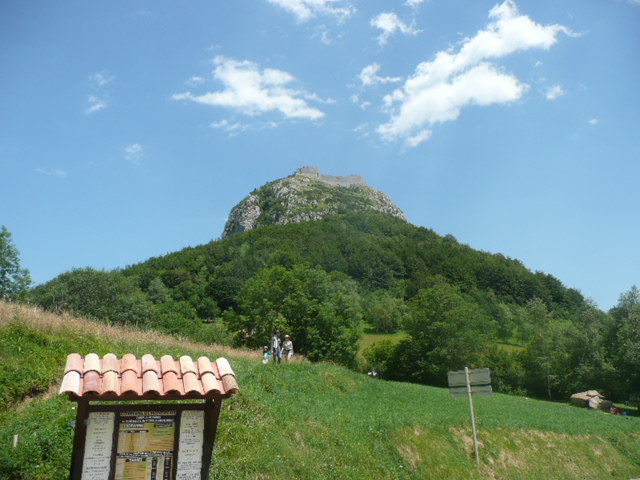
Montsegur
‘Its only another 10 minutes to the top!’ the Irish couple tell us. They recognise us as Brits, and have seen how shattered we are looking, and are trying to encourage us. They are on their way down from the top of Montségur and we are on the way up. We seem to have been climbing the steep pathway for ever … and 10 minutes later we are still climbing … with still no sign of reaching the top. Perhaps our encouragers were still on Irish time rather than French time, and therefore an hour behind?! ‘Whose bright idea was it, to climb to the top of Montségur?’ I mutter breathlessly to Julia. ‘Yours!’ she reminds me.
One of our main reasons for coming to this part of France was to visit Montségur. I have been fascinated with the story of the Cathars for several years now. I first came across these 11th to 13th century ‘believers’ through reading Kate Mosse’s books Labyrinth and Sepulchre, and began to research them academically as a result. They were particularly strong in the Languedoc region of France until their repression at the hands of the Roman Catholic Church and the King of France during the 13th century. For the Roman Catholic Church the repression of the Cathars (or Albigensians, as they are sometimes known) was necessary in order to maintain the ‘purity’ of the Church doctrinally. For the King of France it was primarily a political move, an opportunity to annex vast new territories for the French estate.
Cathar doctrine originated in a labyrinth of complex Eastern influences, prevalent in Europe, during the 11th and 12th centuries. Cathar teaching focussed on the opposition of ‘Good’ and ‘Evil’ differentiating between the ‘material’ world (created by the Devil) and the ‘spiritual’ world (created by God). Obsessed with a repugnance of evil, the Cathars (from the Greek kathari or ‘pure ones’) sought to free people from the material world and restore them to divine purity. They strove to emulate Christ but denied his divinity, and their interpretation of many biblical texts collided head-on with orthodox Roman Catholic teaching. The Cathar Church was essentially comprised of ‘Parfaits’ (Perfect Ones) or ‘Bonhommes’ (Good Men or Women), and ‘Croyants’ (Believers) and essentially sought to restore what they understood primitive Christianity to be. Reacting against the decadence of the Roman Catholic clergy, the austere Parfaits embraced poverty, chastity, patience and humility. The Cathars rejected the traditional Roman Catholic sacraments of baptism and marriage, and adopted different customs and attitudes towards financial and commercial matters. Their beliefs, way of life and simplistic religious rituals challenged Roman Catholic thought, attracted a growing interest and support from ordinary people, but ultimately led to a violent reaction from Roman Catholic clerics.
The question has been raised, ‘Were the Cathars really heretics … or were they, in fact, the first Protestants?’ Undoubtedly they were heretics, in that they denied the divinity of Jesus Christ, but there is nevertheless much about their lifestyle to be admired. It is in this latter sense that they could be described as the ‘first Protestants’. They ‘showed up’ the decadence that characterised much of Roman Catholicism at that time, and challenged many of the things that Roman Catholicism stood for. Their ‘godly behaviour’ and simple but profound lifestyle attracted an ever growing following which increasingly undermined support for the Roman Catholic Church. Although tolerated initially by the Roman Catholic Church – in the way Roman Catholicism is able to absorb most things one way or another – the Cathar Church soon became the object of intense persecution. In 1208 Pope Innocent III launched the first Albigensian Crusade – the only time the Roman Catholic Church declared a ‘crusade’ against fellow professing Christians – and thus launched a ‘holocaust’ that was to last for many years until the Cathars in the Languedoc region were finally wiped out in 1243.
Montségur crag was the setting for the final episode of the Albigensian Crusade, and vividly recalls the CatharChurch holocaust with the ruins of a castle perched on this high rocky peak Julia and I are climbing on a hot sunny day in July 2013. For me it is something of a personal pilgrimage. Although I know that the Cathars were indeed ‘heretics’ – not least in their theological beliefs about the nature of God, the dualist concept of life, and their understanding of the Person of Christ (not to mention their belief in reincarnation or their hope to eventually regain their status as ‘angels’ lost in Lucifer’s rebellion) – there is much about their lifestyle and concern to rediscover the simple purity of early Christianity that I admire. In many ways they are the forerunners of that ‘third force’ at the heart of the later 16th century Protestant Reformation – the Anabaptist Movement – although thankfully our Baptist-Christian forefathers managed to retain orthodox Christian theology to go with the radical Christian lifestyle they espoused.
In 1243 the fortress at Montségur was occupied by 100 men under the command of Pierre-Roger de Mirepoix, and beyond its ramparts lived a community of Cathar refugees. The fortress was besieged by a Roman Catholic army of 10,000 men. After a long siege the garrison surrendered and were spared, but the 207 or so Cathars were all burned at the stake at the foot of Montségur. A memorial stone marks the exact spot today. Fascinatingly, four of their number apparently climbed down the steep precipice on one side of the rocky crag on which Montségur is perched during the darkness of the night before the final surrender of the last of the Cathars, and made their escape, taking with them ‘the treasure of the Cathars’ … whatever that ‘treasure’ may have been?!
Eventually, Julia and I make it to the top of Montségur. The views are amazing and well worth the hour’s steep climb alone. It is very evocative for me here actually standing where these amazing people stood nine centuries or so ago. I find a quiet corner and sit prayerfully thinking about those last Cathars. What they stood for, and how they must have felt before finally taking the steep descent to what they knew to be certain death – a martyrdom that they received calmly, even joyfully, if the records are to be believed. Hopefully Julia and I will be able to return to ministry soon and help others to Christ-centred, faith that marked out the New Testament Church.
After we have explored every nook and cranny of Montségur, and spent time prayerfully contemplating the significance of this extraordinary place and these extraordinary people, we begin our descent. It only takes us about 30 minutes to get back down the steep paths again. Half way down we meet what we perceive to be fellow Brits struggling up the steep path to the top. ‘How much further is it?’ they ask us breathlessly. We hear their Irish lilt. ‘Its only another 10 minutes to the top!’ we reply … encouragingly!
Jim Binney
‘ALLO! ‘ALLO!
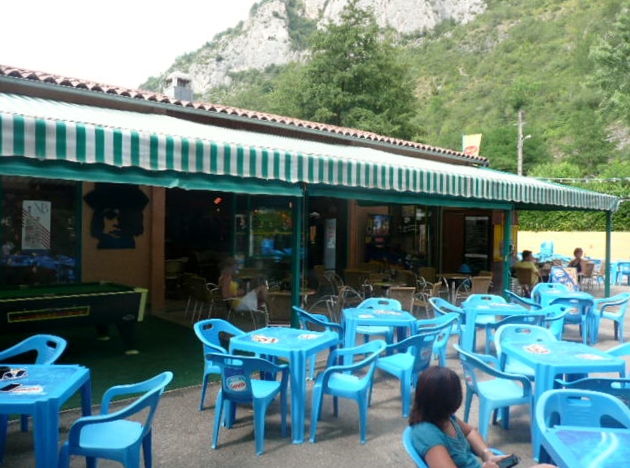
Café Area at Le Pre Lombard
I am sitting at a table in the café area at Le Pre Lombard when I am joined by some of my new young friends who seem to have adopted me as their ‘honorary grandfather’. They were very kind to me when we first arrived, helping me to master the intricate ‘signing on system’ necessary to get on to the internet. As the old saying goes, ‘If you don’t know how any of the latest communication devices work … ask a young person … they know everything!’. There is Nicole and her friend, Fleur … and Fleur’s boyfriend, Justin … and Fleur’s younger brother, Gus. Gus has just turned 13 but he is telling everyone that he is 16. Apparently he has met some nice girls who are older than he is and wants to impress them. I ask him if the strategy is working? ‘Not so far!’ he replies. We all laugh! I confess I did much the same when I was his age … and it didn’t work for me either!
They ask me what we have done today, and I tell them that Julia and I have been to Andorra. They have either all been to Andorra already during their stay here in Tarascon, or are planning to go. We talk a bit about the fabulous drive over the Pyrénées, the weird but wonderful forest of tax free retail outlets right at the top of the Pyrénées found as soon as you enter Andorra, the numerous petrol stations selling ridiculously cheap petrol just across the border, and our disappointment with the Andorran capital city that is trying to ape Monaco. Eventually they leave me to go into Tarascon to the Festival that is on there at the moment – much better music than what’s on at our campsite tonight apparently?!
As soon as they have gone I am joined by a man who I have seen around the campsite but not spoken to as yet. ‘My name is Rene’ he tells me, ‘may I join you?’ ‘Allo! Allo!’ I say … but he doesn’t get the joke?! ‘I heard you talking about Andorra’ he tells me, ‘and I wonder if you could give me some tips as I plan to go there myself sometime this week?!’ I try and answer all his questions. I tell him to go over the Pyrénées to Andorra but come back through the tunnel. I tell him the best route to take, tell him about the retail units and the cheap petrol, and warn him to watch out for cattle on the roads and for cyclists. I wish him a happy visit and we go our separate ways.
There are so many lovely people on this campsite. They are so friendly, kind and helpful. I have always naturally got on with people. For some inexplicable reason people of all ages talk to me. It seems to be especially so here at Le Pre Lombard. We are so impressed by the young people we have met. Nicole is studying to become a child psychologist, Fleur is training to be a Primary School teacher, Justin wants to be either a fighter pilot or a doctor (we are praying that the medical profession pull will win). We get on especially well with Nicole’s parents, her mother, Margot and her step-father, Tonie. They are full of fun and laughter … and even laugh at our jokes … and we would really like to get to know them better. We know that we are all sinners by nature and all need a Saviour – ‘estranged [from God] and hostile in mind, doing evil deeds’ the Apostle Paul tells us (Colossians 1:21) – but nevertheless there is also a spark of something better that clearly resides in the human heart. We are all made ‘in the image of God’ (Genesis 1:26) by which I understand it to mean that deep down inside all of us God has left a spark of the divine. Consequently even the worst of us, deep down, know that we are destined for better things in the plan and purpose of God. Again and again we have seen and sensed this in the various people we have met here at Le Pre Lombard. As Christians our job is to help people see this, and turn to Christ … rather than to be always condemning people in a negative and critical way!
Two years ago (when we were in France for two and half months) we had a bad car accident when someone reversed into our car at the Millau Viaduct. Fortunately we were not hurt, although our car was in a garage for repairs for three weeks as a result. During that time we received a lot of help from a number of people – help that we could not repay at the time. We sensed then, that although we could not repay in person those who were so helpful to us at that time, a time would come when we would be able to show a similar kindness to others in equal need as ourselves. And this is how it turns out for us at Le Pre Lombard.
Bruno and Valerie, in a campervan on the next pitch to ours, reverse into a lamppost and buckle the wheel on their tandem which is strapped to the back of their van. The specialist cycle repair shop is miles away but we are able to drop the wheel off for them on one of our ‘days out’ so that it can be repaired in time for them to pick it up on their way through in a few days time. Bruno and Valerie are so appreciative that they give us a really nice bottle of red wine. Donna (the German lady who put her husband in the ‘dog house’ when we first arrived, you may recall from a previous blog) turns out to be still on our campsite. They left a few days ago but their car broke down and they had to return. She is actually really nice … and clearly has to make all the decisions in the family … and she is really worried about getting the car repaired. We meet up with her ‘by chance’ and are able to reassure her and offer our help. In the end we are not needed, although Donna makes a point of coming to see us to say how important it was for her just to know that we were there with our offer of help. And then there is Leticia, who arrives on the pitch next to ours just a few days before we are due to leave. Her car has also broken down … in Tarascon … and she has to stay on our campsite for a few days until it is mended. She is a single lady, in her 30s, divorced and rather lost, trying to find a new direction in life. She needs to talk … and joins us for breakfast and most evenings … and we hear her whole story.
These are just a few of the lovely people we have met on our two week sojourn here at Le Pre Lombard, Tarascon. People we believe God has put us alongside in order both to help and to learn from. Time does not permit us to say more of so many others … including Kurt and Ellen … the ‘happy Christians’ who we have also got to know so well and who have been nothing but friendly and supportive to us! We will miss them all when we move on at the end of the week.
Later on in the week I am back sitting in the café area trying to ‘log on’ to the internet yet again. Rene comes and joins me at my table. ‘Have you been to Andorra yet?’ I ask him. ‘No’ he replies, but we have been to Carcassonne!’ ‘Oh!’ I reply. ‘We just love Carcassonne! What did you think of it?’ ‘Not much!’ replies Rene. We spent a couple of hours walking around it, and although there were some ‘old bits’ we didn’t see what the hype was all about!?’ It turns out that Rene and his family went to new town … and didn’t see the old cite at all? I am amazed. When I get back to our pitch I tell Julia. She collapses in hysterical laughter! ‘Well, what did you expect … from anyone asking you for directions?’ she says. ‘Someone wants to go to Andorra … and ends up in Carcassonne … and when they get there, they only go to the new town and not to the medieval cite?’ ‘Oh well!’ I respond, ‘I suppose I did preface my directions to Rene by saying, “Listen carefully … I will zay this only once!?”‘
Jim Binney
PEEP! PEEP! BEEP! BEEP!

Church in the Capital of Andorra with the Mountains Behind
Papa Pee-Pee’s parents have finally got fed up with their child’s constant calling out to them every morning at around 6.00 a.m. They too are fed up with being disturbed from their sleep by the constant cry ‘Papa! Pee-Pee! Mama! Pee-Pee! … so they have bought him a tin whistle to keep him amused!? Now all we get is ‘Peep! Peep! Peep! Peep! … the same four notes being played over and over and over again! We have had enough! We get up, shower, grab a quick bite of breakfast, jump in our car and drive off to Andorra for the day!
We have never been to the Principat d’Andorra before, and since it is only 50 kilometres from our campsite it is too good an opportunity to miss. The weather is clear and sunny and hot so a nice drive over the Pyrénées in our nice air-conditioned car is very welcome. It also enables us to add another country to our growing list of countries visited. This small independent state in the heart of the Pyrénées remains curiously apart from its neighbours, France and Spain. ‘Visitors,’ our Guide Book tells us, ‘love its rugged scenery and picturesque villages’. Andorra only became a fully independent state in 1993, with Catalan as the official language. It has a treaty of cooperation with France and Spain and is a member of the United Nations. Andorrans are fiercely independent, and a representative government and 11 centuries of peace, have given them little incentive to alter the country’s administration. Andorrans, who number around 77,000, do not pay any direct taxes or engage in military service. Postal services are free, and most land is communally owned. They also have a football team that plays in the European and World Cup. They usually lose every game by quite a hefty score. If I was Andorran I think I might even get into their national team even though I will be 70 this year and have dodgy knees?!
To get to Andorra we have to drive through the French Pyrénées. Julia has the route all worked out. We will drive over the Pyrénées to the Andorran capital, Andorra la Vella, and return through the tunnel stopping for coffee en route at Ax-les-Thermes before we cross the border. Of course, when we get to Ax-les-Themes it just happens to be the Saturday market … so two coffees, two watches and a dress for Julia, later we manage to continue our journey to Andorra. It may only be 50 kilometres as the crow flies, but with the road winding up and through the numerous sharp turns and twists of the Pyrénées it is probably nearer 100 kilometres. The scenery is stunning, however, and the views quite amazing. This is big skiing territory and there is obviously heavy snow in the winter. The winding roads have 12 foot poles with red tops every 20 yards or so to indicate where the roads are when there is particularly deep snow.
The border crossing into Andorra is unmanned and we simply drive straight through and almost immediately arrive at Pas de la Casa – the most amazing collection of tax free shops and petrol stations just the other side of the French Pyrénées. We decide to fill up with petrol since our petrol tank is less than a quarter full. It is ‘cash only’ and Julia is worried because we only have 50€ in cash with us and it usually costs more than that to fill the tank completely. As it turns out we fill up for around 38€ … result! Andorra has obviously changed a lot since our Guide Book was last revised just a few years ago. There is a lot of new building and little sign of the ‘picturesque villages’. Commercialism is clearly taking over and Andorra la Vella is very expensive and obviously attempting to re-model itself on the lines of Monaco. There is not much to the historic old town and it more Spanish than French. After a nice picnic lunch and a wander round we decide to head back home. The journey home is hilarious. Jane, our SatNav, can’t cope with the mountains and repeatedly commands us to turn right or left (into oblivion on these narrow twisty roads through the mountains) or ‘make a U turn’ when we are on a completely straight road?! We are glad when we get to the tunnel, pay our 6€ toll, and drive through the rest of the Pyrénées and back into France again, via the still unmanned border crossing.
We arrive back at our campsite from our fascinating day in Andorra in the early evening. It is very peaceful around our pitch. It is still very sunny and hot and people are either at the swimming pool or resting quietly in the shade of the trees. There is no sign of Papa Pee-Pee and no sound of Peep! Peep! Peep! Peep! We can’t see the tin whistle lying around either, and hope that it has been mislaid or broken or even stolen! We pour ourselves a drink and sit in the shade ourselves. We are just dozing off nicely when suddenly we hear ‘Beep! Beep! Beep! Beep!. Papa Pee-Pee has indeed mislaid his tin whistle somewhere … so his parents have let him sit in their car so he can play with the horn! ‘Beep! Beep! Beep! Beep! Beep! Beep! Beep! Beep! On and on it goes … endlessly! We give up and go and join the hurried exodus of all the other nearby campers. We are off to the swimming pool … there is a Rhythm and Blues Band performing this evening … they must be more tuneful than Papa Pee-Pee … surely!?
Jim Binney
PAPA! PEE-PEE!

Our Pitch at the Pre Lombard Campsite
I am in a deep, deep sleep. I am dreaming about all the interesting and lovely people – many of them real characters – that we have got to know on this fascinating campsite at Le Pre Lombard. It is just after 6.00 a.m. and the whole campsite is sleeping. I am suddenly rudely awakened by an unexpected early morning ‘Wake Up Call’ … ‘Papa! Pee-Pee! Papa! Pee-Pee!’ cries a shrill penetrating voice, loud enough to wake the dead! A new French family – Father, mother, and two very young children (no more than 3 or 4 years of age) – moved on to a pitch just down from ours yesterday. They nearly decided on the pitch right by ours, but changed their minds at the last minute and moved a little further away. All the other French families around us are impeccably behaved. We are so impressed by the behaviour of the children – polite, obedient, and yet full of fun. But not these two children?!
‘Papa! Pee-Pee! Papa! Pee-Pee!’ The cry goes on unchecked to for a good 10 minutes. Unlike most French families this family has clearly adopted the ‘modern, liberal approach’ of allowing their children free reign in expressing their feelings and emotions. ‘Papa! Pee-Pee! Papa! Pee-Pee!’ On and on it goes! After about 10 minutes the cry ceases – we relax – but only for about 30 seconds. ‘Mama! Pee-Pee! Mama! Pee-Pee!’ is the new cry. You can hear the audible groan uttered in unison from all the surrounding tents and caravans! ‘Mama! Pee-Pee! Mama! Pee-Pee! On and on it goes unchecked by the parents! It is nearly 7.00 a.m. ‘Papa! Pee-Pee! Mama! Pee-Pee! Anyone! Pee-Pee!’ I turn to Julia and ask her if I have got the French for ‘Shut up you little ***!’ correct, when Papa finally shouts at his child! ‘I think that was what you wanted to say!’ Julia laughingly tells me.
I was having such pleasant dreams as well – all about the lovely new friends we have made here on this campsite. There is Raymond and Henni – a very friendly Dutch couple with three delightful teenage children – who are camped just across from us. We toasted the birth of the new royal baby with them with several glasses of wine the other day. We had already had some discussion as to what the royal baby should be called. I was in favour of ‘James’ because it is my name, of course. Their 15 year old daughter wanted to know if I was ‘James Bond’ since I came from the UK? Julia thought this hilarious. Julia also wanted the royal baby to be called ‘George Michael Jackson (and after his accession to the throne) formerly known as Prince’. We all thought that this was rather clever. Then there is Daniel (who is French) and his girl friend Elsa (who is Bulgarian, but lives in the USA) who are on the next pitch to ours, together with Daniels two teenage sons, and Elsa’s 10 year old son (who is always cracking jokes in a broad American accent). Daniel comes from Toulouse (just down the road really) and is a mine of information about what to see in the area. We also came across another Dutch family who are all Christians whilst we were sunning ourselves by the swimming pool the other day. Julia was reading a book about the Cathars and this engendered an impromptu discussion about what it meant to be a true Christian. Our interest in the Cathars has led to a number of such discussions during this trip to France. Our new Dutch friend told us that he and his family worshipped at a ‘Gospel Church’ in the Netherlands, by which we think he meant one of the new churches. He described it as a ‘happy’ church!
We are still lying in bed … as are the rest of the campsite … even though we are all now wide awake. Papa has finally intervened and sorted out the Pee-Pee problem. We are all just lying there enjoying the peace of the moment. Suddenly Daniel’s eldest son, who is about 17, cries out in a loud voice, ‘Papa! Pee-Pee! Papa! Pee-Pee!’ There is a pregnant pause … and then everyone in our section of the campsite dissolves in hysterical laughter!
Jim Binney
CABBAGES AND KINGS
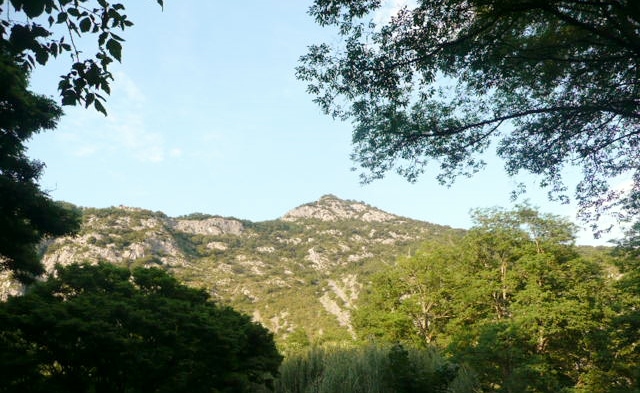
View from our campsite pitch
One of my favourite poems – nonsense song might be more appropriate, on reflection – is Lewis Carroll’s The Walrus and the Carpenter (from Through the Looking Glass) particularly the well known verse that reads as follows:
‘The time has come,’ the Walrus said,
‘To talk of many things:
Of shoes, and ships, and sealing-wax …
Of cabbages, and kings …
And why the sea is boiling hot,
And whether pigs have wings.’
We have been on our new campsite at Tarascon-sur-Ariège, in the Pyrénées, for a few days now. It is very different from our previous campsite at Cordes-sur-Ciel, and I am reminded in many ways of Lewis Carroll’s verse as a result of being here?! it is not just because we appear to have gone from the sublime to the ridiculous in terms of campsites … but also because I suspect that this campsite was once put to more agricultural use in previous days than it is now. Our new campsite is part of the Yelloh Camping Village chain and there are lots of activities for children and young people here, and more facilities such as a shop, restaurant, wine bar and fast food facilities, and so on. We normally would not camp at such a site, but it is near to Montségur – the last stronghold of the Cathar Church – and other places that are on our ‘must see’ list.
Our campsite is called Le Pré Lombard or the Lombardy Meadow, and is situated on meadow land by the River Ariège just a short walk from Tarascon itself. We are not the only famous people to have camped here. In 788 Charlemagne and his army (who consisted mainly of Lombards from Italy) camped on this very site before their decisive battle against the Saracens. Tarascon lies in an accessible, sheltered site in the centre of the AriègeValley floor. The surrounding chalk cliffs carved out by the river’s passage (and it’s tributary, the Vicdessos) make for spectacular scenery. Our campsite itself is dominated by two towering mountains that are both equally breathtaking. As we sit on our pitch drinking in the amazing views we are reminded of the question the Samaritan woman put to Jesus during their meeting at Jacob’s Well (John 4) – ‘Which mountain should we worship at?’ Each morning, as we sit drinking our first cup of tea of the day, we watch the sun rise over the edge of the mountain in the east. And each evening, as we enjoy our evening meal and a glass or two of wine, we watch the sun set over the mountain in the west!
The pitches on this campsite are much closer together, and there are far more people here including families with young children. We were really unsure, on the journey here, that we had made the right decision to come to this site … but actually we really love it! It is really entertaining and exciting and amusing things seem to happen on a daily basis. Julia has banned me from writing a ‘daily blog’ – it disrupts our holiday too much she says – and to be honest (until we came to Le Pré Lombard) there hasn’t been too many funny things to write about!? Now, however, there are characters and incidents galore for the dedicated ‘people watcher’. Just one example occurred on the day we arrived. We had been warned that there could be sudden storms – thunder, lightening, torrential rain, the lot – that would come out of nowhere. We made sure that we got here early enough, therefore, in order to set up and make everything secure should there be a storm! Fortunately we were o.k. but about 9.00 p.m. another family – a German family – turned up and started to erect their tent etc. We felt really sorry for the husband! Obviously they had arrived much later than planned … and it was obviously all his fault … and he really got it in the neck from his wife! I think he was in the ‘dog house’ for at least two days as a result! We met them doing the washing up the other day. She asked us what we had planned for the day. I responded by saying that Julia had planned the day and I would go along with whatever it was she had planned … just like all good husbands should do? ‘Quite right!’ she said … and obviously meant what she had said!
The amazing storms arrived the following day – and have been a daily experience on several nights since. They only last an hour or so, but are quite spectacular! We soon adapted to the camp pattern for coping with the weather. We get up reasonably early – tea, shower, breakfast, pray, swimming pool (if we are not going out somewhere for the day) – because it is so hot here during the day. We stay by the pool – with a short break for lunch – taking in the rays, reading, chatting, and so on until we all see the clouds beginning to gather in the distance in one or other of the valleys. We wait until the thunder starts to echo around in the mountains … and then at the very last moment we all run back as fast as we can to out pitches, gather all the stuff lying around outside or tents or caravans and put them under cover, batten down the hatches against the torrential rain, and enjoy listening to the storm. And because we are a kindly lot we make sure that the washing on the lines of those other ‘happy campers’ who have gone out for the day is also taken in. When the storm has rattled around the valley for a hour or so, and the rain stops, we all emerge again, set up our cookers etc. and have our evening meals. We have enjoyed some great meals thanks to Julia’s culinary skills … no stewed cabbage for us?! It is all great fun … as long as you don’t get flooded out … which we never do because of our great sealed unit Fistral 4 tent! How on earth did Charlemagne cope without one … and did he have to eat cabbage when he camped here?
Jim Binney
ONE LAST NIGHT WITH THE FROGS

Knights of the Round Table at Cordes-sur-Ciel
It is our final night in Cordes-sur-Ciel – one last night with the frogs – not the French, you understand (we would not be so insulting as to refer to the French as ‘Frogs’), but the hundreds of frogs that live in the lake near our pitch and who loudly sing their ‘frog chorus’ to us (and all the other happy campers) at around 2.00 a.m. every morning! To tell the truth, we have got quite used to it after two weeks here in our wonderful campsite at Moulin de Julien, and are no longer disturbed by it … or the birds’ dawn chorus, or the farmer next door driving his tractor at 4.00 a.m. One last night with the frogs it is then! Julia and I are both reminded of a sermon we heard several years ago based on Exodus 8 – the story of the plague of frogs that beset Egypt during Israel’s captivity there – and Pharaoh’s decision to endure ‘one last night with the frogs’ rather than let God’s people go! Neither of us can remember much about the sermon, but we will always remember the title!
Tomorrow we leave for another area deeply associated with the Cathars – Tarascon in the Pyrenees – and another campsite which will be very different from the delightfully rustic Moulin de Julien. The weather forecast suggests storms in the Pyrenees rather than the blistering hot sunshine of Cordes-sur-Ciel. We will miss this campsite and Cordes. We have met so many interesting people – some of them real ‘characters’ – and visited so many interesting places. Madame Betty – yes, we are now on first name terms – the delightful, elegant lady who runs our campsite, and her lovely family we will miss especially. She gives us a bottle of really nice wine as a parting gift – apparently she has really enjoyed having us here as well. Nothing is too much trouble for her and she is always whizzing around the campsite on her little scooter, showing newcomers to their pitches or sorting out problems. She is always elegantly dressed – nice clothes, high heels, makeup, earrings – I don’t think we have ever seen her in the same outfit two days running. Her daughters are equally delightful and on our last evening we have a long talk with her elder daughter about what she hopes to do in the future – her real interest in art history – and the fact that we are Christians and Pastors to boot!
We have met a lot of really nice French and Dutch fellow campers as well. With the French we manage to get by with our wonderful mixture of French and Franglais, and because we try to speak French they are always very friendly and helpful. All the Dutch speak good English and we always enjoy their company. We learn more about the impressive Dutch family – the family with the four teenage children – on the pitch behind ours. He is ex-army and a music teacher – all six of them play brass instruments apparently – thankfully they have left their instruments at home otherwise the frogs, birds, and farmer would probably have had accompaniment to their early morning musical renditions?! Tom and Sandi are another really nice Dutch family who we have got to know quite well. They have three young children including baby Vera who is almost three years of age. Vera is an absolute stunner already with amazing blonde hair – tourists actually stop to take photos of her in the street? It was so hot in Albi the other day that when Vera saw the pool by the Cathedral she immediately ran over, took all her clothes off, and jumped in to cool off! If she does that in 15 years time she will certainly attract the photographers?!
When we first walked into Cordes to have a serious look around, it was so hot that we stopped for a drink at the local bar. As we were leaving we offered our seats to a couple – all the other seats under the sunshades were taken – a couple who turned out to be Brits. We got into conversation and it turned out that they had actually lived here for 10 years or so. They introduced themselves as ‘Curly’ and ‘Baldy’ – their own names for themselves, not our names for them, honest! She had masses of curly hair, and he … well, you can guess? We met them again several days later – in the same bar – when we were on our way back to our campsite after the Medieval Torchlight Parade that is held annually in Cordes on the 13th July. The Torchlight Parade was wonderful with all the locals dressed up in medieval costume. There were priests, Cathars, knights on horseback, serving wenches, musicians, jugglers, stilt-walkers, and so on – all carrying flaming torches. The celebrations normally go on all night we were told – but this year the local Mayor had spent all the money on various projects and so there was none left to fund this extravaganza, much to the local people’s disappointment! We leave about 10.30 p.m. and stop off for a final drink – before the 20 minute walk back to our campsite – at our usual bar. Curly and Baldy are there and come over for a chat. We ask them what they do for a living, and apparently they don’t do anything – we wonder where they get the money to live on? Baldy is very talkative and tells us all about what goes on in and around Cordes. When he gets on to the subject of ‘wife swapping’ however, he gets a withering look from Julia – a ‘full optical’ we call it in the family – and we beat a hasty retreat. We tell Tom and Sandi about it the next day, and Tom thinks it is very funny!
On Bastille Day there is a ‘Medieval Spectacular’ being performed in Cordes. Apparently the Mayor has somehow managed to find enough money to hire a troop of professional performers who are to enact the Legend of the Round Table! Fortunately there is good cloud cover to protect us from the worst of the blazing sunshine since the performance is in the afternoon. It is a great show with musicians, jesters, fire eaters, knights in armour, magicians and sorceresses, sword fighting, jousting, trick horse riding – all used to good effect to tell the French version of the story of King Arthur and the Knights of the Round Table. In typical French fashion the heroine is Guinevere who finally wins the day and defeats the evil Mordred! Lancelot is played by a Willy Carson look-alike – presumably because he can ride a horse well – and invitations from Merlin to cheer King Arthur are met with good humoured cries of ‘ Vive la Revolution!’ from the crowd! We love every minute of it … and even manage to find a parking space right by the arena where the show is taking place!
We have lots of great memories of Cordes-sur-Ciel, and our lovely ‘shabby-chic’ campsite at Moulin de Julien, to take away with us … not least the frog chorus of course! We finally take down our tent, pack the car, and take a very pleasant drive across country (to avoid both paying the motorway tolls and the bust Saturday traffic) to our next campsite at Tarascon in the Pyrenees. We successfully set up camp again – the first time we have attempted to take down and set up again all in one day – and sit down for a rest. Our peace is disturbed by the sound of bells, cow bells, scores of them! We go to investigate! We are right next to a field of goats … and they are all wearing bells?! Oh well … it makes a change to the sound of frogs singing!?
Jim Binney
STRING THEORY
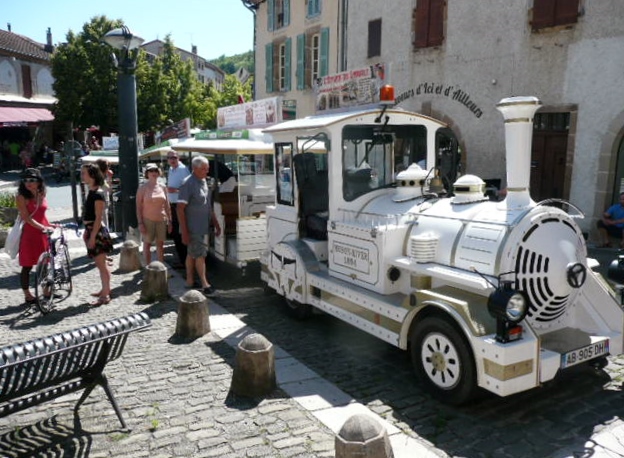
The Little Tourist Train at Cordes-sur-Ciel
We are on the Little Train – the tourist train – that winds through the steep streets of Cordes-sur-Ciel and takes us almost to the main square right at the top of this remarkable hill top medieval town. We are sitting next to an elderly Australian couple who have a house here. They live here in Cordes for several months each year but also have a home in Oxford in the UK where they live for the rest of the year. They are a very interesting couple, Bruce Two (we already met another Australian called ‘Bruce’ on our campsite you will recall) and Mrs Bruce?! Julia tells them that we are taking the Little Train because her husband has ‘old knees’. Bruce Two sympathises and we agree that it is all due to all the sport we both played when we were younger. He tells me that he was an ‘A’ grade elite athlete – like all Australians – ‘A’ grade in sport and bullsh*t!?
Bruce Two tells us an amusing story on the journey up to the top of Cordes. Apparently when the Tour de France came through Cordes a couple of years ago the local tourist board decided to make an English translation of the already existing Internet Guide to Cordes-sur-Ciel available. Unfortunately they used Google Translator to translate the French into English. As a result every time ‘Cordes’ cropped up it was translated as ‘String’?! You will be pleased to know that the error has now been corrected on the official Cordes-sur-Ciel webpage.
Bruce Two and Mrs Bruce clearly love Cordes … and so do we. We enjoyed our visit to the Saturday Market the first weekend we were here – even though it meant queuing for ages in order to avail ourselves of the excellent wares on sale at the fruit and veg stall! For a few moments I thought we were back in the UK – the queuing not the excellent fruit and veg? On a subsequent visit we once again took the Little Train to the top of Cordes and then wandered around the various sites and shops before walking back down the steep road to the market square. The views from the top of Cordes are amazing and so is it’s history.
Cordes-sur-Ciel occupies a remarkable site on the Puech de Mordagne rocky outcrop overlooking the CérouValley. The bright sunlight enhances the soft pink and grey hues of the old façades, and our first sight of the village, as we walked in to the supermarket, the day after our arrival was one of those ‘stop you in your tracks’ moments. Cordes was built as a fortified town in 1222 by the Count of Toulouse, Raymond VII, during the Albigensian Crusade against the Cathar heretics (as the Roman Catholic Church considered them), after Simon de Montfort’s troops destroyed the stronghold of St Marcel. Cordes became a refuge for the Cathars until the Inquisition finally put an end to their stay there – although not until after the local people had thrown two of the Inquisitors down a well!?
The end of the Cathar disturbances brought prosperity to the town and leather and cloth trades flourished in the 14th century with locally cultivated linen and hemp, blue dyer’s woad and saffron. The beautiful houses that date from this period bear witness to it’s wealth at this time. The Wars of Religion and two periods of serious plague brought an end to this period of prosperity and essentially Cordes fell into decline until the early 20th century. In 1923 artists and craftsmen campaigned for the preservation of Cordes’ Gothic houses and this put the town back on the map. In the 1970s Cordes became a musical venue and today the town’s beautiful old houses that line the winding cobbled streets are home to enamellers, sculptors, weavers, engravers, and painters. We love it here – the town, our campsite nearby, the friendly people and amazing characters – we will certainly return here in the future. For us it has struck chords of love!
Jim Binney
ANOTHER BRICK IN THE WALL

Albi Cathedral
We round the bend in the road and there is Albi lying in the plain before us, the Cathedral dominating the city. It is very impressive, even more so when we actually drive into Albi itself and cross the main bridge over the River Tarn with its amazing view of the Cathedral and the Bishop’s Palace. The brick built Cathedral – the largest brick built building in the world we are led to believe – seems to glow pink and red in the bright sunlight. Even Pink Floyd would be impressed!
Albi Cathedral, formally the Cathedral of Saint Cecilia is the most important religious building in Albi, and the seat of the Archbishop of Albi. First built as a fortress the Gothic Cathedral was constructed in brick between 1287 to 1480 in the wake of the Albigensian or Cathar heresy in the area. The French monarch and the Roman Catholic Church mounted a brutal crusade to suppress the Cathars, with great loss of life to the local population. In the aftermath of the bloodshed, the Cathedral’s dominant presence and fortress-like exterior were intended to convey the power and authority of Roman Catholicism. The instigator of the Cathedral’s construction was Bernard de Castanet, Bishop of Albi and Inquisitor of Languedoc.
As suitable building stone is not found locally, the Cathedral is built almost entirely of brick and notable architectural features include the bell-tower which is 256 ft tall, and an elaborate porch entered by a fortified stair, which is the primary entrance to the Cathedral rather than through the west front, as is traditional in France. The elaborate interior stands in stark contrast to the cathedral’s military exterior. The central ‘Chœur’ (reserved for members of the religious order) is surrounded by a roodscreen with detailed filigree stone work. Below the organ, a fresco of the Last Judgement (attributed to unknown Flemish painters) originally covered nearly the whole of the wall. Fascinatingly the central area of the fresco, featuring Christ presiding over the Last Judgment, was later removed in order to provide an entrance for another chapel?!
The main reason we have come to this part of France now, is to visit Albi Cathedral. We arrive in Albi early to enjoy the coolest part of the day before the blazing sunshine takes over and, having parked in the underground car park, we go and get some breakfast at a café by a fountain in the main square. After breakfast we are accosted by some French Communists who are distributing literature. One of them takes Julia on … what a chump?! Julia studied economics at university and is well versed in communist ideology as well as having a Master’s degree in theology. She patiently but eloquently explains to him that we are followers of Jesus (not Roman Catholics, who he has no time for) and that the only real way to change society for the better is to change the hearts of individuals through a living faith in Jesus Christ! He doesn’t quite know how to handle Julia … but we part on good terms!
Our plan is to look round the Cathedral and then visit the Toulouse Lautrec Museum which is situated next door in the old Bishop’s Palace. The Cathedral is amazing – even better than we had imagined it – and (with the aid of an excellent audio guide) we spend a good couple of hours exploring every nook and cranny. The commentary is fascinating. The English language version features an Irish person who sounds just like Henry Kelly … but what a lot of theological twaddle? Surely Roman Catholics don’t believe all this nonsense that ‘Henry’ is telling us they do? Certainly most of the Roman Catholic Christians we know personally are far more Bible based and Christ-centred and don’t subscribe to all this mumbo jumbo? After a couple of hours of listening to ‘Henry’s’ theological explanation of Roman Catholic beliefs we are not at all sure who are the biggest heretics – the Cathars or the Roman Catholics?
After our tour of the Cathedral we have lunch in one of the several restaurants by the Cathedral … and an excellent lunch it is! Suitably ‘fortified’ (do you see what I did there?) we then take ourselves off to the Toulouse Lautrec Museum. Toulouse Lautrec was born in Albi and after his death in 1901 his mother gave many of his paintings (the Paris Art Galleries seemingly didn’t want them) to the city of Albi who just happened to have the space (the old Bishop’s Palace) to house them. It is a wonderful exhibition and we enjoyed another hour or two wandering around the various rooms displaying his paintings and exhibitions detailing his life. We then enjoy a delightful walk through the Bishop’s Palace Gardens that border the River Tarn, before returning to our car for the drive home.
There is just time (says Julia) to fit in a another church on the way back to the car park. The church itself is not very special but it does have a delightful cloistered garden. This is obviously a place where young people gather during the day, and homeless people gather at night. There are lots of young couples sitting around in the sunshine. On the way out I spot a notice pinned to a wall in the covered porch by the entrance to the church. It is clearly the place where homeless people spend the night sheltering from the cold. The notice asks these homeless people to please not pee in the holy water trough, situated by the entrance to the church itself, because devout believers who come to pray usually wash their hands and faces in the said trough before going inside to pray! We are still laughing at this all the way home, even it was a somewhat down to earth end to an otherwise uplifting day!
Jim Binney

