Leave a comment

ON BEING FAMOUS? (Pottering in Paris 3)


image

Today is our first attempt at a major excursion – well major for us that is – venturing out to visit some of the famous sites of Paris we have come here to see. Julia had a plan – she usually has – which involves taking the Metro out to the Église Étienne du Mont (the setting for one of our favourite movies), followed by a walk past the Pantheon, through the University district to the Jardin du Luxembourg, and then on to the Cluny Museum, ending up at Notre Dame. Fortunately, we are allowed to stop for morning coffee … and a picnic lunch (as long as it is somewhere on the banks of the River Seine). I feel exhausted already … and we haven’t even started yet? Despite the lovely sunshine of the previous few days, Julia is insistent that the weather is going to change drastically today … cold and wet at least (and probably gales, snow, typhoons … you name it)?! Consequently, I am wearing my warmest clothing including thermal underwear, hat, scarf and gloves, as well as my raincoat?! She has my best interests at ‘heart’ of course (did you see the joke there?) so I willingly comply!

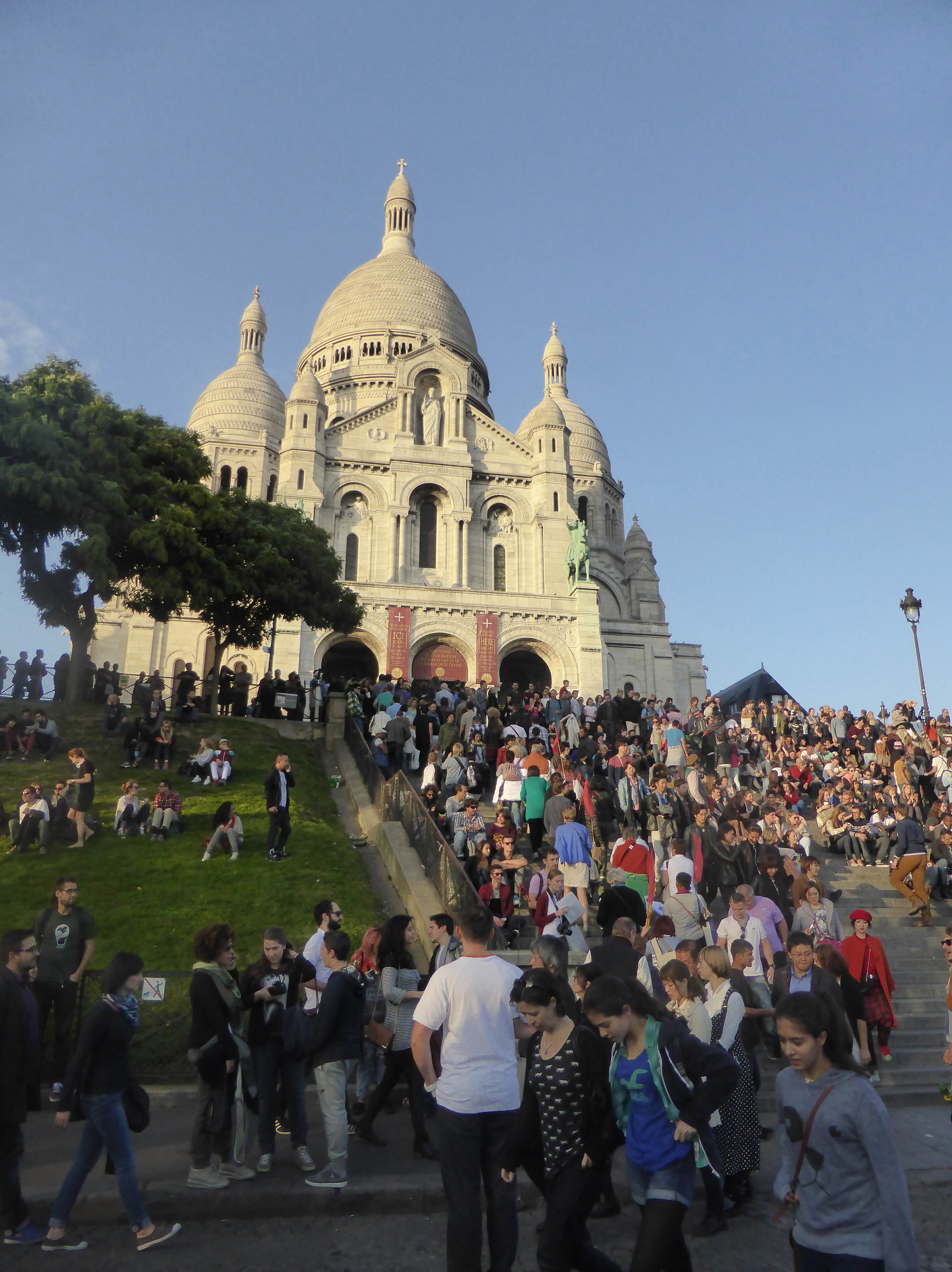
Yesterday we stayed local and explored our bit of Montmartre, wandering up to the Sacré-Cœur through the artists’ quarter, and simply enjoying the ambience of the the area and the spectacular views from the Sacré-Cœur. I think that if I lived anywhere in Paris, I would live in Montmartre which in many respects it is a village in its own right. But today is very different. We walk down the steep steps to the Abbess, our local stop on the Metro, and go down to catch our train. There is a female violinist busking on the platform opposite. The music is spellbindingly beautiful. We wonder if she is famous since there is a bit of a trend these days, we gather, for ‘famous classical musicians’ to go busking. For the most part the majority of people ignore them, apparently? We sit and enjoy the music before getting on our train. We have only travelled a couple of stops when another busker gets on and starts playing to us – another accordion player of course – not quite as good (or as famous) as the violinist but quite jolly. The other passengers don’t seem very keen on him – he is making it difficult for them to listen to their own music through their headphones. We now realise why the majority of French people on the Metro wear the giant headphones that seem to be all the rage in Paris at the moment?!

We leave the Metro at Cardinal Lemoine and find our way to Église St Étienne du Mont, situated near the Panthéon. It is a spectacular building and contains the shrine of St. Geneviève, one of the two patron saint of Paris and the tombs of Blaise Pascal and Jean Racine. Jean-Paul Marat is buried in the church’s cemetery. But we are not primarily here to see the tombs of these famous people?! No! We are here to see the famous steps that play a key part in Woody Allen’s film Midnight in Paris! This is one of our favourite movies. In the film a mismatched couple engaged to be married go to Paris for a vacation. Aspiring novelist Gil Pender spends his nights falling in love with the city, while his fiancee Inez, criticises his dreams. One night as the clock strikes 12, whilst Pender is sitting forlornly on the steps of the Église St Étienne du Mont, he is transported back to the 1920s (his favourite era), meeting Ernest Hemingway, Scott and Zelda Fitzgerald, Gertrude Stein, Pablo Picasso, and many others. I won’t spoil it for you by telling you the rest of the story – get the DVD and watch for yourself!

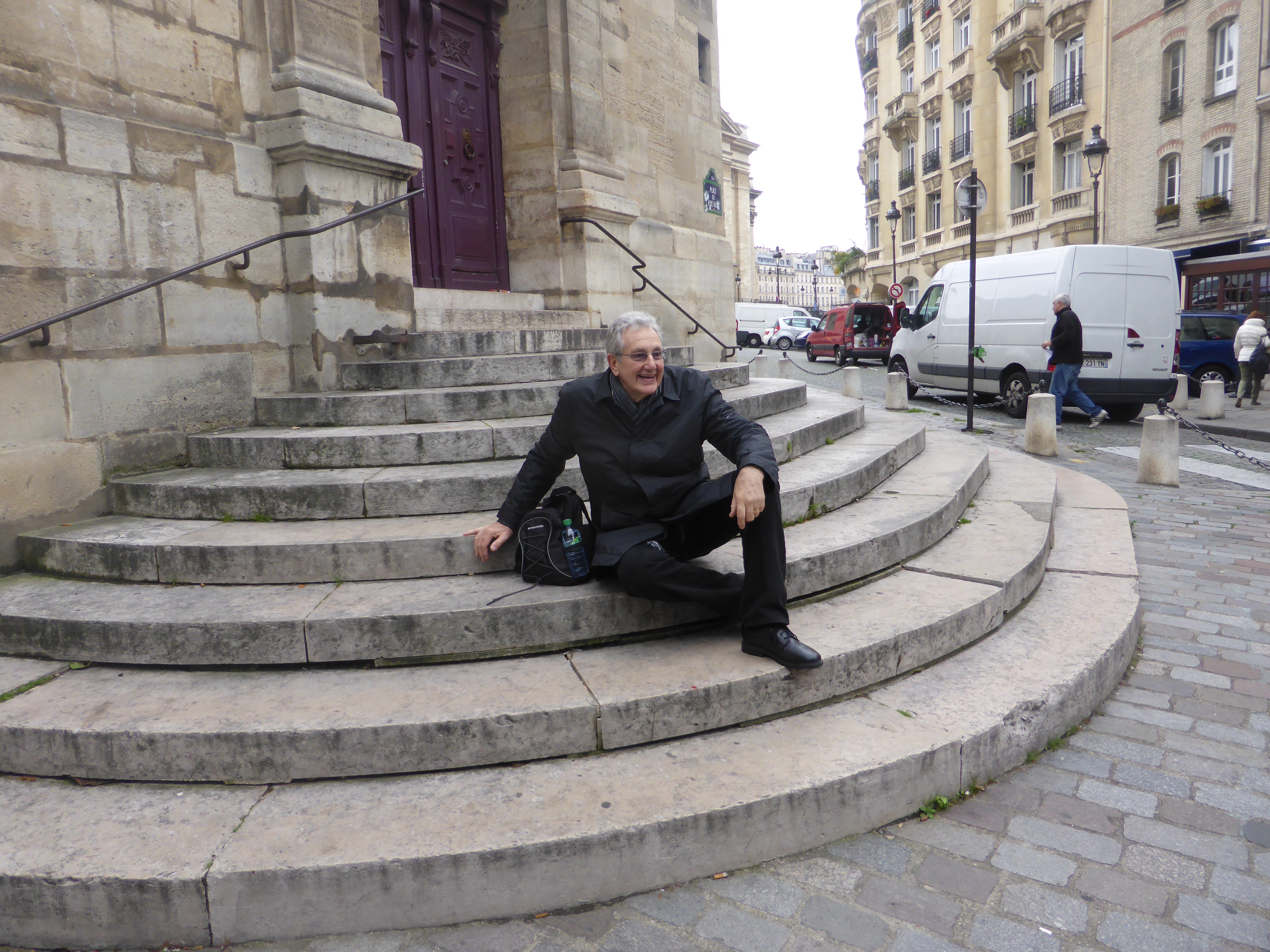
We find the church, and before we look around, we go and sit on the steps in the very place where Gil Pender sat in the movie. Julia is taking my photograph when a tour party of Americans walk by. They stop and wonder what we are doing. I explain that we are re-enacting a key scene from Woody Allen’s film Midnight in Paris and that these steps play a central part in the film … and suddenly I am surrounded by American tourists all taking photographs of me?! I guess that I will soon be famous myself … on numerous Facebook pages across the USA?!

We finally manage to extricate ourselves from the midst of these admiring Americans and go and look round the church. It is very impressive and contains a relic of Sainte Genevieve – a finger bone?! We leave the church and walk through the University area, eventually finding our way, via the beautiful Jardin du Luxembourg, to the magnificent church of Notre Dame. Julia had planned for us to visit the Cluny Museum en route, but when we get there we discover that (contrary to the Guide Book) it is closed on a Tuesday, so we will have to come back another day. I can’t say I’m sorry about this – the weather is absolutely wonderful and I am getting hotter and hotter with all these clothes on. We stop for a picnic by the Seine and then it is off to Notre Dame. Notre Dame is also very impressive – the wonderful square outside with its great views of the facade of the church, and on the inside with its amazing rose window. We spend a very pleasant hour or so wandering around, taking in all the wonderful sites and sounds to be found in the church and its environs.

Eventually it is time to return to our wonderful shabby-chic studio in Montmartre, so we go to the Metro. We have become used to the numerous buskers performing on the streets, in the stations, and on the trains themselves … but today we witness something rather special. In the walkway to our platform the next best thing to a whole orchestra are busking. Now, they must be ‘famous’ judging by the size of the orchestra, the crowds stopping to listen, and the Gendarmes out in forces to keep order – the Paris Philharmonic or something of that nature!? They are wonderful and we nearly miss our train because we too have stopped to listen! We are still hearing the wonderful music in our heads as we board our train. A few stops further on another busker, with an accordion, gets on and starts playing? It’s not quite the same!

Jim Binney


Leave a comment

PEOPLE AND PARROTS (Pottering in Paris 2)

Sacre-Coeur

Sacre-Coeur

It is the second day of our two week holiday in Paris, France. Yesterday was wonderfully warm and sunny when we arrived at Gare du Nord, and the streets of Monmartre were packed with people – Parisians and tourists – out enjoying what was forecast to be the last Sunny day for some time. The Basilica of the Sacred Heart of Paris, commonly known as Sacré-Cœur Basilica and often simply Sacré-Cœur was as striking as we remembered it from last time we were here 10 years ago. A popular landmark, the basilica is located at the summit of the butte Montmartre, the highest point in the city. Yesterday Sacré-Cœur was packed with people sitting on the grass around the church, climbing the escalliers, queuing for the funicular railway, or browsing the numerous shops. Last time we were here there was a Service on a Saturday evening led by Nuns. It was absolutely beautiful and we hope that there will be something similar again while we are here in Monmartre.

After we had found our way to our studio flat, we unpacked and Julia then went to explore Sacré-Cœur while I had a rest. It was so crowded that Julia left going into the church until later in the week when hopefully a lot of the tourists will have gone home and the locals will be back at work. In the meantime there was shopping to be done, so it was off to find the local supermarket. An hour later we struggled back with our shopping bags full to overflowing. Needless to say Julia managed to find a bag and scarf shop on the way?! She was very disciplined, however, and didn’t buy anything although I suspect she has got her eye on something – probably another scarf – and we will just happen to pass the shop again later in the week? We decide to eat in and enjoy a sumptuous meal … with a different glass of wine for each course?!

Today, we wake up after a good night’s sleep, and after an excellent breakfast – fruit, eggs, wonderful French bread and jam, and coffee of course – head for the Metro! According to the weather forecast it is supposed to be cold and wet … in reality it is another lovely warm and sunny day! We are off to Saint Michael’s Church (which is part of the Anglican Chaplaincy) for their 11.15 a.m. Service. Saint Michael’s is situated in the Embassy District of Paris, near the Madeleine. Julia found the Church on the Internet a few weeks ago when she was searching for somewhere for us to worship while we were in Paris. Fascinatingly, a couple of weeks later, when we were visiting a church in Warwickshire for initial conversations concerning the vacant Pastorate there, we met a chap in the church whose daughter, Natalie, was the Children, Youth and Students’ Worker at Saint Michael’s. Apparently she had read Julia’s profile and had encouraged the church in question to seriously consider her?! Although nothing actually came of our visit to Warwickshire in the end, Julia struck up an email friendship with Natalie and we have arranged to meet up with her while we are in Paris and ‘do lunch’ together.

The Paris Metro (like the London Tube) is wonderful and easy to use – once we have managed to grasp the ticketing system. The ornate entrances to many of the stations are themselves beautiful works of art. We walk to our local Metro station – Abbess – and board a train to Madeleine. It is only a few stops along the line, but time for both a busker and a train evangelist to board our carriage?! The buskers playing on the Paris Metro is not unusual. This one is playing an accordion. I am tempted to request ‘Swing Low Sweet Chariot’ (Rugby enthusiasts will understand this) .. but manage to resist the temptation. No sooner does the busker move on to another carriage, than he is replaced by a train evangelist!? He wanders down the carriage ‘shouting the Good News’ at us! He too is ignored! He is somewhat of a scruffy individual and his appearance and manner doesn’t really enhance the Gospel. I am tempted to ask him, ‘Avez-vous le secret du bonheur?’ … but he is moving so fast I don’t have time to stop him. Perhaps the reason he is moving so quickly is that he is afraid someone will actually want to stop him and ask some pertinent question?

We alight from the Metro and go for a coffee because we are early. Our coffees cost us a fortune … well it is Paris after all – but we enjoy sitting in the warm sunshine watching the world go by. We eventually find our way to Saint Michael’s – it looks like an office block rather than a church, but the interior is lovely and the welcome is warm. The Senior Chaplain, Alyson, hails from Holy Trinity Brompton originally (the ‘mother ship’ she calls it) and is one of those wonderfully precious HTB types. We love her immediately and she leads the worship meaningfully with humour and engagement. Alyson announces the result of the church’s recent Gift Day – a staggering 147,000€ – quite a difference from the usual £6,000 or so usually raised in British Baptist Churches?! The music is good, Natalie and her helpers lead a wonderful children’s spot, and the Assistant Chaplain, John, preaches an excellent sermon (from the Book of Nehemiah) about making meaningful promises! The Service concludes with Holy Communion (with wonderful French wafers and wine) and we all leave feeling that we have received something from God, and inspired for the week ahead. Natalie takes us to a nearby restaurant where we enjoy a nice meal together and an opportunity to get to know each other better. She is a lovely person and we feel that – if nothing else came out of our visit to Warwickshire a few weeks ago – we have made a new friend.

On our way back to our flat, Julia and I are still laughing at the story about a parrot John used to introduce the theme of his sermon. It goes something like this: A certain man inherits a parrot. It is rather a nice parrot but unfortunately uses a lot of bad language. The man tries everything he knows – reason, bribery, threats – to persuade the parrot to change his ways, but all to no avail. Eventually – when the man has exhausted all other means, he loses his temper completely and, grabbing hold of the parrot, takes it into the kitchen and throws it into the freezer, slamming the freezer door tight shut. He hears the parrot squawking and swearing and banging about inside the freezer for a time … and then suddenly everything goes ominously quiet!? After a few minutes the man begins to feel rather guilty! He wonders if he has actually caused the parrot’s demise? He opens the door of the freezer and to his surprise finds the parrot quietly sitting there very thoughtfully. The parrot hops on to his arm, very subdued and repentant, and apologises for all its previous bad behaviour, and solemnly promises to be better behaved in the future! ‘I have just one question’ says the parrot,  ‘… whatever did the chicken do?’

Jim Binney

Leave a comment

TRAFFIC JAMS AND TERRORISM (Pottering in Paris 1)

image

It is the 1st November and Julia and I on our way to France to potter about Paris for a whole two weeks!? In response to numerous requests I am once again blogging whilst we are away. Quite unexpectedly we have managed to squeeze this trip into our ‘busy schedule’ following my recovery from major heart surgery earlier in the year. In preparation we have been watching various films featuring Paris on DVD, including one of my favourite films – Woody Allan’s Midnight in Paris. It is a great film, by the way, and well worth getting hold of on DVD and having a look! I will not be attempting to ‘live out’ the story line by the way. As chance has it, I will be celebrating my birthday whilst here in Paris, but at 71 years of age I prefer to be tucked up in bed by 10.30 p.m., so Midday in Paris it is more likely to be for us?!

We left home early yesterday morning and drove up to Ashford in order to catch the Eurostar direct to Paris the following morning. The drive was a nightmare – they sometimes talk about the M25 being the biggest carpark in the UK – well yesterday the M27, M3 and the M25 formed one gigantic car park with half-term holiday makers returning home a day early from the West Country. After several hours crawling along the various motorways we eventually arrived at our hotel in Ashford. Once again we are staying at a Premier Inn – we do like these hotels – and after a somewhat ‘choppy night’ (obviously too excited about actually managing to get our ‘French fix’ in after all this year) we drove to the Ashford International Station car park (where we were leaving our car for two weeks) and found our way to Passport Control!

And what a palaver! Julia set the alarm off for no obvious reason, whereas I got through o.k. despite all the metal inside me after my bypass operation? Well, I thought I had got through customs o.k. … only to be suddenly surrounded by several customs officials who wanted to know why I was carrying a ‘dangerous weapon’ in my suitcase?! This ‘dangerous weapon’ turned out to be my French ‘pocket knife’ – the kind that the majority of French men carry around with them on a daily basis – which they constantly use for cutting bread, and cheese and apples, etc. I bought mine in France several years ago and have taken it back and forwards with me to and from France since then. Nevertheless, I was told by the customs officials that they would have to confiscate it because it was over three inches long? I was told that I was fortunate not to be arrested because it was a criminal offence to carry such a ‘dangerous weapon’ (even though it was folded up and in a button down sheath and in the bottom of my suitcase?! I expressed surprise at this, since just about every man in France carries one all the time? The customs officials conceded this and allowed Julia to run back to our car and secrete said knife in the glove compartment?! Since my heart operation Julia doesn’t allow me to do anything ‘energetic’ so I had to sit and wait for her to return to the customs hall. Perhaps it was the innocent, angelic look on my face that persuaded these officious officials that even though my Passport states that I am a ‘Reverend Gentleman’, this does not mean that, ipso facto, I am therefore a ‘fundamentalist religious terrorist’ intent on knifing everyone on board the Eurostar to death?! After 10 minutes Julia returned … setting off the alarm system once again?! It must be her magnetic personality? And we eventually park ourselves on some seats and wait for our train to arrive.

There are hundreds of school kids also waiting for the same train? They are either French kids returning from an educational visit to the UK … or British kids on the way to France for an educational visit? Ourselves … and all the remaining adults are looking panic stricken at the thought of being stuck in a carriage with these hordes of screaming school kids?! Fortunately, the train is segregated into numbered compartments and we are in a ‘school kid free’ compartment. The journey takes under two hours and we soon find ourselves in the impressive Gare du Nord station in Paris. Whilst we are pouring over our map of Paris a young Muslim woman in a hijab comes sprinting past … pursued by a somewhat portly French station official?! Does she have a French clasp knife hidden in her purse? Is she a suspected terrorist? Is she a pickpocket … there are lots about we are told? Is it because she was wearing a hijab … the French don’t like them, you know? Whatever … it is no contest … youth and energy win the day, and the young lady leaves the portly French official panting for breath as she exits the station at speed!?

We decide to walk to our studio apartment. We reckon it is only about half a mile from the station. It is situated in Montmartre, literally ‘a stone’s throw’ from the impressive Basilica of the Sacre-Coeur set at the summit of the famous ‘escalliers’ (or steps) of Monmartre. Needless to say we ‘take the long way round’ – not helped by the fact that our map is too small, and the street our studio flat is supposed to be situated in has at last three different names? We eventually find our way, however. The flat is wonderfully quirky, full of weird furniture, and wonderfully painted walls. It belongs to an artist, Fabienne (who lives just round the corner) … quelle surprise? We just love it, however! It has a beautiful courtyard and wonderful big windows overlooking the garden. Maya, who lives next door and looks after the property for Fabienne, lets us in and explains how everything works. She doesn’t speak any English but we get by with our usual mix of French and Franglais?! We have been doing the Duolingo conversational French course on our iPads. As a result we can now both talk eloquently in French about ‘how a duck’s wife can drink wine and eat cheese and apples whilst wearing a pair of jeans and and a dress’?! It’s not much use?!

Jim Binney

Leave a comment

GODLY PRESUMPTION

Godly Presumption

Godly Presumption

I never really achieved my potential when I was at school, or even at college. I scraped through my 11+ exam and got to Grammar School but did really badly there. The first time I took my ‘O’ Level exams I only passed one – in Art – and had to ‘re-do’ the 5th Year. The only thing I ever got ‘Excellent’ for on my School Report was Sport … but every Report also said ‘This boy has ability … if only he would make use of it!?’ Even after I became a Christian, eventually scraping together a few more ‘O’ Levels and even an ‘A’ Level and ultimately gaining a place at Spurgeon’s College to train for the Baptist Ministry, I continued to struggle academically. It took me a long time to actually put my finger on exactly ‘Why’ this was? Most certainly I suffered from some kind of ‘inferiority complex’. I was very conscious of other people, and felt that everyone looked down on me and, that as far as the overwhelming majority were concerned, I just didn’t ‘measure up’ to what was expected of me?! Despite being tall, and seemingly very outward going, I was actually quite shy and self-conscious. My outward bravado at the time was essentially a cover-up for how I really felt about myself. I felt that no one really understood me, I feared failure and at the same time believed that failure on my part was inevitable!?

On reflection – and it much easier to see this looking back – much of this negativity stemmed from being an only child and the pressure to succeed that my father put on me from a very early age. Although I am now seen as a ‘glass half full’ person – indeed it has been suggested more than once that I am actually a ‘glass completely full and overflowing’ person – as a child I was definitely a ‘glass half empty’ person. As an only child both my parents doted on me, and my father especially was desperate for me to succeed. He married late – well into his 40s – and wanted me to achieve what he himself had failed to achieve. My father was an intelligent man. He spent 15 years in the army, running away from home at the age of 14, lying about his age, and enlisting in 1914. He fought throughout WWI and then served in India for ten years before returning to the UK. During his latter years in the army he taught Maths and English to his fellow soldiers. He was widely read but had little or no formal qualifications. He worked as a builder and decorator but was a poor business man and, as a result, never achieved anything significant in life. I guess that he too felt the same kind of ‘failure’ that I felt from my childhood right up to early adulthood.

Despite being one of life’s ‘non-achievers’ my father was a good father in many ways. He, and my mother, sacrificed a lot financially to help me ‘achieve’ his ambitions for me – buying me books and encyclopaedias to hopefully help me learn, sending me on ‘foreign holidays’ abroad with the school to increase my understanding of the world, and so on. One of my real regrets in life is that I did not spend enough time with my father when he was alive (he died when I was 23) just really getting to know him? Sadly, one of the ‘spin offs’ of becoming a Christian in my mid-teens was that (like a lot of evangelical Christians in those days) I spent so much time either at church, or doing ‘church things’, that I neglected to spend quality time with my parents? I was ‘too holy’ to even go down the pub with my father on a Sunday lunch time for a drink and a chat? I really regret those ‘wasted opportunities’ now, and would do things very differently today if I had that time all over again. Fortunately my mother lived for another ten years, after my father died, and I was able to spend quality time with her and as a result (despite the fact that she too had no formal qualifications) found her to be a very kind, supportive, caring, and very wise person!

Perhaps because my father felt that he had under-achieved in life himself, he saw in me an opportunity to redeem himself, to live the kind of life he had really wanted to have through me. Consequently, from a very early age he put constant pressure on me to achieve. In fairness to him, his efforts were not entirely unsuccessful. He did teach me to read from a very young age, and instilled in me a love of good books which I retain to this day. He did coach me in various sports which enabled me to play both cricket and football to a reasonably high amateur standard. But in reality the negatives outweighed the positives. He tried to teach me Maths, but his methods clashed with the way the school taught Maths, which resulted in total confusion for me? He put pressure on the school to put pressure on me to do better than I was doing in his eyes. At Junior School level this appeared to be successful because I passed my 11+ Exam and got a place at Grammar School. It was just the local Grammar School, however, and not the ‘highfalutin tooting’ Grammar School that he really wanted me to go to? The reality was that I failed to get a place at either his first or even second choice of Grammar School? This, in itself, was highly embarrassing for me because my father made no secret of his feelings on the matter, whereas the reality was that I was probably fortunate to scrape into his third choice of Grammar School?!  On reflection, I would probably have been better off going to the local Technical School rather than a Grammar School since, like my father, I have always been good at DIY? At Grammar School my father’s ‘interventions’ on my behalf were even more embarrassing – excruciatingly so at times – because I was clearly struggling academically, and my father’s expectations of me only served to make me worse rather than better?!

Before you start to feel too sorry for me, however, I have to say that since leaving school I have actually done quite well academically. I have proved to be what is ubiquitously termed ‘a late developer’. Over the years I have gained a Bachelor’s Degree in Theology, two Master’s Degrees in Applied Theology, and Philosophy, and am about to commence further study for a Doctorate. To be honest, the old way of education, prevalent in the 1950s and 60s, with its total emphasis on learning by rote and written examinations, did not suit me at all. I just didn’t have the kind of mind that could retain facts like that. But the subsequent switch to modular education, with its emphasis on thoughtful research, suits me right down to the ground. Perhaps whoever it was who used to write on my School Reports back in them late 1950s, ‘This boy has ability … if only he would make use of it!’ had a prophetic gift?

Nevertheless, right from childhood, through secondary schooling, during my short career at Taylor Woodrow as a ‘trainee draughtsman’ after leaving Secondary School, and even including my years at Spurgeon’s College, my father’s legacy to me was an over-bearing sense of inadequacy, inability, and impending failure just around the next corner?! Consequently I struggled at school, at work, and in college. My feelings of inadequacy appeared to be repeatedly reinforced by others – teachers and class mates at school, colleagues at work, members of the Faculty and fellow students at college?! Now, I am sure that a lot of this was in my imagination. Not all my teachers and tutors, school and college friends, saw me in this light – although some did. Nevertheless this is how I felt … and it deeply affected me and held me back because I allowed it to become my ‘default position’ in life!?

One day towards the end of my time at Spurgeon’s – I cannot recall exactly when – I was spending time in prayer, when I distinctly heard God say to me, ‘Look, it doesn’t matter what other people think of you … all that matters is what I think of you!’ For me it was a kairos moment when, like Elijah of old, God spoke to me in ‘a still small voice’ (1 Kings 19:11-13), a moment in which everything changed. Perhaps for many of you reading this blog, the truth of what I am saying here is obvious!? You have always known that what other people think of us is not really that important, and that what really matters is what God thinks of us? Well, for me, this was a revelation. It was a shaft of light suddenly breaking into my darkness, and what I previously had been totally ignorant of suddenly became blatantly obvious.

Furthermore, I came to see – and this seeing has grown over the years – that God is for us and not against us! It is one thing to recognise that what God thinks of us is the really important thing, rather than what other people (or even we ourselves) think of us, but it is also important to have a right view of the God to whom we do have to give account. Two very important inter-connected theological questions we need to constantly ask ourselves – and we all ‘do theology’ of one kind or another – are ‘What kind of God?’ do I believe in, and ‘So what?’ If the God we believe in is a harsh, judgmental, always intent on punishing us, kind of God, then we are no better off? Whether we condemn ourselves, or feel condemned by others, or condemned by ‘our kind of God’ … we stand condemned!?

I was brought up in a Roman Catholic home – my mother worked for a Roman Catholic family and we had rooms in the house – and the Catholicism I was exposed to seemed to me to be very hard and harsh. The Church ruled through instilling ‘the fear of God’ into the hearts of the people. I know all Roman Catholics are not like this – but this was my initial experience of Catholicism at that time. Even when I eventually committed my life to Christ as a teenager – and began to see God in a new light – I soon became very influenced by a stringent form of ‘Calvinism’ whose God seemed to me to be every bit as hard, harsh and judgmental as the God of the Catholicism I had previously experienced? Consequently, my feelings of personal uselessness, and impending failure were both affirmed and compounded! For me, then, it was important not only to realise that what God thought of me was more important than what other people thought of me, or even what I thought of myself, but also to come to see God in a new light. To see God for who he really is – loving, gracious, kind, merciful, forgiving, constantly longing to draw us to himself in a meaningful way – and not the harsh, critical, judgmental God whose seemingly greatest pleasure is to punish us, with whom I had been presented!?

Now ‘hearing voices’ – even the so-called ‘voice of God’ is very dangerous. I am sure that God does speak to us in the quiet of our own hearts by his Spirit but any kind of ‘extra-biblical’ revelation needs to checked against the plain teaching of Scripture itself. Amongst my numerous friends in the social media I have a few who are always ‘publishing messages from God’ on their Facebook and Twitter pages for the benefit of the rest of us … and to be honest, for the most part, what they have to say is usually stark staring bonkers?! Fascinatingly, however, following this experience of God speaking directly to me in prayer, I found myself reading the Bible in a new light. Various verses and passages began to stand out to me in a new way, throwing new light onto my understanding of ‘What kind of God?’ and ‘So what?’ I began to see that God, the God of the Bible, the God of the New Testament, and particularly the Gospels – the God who especially reveals himself to us in the Person of Jesus – was loving, gracious, merciful, forgiving, restoring. A God who is very much ‘for us’ rather than ‘against us’!

God is a God who ‘loves the whole world’ not just a small number of select individuals, a God who, in the Person of Jesus, came into the world ‘not to condemn the world, but to save the world’ (John 3:16,17). God is a God who wants the very best for us. As the Apostle Paul tells us, ‘in everything God is working for the good of those who love him, who are called by him’ (Romans 8:28). Writing to his protégé Timothy, Paul tells us that ‘God desires everyone to be saved and brought to a knowledge of the truth’ (1 Timothy 2:4). The same Apostle also reminds us that God’s ‘grace is sufficient’ for every situation we face (2 Corinthians 12:9) and that we ‘can do everything through Christ who strengthens us’ (Philippians 4:13). The Writer to the Hebrews tells us that we can ‘come confidently into God’s presence and that we will find grace and mercy there to meet our every need’ (Hebrews 4:16). These are just a few examples of Scriptures that illustrate that God is a kind, gracious, loving, merciful God who is ‘on our side’, always wants the best for us, and is always for us not against us! The more I read my Bible – even to this day – the more I see that this is the kind of God the Bible portrays for us!

Consequently, my ‘default position’ in life has radically changed. I now live each day with a ‘Godly presumption’ that God is for me and not against me, and that I can venture out into each new day confident that not only is God with me but that he has also gone ahead of me. I go out expecting to both be taught new things in God and be used by God to glorify him and bless others. I presume that, because of all that God has already done for me in Christ, I am right with God and can be used by him. I know that I am not perfect, and that from time to time I fail, but I believe that if I am at any time ‘out of step with God’ the Holy Spirit will ‘convict’ me of that, help me to put things right, and get back on track (John 16:8). To be constantly looking over my shoulder, or hiding under the bedclothes, just in case I take a wrong step and offend God or grieve the Holy Spirit, is no longer my ‘default position’. Rather, my new ‘default position’ is to go out into each new day recognising that God is both for me, and with me, and that ‘I can do all things through Christ who strengthens me’ (Philippians 4:13)! I pray believing that God both hears and answers my prayers, not because I am righteous in and of myself but because Christ has made me righteous in God’s sight (James 5:16). I can preach, teach, and speak to others believing that God will take my words and enable me to ‘speak as though God himself were speaking through’ me (1 Peter 4:11)!

Of course it has taken time for this truth to ‘sink in’ with me. I am still surrounded by numerous voices – both outside and (sadly) inside the Church – that constantly seek to make me feel bad and negative about myself. Daily, I have to remind myself of who I am in God – that I am ‘raised with Christ and seated with him in heavenly places’ (Ephesians 2:6), that in Christ ‘I already have everything I need for living a Godly life’ (2 Peter 1:3), that ‘I can do all things through Christ who strengthens me’ (Philippians 4:13), and that ‘there is therefore no condemnation for those who are in Christ Jesus’ (Romans 8:1)! There will always be those who ‘write us off’ or ‘put us down’ – even in Christian circles? There will always be the ‘You suck … try harder!’ type of preaching that makes us feel worse, rather than better, when we go to church? But thankfully there will always be those, who like Barnabas, encourage us to look to God rather than listen to negative men and women (Acts 4:36)!

When I was a Ministerial student at Spurgeon’s College back in the mid-1960s, the Student Chairman attempted to force us all to do physical exercises first thing in the morning (we nearly all lived in college in those days). It was a dismal failure – it lasted about two days, I recall?! I did learn one thing, however, from all the reaching and bending and stretching we were supposed to do. In God ‘Up-reach and Out-reach, are much healthier than In-reach and Down-reach’! We are so much the better for looking up to God, and out to others, rather than looking in to ourselves and then getting down about ourselves as a result!?

Jim Binney  
1 Comment

WALKING ON WALLS

Walking on Walls

Walking on Walls

Beckenham Baptist Church (where Julia and I were the Pastors from 2004-2010) has a low brick wall, about two feet high, running the length of one side of the building, separating the pavement from a narrow strip of garden bordering the church car park. For generations this has been known as the ‘walking wall’ since small children – on the way to the Church Pre-School or the local Primary School – have climbed up and walked along it. Parents (and even some grandparents) have confessed to me that they too used to walk along it when they were little. A few fuddy-duddies in the church objected to this practice – the children will tread on the flowers, etc – and wanted the wall removed, but for the majority of us, seeing the children walking on the wall was a delight! During our time in Beckenham I had many a good conversation with parents, guardians or au-pairs which ensued as a result of a friendly response on my part to their children walking on the wall? Some of these conversations led to people actually opening up about their problems and needs, and even to some starting to attend our various organisations and Family Services.

I have to confess that as a youngster myself, I too really enjoyed walking on walls. When I was around nine or ten years of age we lived in the London suburb of Ealing. There was a large Methodist Church at the top of our road which had a high wall around three sides of it. My friends and I loved walking on this wall. The real challenge was to get right round the three sides without the church caretaker catching you – the back wall went right along the side of his house. I went back there a few years ago – to show Julia where I used to live – and I was severely tempted to go and walk round the wall once again?!

There is a story told of three boys who also loved walking on walls. Their names were Facts, Faith and Feelings. Facts was very good at walking on walls so he usually went first. Feelings was the worst at walking on walls so he normally went last. Faith was also o.k. at walking on walls – as long as he kept his eyes on Facts. But if he took his eyes off Facts, and looked back to see how Feelings was doing, he fell off the wall … and Feelings fell off with him!?

For a number of years now I have been concerned at the growing number of professing Christians I know, whose faith seems to crumble with the slightest knock or upset. They are ‘up’ one minute, and ‘down’ the next. Full of enthusiasm for short periods, only for that sudden burst of enthusiasm to dissipate into much longer periods of doubt and despair. Now I know that there are those who genuinely suffer from depressive illness and who fight a daily battle to stay on top of things – I am not speaking here of them. Neither am I thinking of those who have ‘honest doubts’ and who, like ‘Doubting’ Thomas, question things in the search for honest answers. We do, of course have to distinguish between what we might call ‘honest doubters’ – whose questioning is aimed at arriving eventually at the truth, and ‘dishonest doubters’ – those who simply are looking for excuses in order not to believe!?  I am thinking more of those who seem ruled by their emotions or feelings! Once again, I am not against showing emotion. As Christians it is good to be able to both laugh, and cry, on occasions. After all, it would be a poor marriage if that marriage contained no emotion whatsoever!?

My growing concern – and the problem seems to me to be worse these days – is the number of Christians who ‘live almost entirely on their feelings or emotions’. Everything depends on ‘if they feel good’ about themselves, or about life, or about church, or about worship, and so on. They are like the middle boy walking on the wall. Instead of keeping their eyes on the facts … they are all too often dwelling on, even driven by, their feelings. As long as they ‘feel’ God is near, or ‘feel’ they are loved, or ‘feel’ things are going swimmingly, or ‘feel’ that church is good at the moment, or ‘feel’ that the worship was amazing this Sunday, and so on … they are o.k. But when the ‘good feelings’ are no longer there … well, they and their ‘faith’ fall off the wall, and their ‘feelings’ fall off with them!?

Now ‘faith’ is a vital ingredient for each one of us – initially if we want to find God in a significant and meaningful way for ourselves personally, but also if we want to continue to know God in such a way and fulfil the rewarding plans and purposes that God has for each one of us in life! Jesus began his public ministry by calling people to repentance and faith – ‘the Kingdom of God is near! Repent of your sins and believe the Good News!’ (Mark 1:15). In many ways repentance and faith are the ‘head and tail’ of the same coin – you cannot really have one without the other. Biblically ‘repentance’ simply means ‘to stop, and then reverse direction’ rather than meaning that we have to ‘cringe’ before God or cover ourselves with sack cloth and ashes. It means to recognise that we are going in the wrong direction – away from God and his plans and purposes for us – and deliberately stop in our tracks, reverse direction, and start going God’s way! In much the same way, ‘faith’, according to the Bible, does not mean (as it often does in the English language) a sort of ‘hope for the best’, ‘fingers crossed’ approach, in terms of trusting a person or venturing into the future, but rather the New Testament word for ‘faith’ signifies ‘a confident trust that comes from knowing that our lives are held in the palm of God’s hand’!

Faith is essential for our salvation! When the Apostle Paul was supernaturally released from prison in Philippi – an event which shook his jailer to the very core of his being and caused him to cry out in desperation, ‘What must I do to be saved?’ (Acts 16:30) – Paul bluntly told him to ‘Believe in the Lord Jesus Christ and you will be saved!’ (Acts 16:31). In other words, ‘with confidence, put your trust (and your life) in the hands of the Lord Jesus Christ, who died and rose again for you, in order to secure your salvation’!

In much the same way, faith is essential for the Christian (and the church) if we are to continue to know God intimately and fulfil the plans and purposes he has for us in life! Jesus repeatedly exhorted and encouraged his disciples to continue in a life of faith – moment by moment trusting in God and in Jesus himself. One example of this is when Jesus, speaking to his disciples about the power of prayer, tells them that ‘Whatever you ask in prayer, you will receive, if you have faith’ (Mark 21:21,22). It is not so much the power of an isolated prayer that Jesus has in mind here, as the ongoing power of a prayerful life. Another example of the necessity of what we might call ‘a life of faithfulness’ rather than just ‘one off’ inspirational moments of faith, occurs when Jesus and his disciples are crossing the Sea of Galilee in a small fishing boat and a sudden violent storm breaks out (Mark 4:38-41). Despite the presence of Jesus in the boat the disciples panic, eliciting the response from Jesus, ‘Why are you so afraid – have you no faith?’ (v.40).

The problem of course, is not really an absence of faith but rather the direction of faith? Faith or trust is basically a very simple thing, and something we all demonstrate on a daily basis in one way or another – albeit that ‘faith’ being what we might call ‘human faith’ rather than the kind of confident faith or trust in a loving God described earlier. We trust in our family and friends, in the driver of the bus or train that takes us to work or the shops, in the doctor who prescribes medicine for us, in the bank who holds our account, and so on. When Jesus’ disciples, on one occasion, asked him to ‘increase their faith’ (Luke 17:5) he bluntly told them that they actually didn’t need more faith – ‘If you had faith as small as a mustard seed (the smallest known thing of the day), you could tell this mulberry tree to uproot itself and throw itself in the sea, and it would do just as you told it to’ (Luke 17:6)! The disciples problem was not that they didn’t have faith – even the small amount of faith they did have was sufficient to do amazing things – it was that they were not using it properly. They were looking inwards rather than looking to God!

What is important in life – especially the Christian Life – is to keep focussed of Jesus and the facts that are central to the Christian Faith and Life. When Jesus called Peter to get out of the boat and walk on the water towards him (Matthew 14:22-33) Peter was o.k. as long as he kept his eyes on Jesus. The moment he took his eyes off Jesus – and began to look at the wind and the waves and the fact that what he was doing just wasn’t logical – he began to sink! Now in fairness to Peter, he did far more walking than sinking! He had walked quite a way towards Jesus because when Peter began to sink, Jesus was able to reach out an grab him. Nevertheless, the point I am stressing here is that Peter was o.k. as long as he kept his eyes on Jesus! It was only as he did so that he was able to walk on the water of his circumstances!

I learned, a long time ago, that I wasn’t ‘saved’ because I ‘felt saved’ but because of the fact that Jesus had died on Calvary’s Cross for me, and risen from the dead for me … and for countless others who would turn in faith to him and put their trust and confidence, not in their feelings but, in Jesus Christ himself and his ‘finished work’ (John 19:30) on our behalf! God, in the Person of Jesus Christ, is always near – even when he doesn’t ‘feel’ near – because Jesus himself promised that he would ‘always be with us, right to the end of the age’ (Matthew 28:20). I know that I am never ‘out of my depth’ when it comes to anything God calls me to – not because I don’t ever feel ‘inadequate for the task’ (as I often do) but because (as the Apostle Paul discovered) ‘God’s grace is sufficient for my every need’ (2 Corinthians 12:9)! Even when I ‘screw up’ as a Christian I know that I can come back to God, and experience cleansing and restoration from him, because the Bible tells us that ‘God’s gifts and calling are irrevocable’ (Romans 11:29)! And so I could go on … the point being that we need to constantly look to the facts – what God has done for us in Jesus Christ, what the Bible repeatedly promises us – not to our feelings. Time we learned how to walk on walls!

Jim Binney

Leave a comment

FADS AND FANCIES … OR FRUITFULNESS?

The Next Big Thing

The Next Big Thing

Some years ago, a close friend of mine was the Assistant Minister of a large Baptist Church in the UK. Although he initially thought it both a privilege and an honour to be called to serve God in such a church, he soon found it to be a very frustrating experience. The Senior Minister – who was a very charismatic preacher, well known throughout the Baptist world and beyond – was essentially an ‘ideas man’. Now, in many ways, his ideas were very good ideas. They were designed to grow the church both numerically and spiritually. The problem was that these ‘ideas’ simply poured out of him. No sooner had he promulgated one ‘visionary idea’ – that would without question ‘transform the church and the community’ – than he moved on to yet another idea. The problem for my friend was that the Senior Minister never saw any of these ideas through into something workable – he left all that to his Assistant Minister?! And there were so many ideas – every few weeks or months, yet another ‘God-given, concept’ that the church needed to respond to immediately if the church was to be ‘faithful to God’s vision for the church’ – that it was impossible for my friend, and the church, to see hardly any of these things through to something significant or even workable?!

Now, of course, there is a big difference between ‘good ideas and God-ideas’! Having known the Senior Minister in question, personally, for a number of years – he has since died and gone to Glory (where no doubt he is suggesting to God more effective ways of doing things?!) – I guess that he was not always capable of making this distinction between ‘good ideas and God-ideas’? I don’t mean to be judgmental in saying this, although I do believe we need to distinguish between ‘being judgmental’ and ‘making judgments’ – especially when it comes down to doctrine and direction promoted by influential people in the church. As an ‘ideas man’ myself it has taken me a long time to learn the difference between ‘good ideas’ and ‘God-ideas’, and even now I recognise the need to be prayerfully careful … after all, the first rule of theology is to always bear in mind the fact that ‘We could be wrong?’

There is a big difference between indulging in ‘fads and fancies’, in following the ‘latest evangelical or charismatic trend’, in ‘copying what the church down the road is successfully doing’ … and correctly discerning and fulfilling the genuine plan and purpose of God! I recall another prominent Baptist Minister confessing to me, some years ago, that he was pulled up short by one of his church members when the said church member said to him, ‘Well, Pastor, I have been Wagnered, Wimbered and Willow Creeked … what’s next?’ For those not familiar with these names – as an illustration of how quickly fads and fancies come and go in church life – Peter Wagner was one of the leading lights in the Church Growth Movement prominent from the 1970s onwards, John Wimber was the charismatic personality behind the Power Evangelism movement of the 1980s onwards, and Willow Creek was the American Church that advocated a multi-sensory approach to Seeker Services in the 1980s and 90s. Today, these ‘movements’ have, to a lesser or greater extent, declined in both prominence and influence … but they have been replaced by other popular churchy ‘trends’ such as the Alpha Course, Church Planting, Purpose Driven Church, and various ‘revival’ movements such as Revival Fires, and so on. Once again, I don’t want to be critical of either these older or newer movements. The Church Growth Movement, Power Evangelism, and Willow Creek inspired some people and churches to both ‘think outside the box’ and to attempt to move forward in new directions. For some individuals and churches this resulted in spiritual and (in the case of local churches) numerical growth, although I suspect that in the majority of cases the result was frustration and failure!? Equally, there is a lot to be said for the current movements. The Alpha Course, in particular, has proved to be very successful – although I suspect that the number of churches using it is now on the wane – as an ‘evangelistic tool’. The Church Planting trend has produced as many failures as successes, Rick Warren’s Purpose Driven Church approach probably works better in the USA than in the UK, and the various ‘revival movements’ tend to be very introspective and come and go with regularity and with little sign of producing any genuine nationwide Revival! For me, however, the bigger problem is not primarily the various ‘movements’ themselves – this trend will probably continue to happen until the day Jesus Christ returns again – but the way in which individual Christians and local churches ‘buy into’ such movements, without seemingly much thought and prayer, as some kind of ‘quick fix’ for their current dilemma, whatever that particular dilemma of the moment may be. All too often the reality is that we are simply indulging in ‘fads and fancies’, or following the ‘latest evangelical or charismatic trend’, or just ‘copying what the church down the road is successfully doing’?!

Encouragingly – because it shows that we are not just ‘bonkers’ – even powerful, prominent, gifted, charismatic, influential Apostles such as Paul, got it badly wrong on at least one occasion, and probably on several other occasions if we read through the Acts of the Apostles, and the Pauline Epistles, carefully? Writing to the Corinthian Church, Paul confesses that on one particular occasion he went to Troas to preach the Gospel believing that ‘the Lord had opened a door for me’ (2 Corinthians 2:12) only to discover when he got there that he ‘had no peace of mind’ (v.13) after all … so he left Troas and moved on to Macedonia. Paul was probably also wrong to dismiss John Mark so harshly prior to commencing his Second Missionary Journey (Acts 15:36-41) – a fact that Barnabas clearly saw at the time, and which Paul himself came to acknowledge later (2 Timothy 4:11). Perhaps the success of Paul’s First Missionary Journey had ‘gone to his head’ somewhat because quite early in his Second Missionary Journey it needed supernatural divine intervention to persuade Paul to head for Macedonia (Acts 16:6-10) rather than follow his own natural inclination to go in the opposite direction?!  We must never forget that although Paul was a ‘super-Apostle’ he was not perfect and sometimes he just ‘got it wrong’. It is not without significance that he began his ministry exhorting his hearers to be ‘followers of me’ (1 Corinthians 4:16, 11:1, etc) but ended it by acknowledging that he was the ‘chief of sinners’ (1 Timothy 1:15). It is important that we ‘correctly handle’ Scripture (2 Timothy 2:15), that is, learn to see negatives as well as the positives that are clearly there – not least in the life and ministry of the Apostle Paul.

What then are the ‘safeguards’ that we should employ to save ourselves from getting dragged in to simply indulging in ‘fads and fancies’, or following the ‘latest evangelical or charismatic trend’, or ‘copying what the church down the road is successfully doing … rather then being fruitful’?

Firstly, be aware of the danger – the subtlety of the temptation to get drawn into something simply because it is ‘on trend’ in Christian circles, or because we are ‘pressurised’ by others, albeit the Pastor, or our Church Leaders, or an influential person or group within the church. The Apostle John exhorts us to ‘not believe everyone who claims to speak by the Spirit’ but rather ‘test them to see if the spirit they have comes from God’ (1 John 4:1). Just because someone claims to have some relevant ‘word’ or ‘vision’ or ‘idea’ from God doesn’t mean that they really do? A man or woman (even a Christian man or woman) may be motivated by any one of three ‘spirits’ in what they advocate. What they suggest may indeed come from the Holy Spirit, but it may also come from either a demonic spirit or, in more cases than we are often prepared to admit, simply the human spirit? We may mean well, but nonetheless be motivated by fleshly ambition, pride, the wrong sort of kingdom building, or the quest for power, and the like?!

Secondly, don’t be afraid to ask ‘the hard questions’? By all means explore ‘fresh expressions’ of sharing the Faith or growing the church, etc. but always do so in a spirit of prayer and openness to God. Writing to the Philippian Church, Paul exhorts us to ‘do everything with prayer’ (Philippians 4:6) which, amongst other things, means every new venture or step should be born of prayerful waiting on God, carried along with prayerful reliance on God, and even (where necessary) concluded with prayer by which I mean calling a halt to the experiment or venture should God reveal to us (as we prayerfully seek him) that this is no longer right for us. Particularly, we need to ask ourselves the hard question – after we have been running with something for a while – is this ‘fruitful’? Jesus taught us that ‘fruitfulness’ is the true test of someone’s or something’s true value or effectiveness (Matthew 7:15-20).  If what we are doing is not producing the anticipated spiritual or numerical fruit, if it is not fulfilling our expectations in a God-glorifying way … then it is probably past it’s ‘sell-by date’ or we have got it wrong, and all we are doing is indulging in ‘fads and fancies’, or following the ‘latest evangelical or charismatic trend’, or ‘copying what the church down the road is successfully doing’?

Thirdly, we need to ‘look for the holes’ before we commit ourselves to some new step or venture. When I have prepared a sermon, or written an academic paper, or put together a ‘draft idea’ for the church, I always prayerfully, carefully, and thoughtfully re-read what I have written – usually over a couple of days – and look for any holes in the argument. I try to anticipate any questions that might be raised, and answer them in the sermon or paper before they are asked. It is not a negative thing for us as individuals, or for the Pastor, or the Church Leaders, or the Church Meeting, to do the same before taking what may be a radical new step. Indeed, I believe that it is wisdom. According to James (the brother of Jesus), faith and wisdom go hand in hand (James 1:2-8). Looking for the holes in an argument does not preclude us from taking a particular step of faith – it simply means that we avoid falling down the holes! The Apostle Peter exhorts us to be able to ‘give a good reason’ for what we believe (1 Peter 3:15) – in other words God gave us brains and expects us to use them! He doesn’t expect us to simply ‘catch the next wave’ of what God is allegedly doing, whilst on an ’emotional high’, at the behest of some charismatic personality who claims to have had some ‘special revelation’ from God?!

Fourthly, don’t give too much power or place to one person – in your own life, or in the local church! As a committed user of the Social Network I have gathered together a motley collection of several hundred ‘friends’ on both Facebook and Twitter. I am fascinated by the fact that several of these ‘friends’ are committed followers of certain prominent Christian ‘personalities’ such as Joyce Meyer, Joel Osteen, Rick Warren, R C Sproul, John Piper, to name but a few. Once again, I pass no judgment on these prominent ‘personalities’ – other than to suggest that what some of them have to say may be of more value than some of the others – what bothers me is the way in which some of my social media ‘friends’ put these people on a pedestal of one kind or another, and follow what they have to say as if their words are ‘holy writ’?! Equally, some Pastors or Leaders in a local church are either given, or assume, an authority over the other members of the church or congregation that is both unhealthy and unhelpful for both the congregation and the Leaders themselves. The Pastor or Leader concerned is given the unquestioning right to ‘speak into the lives’ of these church members, who are expected to ‘submit’ to them on the basis of Hebrews 13:17 … whilst at the same time such Leaders often conveniently forget that Scripture also exhorts Pastors and Leaders ‘not to Lord it over those assigned to their care’ (1 Peter 5:3)! One of the reasons why I remain a Baptist-Christian (in deference to many other denominations or groupings) is because of the Baptist Church’s commitment to Congregational Government, rather than Episcopal or Presbyterian forms practiced by other Churches. Whilst these others forms of Church Government may find equal support in Scripture – and probably all forms have their own particular ‘strengths and weaknesses’ – for me, Congregational Government is the ‘best worst option’! Essentially Congregational Government means that the power resides in the individual members of the local church and congregation, meeting together in Church Meeting, and not in any one individual. We believe that God is capable of speaking to the whole Body of Christ through the newest and weakest convert just as much as  through the Pastor?!

Finally, study the Scriptures together as a Body of Believers in order to discern both the truth and rightness of any doctrine or direction suggested – either by the Pastor or Leaders, or anyone else for that matter. Especially be careful of those who come back from some conference or meeting with some ‘wonderful new teaching’ that has suddenly just been discovered?! In Acts 17:11 Luke tells us that when Paul and Silas arrived in the city of Berea, during Paul’s Second Missionary Journey, the people were ‘open minded … and they listened eagerly to Paul’s message’. However, they did not take it for granted that even the Apostle Paul’s teaching was true but rather corporately they ‘searched the Scriptures day after day to see if Paul and Silas were teaching the truth’! Just because someone stands up and tells us ‘The Bible says …’ or ‘What I am teaching you is Scriptural!’ doesn’t mean that it is!? Check it out for yourself … and do so with others, because in that way we are more likely to discover the truth. Our Baptist fore-fathers, the Anabaptists of the 16th century, believed that the best way to study the Scriptures was to do so corporately in a group. In this way various ‘checks and balances’ were maintained to ensure that we were not led astray by some ‘charismatic’ (in the dictionary sense of the word) personality on one hand, or wander off on some ‘half-brained idea’ of our own?!

For the gifts of heaven in the fields of earth,
My soul will sing to the Lord.
For the fruitful lands as they yield their worth,
My heart gives thanks to him.
We may plough the soil, we may plant the seed,
But God will make it grow,
And the harvest comes from the tender goodness
Of the Father’s hand.

As the trade winds blow over thirsty plains,
My soul will sing to the Lord,
And the storm clouds pour with reviving rains,
My heart gives thanks to Him.
Every season whispers the mystery,
The glorious rhythm of life,
Till the harvest comes from the boundless goodness
Of the Father’s hand.

When the crops have failed and the fields are bare,
My soul will cry to the Lord.
When the hungry know only death’s despair,
My heart will look to Him.
For the call goes out from the heart of God 
To share with those in need;
As we feed the world we reflect the goodness
Of the Father’s hand.

~ Stuart Townend, Keith Getty and Matt Bronleewe

Jim Binney

1 Comment

PUNCHING HOLES IN THE DARKNESS

The Lamplighter

The Lamplighter

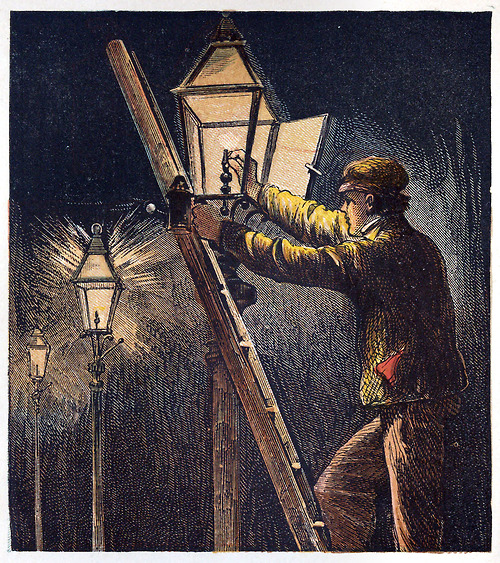
Robert Louis Stevenson (1850-94), the author of classic books like Treasure Island, Kidnapped, and The Strange Case of Dr Jekyll and Mr Hyde, spent his childhood in Edinburgh, Scotland. Apparently, one evening, when he was a young child, as dusk was turning to darkness, Robert had his face pinned to the window at the front of his house fascinated by the lamplighter coming down the street, with his ladder and burning wick, lighting the old-fashioned gas street lamps and setting them ablaze for the night. Seeing their son glued to the window, his parents asked him, ‘Robert, what in the world are you looking at out there?’ With great excitement he exclaimed, ‘Look at that man! He’s punching holes in the darkness!’

Punching holes in the darkness! That is what it must have seemed like to an impressionable young child watching the descending darkness being driven away, bit by bit, by the lamplighter as he lit the various lamps along the street. And this, of course, is what Jesus Christ came into our world to also do – not by lighting old-fashioned gas street lamps – but simply by his Presence and his Passion! The Apostle John tells us, in the Prologue to the Gospel that bears his name, that with his Incarnation Jesus ‘brought light to everyone … a light that shines in the darkness and the darkness cannot extinguish it … the One who is, in and of himself, the true light who gives light to everyone’ (John 1:4-9). In reality it is impossible to separate the Incarnation and the Cross – they are, in effect, the ‘head and tail’ of the same coin. Without Christ’s Passion – the events surrounding his death and resurrection – his Incarnation would have been pointless! But, equally, without his Incarnation, the Passion simply would not have taken place!?

But what does John mean by Jesus Christ being ‘light’ for everyone here in this section of the Prologue to his Gospel? Clearly ‘light’ here is not simply indicative of ‘light as natural phenomena’ or even metaphorically of ‘light as a natural understanding of things – the natural gaining of knowledge and wisdom’ and so on. The ‘light’ that John refers to here is ‘spiritual revelation’, the ‘understanding of spiritual things’. It is, as the Apostle Paul tells us elsewhere, particularly ‘the light of the knowledge of the glory of God in the face of Jesus Christ’ (2 Corinthians 4:6). In reality it is the key to all true understanding. It takes us well on the way to finding answers for all the key questions of life – Where did we come from? Why are we here? Where are we going? Accessing this light is essential. As someone once wisely said, ‘We need an understanding of spiritual things, and a spiritual understanding of other things!’

Later on in John’s Gospel, John records that Jesus re-enforced this great truth when he bluntly spoke to the people once more and said, ‘I am the light of the world. If you follow me, you won’t have to walk in darkness, because you will have the light that leads to life!’ (John 8:12). Fascinatingly however, Matthew tells us that in the Sermon on the Mount Jesus also told those who would follow him, ‘You are the light of the world!’ (Matthew 5:14). So how can Jesus be ‘the light of the world’ and we – all those who choose to ‘name the Name  of Christ’ – both be ‘the light of the world’ at one and the same time? Well, simply by allowing Jesus to live in and through us! In and of ourselves, we cannot bring spiritual light to anyone!? But if we allow the light of Christ to shine through us to others, then we too can be the vehicles, the channels, the instruments through whom God can work in the lives of others! God’s purpose, in coming into this world in the Person of Jesus Christ, was to ‘punch holes in the darkness’ for us! And his on-going purpose for his Church – all those who truly ‘name the Name of Christ’ themselves – is that we too should ‘punch holes in the darkness’ for others! As Jesus himself also taught us in the Sermon on the Mount, ‘In the same way, let your light so shine before others, that they may see your good works and glorify your Father in heaven’ (Matthew 5:16)! So, wherever we are – and wherever we go – let us endeavour to let God’s love shine through us so that, by our manner of conversation and life, we too will ‘punch holes in the darkness’ – the spiritual darkness that surrounds us!

It is vital that the Church – particularly ‘local churches’ – grasp the importance of this principle! It is all too easy for us to become very ‘inward looking’, a ‘holy huddle’ obsessed with ourselves, our problems, the way ‘we’ do things, the way ‘we’ worship, etc. rather than seeking to genuinely be ‘a caring Christian church at the heart of the community’. Having ‘retired’ from the Baptist Ministry some four years ago now, I have had the opportunity to visit a number of local churches, during that period, simply as a member of the congregation. One of the things that has struck me in that time has been the absence of Intercessory Prayer in many churches during the main Sunday Services. I have often come away wondering ‘If we aren’t praying for the Church and the World – particularly for our local town or community – in our Services, who is?’ For me – whatever else we may seek to do in our local community – intercessory prayer is vital if we are truly to be ‘salt’ and ‘light’ and ‘leaven’!

The Grace Outpouring (first published in 2008) is the remarkable story of how a small Community of Christians in rural West Wales brought significant blessing to their local community simply by regularly and consistently praying God’s blessing on that community. I would encourage you to read the book for yourself – a new, more up-to-date edition is about to be published – and be both challenged and inspired as a result. The book encourages us to ‘imagine a House of Prayer in every town. Imagine churches filled with Christians who want to bless others; who want to pray and then stand back and watch God at work, changing lives before their very eyes!’ In other words Christians, and local churches, prayerfully ‘punching holes in the darkness’!

O Jesus son of God, so full of grace and truth,
The Father’s saving Word, so wonderful are you.
The Angels longed to see, and prophets searched to find,
The glory we have seen revealed.

You shone upon the earth, but who will understand?
You came unto Your own, but who will recognise?
Your birth was prophesied, for You were the Messiah,
Who came and walked upon the Earth.
Your glory we have seen, the one and only King,
And now You’re living in our hearts!

Light of the world, light of the world,
Light of the world, You shine upon us!

~ Matt Redman (1974- )

Jim Binney

Leave a comment

I WANNA TELL YOU A STORY

Tell Me the Old, Old Story

I was brought up listening to stories. As a young child my parents read stories to me every night until I learned to read for myself and was then able to hungrily devour book after book! My father, in particular, told me numerous stories. Stories from his own childhood in the 1900s, stories from his time in India as a soldier during the British Raj, and other stories that he simply made up. Consequently I too always read to my own children, and told them stories – some of which they in turn told to their children?! In addition, my formative years were the early 1950s, when very few people actually had television but everybody listened to the radio. In the early 1950’s the memory of the wartime years still remained comparatively fresh in people’s memories in the UK so radio programmes were often quite jolly and steered toward leaving your troubles behind you. The radio was always on in our house, and as a child I became familiar with programmes such as Workers Playtime, Housewives Choice, Music While You Work, and Mrs Dales Diary. My favourite programmes, however, were always the stories – detective stories such as Paul Temple, or adventure stories such as Dick Barton: Special Agent. I also enjoyed the Variety Shows such as Educating Archie with the ventriloquist Peter Brough, and his dummy Archie Andrews. It was this programme that first introduced me to Max Bygraves (1922-2012) who appeared as one of Archie’s ‘guest tutors’. Bygraves went on to become a very successful entertainer in his own right, combining a mixture of songs and anecdotes in his act. Bygraves’ catchphrase – which always led into a poignant or amusing anecdote – was, ‘I wanna tell you a story!’

As a Christian, and as a preacher and teacher, I also tell stories! I am not speaking here of merely ‘sermon illustrations’ although these are helpful – ‘windows to light truths difficult to understand’ as someone once described them. Neither am I suggesting – as critics of the Christian Faith often do – that the Bible is full of ‘made up’ stories that no intelligent person can really believe? The whole Bible is  essentially narrative – a book of numerous stories of God’s gracious dealings with individuals, people groups, and even nations – rather than a book of rules and regulations we are slavishly meant to follow. The old idea of God’s eternal plans and purposes being akin to some kind of overarching rainbow above us, which presented us with an idea of God as being wholly ‘other’ and distant from us, has been replaced by a more perceptive understanding of God’s eternal plans and purposes being more like a divine safety net undergirding us. Biblical history is to be seen as a kind of eternal time line of stories of God’s gracious dealings with humanity in which individuals, various people groups, and nations have come to encounter God for themselves in a meaningful way. Their little stories have found a place in God’s big story, if you like. And when we read their stories in the Bible, and see how they fit into God’s big story, and how God dealt graciously with them, it encourages us not just to find parallels with their stories, but to see that our own particular story also fits into God’s big story and that we too may expect God to deal graciously with us if we allow him to shape and mould our destiny.

The whole Bible is essentially one big story – albeit split into significant component parts – that tells of God’s gracious dealings with his Creation from Eternity to Eternity.  What we call the Old Testament is primarily the story of God’s gracious dealings with a particular people group, chosen by God himself, for a specific purpose – namely to bless all the other nations of the world by giving birth to God’s Promised Messiah and by sharing the knowledge and understanding that God had given them with everyone else! Right from the beginning – made perfectly clear in God’s initial covenant with Abram – Israel was brought into being, and given a special place in God’s plan and purpose, so that ‘all peoples on earth will be blessed through you’ (Genesis 12:2,3)! Sadly, Israel repeatedly failed to fulfill this God-given mission, so God gave it to another – the mysterious ‘Servant of the Lord’ whom we find mentioned in several places in the Book of Isaiah. Thus God tells the ‘Servant’ that ‘It is too small a thing for you … to restore the tribes of Jacob and bring back those of Israel I have kept. I will also make you a light for the Gentiles, that you may bring my salvation to the ends of the earth’ (Isaiah 49:6). Who is this mysterious ‘Servant of the Lord’? Clearly it is none other than God’s Promised Messiah, God’s ‘only begotten Son’ (John 3:16), the Lord Jesus Christ.

Thus what we call the Gospels is essentially the story of the life and mission of Jesus who came into the world ‘not to condemn the world, but so that the world might be saved through him’ (John 3:17)! Although I firmly believe that ‘all Scripture is God-breathed’ (2 Timothy 3:16) and that therefore, under God, the Bible is our authority for all matters of faith and conduct, belief and behaviour, the Gospels are the most important part of the Bible!  They are the ‘lens’ through which the rest of the Bible should be read. We should regularly read the whole Bible but whenever we read something from either the Old Testament or the rest of the New Testament, we should constantly be asking ourselves, ‘What did Jesus have to say about this?’ or ‘How would Jesus have viewed this?’ In his famous ‘Sermon on the Mount’ (Matthew 5-7) we read that Jesus repeatedly used phrases such as, ‘You have heard that it was said … but I tell you’. When Jesus said this, he was primarily thinking of the inadequate understanding of the teaching in the Old Testament in the minds of the Jewish people – both God’s ancient people and the people of Jesus’ day. Jesus did not say that the teaching of the Old Testament was wrong – simply that it was all too often misinterpreted and misunderstood – which is why he said (also in the Sermon on the Mount) that he had not come ‘to abolish the Law or the Prophets … but to fulfil them’ (Matthew 5:17). Jesus did this through both his life and teaching. Thus, as suggested earlier, whenever we read the Old Testament we should view it through the ‘lens’ of Jesus’ teaching in the Gospels. In addition, I would also suggest, that we need to apply this same principle to reading the rest of the New Testament also!? Once again I am not suggesting that the Acts of the Apostles or the various Epistles etc are less inspired than the Gospels. There has however been a tendency over the years (especially in evangelical circles) to over-emphasise the teaching of the Epistles (particularly the Pauline Epistles) over and against the teaching of the rest of the Bible. It has even been suggested, by N T Wright and others, that the Church actually developed it’s theology primarily from the teaching of Paul (rather than Jesus)?! Thus we also need to read the rest of the New Testament through the ‘lens’ of the teaching of Jesus in the Gospels. We need to ask similar questions (to those suggested earlier in connection with reading the Old Testament) when reading Acts or the Epistles etc, namely ‘Did Jesus have anything to say about this?’ or ‘How would Jesus have viewed this?’ To do this provides us with a healthy antidote to some of the Charismatic, Reformed, Evangelical and Liberal excesses that have subtly crept into the Church over the years.

In much the same way, what we call the Acts of the Apostles, and the various Epistles and Letters (that make up the rest of the New Testament) are largely the stories of the growth of the early Church and individual local churches. We too easily forget this – particularly when it comes to the Epistles – and thus interpret what we read simply doctrinally rather than as narrative? Primarily, however, Paul and the other Apostles are responding to ongoing situations in the life of various local churches. They are answering questions raised by these local churches, or dealing with problems that have arisen as a result of the cultural clash between local customs and Christian values. Thus Paul’s comments about appropriate behaviour between husbands and wives in worship in 1 Corinthians 11 should be understood not in ‘prescriptive terms’ as binding on men and women for all time in every church, but as salient advice for dealing with a localised cultural problem pertaining to 1st century Corinth. One of Paul’s abiding concerns (seen repeatedly throughout his Letters) was for the effectiveness of the Church’s testimony in a largely pagan world. Hence his advice given here for Christian men and women to behave appropriately – even conservatively – in a Corinthian culture that simply would not have understood (or accepted) the new found freedom that Christian women now enjoyed in the Church as a result of coming to know Jesus Christ as Saviour and Lord! The seeds of liberty and equality for women (and slaves for that matter) are clearly found in Paul’s teaching (as in the teaching of Jesus), but Paul knew that it would take a very long time for these seeds to ultimately bear fruit. Thus his advice for the Corinthian church at this time and place in their particular story, was not to allow particular issues – however commendable – to get in the way of the Gospel which alone could change people’s hearts and minds (and therefore ultimately their negative behaviour patterns).

Jesus himself taught primarily by telling stories. His disciples on one occasion asked him about this. Matthew tells us that Jesus’ disciples came to him and asked ‘Why do you speak to the people in parables?’ (Matthew 13:10). Now a parable is simply ‘an earthly story with a heavenly meaning’. A cursory reading of Jesus’ response to this question would seem to suggest that whilst the disciples were in a privileged position whereby the message Jesus sought to communicate was made clear to them, Jesus used parables so that the majority of the crowd listening to Jesus were simply left ‘clueless’ because Jesus never explained the meaning of these parables or stories?! There has to be more to it than this, however? Jesus’ mission was far more than entertaining the crowds with amusing stories of every-day country folk?! From the preacher-teacher point of view the concept of preaching or teaching in such a way so as to deliberately leave your hearers in ignorance is plainly ridiculous – although, in fairness, it could be said that perhaps some preachers and teachers in the Church today do just that?! A more discerning view of this passage, however, would suggest that although Jesus favoured the narrative approach this was intended to encourage his hearers to think more deeply about hidden meaning behind the stories Jesus told!  Teaching through story-telling would most certainly attract a congregation, but those same stories would also intrigue many of the hearers. Some, of course, would not get beyond the story itself, but others would surely ask themselves, ‘What is Jesus really seeking to say here?’ ‘There has to be more to this story that just the obvious?’ And of course, that is exactly what Jesus wanted his hearers to do. He wanted them to explore beneath the surface. He wanted them to ‘tease out’ the deeper meaning. Thus here, where Jesus tells the crowd The Parable of the Sower (Matthew 13:1-9), Jesus wanted as many of his hearers as possible to recognise that he was likening the ‘seed’ sown by the Sower in the story to ‘the message of the coming of God’s kingdom’ (Matthew 13:19) and that the various soils represented the differing responses of the ‘hearts’ (Matthew 13:19) of the hearers.

The use of ‘narrative’ is the most honest and effective way of communicating the Gospel, and the teaching of Scripture, to others! It is the more honest way because, as we have seen, virtually the whole of the Bible from Genesis to Revelation is itself in narrative form. It is more effective because it draws the hearer into the story. We hear the stories of God’s gracious dealings with various individuals, people groups, and recognise that their little stories fit into God’s big story and how God dealt graciously with them. This in turn encourages us not simply to find parallels with their stories, but to see that our own particular story also fits into God’s big story so that we too may expect God to deal graciously with us if we allow him to shape and mould our destiny! The old idea of rather close-knit, exegetical exposition of a verse, a phrase, or even just a word is, to my mind, not only unhelpful but prone to abuse? Equally, the more modern idea of what I call ‘How To’ sermons is also both dishonest and unhelpful with its use of ‘proof texts’ to support points the preacher has already decided to make, and has a tendency to make the hearers actually feel even more inadequate than they were when they came into church?! Good narrative preaching and teaching, on the other hand, involves the hearers in the story being told, and takes them on a similar journey to a better place in God.

In secular society ‘story telling’ is enjoying something of a renaissance. The ‘story telling’ comedians such as Michael McIntyre are proving very popular these days, often playing to full houses at the various theatres and comedy venues up and down the country. Many pubs also host ‘story telling’ evenings where people can go along to either listen to, or tell, stories and folk tales of one kind or another. I know of one Christian man who goes to such events and simply re-tells Bible Stories. He is a good ‘story teller’ and his stories go down well – even though he doesn’t necessarily tell his audience that he is simply telling ‘Bible Stories’ – because quite a number of those present have never heard them before!? Even ‘in church’ there is a place for simply ‘telling Bible stories’ and not just ‘reading them from the Bible’. In our own church in Dorchester we have a couple who are very good at doing this. They simply re-tell the Bible story in question in a way that is both faithful to the text but also really interesting, and often amusing as well as poignant, and which really ‘grabs the attention’ of the congregation!

One further thing needs to be said, however, and that is about telling our own story! The Psalmist encourages all of us who name the Name of the Lord to share our story with others. In Psalm 107:2 he says, ‘Let the redeemed of the Lord tell their story!’ All of us who have come to know Jesus Christ as Saviour and Lord have a story to share with others. We may not necessarily be called to be preachers or teachers, but we all have a testimony to share. When I was one of the Youth Leaders in my home church in Greenford in Middlesex, we had a young girl in the Youth Group named Lorraine. She was quite a simple girl, not very attractive or intelligent to tell the truth, and she came along to the Youth Meeting because another girl – a Christian girl at her school – befriended her. Lorraine made a commitment of her life to Christ and began to change. She soon possessed an attractiveness that only Christ can give to us, and her academic work improved – she went on to become a qualified nurse. Lorraine managed to retain her ‘simplicity’ however. She never became a great preacher or theologian but she had a grasp of the significance of scriptures such as John 3:16,17 (quoted earlier) and she had a testimony of what God had done for her in Jesus! She would share both these with anyone who would listen, and as a result several other people came to know Jesus Christ for themselves. They recognised the Lorraine’s simplicity and genuineness. They said things like, ‘This is Lorraine … we now understand why she has been transformed … her story must be true!’ And they believed in Jesus for themselves!

Tell me the old, old story,
Of unseen things above,
Of Jesus and His glory,
Of Jesus and His love;
Tell me the story simply,
As to a little child,
For I am weak and weary,
And helpless and defiled.

Tell me the old, old story,
Of Jesus and His love.

Tell me the story slowly,
That I may take it in –
That wonderful redemption,
God’s remedy for sin;
Tell me the story often,
For I forget so soon,
The ‘early dew’ of morning
Has passed away at noon.

Tell me the story softly,
With earnest tones and grave;
Remember I’m the sinner
Whom Jesus came to save;
Tell me the story always,
If you would really be,
In any time of trouble,
A comforter to me.

Tell me the same old story,
When you have cause to fear
That this world’s empty glory
Is costing me too dear;
And when the Lord’s bright glory
Is dawning on my soul,
Tell me the old, old story:
‘Christ Jesus makes thee whole’.

~ Katherine Hankey (1834-1911)

Jim Binney


3 Comments

REFLECTIONS ON RECOVERING FROM MAJOR HEART SURGERY

A Heart for God

A Heart for God

The first thing I saw, when I came round from my recent  major heart surgery, was Julia’s lovely face grinning at me through a forest of arms, legs, tubes, drains and so on! I would like to tell you that my first words on waking up were a heroic statement of faith and confidence, such as ‘Why were you all so worried? I told you that I would come through it all without any problem or pain!’ The reality, however was that I apparently muttered a rather feeble, ‘I’m feeling a bit uncomfortable?’ The truth of the matter was that I actually felt, as the French somewhat indelicately put it, like merde!

I felt as though a herd of elephants had trampled all over my chest – which was not too far off the mark – since they had opened my chest, deliberately broken the breast bone to get to my heart, ‘harvested’ veins from inside my chest and left leg, deliberately stopped my heart and collapsed my lungs, put in a double bypass and closed off the rogue fistulas that had been ‘stealing oxygenated blood’, sewn me all up again very neatly, inside and out, but inserting various tubes, drains and cannulas in to aid me in my recovery!? To be really honest with you, my initial thought was, ‘Why the heck did I have this operation?’ Of course, I had this operation because without it I would have died, sooner rather than later, and the heart bypass operation will – as the surgeon’s report succinctly states – ‘extend the quantity and quality’ of my life, hopefully in a way which will enable me to continue to live a life and exercise my ministry, for the glory of God and the good of others, in a more dynamic and effective way for a further ten years at least! But at that initial stage of recovery, ‘Thank God for morphine!’ was all I could say!

My wonderful surgeon, Mr Ohri, was very confident that I would come through the operation with ‘flying colours’. ‘I have a 99% success rate!’ he told me, ‘and since you are otherwise in excellent health, this operation will be quite straightforward!’ And then he added, ‘As long as I can find the fistulas that need closing, that is!’ Fortunately is turned out to indeed be straightforward, and he found the rogue fistulas easily and was able to close them off. However, I couldn’t help but think, ‘He may have a 99% success rate … but what if I am amongst the remaining 1%?’ Laying awake the night before the operation, Psalm 27 came into my mind and I opened my Bible and began to read it to myself. It is one of my favourite Psalms, and begins with those familiar words, ‘The Lord is my light and my salvation – whom shall fear?’ It was not these words, however, that I felt drawn to but rather a verse later in the Psalm – ‘I remain confident of this: I will see the goodness of the Lord in the land of the living’ (Psalm 27:13). This verse seemed to stand out from the page – as Scripture can sometimes do – in a way that suggested that this was God’s ‘now word’ for me at this time in this place, just before major surgery. In his Letter to the Ephesians Paul speaks of ‘the word of God’ being ‘the sword of [God’s] Spirit’ (Ephesians 6:17). The Greek word here is rhema which is indicative of ‘a particular word that comes to us underlined by the Holy Spirit’. And that is just what Psalm 27:13 seemed to be for me in that moment – a word from God assuring me that I would come through this major surgery o.k. and that I would continue to see – in future days – ‘the goodness of the Lord in the land of the living’!

My stay in hospital was estimated at five days. This seemed to me to be an incredibly short stay given the nature of my operation, and the way I felt immediately after surgery!? I was assured, however, that this would be the case and that I would be back home in a week’s time. They even gave me an A4 sheet of paper listing what I would be able to do each day from Day 1 (the day after my operation) to Day 5 (the day when I would be discharged and sent home). It provided a step-by-step expectation list of what I would be able to achieve day-by-day while still in hospital – everything from getting out of bed, through having all the tubes and cannulas removed, to being able to walk down the corridor and climb stairs. This was very helpful, especially as it gave me a realistic assessment of what I would, and would not, be able to achieve, over the first few days after the operation. I was also given a short booklet to take home with me that did much the same thing – although week-by-week this time – for the next 12 weeks when I would be in the process of recovery. This booklet dealt with the highs and lows, the various aches and pains, that I would experience over this period, as well as the various goals and objectives I would undoubtedly reach week-by-week. This too has proved extremely helpful – especially when one starts to experience times when one feels ‘down’ for no explicable reason or starts to feel weird pains after going for a longer than usual walk caused by the muscles being exercised and bones mending. Reflecting on this, underlined for me the wise saying that churches ‘overestimate what they can achieve in a year, but underestimate what can be achieved in five’! How true this is! As with the human body, so with the local church, healing and progress take time. How many Pastors, I wonder, have found themselves on the ‘receiving end’ of criticism from their churches because the hoped for growth and development didn’t happen in the first year of the new pastorate? How many local churches have grown despondent because their ‘short-term plan’ for reviving the church didn’t actually produce the hoped for fruit? I know that the Bible exhorts us to ‘redeem the time’ (Ephesians 5:16), but it also tells us that ‘there is a time for everything’ (Ecclesiastes 3:1-8). We have to learn that things – in the healing of the human body and the growth of the local church – take as long as they take. In both cases we have to play our part of course, but we cannot go faster than God wills it without doing damage to ourselves!? Just as I am having to learn to be a ‘patient patient’, so as churches we need to learn to be prayerfully patient!

I have to confess, as alluded to earlier, that I was anxious before my operation. Invasive surgery of any kind is a big thing and, despite my surgeon’s assurances I did wonder if I would wake up in the recovery ward or in Heaven? In actual fact I did wake up in the recovery ward, even though it felt as though I had actually been through Hell?! Now I did not want to die. For various reasons I wanted to survive and, hopefully, experience a greater measure of fitness and energy than I have had for a long time. But even though I did not want to die, I was not afraid of dying. I could honestly say with the Apostle Paul, ‘O death, where is your victory? O death, where is your sting?’ (1 Corinthians 15:55). I settled this issue a number of years ago when I put my personal trust in Jesus Christ as my Saviour and Lord. I recently listened to Murray Walker, the semi-retired Formula One motor racing commentator, being interviewed on the Sunday Programme by Sian Williams. In this programme he said that he didn’t believe in ‘life after death’ because no one had ever come back from the dead?! Well, with due respect to Murray Walker, he is wrong! Jesus Christ died on Calvary’s Cross but three days later came back from the dead – with the joyful news that death is not the end! As the Apostle Paul also tells us, ‘I passed on to you what was most important and what had also been passed on to me. Christ died for our sins, just as the Scriptures said. He was buried, and he was raised from the dead on the third day, just as the Scriptures said. He was seen by Peter and then by the Twelve. After that, he was seen by more than 500 of his followers at one time, most of whom are still alive, though some have died. Then he was seen by James and later by all the apostles. Last of all, as though I had been born at the wrong time, I also saw him’ (1 Corinthians 15:3-8). The whole Christian Faith stands on this remarkable truth, and the experience of every Christian is similar (although unique to each individual) to that of the Apostle Paul, in that we too have come to know the Risen Jesus in a personal way. Whilst in hospital I had an hour long conversation with a young, highly intelligent nurse (at her instigation), who had just qualified as a Staff Nurse and was about to undertake a PhD. She did not want to know what I knew academically about Jesus Christ – she wanted to know how I had come to know Jesus Christ in a personal way, and how she might experience the same! It is clearly not just the elderly who have questions about death, and life for that matter? For many years now I have believed that one of the major things we can do for people as Pastors is to prepare them for death. I do not mean this in a morbid way, but my conviction is that people cannot really enjoy life, live it to the full, live really useful lives if you like, until they have dealt with that old enemy, death!

My discharge letter from the hospital written by my surgeon, which I also alluded to earlier, states that the purpose of my heart bypass operation was to ‘extend the quantity and quality’ of my life!  I am still in the recovery period but already I feel so much the better for it. The pains associated with a possible imminent heart attack have gone. I have the ability to breathe really deeply in a way I have never known before (I have had a heart condition since birth apparently). I can actually walk faster and longer than for a long time, and feel that the best is still yet to come. I have a new energy and  alertness. This has affected me spiritually as well as physically and mentally. I have a renewed enthusiasm for the work of ministry and the work of the Kingdom. Perhaps this is akin to that which Jesus promised us when he said that he had come ‘to bring life – life that can be lived to the full’ (John 10:10). One of the reason why I didn’t want to die on the operating table was because I still believed that God had important stuff for me to do. I didn’t want to leave my wife Julia (who is also an ordained and accredited Baptist Minister, and 15 years younger than me) but be around to support her when she returns to the Baptist Ministry after a period of absence due to illness, hopefully in the near future. I don’t want to ‘interfere’ with her ministry, but I do want to be there as a support. Of late, however, I have also felt a renewed sense of my own ‘call to ministry’ – a feeling that ‘God hasn’t finished with me yet’ and that I still have something to contribute to the cause of Christ and the work of the Kingdom. In fact, I felt this so strongly that, prior to my operation, I asked God ‘for at least another 10 years of effective and dynamic life and ministry’. I recognise that there is a dangerous precedent here – King Hezekiah asked God for an extension to his life and God gave him an extra 15 years (Isaiah 38; 2 Kings 20:1-11; 2 Chronicles 32:24-26) although it is questionable as to whether or not he made ‘best use’ of this time?! For me, however, it seemed somehow right. I have had four years ‘retirement’ and, quite frankly, have found it rather boring even though we have managed to travel quite a bit during this time. Retirement may be fine for some Ministers – I don’t pass any judgment on others – but as for me, I am anxious to be more involved once again. Partly this is because of the state of the Christian Church in the UK – there is so much that remains to be done. I feel a bit like the Apostle Paul who in one way was happy to die and go to be with the Lord, but felt that he still needed to ‘stick around’ a bit longer in order to help the Church in its mission (Philippians 1:23). How this will all ‘work out’ I don’t know? Perhaps it will be acting as an ‘Associate’ with Julia when she returns to the Pastorate, or just helping out in the local church or Association in some way, or doing something I have never thought of before? Time will tell!

Jim Binney

Leave a comment

BUILDING WITH BANANAS

Building with Bananas

Building with Bananas

A book that I have found both fascinating and helpful over the years – and one that I find myself frequently returning to – is Derek and Nancy Copley’s little book (first published in 1978) called Building with Bananas. Derek and Nancy chose the title after listening to a bricklayer on a local building site standing next to a pile of badly made bricks. Looking at the curved up ends he muttered ‘How can anyone expect me to build with these? They’re just like bananas!’ But, in spite of these bricks being seriously ‘odd-shaped’ he was still able to use his skill to build a fine wall. These bricks reminded Derek and Nancy of what Christians are like – imperfect and very different from one another – and yet God wants us to fit together in a loving community. As a result, they wrote this humorous, yet helpful, little book (complete with some wonderful cartoons of ‘banana-shaped’ people), to help each of us who name the Name of Christ to understand  how to achieve harmonious relationships with other church members.

I was reminded of this the other day following a conversation with two Christian friends. A married couple, they are both very sincere and devout Christians who have been faithful followers of Jesus for many years. They have always been very faithful in attending worship and have worked very hard in the local church in a number of capacities, particularly in youth and children’s work and in social work with the poor and needy. They have a large family of grown-up children who make a number of demands on their time. Despite these demands they continue to attend church regularly, carry on with their responsibilities in church life when able, attend a home group as often as possible, and give financially to the church on a regular basis. Sadly, however, they are resigning from the membership of the church they attend!? The reason for this is that a couple of weeks ago one of the church leaders preached a sermon on ‘commitment’, the gist of which was that unless members of the church and congregation attended every meeting in the church – worship, prayer, business, and so on – they were not really committed to Christ and should be ashamed of themselves!? This was not an isolated case of such a message being preached? In fact it would appear to be almost a weekly happening! The effect on our friends, sadly, has been to totally undermine any sense of worth or value they had in terms of usefulness to Christ and the Kingdom?!

Sadly, this is not the only story of this kind that we have come across in the last few years. As a total convert to the use of social media – particularly Facebook and Twitter – I have gathered a motley collection of somewhere between 300-400 ‘friends’, many of whom are people who I have known for more than 50 years or so. A number of these are contacts that I have made through the Church over the years. Some were members of the churches and congregations that I have Pastored at one time or other. Quite a few of these people no longer attend church anywhere these days – although they are very happy, even delighted, to be back in contact with me because apparently they found (and still find, thankfully) something genuine about me, someone who could be trusted, someone who would listen to them and give them sensible advice. Although they no longer attend church, many of them still ‘believe in God’ they tell me. In nearly every case, the reason why they no longer attend church is because they have had ‘a bad experience of church’!? And a prominent complaint amongst them is that what ‘put them off’ was the constant haranguing from the pulpit for them ‘to be more committed’?! Week in, week out, the message was the same, and in the end they just got ‘tired of being told off’ instead of being helped and encouraged, and just stopped going!

We too have noticed that this approach appears to be becoming a trend in many of our evangelical and charismatic churches here in the UK. The incessant demand that members of the church and congregation be ‘more committed’ to the local church than they ‘obviously’ are!? We call it ‘You suck! Try harder!’ preaching?! Basically, the congregation is harangued week after week along the lines that they are not good enough and that more is required of them … in terms of time, effort and money, etc. Such an approach is not only unhelpful, but it is damaging both to the health of the local church and to the cause of Christ. In our opinion the vast majority of professing Christians are very genuine about their personal commitment to Christ. They may not be perfect but they are sincere. And instead of being ‘harangued’, ‘told off’, and ‘got at’ week after week, they need to be encouraged, helped, and enabled to become all that God wants them to be in Christ, and to fulfil their God-given ministry and calling!

It is vital for us all – especially church leaders and ‘keen’ Christians – to recognise that the local church is essentially made up of ‘volunteers’. The local church is not a business, where those who don’t ‘pull their weight’ can be sacked? Neither is the local church like an ‘army’ where if you don’t ‘obey orders’ you end up on a charge?! Neither are we like a pile of uniform ‘bricks’ that can be neatly built into a wall?! The local church consists of men and women, of variable age and education, some older and some younger, some very gifted and others not so gifted, some wealthy and some poor, some with major responsibilities in society or at work, some who are ‘retired’ or who have time on their hands – all of whom have, at some time or other, made a conscientious decision to follow Jesus Christ as Saviour and Lord. We do what we can, when we can, out of love for Jesus Christ, the church, and the society we live in. We do not do what we do because ‘we have to’ but because ‘we want to’! And because of this the level of personal commitment to the local church – in practical terms – varies considerably from person to person. For some of us it is a question of time – we have other pressing responsibilities at work, or to the family, for example, which limits what we can do in the local church. For others it is a question of ‘discipleship’ – adjusting our priorities as we grow as Christians and discovering what God’s particular plan and purpose for our lives is? Hopefully all of us, given time, will eventually find the right balance in serving Christ in the home, in the church, and in the world!

As Baptist-Christians (in membership with the Baptist Union of Great Britain) we adhere to Five Core Values. We believe that as a Gospel People we are called to be: A Prophetic Community, An Inclusive Community, A Sacrificial Community, A Missionary Community, and A Worshipping Community. Several of us would like to add a further two values, namely that we are called additionally to be: A Community that stands for the Freedom of the Individual, and also A Committed Community!? Commitment to Christ and his Church (particularly the local church) IS important! It is not the need for commitment that I am questioning here … simply the best way of encouraging such commitment. Haranguing people, making people feel small and bad about themselves, criticising people and harshly judging them, is NOT the way to go about achieving this aim!? Teaching people, encouraging people, enabling people is so much the better way!

Jesus told a fascinating parable about the Sower and the Seed (Matthew 13:1-23). Essentially the point of the Parable is that the fruitfulness of the preaching and teaching of God’s word is to some degree dependant on the type of ground that receives this ‘seed’ as it is sown by the Preacher. Some of the ‘soil’ that it falls on – mirroring the attitude of our human hearts and minds – hinders the growth of this seed. Some hearts are hard, some are shallow, some are taken up by the cares and sorrows of life, and thus the hoped for spiritual growth is limited as a result. But, even when the ‘good seed’ of God’s word falls on ‘good soil’ … the fruitfulness is variable. As Jesus tells us here in this Parable: ‘But others fell on good ground and yielded a crop, some a hundredfold, some sixty, some thirty’ (Matthew 13:8). Clearly, whilst some of those who responded to the Good News of the Gospel gave themselves 100%, others only gave 60% or even just 30% of their time, talents, possessions, self, and so on!?

As Pastors and Preachers, it is right that we should continually be encouraging our people to ‘lay their all on the altar’ for God (as the old-time saints used to put it) … but the reality is that this ‘just ain’t gonna happen!’ … and we Pastors, and Preachers, and Leaders in the local church need to be realistic about this!? If we lose sight of the reality, if we forget that we are ‘building with bananas’, if we ‘lose the plot’ and (instead of encouraging and enabling our people) start ‘having a go’ at our congregations, we will do immense damage to them and to the cause of Christ! As W T H Richards, the Senior Pastor at the Gospel Tabernacle, Slough, when I was on the staff there (and a very wise man) used to say to us younger Pastors, ‘Although we are right to call our people to 100% commitment to Christ and the church, the reality is that some will only give 60%, and others only 30%? I have learned, however, to be grateful for the 60% and the 30% … after all, they could be giving nothing!?’

All to Jesus I surrender;
All to Him I freely give;
I will ever love and trust Him,
In His presence daily live.

I surrender all,
I surrender all;
All to Thee, my blessed Saviour,
I surrender all.

All to Jesus I surrender;
Humbly at His feet I bow,
Worldly pleasures all forsaken;
Take me, Jesus, take me now.

All to Jesus I surrender;
Make me, Saviour, wholly Thine;
Let me feel the Holy Spirit,
Truly know that Thou art mine.

All to Jesus I surrender;
Lord, I give myself to Thee;
Fill me with Thy love and power;
Let Thy blessing fall on me.

All to Jesus I surrender;
Now I feel the sacred flame.
Oh, the joy of full salvation!
Glory, glory, to His Name!

~ Judson W Van DeVenter (1855-1939)

Jim Binney