Leave a comment

STEPPING INTO THE FUTURE (Views from the Abbey 4)

stepping into future

A visitor to a class of seven-year olds was struck by the sad, worldly expression on the face on one little girl apparently labouring over a poem. Stopping by her desk he read her work:

yesterday, yesterday, yesterday
happiness, happiness, happiness
today, today, today
trouble, trouble, trouble
tomorrow, tomorrow, tomorrow
sorrow, sorrow, sorrow

Deeply moved by what the little girl had written, he asked what had inspired her to write such a beautiful poem like that. The little girl looked at him blankly and then replied that this wasn’t a poem … these were her spelling corrections.

Whilst many of us begin a new year with a determination to use it as a springboard to a brighter, more positive future, many others approach yet another new year in quite the opposite way. Their feelings reflect the little girl’s perceived ‘poem’ – the good times all in the past, the present rather complicated to say the least, the future full of dread.

So, how do you feel at the start of this new year? What might 2019 bring for you? There is so much uncertainty in our world and many face the future with fear and trepidation. We can have an over rosy view of the past and we can find the unknown nature of the future overwhelming, and both can bring a sense of inertia and stagnation in the present. How can we step into the future with hope and anticipate tomorrow with courage and positivity?

Herbert Butterfield, a British historian and philosopher of the last century, and a devout Christian wrote, ‘there are times when we can never meet the future with enough elasticity of mind, especially if we are locked in contemporary systems of thought. We can do worse than remember the principle which both gives us a firm Rock and leaves us the maximum elasticity to our minds: the principle: Hold to Christ, and for the rest be totally uncommitted.’

Minnie Haskins in her poem, God Knows, quoted by George VI in his 1939 Christmas Broadcast when the country was facing an uncertain future, points us in the same direction:

‘And I said to the man who stood at the gate of the year:
“Give me a light that I may tread safely into the unknown.”
And he replied: “Go out into the darkness and put your hand into the Hand of God.

That shall be to you better than light and safer than a known way.”
So, I went forth, and finding the Hand of God, trod gladly into the night.
And He led me towards the hills and the breaking of day in the lone East.’

As has been said, we do not know what the future holds but we do know who holds the future. The prophet Jeremiah, the writer of Lamentations, had been going through a tough time, ‘I’ll never forget the trouble, the utter lostness … I remember it all – oh, how well I remember – the feeling of hitting rock bottom. But there’s one other thing I remember, and remembering, I keep a grip on hope: God’s loyal love never runs out, his mercies never run dry. How great is your faithfulness!’ (Lamentations 3:19-23 The Message).

When we hold on to Christ and look to God, we find the hope to face tomorrow. When we put ourselves into the hands of God, there is no safer place to be. We can step into the future with faith and the assurance that he is with us, he will meet the need and make the way forward clear and plain. As our Motto text for 2019 tells us, our God is the God of Hope: ‘May the God of hope fill you with all joy and peace as you believe in him, so much so that you actually begin to abound in hope through the Holy Spirit whom God has given to us’ (Romans 15:13). That word ‘hope’ in the Greek (the language of the New Testament) is a much stronger word than our English word. It literally means ‘guarantee’, that is, it carries a sense of certainty concerning things working out for the best in the future. Thus, Martin Luther translates Romans 15:13 as ‘the God of the guarantee’. As Mary Bowley Peters aptly reminds us in one of her hymns:

Through the love of God our Saviour,
all will be well.
Free and changeless is his favour,
all, all is well.
Precious is the blood that healed us,
perfect is the grace that sealed us,
strong the hand stretched forth to shield us,
all must be well.

Though we pass through tribulation,
all will be well.
Ours is such a full salvation,
all, all is well.
Happy, still in God confiding,
fruitful, if in Christ abiding,
holy, through the Spirit’s guiding,
all must be well.

We expect a bright tomorrow,
all will be well.
Faith can sing through days of sorrow,
‘All, all is well.’
On our Father’s love relying,
Jesus every need supplying,
in our living, in our dying,
all must be well.

~ Mary Bowley Peters (1813-56)

Julia Binney


1 Comment

BEYOND THE FAMILIAR (Views from the Abbey 3)

New Year

I am really looking forward to receiving my congratulatory telegram/card from King William in 25 years’ time (when I will have reached the ripe old age of 100). Five years ago, when I was 70, I had major heart surgery. The night before the operation I asked God for another 10 years of active ministry – not just life but years of active ministry. I hope that I will have another five years or so on top of that so that I can enjoy at least some years of genuine retirement with Julia. But, having already had five years of enforced retirement down in Dorset (a most frustrating time since I didn’t feel ready for retirement) I was raring to get going for God again. I believe God answered that prayer positively and, first at Knaphill (where I became very involved in the community, eventually being appointed the church’s Community Minister because the church thought it was better to have me inside the tent rather than outside the tent) and now here in Reading (where the church haven’t got a clue what to do with me as yet) I have found opportunity after opportunity to serve God and others surrounding me.

Life is a journey and, as suggested by the story of the two on the Emmaus road (Luke 24:13-35), a journey in which God himself walks alongside of us waiting for us to recognise him. When we walk this journey, unaware of his presence, life fails to make sense – we don’t know where we came from, why we are here, or where we are going. It is only when we bring Jesus into the equation that life begins to make sense. The Bible clearly teaches that we are all here for a reason – God has a plan, a purpose, for each one of us. As the Prophet Jeremiah reminds us: ‘I have plans for you, declares the Lord, plans for good and not for evil, plans to give you hope and a future’ (Jeremiah 29:11). The Apostle Paul follows up on this when he tells us that with God in the frame ‘everything ultimately works out for the best, for those who genuinely love God and determine to walk according to his plans and purposes’ (Romans 8:28).

Since being a Christian, and even being a Christian Minister, is a way of life and not a job so to speak, it is not something that we can ever actually really retire from in the accepted sense of retirement. We may step down from an active leadership role, or step back from being involved in a particular activity, because of age or infirmity or simply because we sense from God that he has something else for us – but there will always be a ‘something else’ even if that something else is simply to give ourselves to prayer and intercession. We all need to resist the temptation to compartmentalise our lives where God is concerned, for example by attending worship reasonably regularly on a Sunday morning yet living the rest of the week as though it belonged to us, or (as I have sadly known to happen) spending 40 years in Christian Ministry and then retiring at 65 and never going to church ever again?!

For me, every day is more exciting than the day before. Here we are, at the beginning of yet another new year, in a new church (well, new to us … Abbey has actually been around since 1640), and at the beginning of yet another adventure with God. I have spent my entire ministry going to churches who needed help, encouragement and the right kind of input that would help them recover from the lean years and move into a time of plenty. Abbey is much the same – a group of 30 or so, mostly elderly, believers who love the Lord but who recognise that unless something changes drastically over the next few years the church will cease to exist. Obviously, Julia and I (and our church members for that matter) believe that God’s plan and purpose for us at Abbey has exactly the opposite of that scenario in mind – otherwise we would not have come to Abbey in the first place. For us, therefore, beginning 2019 is beginning a new adventure – beginning this new chapter in the life of Abbey with the question: ‘How are you going to do it again, Lord?’ The one thing we can be sure of is not just that God will do it again, but that it will not necessarily be in the same way he has done it before. It will be a journey beyond the familiar for us all!

One of my favourite saints (if Baptist-Christians can have saints) is the Irish saint, St. Brendan the Navigator. Born in Kerry in 484, very little is known about his early life other than rumours that brightly shining angels hovered over the house when he was born. Ordained to the priesthood in 512 St. Brendan established several monasteries throughout Ireland. Of all the Irish saints, St. Brendan was the most adventurous. He loved travelling on the sea and was very skilled with the coracle (a small boat). On some of his earlier ventures, he visited Britain, many of the islands off the coast of Scotland and possibly even Iceland. He is best known, however, for his famous voyage, a voyage that lasted seven years and during which he travelled to Iceland, Greenland and maybe even America in search of the Island of the Blessed. The story of this voyage is told in a 9th century manuscript called Navigatio Sancti Brendani Abbatis (The Voyage of St. Brendan the Abbot) and is a good read full of the adventures Brendan encountered on his journey tackling large sea monsters and the like.  St Brendan died in 578 and he is known as the patron saint of seafarers and travellers. He serves as an example of someone who never lost his vital relationship with the Living God, nor his sense of adventuring with God.

Amongst the stories and sayings attributed to St Brendan the Navigator is the following prayer which we need to take to heart as we enter this New Year ahead of us with all its challenges, and possibilities. May God help us to also ‘journey beyond the familiar’.

Lord, I will trust You,
Help me to journey beyond the familiar and into the unknown.
Give me faith to leave the old ways and break fresh ground with you.

Christ of the mysteries,
Can I trust You to be stronger than each storm in me?
Do I still yearn for Your glory to lighten me?
 

I will show others the care You’ve given me.
I will determine amidst all uncertainty always to trust.
I choose to live beyond regret, and let You recreate my life.

I believe You will make a way for me and provide for me, if only I trust You and obey.
I will trust in the darkness and know that my times are still in Your hand.
I will believe You for my future, chapter by chapter, until the story is written.

Focus my mind and my heart upon You, my attention always on You without alteration.
Strengthen me with Your blessing and appoint to me the task.
Teach me to live with eternity in view.
Tune my spirit to the music of heaven.
Feed me, and, somehow, make my obedience count for You.
 

Jim Binney

Leave a comment

TWIXMAS (Views from the Abbey 2)

p0e9spwmsrj01 (1)

Twixmas is a British slang word used to describe the period between Christmas and New Year, typically the 27-30 December. It is used a lot in the tourism industry when advertising holidays or events during this period. Personally, I rather like the word because it somehow does describe that rather weird period when the key events of Christmas – Christmas Day and Boxing Day – are over but the festivities of New Year’s Eve and New Year’s Day have not yet started. These few days have become a rather insane period in the yearly calendar with lots of cars on the road as people travel either home after being away visiting family for Christmas, or simply moving on to the next set of relatives to be visited for New Year, or off to the shops to buy those bargains on offer in the Sales.

For working clergy Twixmas is often a welcome break after all the energy sapping activity of Advent and Christmas with its numerous services, carol singing in the hospitals and old people’s homes, etc., etc., and before the start of another New Year with all its challenges and possibilities. Church-wise most activities are closed at this time – some churches don’t even meet for worship on the last Sunday in the year – so we can actually get some sleep, rest, recovery time (in between seeing family and friends ourselves, that is).

Julia and I like to use this time, not only to recharge our batteries but, to think prayerfully about where we would like to see the church go during the coming year. Although Julia is the Minister at Abbey (and I am just the BOGOF) we still operate very much as a team. Our specific roles in that team may have changed down through the years, and I have happily taken on board an amended version of John the Baptist’s words:  ‘She must increase whilst I must decrease’ (John 3:30), but we remain a team nevertheless even though I have no primary role in the leadership team at Abbey. This does not prevent me, however, from playing an important supporting role, especially when it comes to talking through our situation, prayerfully waiting on God for guidance as to the best way forward, encouraging each another in our respective roles and ministries, and so on.

Twixmas is also a good time to take stock. To look back and see what we have learned during the past year which is of value, but also to look forward to what might be in the future. We have been inspired in this by our Bible readings this week which have centered on the stories of Simeon’s Song and Anna’s Prophecy associated with the events surrounding that first Christmas time (Luke 2:21-40). Essentially, we see here Simeon looking back to see how God has been with Israel in the past and how all that God has done for his people during that time has culminated in this wonderful event, the birth of the Christ-Child, the Promised Messiah. Anna, by way of contrast, looks forward prophetically to what is going to be, the redemption of God’s people, not simply believing Jews but all who will in due course turn to God in Christ and commit themselves to him and his plans and purposes. And God is looking for a similar response from us. A looking back in recognition of the solid foundation on which we build, coupled with a looking forward in recognition of all that God is calling us to in the future. And what does that entail?

Perhaps it is best summed up in something someone sent me just a few days ago:

When the carols have been stilled,

When the star-topped tree is taken down,

When family and friends are gone home.

When we are back to our schedules

THE WORK OF CHRISTMAS BEGINS

To welcome the refugee,

To heal a broken planet,

To feed the hungry,

To build bridges of trust, not walls of fear,

To share our gifts,

To seek justice and peace for all people,

To bring Christ’s light to the world.

Of course, this is all very good on paper – the real problem comes when we have to seek to put it all into practice come the New Year? But putting it into practice is what we must do both as individual Christians and as local churches. This is the challenge for us at Abbey. It is not a challenge just to the Minister, Elders and Deacons but to all of us who name the Name of Christ.  Invariably we know what the will of God is … actually doing it, however, is an entirely different matter!?

Jim Binney


1 Comment

BIG? (Views from the Abbey 1)

42911622_205499053713585_5897278504860304016_n

‘So, you are leaving us to go to a big church then?’ said one of the members of our previous church when the news broke that we were moving to Abbey Baptist Church in Reading. ‘Glad to hear that you are going to a big church!’ wrote someone in an email to us when the news became public knowledge. We were greatly amused by both comments because (in the way these two friends understood ‘big’) Abbey was far from big. Numerically it was smaller than the church we were leaving, and the stipend they were offering was also less (although I am pleased to say that subsequently they have matched Julia’s previous stipend). Nevertheless, reflecting upon the meaning of ‘bigness’ subsequently, I have come to see that Abbey is indeed a big church … for a number of reasons!

Abbey is a big church because of its history! Dating from 1640 Abbey is one of the first Baptist Churches to be planted in the UK. During the last 380 or so years it has moved site several times and is now based in the historic Abbey area of Reading. It is not, however, simply important because of its historical longevity (although it is known and respected as such) but because of what it has achieved in that time. Over the years Abbey has planted somewhere in the region of 25+ congregations in and around Reading but also further afield. Not many churches have done that kind of thing. As a result Abbey is held in high esteem by many of the other churches (of all denominations) in Reading.

Abbey is a big church because of its location! Situated as it is in the historic Abbey Quarter of Reading, Abbey Baptist Church is right at the centre of the town with all the potential that that carries. Built as it is on the site of the old Reading Abbey precincts, one cannot help but feel (as many others do) that having a church, recognised even by non-Christians possessing such an esteemed heritage, at the heart of the town, is important. In some ways Abbey is a kind of sleeping giant waiting to wake up and achieve its potential, its destiny. And, sitting spiritually, as we do, in both the evangelical/charismatic Reading Christian Network and the Central Reading Council of Churches, we are ideally placed to encourage and facilitate meaningful cooperation in the cause of the Kingdom. 

Abbey is a big church … literally! Our buildings are a bit like the Tardis. From the outside the buildings do not appear to be as large as they are. Once you get inside the building, however, you discover that there are rooms galore spread over three floors. They are already being put to good use in several ways. We house four congregations on a Sunday – a Sri Lankan Tamil speaking congregation, a Ghanaian congregation, and a Portuguese congregation, as well as our own congregation. Currently we are four different churches, but we are already meeting together for social events, and sometimes shared worship, and hopefully this will develop more and more. In all over 200 people meet for worship in our building every Sunday, which more than many churches today.  Julia and I would love to see these four congregations start to work even more closely together in the future. Our buildings are extensively used every day of the week by various community groups and charities including U3A. In addition we rent out part of the building to a charity that works with ex-offenders, and we are also part of the ‘Bed for the Night’ scheme that provides overnight accommodation for the homeless during the excessively colder winter nights.

Abbey is a big church because of the opportunity it presents! Our friend Azar Ajaj (President of the Nazareth Evangelical College) never talks about ‘problems’ but always refers to perceived problems as ‘opportunities’! I want to say something about some of the difficulties we face in a moment but for now I want to underline the wonderful opportunities we have at Abbey. Situated where we are just off the main town centre drag, surrounded by tall buildings originally built as offices, has been perceived in the past as a major problem. But today, the historic Abbey Quarter of Reading has been developed into a tourist attraction, the office blocks are being converted into flats (including social housing), and our buildings (as my mother-in-law describes them) are a ‘hidden gem’. The premises (although in need of some updating) are both pleasant and useful. Lots of people know about Abbey. Over 60 local church leaders meet to pray for Reading every Wednesday morning from 8.00 a.m. for an hour. Baptist-Christians in Reading are strong with a good number of churches who work together well. The holistic needs of people in Reading are great, but we are in a position to meet many of them in Christ’s name. The future could be amazing!

Abbey is a big church in terms of vision! Julia and I come to Abbey with a vision for us as a church to become a Community Hub Church open 24/7 to meet the physical, mental, social, emotional and environmental needs of our community, as well as the spiritual. Whilst we understand the Gospel holistically, we also recognise the integral nature of the Good News and that primarily we need to help men and women come into a living relationship with God through a living, personal experience of coming to know Jesus Christ as Saviour and Lord. Without this we have effectively done nothing to meet the real need of men and women. It is only when we become ‘new creatures in Christ’ (2 Corinthians 5:17) that we find the real answer to the meaning and purpose of life. Abbey is already well on the way in their journey along Community Hub Church lines – our role is to encourage and facilitate this aim and objective.

And finally, Abbey is a big church in terms of it being a big challenge!  Numerically we are a small church – around 30 or so members of the church and congregation. We are also largely an elderly congregation with most of us being 70+ in years. They are a great bunch of people who still work hard at enabling us to function as a church. Everybody, almost without exception, plays a significant part. But, the simple fact of the matter is that we need a spiritual blood transfusion if the church is to survive and continue to be a significant influence for good and for God in the future. We need new people, younger people, people who will buy into the vision for Abbey and who see its importance in terms of the Kingdom. Ultimately, we need conversion growth, and this is one of our aims and objectives, but we could also do with some mature Christians coming to join us. One of my bug bears (and I am not just thinking of Reading here) is the number of larger churches numerically where a huge proportion don’t really do anything other than attend on a Sunday morning. Here at Abbey we could do with some ‘dirty hands Christians’ – people who take the call of God seriously and want to get stuck in and see something significant achieved in God. Please pray for us, especially that God will send us some mature Christians to help us and add to our numbers those who are ‘being saved’ (Acts 2:47).

So, yes Abbey is a big church in a lot of ways. Most of all, however, we have a big God who is ‘able to do so much more than we ask or even think possible’ (Ephesians 3:20). Perhaps God is calling you to come and join the revolution – here at Abbey or if not here right where you are right now!

Jim Binney

Leave a comment

SAGA OF THE DROPPED COFFEE POT (Deaf in Venice 6)

1148

We are nearing the end of our wonderful holiday in Venice – just a couple of days to go. We have had another wonderful day today visiting various churches, museums and art galleries, and now we are relaxing back at our apartment. We have enjoyed a lovely meal in the apartment garden and are about to have some coffee and a glass or two of Limoncello. Julia is in the kitchen making the coffee when there is a sudden shriek accompanied simultaneously by the sound of breaking glass. Julia has dropped the glass coffee pot and it has smashed into numerous fragments!

We recall something in the instruction folder that told us what we should do in the event of such a calamity. Obviously, we are not the first guests to have committed such a faux pas. Sure enough there is a paragraph in the coffee pot section of the folder that tells us where the shop is in Venice where we can purchase a replacement glass coffee pot. Since we only have one more complete day of our holiday left that is tomorrow’s activity sorted because the replacement coffee pot shop is right over the other side of the Rialto Bridge and the Rialto market. Seemingly you can’t get a replacement anywhere else in Venice.

We set out about mid-morning the next day. Once again Julia has a map and a plan, and it looks like the day will not be wasted since there are various places to visit along the way, places we had not planned to visit but which look rather interesting nonetheless. We take the lid of the old glass coffee pot with us and make a rough guestimation of the height of the pot we will need. We still have some space on the tickets we bought at the beginning of our holiday to enable us to visit several churches and museums across Venice.

We know our way around Venice well by now and we soon arrive at the famous Rialto Bridge where the views are just as spectacular as ever and we take even more photographs to add to the ones we have already taken. We find a vacant shop on the Rialto which we think we should buy, reopen it as a butcher’s shop called ‘Shylocks’ where every cut of meat is sold for a pound! We carry on over the bridge to the Rialto Market where Julia (having once been in the fish business) is keen to see the fish market. It is great fun, full of strange looking fish (as well as the normal kind), and lots of people. We resist the temptation to buy some fish since we have an important task to complete first and we are also planning to go out for a final meal this evening.

Finding the shop that sells the replacement coffee pots turns out to be more difficult than we thought. Venetian house numbers are notoriously complicated, and we eventually discover that there are two streets with the same name in the same vicinity. Fortunately a nice lady in another domestic appliances shop helps us out by looking our shop up on the internet and giving us more precise directions. There is only one problem – the shop closes as 12.00 noon and doesn’t open again until 3.30 p.m. We make a dash for it and arrive at 12.05 p.m. The shop has closed for lunch! And we thought that it was only the French who took three-hour lunch breaks?  

This enforced delay has its compensations however. The shop itself is in a road just off the Campo Giacomo dell’ Orio, a square full of quiet charm, where we stop for a coffee and enjoy a picnic lunch. We visit the nearby unusual church of Chiesa di San Giacomo dall’ Orio with its amazing paintings and then take ourselves off to the 18th century Palazzo Mocenigo with its richly furnished and frescoed rooms, and a fascinating history of perfumes. Julia is in her element. Eventually I manage to drag her away as it is time to see if the coffee pot shop is open. It is not, but we hang around for 15 minutes and eventually the owner appears. He is very helpful even though he doesn’t speak English and we don’t speak Italian. He climbs up a tall ladder, roots around in various boxes, and eventually comes back down with a replacement glass coffee pot that looks about the right size.

We retrace our steps back to our apartment carefully carrying the new glass coffee pot. We don’t want to break it before we get home. Eventually we arrive back at our apartment, unpack the new glass coffee pot, insert it in the coffee machine … and it doesn’t fit! There is nothing for it but to take it back to the shop and see if they have another one. I am exhausted, so Julia insists I have a rest while she goes back to the shop, armed this time with all the details about the coffee machine we can muster. An hour later she phones me to tell me that the man doesn’t have a replacement glass coffee pot. Apparently, the coffee machine is so old they don’t make them anymore. He refunds our outlay and points Julia in the direction of another shop on the Rialto that sells new coffee machines at reasonable prices, and so we must buy a new machine.  Julia gets it home safely and it looks rather nice. We discover that the glass coffee pot that is part of it fits then old coffee machine perfectly?! Julia’s journey is not wasted, however, since (without me being in tow) she is able to make one or two other purchases for our new house back in the UK en route!

We decide that we will not use the new coffee machine but use another kind of coffee machine that is also resident in the apartment. It is somewhat complicated, but Julia eventually manages to master it. When we get back to the UK Julia confesses to Johanna (who owns the apartment with her husband Bruce) the saga of the dropped coffee pot. Johanna is appreciative of our efforts and kindly volunteers to split the cost of the replacement pot.   She also laughs and tells us that when she originally bought the old coffee pot she got it back to the apartment, took it out of its box, and immediately dropped the glass coffee pot on the floor and saw it smash into numerous pieces. No wonder she knew where the replacement glass coffee pot shop was!

Jim Binney

Leave a comment

CHUTZPAH (Deaf in Venice 5)

805

One of the advantages of having an apartment in the Cannaregio area of Venice is that it gives us the opportunity to explore bits of this magical city that are somewhat off the well beaten tourist trail. Today we are walking through the narrow alleys, with surprises around every corner, that make up the huge crescent between the northern bank of the Grand Canal and the lagoon, to the old Jewish Ghetto. The former Ghetto is now a lively and popular district of the city where the religious and administrative institutions of the Jewish Community and its five synagogues still exist.

The word ‘ghetto’ originated in Venice, derived from getto (meaning ‘casting’) due to an old iron foundry once situated here. As of 1492, many Jewish refugees started arriving in Venice after expulsion from Spain. At first, they enjoyed complete freedom but in 1527 they were obliged by law to move to the Ghetto to live, to wear a sign of identification, to remain behind locked gates from 6.00 p.m. every night until 12.00 p.m. the following day. Their island home was circled by an armed patrol boat to make sure that they kept the night curfew. Many other onerous regulations were also included, in exchange for which the Community was granted the freedom to practice its faith and protection in the case of war.

There were various reasons for this move on the part of the Venetian authorities. Jealousy of the Jewish business acumen was possibly one reason. Banned by the Venetian Republic from practising manual trades, many Jews became skilled doctors or moneylenders. Most were refugees from other parts of Europe, and they are credited with introducing rice-based dishes to Venetian cuisine. Another reason for this move was to prevent Jewish fraternisation with ‘Christian’ Venetians. They were not allowed to build new houses on the island so, with typical Jewish ingenuity, they built upwards adding stories to the already existing buildings. Waves of new arrivals saw each language group incorporate its own synagogue on a floor in some of these buildings raising them to seven floors in height. After the fall of the Venetian Republic in 1797, Napoleon decreed the end of the Jewish segregation and the equalisation of the Jews to other citizens. This provision became definitive when Venice was annexed to the Italian Kingdom.

In September 1938, the introduction of fascist racial laws deprived the Jews of civil rights, and the Jewish community entered a difficult period. In September 1943, Italy changed from being an ally of Nazi Germany into an occupied country, and the Nazis started a systematic hunt for Jews in Venice as in other Italian cities. In November 1943, Jews were declared ‘enemy aliens’ which meant they could be arrested, and their property seized. Although some Jews managed to escape to neutral Switzerland or Allied-occupied southern Italy, possibly as many as 246 Jews were detained (including some 20 residents of a Jewish convalescence home) and deported to  the Nazi death camp at Auschwitz-Birkenau. Only eight Jewish residents of Venice emerged from the death camps, and the Jewish population of Venice was halved to just over 1,000 because of WWII. Today only about 30 Jews still live in the Ghetto, while a further 470 Jews reside in other parts of the city.

We want to visit the old Jewish Ghetto for several reasons. Firstly, the walk there will take us through some very interesting places such as the Campo dei Mori, an odd funnel-shaped square with its three statues of Arabian-style ‘Moors’ – most probably medieval traders who made their home there – and a house by a bridge over Rio della Sensa (number 3399), once the home of the renowned 16th century Venetian artist Tintoretto. Secondly, however, we want to visit the old Jewish Ghetto because we have been told that it is both a very interesting and deeply moving experience.

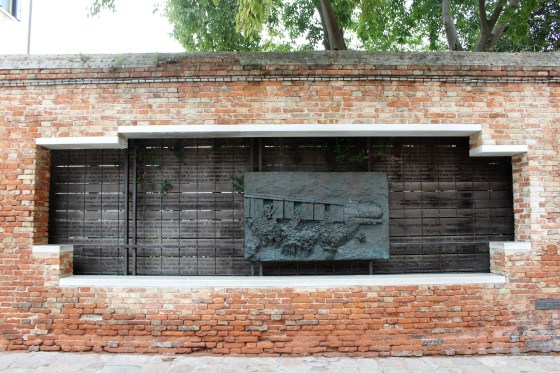
Julia has a map, and a plan, and so we enjoy a fascinating walk to the Ghetto noting various interesting places on the way, enjoying seeing some of the locals out rowing their own boats in preparation for the upcoming races (there are a lot of rowing clubs in the vicinity), and stopping off for coffee of course. We know that we are nearing the Ghetto when we start seeing people in traditional Jewish dress. We cross the bridge into the Campo del Ghetto Nuovo and are immediately aware of the tall buildings, the Jewish Museum, and the powerful, prominent memorial plaque to Venice’s Holocaust victims. We want to join the tour of the various synagogues, but we must wait until after lunch for the next tour. We decide to have a look at the museum, situated between the two most ancient Venetian synagogues, first and then come back later for the tour. The museum is small but fascinating and we learn a lot about the Jewish Faith (that we did not know before) and the history of the Jewish Community of Venice. We still have an hour before the tour of the synagogues starts so we decide to have lunch and find a lovely little restaurant nearby where we enjoy Venetian liver – a local speciality – and a Venetian spritz or two.

After lunch we join the 30 or so other people on the tour. There are several Jewish tourists in the party including a man who is very knowledgeable about Judaism, most probably a teacher or Rabbi we suspect. He is very impressive and displays the kind of chutzpah associated with Jewish people (especially the men one suspects). Chutzpah is a Yiddish word that derives from the Hebrew word ḥutspâ (meaning ‘insolence’ or ‘cheek’ or ‘audacity’) describing a kind of supreme self-confidence, nerve, gall that can be used for good or for bad. It is a kind of ‘in-your-face-ness’ that I both admire and hate at the same time.  This man has bucket loads of it. I admire his knowledge but struggle with his know-it-all attitude. Whereas the rest of us on the tour ask questions this man gives opinions. He has opinions about everything including the place of women within Judaism. He obviously likes the idea that these synagogues follow the traditional pattern and that women are relegated to the galleries (even though the numbers at worship these days are very small).

Our guide on the tour of the synagogues is a youngish Jewish lady who knows her stuff. She is clearly very intelligent and gives our friend as good as she gets. She must have met a good number of his kind before and handles him and his opinions with an equal measure of skill, reason, knowledge and winsomeness. She displays a chutzpah of her own but a more attractive and impressive kind.

After we have looked at the two synagogues within the buildings housing the Jewish museum we go back into the Campo del Ghetto Nuovo so that our guide can show us from the outside where the synagogues are in the tall buildings we have just been in. She explains more about the history of the Jews in Venice, particularly the story of the war years in the 1930s and 1940s. We look at the impressive memorial in more detail and see how graphic and powerful a picture it portrays. Our final port of call is another synagogue just a stone’s throw away, opposite the lovely restaurant where we enjoyed our wonderful lunch. Whilst we are standing around in our group listening to our guide I notice some Jewish boys playing football in the square where we are standing. Suddenly one of the boys belts the solid leather football towards the makeshift goal near the museum, miss-kicks it completely, and sends it sailing towards our group. It strikes chutzpah man’s wife on the head. She is OK but very angry. She rounds on the boys playing football and gives them a real mouthful. Chutzpah plus! Julia and I look at each other and grin. So much for chutzpah man ruling the roost, being head of the family, keeping his wife and everybody else in their place? We know immediately who really wears the trousers in his house!

Jim Binney

Leave a comment

LEFT BEHIND! (Deaf in Venice 4)

2000 (618)
We are going on a Sightseeing Tour across the Venetian Lagoon to the islands of Murano, Burano and Torcello. It will take about four hours or so and we have been warned that it is a tight schedule and that we need to be on time at every stage of the tour. We reckon that it is a good way to see at least some of the more significant islands in the Venetian Lagoon. Murano is famous for its fabulous glassware and we will have an opportunity to see a Master glassblower at work. Burano is known for its amazing multi-coloured painted houses (originally painted in different glowing colours so that the fishermen could tell their own houses in the gloom) and its elegant lacework. Torcello is an island known for its ornate palaces and ancient churches.

We get up early, route march across Venice to St Mark’s Square (managing to fit in a quick stop for coffee on the way) and arrive in plenty of time at the Alilaguna Pier (where we are to board our motorboat) brandishing photocopies of our pre-booked tickets in our hot little hands. We are much wiser after the chaos of the Doge’s Palace, so we check with guy at the gate if our photocopied tickets are OK? ‘No,’ he tells us, ‘You have to go down to the ticket kiosk and exchange your photocopies for proper tickets!’ We comply with his instructions, retrieve our proper tickets, and return to the Pier where (being the English-speaking tour) a small queue is already beginning to form. ‘Have you all got your proper tickets?’ we ask the queue. ‘Yes!’ the queue responds in unison, waving their photocopies at us. We explain the ticketing situation. The queue disperses with everyone heading for the ticket kiosk. We now find ourselves at the front of the queue.

Since we still have 30 minutes to go before the tour is due to leave – and there is no sign of the motorboat – Julia takes the opportunity to find a ‘rest room’ (as our American friends say). After she has been gone for 20 minutes I begin to worry, not just about missing the boat, but because she set off in the direction of Harry’s Bar (made famous by Earnest Hemingway) where the prices are exorbitant but where we know they have toilets. Has she given in to the temptation to have one of their famous Bellini cocktails, a mixture of Prosecco sparkling wine and peach purée or nectar (at 20€ a shot) in order to use the loo?

I needn’t have worried, however, as I spot Julia returning … with our friend little Margaret from Knaphill in tow and they are chatting away nineteen to the dozen. What is little Margaret doing here in Venice, I ask myself? I do a double take and realise that it is not little Margaret but someone who looks exactly like her in every way. It turns out that this nice lady, and a friend who is with her, are both from Australia. They are on a tour of Europe and are spending a couple days in Venice. They too are going on the same half day tour of the islands that we are doing.

Julia introduces me to them both. ‘Have you got your tickets for the islands tour?’ I ask them. ‘Yes’ they reply in unison, waving their photocopies at me. We explain the ticketing situation to them and they rush off to the ticket kiosk to get the proper tickets. Some newcomers in the queue have overheard our conversation and want to know the score. It seems just about everyone has photocopies and no one has proper tickets. New people are joining the queue all the time, and we are the only ones telling them that their photocopied tickets are not acceptable – the guy on the gate ignores us all! Eventually the queue cottons on and those at the end of the queue pass the message on to any newcomers.

Eventually our boat arrives, and we all get on board and set off across the Venetian Lagoon to our first stop, the island of Murano. The views all around us the journey across the lagoon are tremendous and I take lots of photos. After about 20 minutes we arrive at Murano, disembark and are immediately ushered in to a glass factory, where we watch a glass blower creating beautiful pieces of glassware, a Murano tradition that dates to 1291. We hear a bit about the island’s history, about Murano’s prosperity in the 1400s and 1500s when it was the centre of glassmaking in Europe, but we don’t have time to see other sights like churches decorated with mosaics and ornamental details. We are ushered in to the showroom where several sharply dressed aggressive salesmen try and sell us expensive pieces of glassware. Julia asks the price of an elaborate chandelier – we want to buy some new lights for our new Manse in Reading – and are told that it is a snip at 6,000€. ‘How many do you need?’ asks the salesman. ‘Three!’ we reply.

The salesman realises that we are not serious buyers and gets somewhat snooty. Everything is far too expensive here, I tell him. ‘When I bought my Rolex, I went to Switzerland to buy it! When you want the best glass ware you buy it here!’ he responds. ‘If I charged the prices you charge here for glassware, I could afford a Rolex as well!’ I tell him. We leave the shop, walk down the road to another smaller shop, and buy a small piece of Murano glass for 10€. It was probably made in China, but we bought it on Murano.

We make it back to the boat in good time … we don’t want to get left behind … and we head to our second stop, Burano, an island known for its lace production, which dates to the 16th century and was once the best in Europe, and the island’s brightly coloured fishermen’s houses. It is beautiful, and we could easily spend a whole day here. If we had been more familiar with Venice, we would have come here on the water bus and done just that. There are Japanese and Chinese tourists everywhere – all taking photographs. We really enjoy just wandering around. The church in the middle of the town has a prominently leaning tower which is not quite as bad as the leaning tower of Pisa but not that far off. We have 45 minutes to look around, not quite enough time for Julia to buy any lace or dresses or any of the other wonderful items on sale in the various shops. We meet ‘little Margaret’ and her companion. They have bought some very expensive lace. We rush back to the pier to catch our boat … we don’t want to be left behind … and the warning about the necessity of being on time is reinforced every time we dock at a new island. We join the queue for our boat and get into conversation with another Australian couple who are on their honeymoon. They have a huge box with them. They bought a set of expensive wine glasses at the expensive shop in Murano, and now they are worrying about how they are going to get it back home to Australia in one piece?

Our next stop is a visit to Torcello, an island established between the 5th and 6th centuries, to see its ornate palaces and churches including the Cathedral of Santa Maria Assunta, founded in the 7th century, and the excavated remnants of the baptistery in the Church of Santa Fosca. There is a long walk, along a canal, from where our boat docks to the ancient churches we have especially come to see. It is, however, a delightful walk in the pleasant sunshine with lots to see on the way including a rather nice restaurant – where we fancy stopping for lunch, but we haven’t the time – and an old bridge without a parapet so nothing to stop you falling in if you have had too many glasses of wine at the posh restaurant. The 7th century church is amazing (although you can’t take photographs on the inside) and we spend most of our time simply drinking in the atmosphere. We just have time to eat our packed lunch before a quick march along the canal side back to the jetty to catch the boat. We must be back by 5 to 1, we don’t want to be left behind, and we make it with a minute or two to spare.

Our tour of the islands is over … just the 40-minute return boat ride to Venice. We find a seat in the stern of the boat so that we can get a great view. At two minutes to one our boat pulls away from the jetty. They have another trip scheduled for 2.00 p.m. and can’t be late. ‘Where are our Australian friends? ‘Little Margaret’ and her companion?’ asks Julia. ‘Where are the ‘happy couple’ with their great big Murano box?’ They must be up the front of the boat we think to ourselves … but no … there they are, still on Torcello! They have just arrived at the jetty. They are waving to us, but the ‘waving’ soon turns to a ‘shrug of the shoulders’ as they realise the boat is gone and won’t be coming back for them. They have been left behind.

We feel guilty. Perhaps we could have done or said something to make the boat wait for just a minute or two longer. We console ourselves with the thought, however, that if our Australian friends could afford to buy lace from Burano, and wine glasses from Murano … they could surely afford a water taxi back to St Mark’s Square!

Jim Binney

Leave a comment

PHONE HOME (Deaf in Venice 3)

image

We are part way through our tour of the magnificent Doge’s Palace in Venice – admiring the pictures in the wonderful Tintoretto exhibition in fact – when Julia suddenly exclaims, ‘You’re not quite the ticket!’ Everybody looks at us. What is going on here I wonder. One minute I am ‘Deafo!’ and now I am ‘Not quite the ticket!’ ‘I’ve lost the ticket!’ Julia says again.

‘What ticket?’ I ask. It can’t be the entrance ticket because we are already in here … and what a palaver that was. We had pre-ordered our tickets on-line over the Internet prior to arriving in Venice and were clutching the relevant photocopies in our hot little hands when we arrived at the entrance to the Doge’s Palace. There were three separate queues to get in but thankfully the lane for pre-paid tickets had no one in it. Unfortunately a large party from one of the Cruise Ships had also just arrived as well and they are given priority over us. And when we do eventually get through the doors the guy at the ticket box won’t accept our photocopied sheets. Eventually we get passed up the chain of command and get issued replacement tickets which the scanner gun accepts. Judging by the numbers of people following us from the entrance kiosk to the ticket office to the manager’s office, and then back again, we are not the only ones with this problem.

The Doge’s Palace is indeed magnificent but we pay extra to see the special Tintoretto exhibition, that is on at the moment, first. Tintoretto was a 16th century Venetian artist, looser in style than many of his contemporaries, a strange mixture of genuine Christian faith and sharp entrepreneurial practice, and we like his paintings. Our rapturous appreciation of these paintings, however, is rudely interrupted by Julia’s sudden realisation that she has ‘Lost the ticket!’ She turns out every pocket and, sure enough, there is not a ticket of any description to be found. ‘What ticket?’ I ask again. ‘The ticket for the left luggage office over by the Basilica!’ Julia explains.

Light dawns. Prior to visiting the Doge’s Palace we joined the queue to visit the ornate St Mark’s Basilica, only to discover that we couldn’t take our backpacks in with us and that we had to leave them at a storeroom nearby. I kept our place in the queue whilst Julia rushed round the corner to find said storeroom and deposit our backpacks. She returns 10 minutes later sans backpacks and flourishing numbered ticket. We shuffle round the Basilica with scores of other tourists. To be honest there is not much to see. It is rather dark and dingy and we are all continually hassled by officious attendants making sure we keep moving and don’t take any photographs. There are lots of extra bits to the Basilica that we can visit … as long as we are willing to pay extra. Blow that for a game of Gondoliers! We are in and out of the Basilica within 15 minutes and on our way to see the Doge’s Palace.

So, everything is fine and dandy … until Julia realises that she has lost the numbered ticket to the storeroom where we have left our backpacks (along with several hundred other backpacks). Our backpacks with all our money, passports, cameras, keys, etc, etc. What if someone has found our lost ticket and claimed all our stuff? Panic ensues. Julia goes rushing off in one direction … I don’t know where she has gone or what she is doing. I wait around for a bit and then male logic sets in. I find my way to the exit, go back to the Bascilica, ask where the storeroom is situated, find my way to the storeroom and explain the situation to the two ladies who are running the show.

The two ladies are not the least bit interested in my plight. They are attempting to deal with a continuous stream of people coming in to the storeroom to retrieve their bags … all of them with the appropriate tickets. They don’t speak any English and I don’t speak Italian but they do allow me to come behind the counter to search for our bags. I can’t find them anywhere … and they won’t allow me to move any bags to see if I can find ours. I have a sudden flash of inspiration … Julia is bound to have left her mobile phone in her backpack, and I have my mobile phone with me, so if I phone her number the appropriate back back will ring. Simples! I phone Julia’s mobile … and although it rings I can’t hear a backpack ringing! After all I am ‘Deafo’ … how can I possibly hear a backpack ringing. I ask the ladies to listen out … but they can’t be bothered. Why should they help? I am just another prat of a tourist. I am from the UK … and we are brexiting Europe aren’t we?

I give up on my good idea and go and try and find Julia. I don’t venture too far from the storeroom because I know Julia will eventually come here and being 6′ 4″ tall means that she should be able to see me above the crowd. Eventually she turns up and we return to the storeroom to repeat the ‘phoning home’ exercise. The two ladies are just as uncooperative as before but do allow Julia behind the counter. I make the phone call … and joy of joys, a backpack hidden in the pile rings and Julia can hear it. We retrieve our backpacks … nobody has stolen them after all … and we are able to prove they are ours!

We are so relieved! We go back to the Doge’s Palace. We resume our tour. The Palace is amazing. We cross the Bridge of Sighs. We visit the prison. We are high on adrenaline when we finally leave and decide that we both need a drink to recover from our traumatic day. We return to St Marks’s Square for a Venetian Spritzer only to discover that if we want to have a drink at one of the prominent cafes we have to pay 12€ just for the privilege even before we buy any drinks because they have a quintet playing light music. Greedy s**s! We go round the corner where the music is free and the drinks are cheeper. We have a delightful time. Julia gets up and dances to the bossanova music the band are playing … so much better than Theresa May’s embarrassing performance the Conservative Party Conference … and we have a great evening.

Julia can’t be bothered to cook for us tonight – we are on holiday after all, and it has been a stressful day – so we stop off for dinner at a gluten free restaurant we have discovered on our way home. When we get back to our apartment Julia remembers that she should have ‘phoned home’ tonight to let her mother know that we were OK. Oh well! It is too late now. We can ‘phone home’ tomorrow … one phone call is enough for today!

Jim Binney

Leave a comment

NO! NO! POLIZIA! (Deaf in Venice 2)

image

Julia and I are having a debate about whether or not to go on a Gondola ride whilst we are here in Venice. We know that it is expensive: 80€ for 30 minutes and 120€ for 45 minutes. The 80€ trip is rather minimalistic – just around the back canals if you choose to board a Gondola in the back streets, or more or less under the Bridge of Sighs up a bit and back again, if you hire a Gondola near St Mark’s Square. The 120€ trip takes you on a round tour taking in a number of the main sites depending where you board from. Julia says she doesn’t want to go on a Gondola (even though I know she does really) because of the expense. I want to go because … well you have to if you are in Venice, don’t you. Who knows when, or even if, we will ever be back here, and we are celebrating two very special birthdays aren’t we. When we visited Pisa we saw the famous leaning tower but didn’t good up it – a decision I have regretted ever since. The last time we were in Paris we went up the Eiffel Tower but not to the very top – another decision I have regretted since. I now have to revisit both places to fulfil my ambitions – incuring greater expense than what it would have cost us at the time. So, for me it is a no brainer! We are going on a Gondola – it is just a question of how much.

I have been on a Gondola before. It was back in 1960 when I was part of that school trip to Rome and Venice as a teenager that I told you about in my previous blog in this short series of blogs. Mind you it didn’t cost anything like 80-120€ in those days. There were four of us, two boys and two girls, and it was memorable for me because when the girl I was with and I decided to have a quick snog whilst travelling under the Bridge of Sighs the Gondolier rapped us over the head with his oar shouting, ‘No! No! Polizia!’ Apparently that sort of behaviour was against the law in those days! Julia knows this story and thinks that it is very funny.

We enjoy a pleasant walk through Venice on a bright sunny morning stopping for our usual coffee on the way. I take lots of photographs. The clear air is ideal for photography and I already have some great photos. We decide to catch a Gondola near St Mark’s’ Square so we can actually go under the famous Bridge of Sighs – so-called because it was the bridge from the old courthouse in the Doge’s Palace to the prison. Our route takes us via Santa Maria Formosa Campo but when we get there it is in chaos. There is rubble everywhere where buildings have fallen down, the market stalls are all smashed and broken, it is a scene of absolute carnage. Are we in the middle of a terrorist incident we wonder? But, no, everything is OK … all the rubble is made of polystyrene and they are actually filming the latest Spider-Man movie and the day’s shooting is about to begin! For us this particular Campo now has assumed a new name – Spider-Man Square.

We resist the temptation to join the hundreds of teenage fans waiting to see Tom Holland, the star of the film, and press on with our quest. We discover that we can’t hire a Gondola sharing with another couple (something about family members only, which sounds like an excuse to me) but settle for the longer circuitous trip of around 45 minutes plus. We do manage to get the cost reduced to 100€ on the condition that we don’t tell anyone about it – well, apart from you, that is.

We enjoy a great trip and love every moment of it. Our Gondolier is very friendly and provides us with a guided tour of all the places of interest also the way. As we got under the Bridge of Sighs Julia and I risk a quick kiss but don’t get hit by an oar this time! Obviously morals in Venice are slacking somewhat these days. Our Gondolier tells us that they don’t sing much either. Apparently ‘Just one cornetto’ is not a genuine Venetian song and is therefore no longer allowed. If singing is out, mobile phones are in, and we notice that quite a few Gondoliers are chatting away on theirs as they row. Rowing is an amazing skill for these guys and they train for it from childhood and being a Gondolier is a family tradition and therefore a restricted profession. We have a great trip of more than the allotted 45 minutes and it was worth every penny.

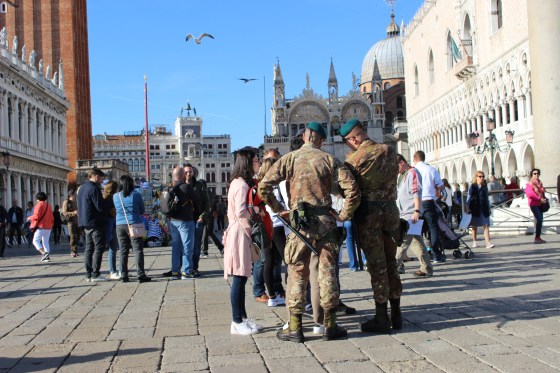
After our trip we sit by St Mark’s Square people watching. A Chinese couple (there are lots of Chinese tourists here) are being interviewed by Italian soldiers? I am sure that they were in another Gondola we passed on our trip. There is a lot of gesticulating and wagging of the finger going on. I can’t help but wonder … what on earth had they got up to on their Gondola when under the Bridge of Sighs?

Jim Binney

Leave a comment

SUNSHINE AFTER THE RAIN (Deaf in Venice 1)

image

We are in the wonderful city of Venice for 10 days celebrating two special birthdays this year – Julia was 60 in May and I will be 75 in November. Julia has never been to Venice but I first came here nearly 60 years ago on a school trip when I was 16. That visit is eternally etched in my memory because our Latin master took 40 of us hormonal teenagers to Rome and Venice on his honeymoon?! He was a Roman Catholic and we stayed in hostels run by nuns. You can imagine the chaos.

To be truthful I can’t remember that much about that visit so I too am looking forward to being here in this remarkable city. I am calling this short series of blogs ‘Deaf in Venice’ because amongst Julia’s pet names for me ‘Deafo’ is becoming more prominent. It is not that I am really gradually becoming more deaf – I have had my hearing tested and am just about on right side of the scale – it is that (like many married men) I have developed selective hearing. It actually runs in the family. My late Uncle Ron had one of those old fashioned huge deaf aids, and his wife, my Auntie Ethel, used to talk a lot. I asked Uncle Ron one day how he coped with her non-stop chatter. He smiled knowingly, pointed to his deaf aid, and said, ‘I just switch it off! I can see her lips moving, and I have learned to nod every now and again, but for the most part I live in a world of peace and quiet!’

‘Deaf in Venice’ is therefore a good overall title for these blogs firstly, because ‘Deafo’ is here, and secondly, our Guide Book informs us that the film ‘Death in Venice’ is amongst the top ten most famous movies to be filmed here in Venice. The new Spider Man movie is actually being filmed here right now.

We leave Gatwick in glorious sunshine and arrive in Venice in pouring rain. We hope it is not going to be like this for the next 10 days. We catch a water bus from the airport to the the appropriate stop five minutes walk from the apartment we have rented from friends. The water buses are great and a lot cheaper than the water taxis. We were told that the water bus trip from the airport to Venice takes about 40 minutes but is wonderful, especially in the late afternoon/early evening because you see Venice rising out of the mist in the light of the setting sun. All we see is mist and rain. When we arrive at our stop we don our rain gear, I put up the umbrella I bought back in the UK at a budget price, and venture out in the gale. My umbrella lasts about 30 seconds before it blows inside out and all the spokes bend and break!

We find our way to our apartment … and it is marvellous! We settle in, unpack, have a cup of tea and a rest, and then venture out to find a restaurant and dinner. The storm has abated, the rain has slackened off, and we make our way down narrow lanes and over umpteen small bridges over numerous canals to a Pizza Restaurant that Julia has made a note of in the meticulous planning of our holiday because it is a gluten free Pizza Restaurant. We pass several other really nice looking restaurants on the way but Julia has her heart set on a gluten free pizza and a glass or two red wine! We enter the restaurant, find a nice seat, we are made very welcome … but when we order a gluten free pizza for Julia we are told that this gluten free pizza restaurant doesn’t actually sell gluten free pizzas! We leave and go back to one of the restaurants we have already passed … and we share an excellent seafood risotto, and a glass or three of delightful red wine.

After a lovely evening we return to our apartment and enjoy a really good night’s sleep. It is amazingly quiet here, not because I have become even more deaf I realise but because there are no cars, or buses, or even motor bikes! We wake in the morning to glorious sunshine – the sunshine after the rain.

Jim Binney