In July 1945, when Clement Attlee had led the Labour Party to Victory in the General Election, the Rev Dr Howard Williams (who was the Minister of Blenheim Baptist Church, Leeds, at that time, and a life-long socialist himself) caused a stir with a ‘wayside pulpit’ notice outside the church which read: ‘CHANGE OF GOVERNMENT. One lot of sinners out! Another lot of sinners in! It caused uproar in the city council and, with Williams away on holiday, the embarrassed Blenheim Baptist Church Deacons covered the poster with plain paper?! On his return Williams wrote to the Yorkshire Post explaining that all he meant was that all of us are sinners and the current crisis was not just economic and political but also moral. In any case the offending words were not original to Williams but borrowed from Studdert Kennedy, ‘Woodbine Willie’.
Nearly 80 years later we have another General Election looming. Whatever the result I have to confess that I too would rather like to put a large notice outside our church, Abbey International Baptist Church in Reading, saying much the same thing as William’s notice did… and for much the same reason. I am not one of those Christians who believes that faith and politics don’t mix. Quite the reverse. I believe every Christian should engage with politics and vigorously put forward their views. C H Spurgeon (1834-1892), a prominent Baptist Pastor of his day, had no hesitation in encouraging his people to vote Liberal (the Liberal Party of his day). Politics is important but, in and of itself, can only provide the framework of a building or the skeleton of a body. It cannot create a home or a living being… for that we have to look elsewhere.
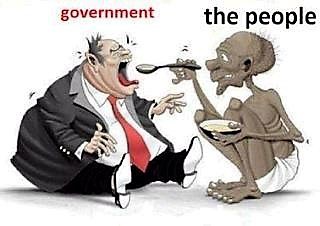
Politics are the activities associated with the governance of a country, and in a democracy such as our own the definition of democracy as ‘the government of the people, by the people, for the people’ (Abraham Lincoln) has a lot to commend it. I would hope that every candidate standing for parliament in the upcoming General Election would ask themselves the question, ‘Why am I standing as a candidate in this election?’ Are they standing in order to genuinely benefit all the people in the communities they are seeking to represent… or do they have another agenda entirely? Agendas driven primarily by party politics or personal opinion rather than the good of the people?
According to Carnegie UK the democratic wellbeing of England is in crisis with less than half of the English public (45%) believing that democracy works well in the UK and an overwhelming majority confessing that they do not trust MPs (76%) or the UK government (73%) to make decisions that will improve their lives. Whilst distrust of those in national political life is highest, local authorities do not escape unscathed with 60% making similar judgments about councils. This lack of trust pervades every facet of everyday life with only around a fifth (18%) trusting what they see and hear in the media and fewer than one in ten (8%) trusting social media content. In contrast public services, such as doctors and transport services (71%), official statistics (61%), and even businesses used by respondents (51%) were on the whole trusted by the public.
I appreciate that many of my generation have a tendency to look back and see the past through rose tinted spectacles, but I seem to recall days (both here in the UK and across the pond in the USA) when politicians of all parties had certain standards that they more often than not adhered to. In many cases politicians were honest enough to resign at the slightest whiff of scandal and no-one considered themselves to be above the law. Admittedly these standards were based on common Judaeo-Christian ethics or values which underpinned them. Values that have been systematically eroded over the last 40 years here in the UK, and distorted beyond recognition by the evangelical right and the so-called Apostolic-Prophetic Movement in the US. Today lying has become a virtue and setting oneself above the law a way of life. If Howard Williams thought that there was a ‘crisis’ in the UK in 1945, a crisis that ‘was not just economic and political but also moral’ whatever would he think of what is going on in the UK and USA right now?
To suggest (as Williams did in his day) that the reason for this moral decay is because we are all ‘sinners’ is equally controversial. People do not like to think of themselves as ‘sinners’ indeed quite the reverse. My late mother-in-law maintained right to the end of her life that she was not a sinner because she had ‘never committed adultery or stolen anything from the corner shop’. In her mind it was those two things that constituted someone being a sinner. If we believe in sin at all, sin is what other people do, not us.
But what exactly is ‘sin’? The dictionary defines ‘sin’ as ‘the offence of breaking a religious or moral law’ but in these days – when we seem to make up our own morals as we go along – the dictionary definition is not that helpful. Actually, the Bible (bear with me here) is probably more useful in helping us to understand the meaning of sin than we might think. The Bible, by the way, is by far the most published and yet least read – and even less understood – book of all time. Many people, religious and not, find strength wisdom and inspiration from its content. Of the several different biblical words for ‘sin’ the word that is used most frequently (probably because it is the most helpful term) in the New Testament is the Greek word hamartia. Borrowed from archery it means ‘missing the mark.’ It is the most comprehensive term for explaining sin. Paul used the verb hamartano when he wrote, ‘For all have sinned, and fallen short of God’s target’ (Romans 3:23) to explain what is wrong with all of us. None of us is perfect and, despite our best efforts, we all fail to live up to our own standards leave alone God’s. Deep down we know this.
Sticking with the Bible for a moment or two longer, the biblical Creation Narrative tells us that each of us is ‘created in the image of God’ (Genesis 1:27). Whatever else this means (and it probably means a lot of things), I would suggest that it implies God has implanted a sense of ‘conscience’ within each one of us – some kind of ‘receiving set’ – by which we all subconsciously, deep down, instinctively know the difference between right and wrong, good and bad. This is why the Apostle Paul tells us that ‘since the creation of the world God’s invisible qualities – his eternal power and divine nature – have been clearly seen, being understood from what has been made, so that people are without excuse’ (Romans 1:20). This sense of knowing the difference between right and wrong, good and bad, can of course become totally depraved, deadened, over time by our refusal to listen, respond, do the right thing etc. as the pages of history (and the front pages of our newspapers today) all too often sadly illustrate. This is why Williams was correct to suggest in 1946 that, whatever the aspirations of the Attlee Government (and every other Government subsequently for that matter) it was effectively ‘One lot of sinners out! Another lot of sinners in!’
Because of our propensity to ‘miss the mark’ we need to temper our ambitions and agendas, and our language and promises, with a good dose of humility, especially those of us who are ‘platform people’ such as preachers and politicians and the like. As the Apostle Paul wisely encourages us elsewhere in his Letter to the Romans: ‘Do not think of yourself more highly than you ought, but rather think of yourself with sober judgment’ (Romans 12:3). Whatever the particular hue of our politicians (and preachers) today we could do with less arrogance and inflated egos, a greater willingness to listen rather than shout others down, coupled with a greater willingness to put the needs of others before personal material gain. As the Old Testament Prophet Micah reminded us many years ago: ‘[God] has already made it plain how to live, what to do… what [He] is looking for in men and women. It’s quite simple: Do what is fair and just to your neighbour, be compassionate and loyal in your love, And don’t take yourself too seriously – take God seriously’ (Micah 6:8).
Jim Binney
 therevdrjs
[…] Now that doesn’t mean I’m going to break my promise and give some steer on which party I think people should vote for at the General Election next month. I will remain publicly neutral on that. And I recognise that the economic situation will be challenging for whoever is in Downing Street. I would rather pose the question as a Baptist minister friend of mine couched it the other day. He wrote: […]
LikeLike