Leave a comment

Thursday 4 October: EARTHQUAKES AND ENLIGHTENMENT

We are woken at 5.00 a.m. by an earthquake. Well it sounds like an earthquake. The only member of our group who will be pleased by this is Charlene. She is very interested in earthquakes and records their occurrences on her computer daily. I ask her why she does this? Is it because she has a scientific interest? She tells me that she does … but that they are also ‘signs of the times’. Actually, as it turns out, our ‘earthquake’ is the dust cart collecting the rubbish from the local shops and houses. We hope that this is a weekly, and not a daily, collection. Well I guess that there had to be a downside somewhere about stopping in this great little hotel.

Julia spends an inordinate length of time in the super shower and I follow suit. Another hot day is forecast. We are getting used to daily temperatures of around 33 degrees. We enjoy a really nice breakfast and then head up to the Seminary in time for this morning’s lecture. It takes about 10-15 minutes to walk up the hill to the college and we see it as part of our fitness regime for the month. Today Azar is enlightening us on the subject of  ‘Christian Arabs in Israel’ … and it is an excellent lecture, with plenty of time for questions and discussion, and we learn a lot. We also love the way lectures happen over here with various breaks for coffee, phone calls, and interruptions from the office. Just like being back at Spurgeon’s College really?!

Essentially the lecture is about the fact that evangelical Arab Christians are a minority within a minority within a minority. The population of Israel is approximately 7.5 million of which only 160,000 are Arabs. Of these 90% are Moslem and only 10% are Christian. Of these Arab Christians somewhere between 5,000 and 10,000 are evangelical Christians. There are also about 15,000 Messianic Jews. Although they often have relatives in the Palestinian territories, Israeli Arabs are often seen as ‘not quite the ticket’ by the Palestinians for remaining in Israel. It is absorbing stuff and Julia and I come away wishing that more western Christians would take the time and trouble to really learn about the situation here in Israel and not simply ‘buy into’ the very biased stuff that is churned out on the various ‘God Channels’ on our TVs at home.

After the lecture we have the rest of the day free so Julia and I walk back to our hotel, stopping off at a supermarket to buy some stuff for lunch. We think that it will be cheaper to do this than to buy something from one of the food outlets or restaurants en route. Julia buys a huge bag of almonds as well … so it would probably have been cheaper to have gone to a restaurant after all! When we get back to our hotel we have a rather yumacious picnic in our room, followed by a power nap, before I get down to writing up my daily blog which is now several days behind schedule.

Dinner is at 7.00 p.m. but at wine o’clock (that is 6.00 p.m. for the uninitiated) Julia and I play hooky and stroll down to one of the cafes in the square by the Greek Orthodox Church of the Annunciation for a couple of cold beers. They are almost as good as the Arabic coffee that I am fast becoming addicted to! We stroll back in time for another splendid meal up on the terrace. This evening they bring us candles as well as food … it all looks very romantic … they are obviously out to impress. I guess they would like the regular business that NETS have to offer. The Arabs in Nazareth are so pleased to actually have people like us staying in Nazareth. Apparently the tourists normally just bus into Nazareth, do the sites, and then leave again all in the one day. We wonder if this is because most of the tour guides are Jews and Nazareth is 100% an Arab city?

Jim Binney

1 Comment

Wednesday 3 October: A CHANGE FOR THE BETTER?

20121007-201806.jpg

Today we have to vacate our hotel for two nights. Although we are supposedly booked in here at Saint Margaret’s Hostel for the best part of four weeks they have a big group arriving today and need every available bed in the place to accommodate them all. Since things are done very much on a relational basis in Arab culture, and since the seminary want to keep their current good relationship with the people at Saint Margaret’s, it has been agreed that our party will move down to Villa Nazareth, a new guest house, just off the square by Mary’s Well and the Greek Orthodox Church of the Annunciation. It looks very nice from the outside. We walked past it on Monday when May took us round some of the sacred and historical sites of Nazareth. Quite what it will be like on the inside we don’t know. Saint Margaret’s are footing the bill because we are helping them out by agreeing to move out for a couple of nights.

After breakfast Salim organises a taxi for us – Saint Margaret’s are paying for that as well. We are not taking all our stuff with us – just enough for the two nights – the rest is being stored somewhere at Saint Margaret’s. When the 10 seater taxi arrives we load all our stuff into the back of it and climb on board. I am sitting in the front seat next to the driver. It proves to be an interesting drive down into the centre of Nazareth as the taxi driver indulges in the usual illegal turns, reversing into busy traffic, talking on his mobile phone as he drives, stopping for a chat when he sees a friend, squeezing past cars and lorries that are parked where they shouldn’t be, and driving at speed down narrow back streets – all of which appear to be the lot of anyone brave enough to drive in Nazareth.

Eventually we are deposited outside the Villa Nazareth, where we are welcomed by a very nice young lady, who explains that our rooms are still being prepared as it is only 9.30 a.m. and normally new guests are not allowed in until after 3.00 p.m. We sit in a very comfortable lounge area for about 30 minutes and then we are shown to our rooms. They are luxurious. A nice king-sized double bed, a silent air conditioning unit, a great bathroom with a shower that doesn’t leak or needs the shower head to be held if you actually want to shower all over. We wonder what the food will be like? We wonder if we can stay here for the next three weeks or so?

After we have settled in we walk up to the seminary for our morning lecture. It is only a 10 minute walk or so and there is some nice Arab coffee waiting for us when we arrive. May is speaking to us this morning about the cultural differences between the Western and Arab worlds. It is very interesting, informative, and challenging. We learn a lot and I can’t help but feel that there is a lot to be said for the more relaxed approach to life espoused by the Arabs in contrast to the driven-ness of our Western world. After the lecture and discussion that it provokes we wander down into Nazareth to find some lunch before those of us who arrived on Sunday go to visit the supposed site of the precipice where the crowds attempted to throw Jesus from after his first recorded sermon (Luke 4:28,29).

May and Phil drive us up to the Precipice Site in two cars. It is impressive, and the views are amazing. We can see all over the surrounding area – a panoramic view of Nazareth itself, the Valley of Armageddon, and Mount Horeb. There are plaques in Hebrew, Arabic and English that all tell us that this is the site where Jesus escaped from his persecutors by jumping off the precipice?! We find this blatant misinterpretation of the story in Luke somewhat amusing and have visions of Jesus abseiling down the face of the precipice rather than simply walking through the crowds.

Phil drops us off at the roundabout by the Peace Mosque and we walk up through the market back to our new hotel. We want to visit the Site of the Ancient Synagogue where Jesus preached as a young man, and where he read from the Prophet Isaiah – ‘The Spirit of the Lord is upon me …’ and applied these words to himself (Luke 4:18,19) – which resulted in the congregation wanting to throw him over the precipice for committing blasphemy. Julia and I visited this place last time we came to Israel, and it is even better than we remember it. Julia reads the story from Luke 4 aloud … and then we just sit quietly and prayerfully and reflectively, recalling the fact that this story happened right here on this site 2,000 years or so ago.

We walk back through the market and arrive back at the Villa Nazareth in time to have a rest before dinner. What will dinner be like we wonder? Will it be as good as the rest of this hotel? We eat together as a group at a long table on the balcony restaurant in the open air … and dinner is great! We have the usual salads to start, plus plenty of fruit juice to drink, and the main course is chicken once again, but it is delicious. The group is beginning to gel nicely and we enjoy good conversation. We have coffee after the meal, before retiring for the night, and we are all agreed that we would have liked to have stayed here all the time! We guess that it is probably far more expensive than the cost of staying at Saint Margaret’s, however. We are glad that they are footing the bill and not us!

Jim Binney

Leave a comment

Tuesday 2 October: BOATS, BAPTISMS & BURGERS

We have a big trip ahead of us today. We are going to Galilee. Julia and I love this area and are really looking forward to visiting it again. We say our prayers, enjoy our usual interesting hostel breakfast – I am still not sure of all that I am eating, but that has never stopped me yet – and then board our 15 seat luxury coach. Phil is our guide today. David and Margi, and Graham and Rosemary arrived late last night and they all seem very nice. We get to know them a bit over breakfast and on the hours’ journey to Galilee.

Our first port of call is Ginosar, situated on the shores of the Sea of Galilee a few miles north of Tiberius, where the remains of an ancient boat in the mud of the lake was discovered a few years ago. Julia and I have seen this before when we came with a group from Beckenham Baptist Church (where we were the Ministers at the time) in 2004. The exhibition centre is next door to the magnificent kibbutz hotel where we stayed then. Seeing it all again evokes pleasant memories for us. Julia and I don’t bother to go into the exhibition again. We have seen it before and it is not worth paying to see it again. We go for a coffee while the rest of our party go to see the ancient boat. Phil joins us because he too has seen it before. I order an Arabic coffee – I am really getting to like this stuff – but something gets lost in translation and I end up with a Turkish coffee, which tastes like stewed sawdust in treacle.

Once our group has reassembled we take the short walk to the jetty where we are going for a trip out on to the Sea of Galilee in one of the replica craft that cater for the tourist trade. We are really looking forward to this after taking the same trip eight years ago. We have really sold it to the rest of our group – taking a boat across to the other side of the lake; seeing the Church of the Beatitudes and the beach at Tabgha from the sea; listening to one or two of the relevant gospel passages being read to us; an opportunity for silent reflection and prayer. I should have known better? When we tell one of the boat captains that we are booked to sail with Daniel he smiles knowingly, and points to another boat approaching the jetty. The sound of singing drifts across the water to us. I start to feel anxious for some reason. When we get on board and I see that there is a keyboard player as a prominent member of the crew I get even more anxious. The boat pulls away from the shore and when we are too far away to jump ship, Daniel gets on the microphone. He tells us that he is a Messianic Jew, the only Christian captain sailing on the Sea of Galilee, and shares his testimony with us. He then introduces a friend who shares a testimony about being miraculously healed of cancer the previous day. I know that several of our party have lost partners as a result of cancer and feel very embarrassed and concerned for them. Daniel then tell us that he is a gifted singer and proceeds to sing to us for the next half an hour before trying to sell us the CDs of himself singing that he has had produced. We are only a third of the way out into the lake? Daniel has a captive audience! Why haven’t we gone over to the other side of the lake to see the sites we want to see? Where are the relevant bible readings? Where are the times of quiet to pray and reflect? I want to throw myself overboard! When we get back on dry land I feel desperately disappointed. Fortunately Julia and I have been on Galilee before and we can still recall the simplicity and profundity of that experience. It is that time I will remember when I think of being on the Sea of Galilee.

After our boat trip we get back on our coach and take the short trip to Tabgha where we visit the Church of the Multiplication, built on the purported site of Jesus’ miracle of the Feeding of the 5,000, and the Church of Peter’s Primacy which is built over a large rock and purports to be the place where Jesus commissioned Peter with the words, ‘You are Peter, and on this rock I will build my church’ (Matthew 16:18). The beach at Tabgha was a favourite meeting place of Jesus and his disciples, and the site of many important happenings. It is one of my favourite places and I am so pleased to back here. Julia paddles contemplatively in the sea while I sit on a convenient rock and contemplate prayerfully as well. All too soon it is time to leave and I drag myself reluctantly away … comforted by the thought that we are about to have lunch, another of my favourite things!

Our coach driver takes us to a nearby restaurant that specialises in fish and we indulge our selves in freshly caught and cooked Saint Peter’s fish. It is truly yumacious! After lunch we drive a short distance to Capernaum on the northern tip of the lake which became a second home for Jesus. We look round the fascinating ruins – the site of the synagogue where Jesus used to preach, and the site of Peter’s house where Jesus healed Peter’s mother-in-law and performed numerous other miracles (Matthew 8:14-16). We all sit together in the shade in the ruins of the old synagogue and Phil reads the story to us from the bible. We then spend some time in quiet, reflective prayer.

From Capernaum we drive up to the Church and Monastery of the Beatitudes standing on a hilltop overlooking the Sea of Galilee. It is considered to be the site where Jesus preached what has become known as ‘The Sermon on the Mount’ (Matthew 5-7). It is a beautiful setting and very evocative. Set in a natural amphitheatre one can imagine, and almost hear, Jesus speaking out those wonderful words. We sit by the chapel and listen to a section from the sermon being read to us, the Beatitudes, and then we take some time out to wander quietly around the gardens thinking about what we has just been read to us.

We drive through Tiberias, on the way back to Nazareth, stopping off at the baptismal site on the River Jordan. There are lots of people getting baptised … well, more accurately, there are a lot of people baptising themselves!? It is both completely fascinating and thoroughly disturbing at the same time. You can only be baptised if you buy a robe from the gift shop, and then you have a half hour slot to get it all over and done with. The whole thing is supervised by various surly stewards. As far as I can make out the majority of ‘baptismal candidates’ baptise themselves by making the sign of the cross, pinching their noses, and then dunking themselves under the water. The really keen ones (or is it the really superstitious ones) do this repeatedly. Quite what their ‘theology of baptism’ is, I haven’t got a clue? In the midst of all the chaos there actually seems to be some genuine baptisms taking place which is encouraging, as church groups baptise new converts.

After a full day we return to Saint Margaret’s in time for a short rest and then dinner. We are all feeling rather stuffed after our huge lunch and so we are pleased to see that there is no chicken dish tonight – only a light salad laid out for us. We are enjoying our salad when Salim arrives with bowls of soup for us. We want to be polite so we eat our soup as well. And just when we are finishing Salim arrives with a huge plate of home made burgers … followed by a huge plate of chips! Even I cannot eat everything this time!

Jim Binney

Leave a comment

Monday 1 October: CHAPELS AND CHICKENS

Today we are going down to the Nazareth Evangelical Theological Seminary. We are having an orientation session with May, who will outline the programme for the month with us, and we will also have an opportunity to look around the college and meet the rest of the staff.

We have breakfast at 8.30 a.m. which is an interesting mix of humus, cheese, ham, eggs, tomato, cucumber, and bread. The bread is a bit like pitta bread and I rather like it. The coffee tastes rather like Bovril so I think I will stick to tea from now on. After breakfast May and Azar collect us in their cars and transport us to the college. Nazareth is 100% an Arab town – the largest Arab town in Israel with a population of around 70,000 although that can rise to as many as 250,000 on a working day since it serves as a centre for the surrounding region.

The college is compact but very nice with a library, offices, lecture rooms and a kitchen. It is nice to meet up with Bryson (who is the President or Principal of the college), and Azar, and Phil Hill (two of the lecturers here). I have met them before – a few years ago, at Spurgeon’s College in London where I was studying for a research degree. They were in the UK for discussions regarding NETS linking up with Spurgeon’s in order to take on board the same BD degree that Spurgeon’s teach, in Nazareth. At the time there was some talk about me acting as some kind of ‘link person’ between the two colleges. Although this didn’t materialise in the end I retained my interest in the work in Nazareth and have always wanted to return to Israel to learn more about the work amongst Arab Christians.

Our morning begins with Arabic coffee which I am somewhat suspicious of to begin with but which is actually really nice. We all gather in Bryson’s office and share our stories – who we are, why have come on this sabbatical, and so on. I love hearing people’s stories, and some of the stories are very moving. If there is a common theme, apart from the fact that we are all Christians, it is testimony to how God has graciously brought us all through difficult times. There are still four more members of our group to arrive. They will be flying in tonight – David, a Church of Scotland Minister and his wife Margi, a medical doctor, and Graham, another Church of Scotland Minister, and his mother, Rosemary who is retired. They couldn’t arrive before today because both of these reverend gentlemen were preaching yesterday.

After our coffee, and the sharing of our various stories, May gives us each a copy of the programme for the month and talks us through the various days activities. Essentially our month will comprise of a combination of various classes in which we will learn about the situation in Israel, visits to major sites of historical and spiritual importance, and opportunities to share in ministry of various forms as well as visiting various different Christian congregations in the vicinity. It looks great and we are really looking forward to it.

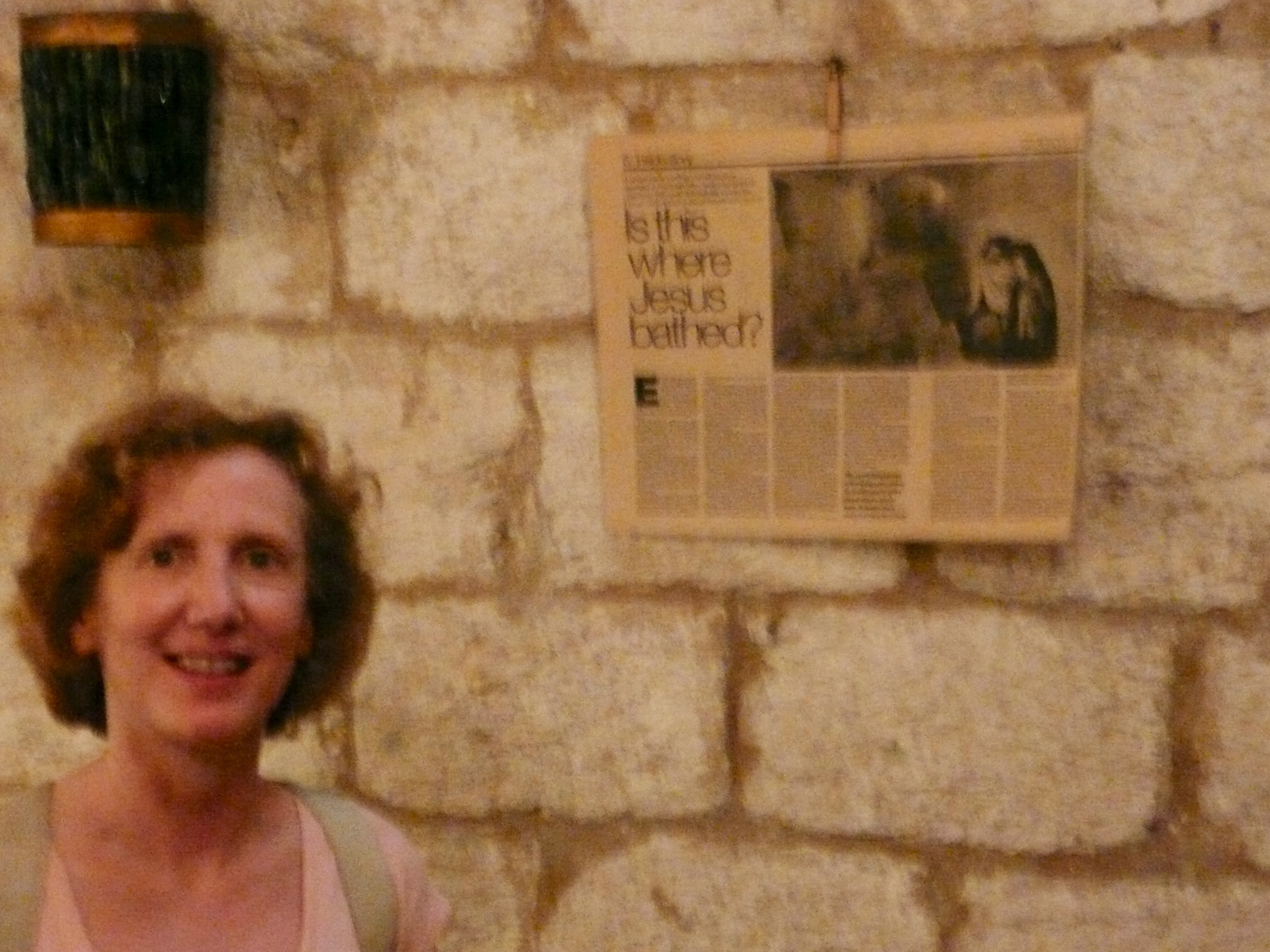
After our orientation we wander down into the centre of Nazareth with May. We grab a bite to eat at one of the numerous food outlets. I opt for a ‘falafel’ which is like an open sandwich stuffed with all sorts of local produce. I haven’t got a clue what is in it, but it is yumacious! After our ‘on the hoof’ lunch, May takes us round the various local sites of interest. We visit Mary’s Well, the Greek Orthodox Church of the Annunciation, the Roman Catholic Church of the Annunciation, and the recently discovered site of an ancient Roman bathhouse that dates from the time of Jesus where we are assured that ‘Jesus washed here!’ Some of these sites we have seen before, but it is so good to be back. Somehow they seem to mean more to us this time. Perhaps it is because we have more time, or maybe it is because I understand the geography and the places better than when we were last here? As per usual I take loads of photographs … even though I probably have similar photos of the same places back home – photos I took eight years ago when we were last here!?

We catch a bus back up to Saint Margaret’s. May comes with us to make sure we don’t get lost. I manage to get lost even before we get to the bus stop. One minute we are all together and then, because I have stopped to take yet another photograph, everyone else has disappeared! I wander around aimlessly looking for the other members of the group. They are nowhere in sight. Eventually I find Chris and Margaret. What a relief … until I realise that they are lost as well! The three of us wander around aimlessly looking for the other members of the group. Just as we are giving up, Julia finds us! Where would I be without her? She takes us to the bus stop where we eventually get a bus back to our hostel. We arrive just in time for dinner! It is chicken again! We have the feeling that we are probably going to get a lot of chicken?

Jim Binney

Leave a comment

Sunday 30 September: PARTY TIME

We wake up in good time to fit in another final full English breakfast before driving to the airport to catch our flight to Israel. Included in our overnight stay package at the Premier Inn are two ‘all you can eat’ breakfasts. As per usual my eyes are bigger than my stomach and neither of us can actually eat as much as we think. If the truth be told we are still full up from last evening’s sumptuous meal. But we don’t know what we are going to get to eat for the rest of the day so we force ourselves to eat as much as possible anyway!

After breakfast we take the short drive to the mid-term car park where we are leaving our car for a month. It is all very straight forward really. We park the car and then catch the shuttle bus to the terminal. We have been told to arrive by 9.30 a.m. but we are there by 9.00 a.m. in the hope of being able to get some ‘speedy boarding’ passes. We are flying by easyJet and we know from previous experience that it can sometimes be something of a ‘bun fight’ to get two seats together without speedy boarding. We tried to book them on line when we were informed that we were flying by easyJet but couldn’t do so since it had to be a whole party booking and some of our party didn’t want speedy boarding. We have been assured that getting speedy boarding won’t be a problem because ‘speedy boarding can always be purchased on the day’. When we go to the easyJet information desk we are told that no speedy boarding is available because they were all sold out weeks ago?!

We return to the easyJet check in only to be told that we have to wait until 9.25 a.m. on the dot in order to check in. Finally we are allowed to check in and discover that our cases are well within the weight limit … unlike the couple ahead of us who seemingly have to dispose of half the contents of their cases. The cheap luggage scales we purchased from the 99p shop in Weymouth (Weymouth is too poor have a £ shop) have actually worked in our favour by erring on the right side.

Having disposed of our luggage we go through security without any problems – no removing of shoes or belts this time – and head for Starbucks for a coffee. We sit in the departure lounge for an hour or two until our flight is called. We are then separated into three queues – one for those with speedy boarding, one for those with young children, and one for the rest of us. The queue for those with speedy boarding seems immense. The queue for those with young children is reasonable … until the ground staff invite all those who are prepared to have their hand luggage stored in the hold to join it. Immediately half the remaining people in our queue desert and join the queue for those with young children?! As it turns out we have nothing to fear. Our plane holds more people than those who are travelling and Julia and I get a couple of nice seats by a window.

We are joined by a very nice young Jewish lady who is flying back to Israel after a walking holiday in Scotland. She tells us that her name is Michel (like King David’s wife) and that she is a computer software designer. I ask her if she can show me how to work my new iPad? She laughs! We enjoy a smooth takeoff and a pleasant flight. After an hour or so I get up and go for a walk down the plane to find the toilets. I get into conversation with a very pleasant young man who asks me why I am going to Israel? I tell him about our sabbatical and he asks lots of good questions. He tells me that there is another group of Christians on board who are going to Israel to ‘stand in prayer with Israel’ and wants to know if I am part of this? Later on I meet up with some of this group. They are very pro-Israel, and we have an interesting conversation as I have a heart for the Arab Christians.

After a very pleasant flight, during which we enjoy an excellent packed lunch that we bought at Luton Airport from Pret-a-Manger (surprisingly it was quite cheap) we land in Israel. We get though customs quickly and easily and are met by a man with a large NETS sign (short for Nazareth Evangelical Theological Seminary) who turns out to be a taxi driver sent to drive us to the Saint Margaret’s Hostel in Nazareth where we will be staying for the next few weeks. We also meet Chris and Margaret, who are also going on this sabbatical, who were on our flight but neither of us knew what the other couple looked like. They come from the Southampton area and are very nice. We look forward to getting to know them better.

It takes just over an hour to drive from the airport to Nazareth. When we arrive at Saint Margaret’s Hostel, May Arthur (the wife of the Principal of the Seminary) and Azar Ajaj (one of the college lecturers) are there to meet us. May has made all the arrangements for us, and she is also one of my Facebook Friends, so although we have never met I feel that I know her already. Another member of the sabbatical group, an American lady named Charlene, is also there. There is an amazing party going on in the hostel courtyard when we arrive. We wonder if it has been arranged in our honour to welcome us to Saint Margaret’s, but it turns out to be a Christening Party for an Arab Christian family.

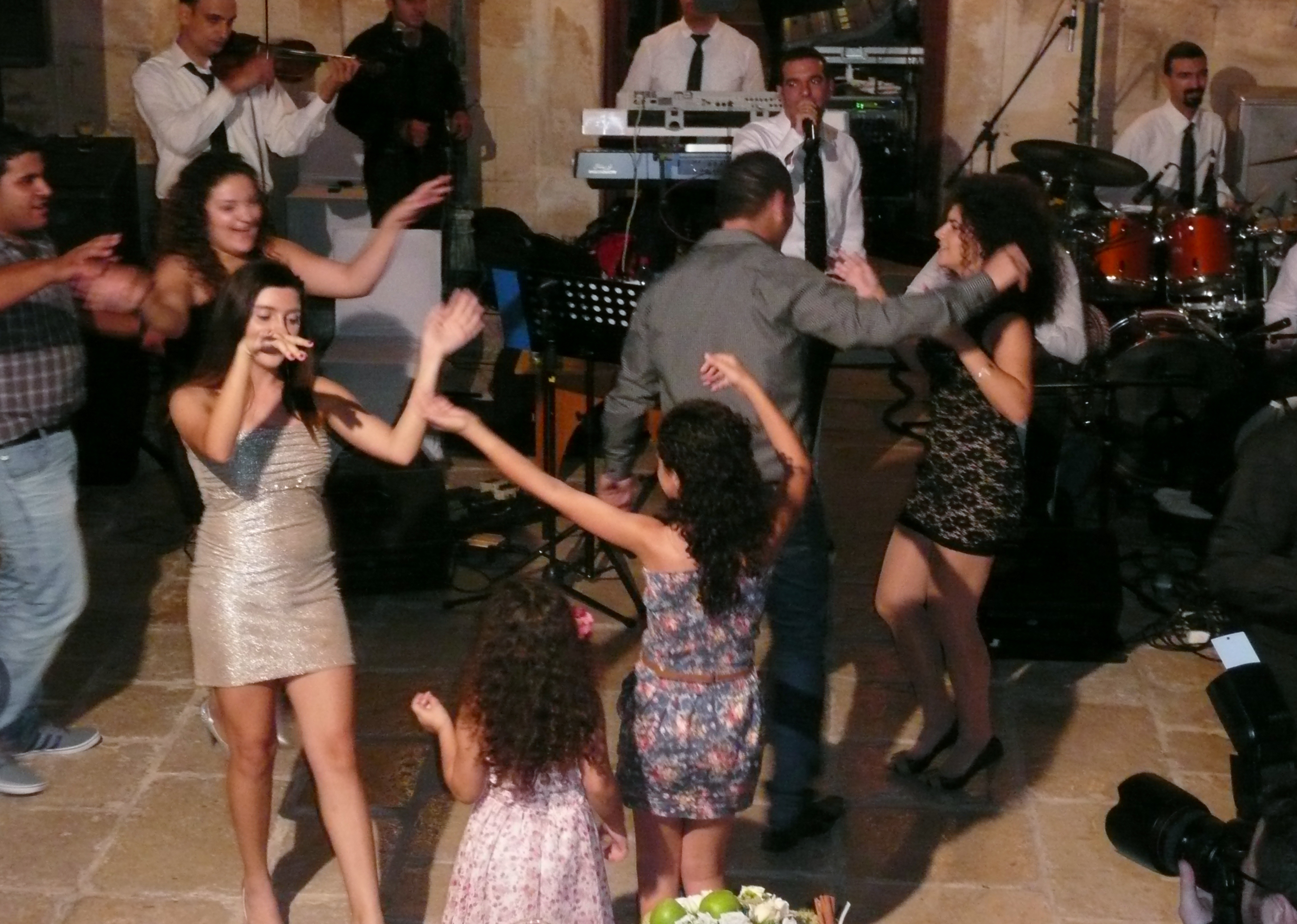
We are shown to our room and our luggage is carried up for us. It is quite a nice room, somewhat basic but en suite, overlooking the courtyard, with a large TV that has English speaking news programmes, and internet access. A light supper has been prepared for us that actually turns out to be quite substantial. There are the various salads that we remember from the last time we were in Israel, and there is chicken as well. After supper we return to our room and unpack. We then go down to the courtyard to watch the Christening Party celebrations. It is fascinating. There is music and dancing to go with the eating and drinking. The men are all handsome and smartly dressed, and the women are all gorgeous and wearing dresses out of the latest fashion magazines. They are having a wonderful time. It is a real celebration of one of the rites of passage – the birth of a new baby. There is a great band, and the dancing is fascinating. It is kind of slow but very rhythmic, and even I would be able to do it. It is a kind of ‘dad dancing’ but nice with it! Julia and I just sit there watching everything that is going on and thoroughly enjoying every moment. We are so glad to be back here again and are really looking forward to this sabbatical time. Eventually we go to bed, tired but happy, with the music still ringing in our ears … which is just as well because the party goes on until gone midnight!

Jim Binney

Leave a comment

Saturday 29 September: BAD DOGGIE

Today we leave Chipps Barton on the first stage of our journey to Israel. We have packed our cases and just about managed to get everything in within the 20 kilos limit. Fortunately we only have to get two cases and a couple of small travel bags into our Corsa. We can almost audibly hear our little car sigh with relief. No tent and all the other things we usually have to cram in when we go camping in France for the summer.

Julia sits on her case while I do the zip up, put a strap round it, and lock it. We weigh it just to make sure it is o.k. It is exactly the correct weight now that Julia has removed  a number of clothing items ‘that she just had to take with her’ originally. Congratulating ourselves on our efficiency we stand the case on its side … and it explodes! We knew that one of our cases had a suspect zip but we couldn’t remember which one. We now know that it is this one. Well we hope that it is this one? Fortunately we have a loft full of suitcases and we soon replace the broken one.

Reggie Doggie, the family Jack Russell (who doesn’t know that he is a dog but thinks he is human) knows that something is up. He follows us all round the house, constantly getting under our feet. For the last two years, when we have been packing up the car to go to France, he has tried to stow away. We wonder what tricks he will try is time? He is in a right mood and whines pitifully when the time comes for us to leave. He will only be on his own in the house for a short time. Julia’s mother, Olivia, will be back from her coffee morning soon.

We are flying out of London Luton Airport tomorrow. Our flight is not until 12.25 p.m. but we have to be at the airport by 9.25 a.m. so we are staying overnight at the Premier Inn by the airport. We like Premier Inns. They are not too expensive and provide a good standard of accommodation. We have a great room with triple glazing and air conditioning … the airport is right next door. Indeed we wonder if the planes are taking off from the hotel car park? There is a Beefeater Restaurant in the hotel complex and we book a table for later in the evening.

Julia phones home to make sure that her 85 year old mother is coping without us. I am not directly involved in this phone conversation but am soon made aware that all is not well. We knew that Reggie Doggie was not too happy about us going away, but apparently when Olivia took him for a walk during the afternoon he slipped his lead and ran away. Olivia was very upset and had little choice others than to come home and ask a neighbour to go and look for him. Eventually he was found hiding in a ditch … bad doggie!

We enjoy a really nice meal at the Beefeater Restaurant, made better by the fact that the wine waiter forgets to bring us the bottle of wine we have ordered to go with our food so the management gives us two huge glasses of top quality wine free, gratis, and for nothing to compensate for their error. The glasses are so huge, and the wine is so top notch, that we cancel the bottle we ordered and just enjoy these two glasses with our food, before returning to our room and a good night’s sleep before flying out to Israel tomorrow.

Jim Binney


Leave a comment

REVIVAL … WITH A DIFFERENCE?

It is said that when Dr Billy Graham came to the UK in 1953 he visited Wales. Whilst there he spoke at a meeting for Ministers and Lay Leaders, many of whom could remember the 1904 Welsh Revival. ‘Do you remember the 1904 Revival?’ Dr Graham asked. ‘Yes! Yes!’ came the reply from the congregation. ‘Are you praying for God to send another Revival?’ Dr Graham asked. ‘Yes! Yes!’ came back the enthusiastic reply. ‘Would you like the Revival to be as it was in 1904?’ Dr Graham asked. ‘Yes! Indeed yes!’ his excited hearers responded loudly. ‘Are you prepared for such a Revival to be completely different?’ asked Dr Graham. His congregation responded with stunned silence!

According to James Packer ‘Revival, as Protestant theology has used the word for 250 years, means God’s quickening visitation of his people, touching their hearts and deepening his work of grace in their lives. It is essentially a corporate occurrence, and enlivening of individuals not in isolation but together.’ This phenomena is not to be confused with the narrower American use of ‘revival’ for a concentrated evangelistic campaign, and of ‘revivalist’ for its leader, but rather describes something far more significant, profound, deeper in terms of spiritual impact. The Reformation in the 16th century, the 18th century Evangelical Revival in England, the first and second Great Awakenings in America during the mid 18th century and early 19th century,  the Welsh Revival of 1904, and the East African Revival that begun in the late 1920s/early 1930s, are all seen as genuine instances of revival. There have also been many other movements in recent years that have been described as ‘revival’ – the ‘charismatic renewal’ of the late 60s and 70s, the ‘Toronto blessing’ and the ‘Pensacola outpouring’ that both began in the 90s, for example – although opinion as to the validity of describing these movements as revival remains divided.

With all the talk we hear today about revival it is important that we find out what revival really is. Most certainly the idea is biblical. There is a recurring pattern of ‘revival’ that appears in many descriptions and anticipations of spiritual movements throughout the Bible. We think perhaps of Ezekiel’s vision of ‘the valley of dry bones’ being brought back to life in Ezekiel 37, or the story of the events of that first Day of Pentecost in Acts 2. There are two Hebrew words (the language of the Old Testament) that are variously translated as ‘revive, revived, or reviving’, and there is one Greek word (the language of the New Testament) that is translated as ‘revive’ and literally means ‘to be made alive’ or ‘to live again’. We think perhaps of the heart cry of the Psalmist in prayer to God, ‘Won’t you revive us again, so your people can rejoice in you?’ (Psalm 85:6), or Paul’s exhortation to the Corinthian church to do corporate worship in such a way so that those present ‘are convicted of sin … as the secrets of their hearts are laid bare … so that they will fall down and worship God’ (1 Corinthians 14:24,25).

To be honest, I have never really been keen on talking a lot about revival, and less keen on ‘praying for revival’. I think I prefer the word ‘renewal’ to ‘revival’ when speaking to Christians about this ‘process of spiritual re-animation’ (as Packer calls it).  ‘Renewal’ helps us to take on board that what the Bible is speaking of here, is a ‘process’ rather than a sudden happening. For me, this constant talk of the need for a ‘revival’ is all too often a form of escapism, of looking for a ‘quick fix’, of ‘passing the buck’. I am convinced that when God sees us taking seriously the biblical concept of daily seeking to ‘be being filled with the Holy Spirit’ (Ephesians 5:18) then, and only then, he may be pleased to do something significant among us. And in any case, the word ‘revival’ literally means ‘resuscitating that which is dead’ … and the church today is probably not actually dead enough to warrant such resuscitation! I also prefer the word ‘awakening’ when speaking of non-Christians, because their real need is to awake to both their need and all that God has done for us all in and through Jesus Christ! The word they need to hear is the same word that the unbelievers in Ephesus needed to hear: ‘Awake O sleeper, rise up from the dead, and Christ will give you light’ (Ephesians 5:14). What we have here is Paul quoting a phrase, possibly the chorus, of a hymn or song sung during public Christian baptismal services when there would probably have been a number of unbelievers present. It was a reminder to the believers being baptised (and testimony to the unbelievers present) that they had risen from the sleep of spiritual death and entered into the light of Christ.

Despite my reservations concerning ‘revival’ … I have, of late, had an overwhelming sense (particularly when I have been in prayer) that a revival is already actually beginning to take place, albeit ‘a revival that is completely different’ to what many Christians expect. There is already some evidence to suggest that people are beginning to return to the church in search of more traditional values, something more solid to build their lives on, driven to some extent by an innate sense that we have lost something important somewhere along the line. Statistics suggest that the main beneficiaries of this ‘revival’ of interest in Christian things are the congregations in our great cathedrals, with their more tradition ways of worship, rather than those congregations that are committed to ‘contemporary praise and worship’ as many of us would have expected. The very moving opening ceremony at the 2012 London Olympics with its emphasise on things very much associated with Christian values, and its use of several old hymns, and the equally moving act of remembrance in Liverpool following the recent findings of the Hillsborough Independent Panel, suggest that there is still a place in the heart of many people for traditional Christian values and experience.  I would suggest that, in the light of what appears to be a grass roots movement back to church, there is a need for the re-establishing of some of the more traditional elements of public worship: the use of good hymns, Bible Readings, intercessory prayers for the church and the world, something of the mystery and the magnitude of God within Communion, for example. I suggest this in recognition that (even though we Christians may like it) ‘contemporary praise and worship’ has a limited appeal, and that the majority of those returning to church today are looking for at least some ‘traditional’ elements in our worship services that they can identify with.

Jim Binney

2 Comments

TAKE THE HIGH ROAD


Many of us, especially those with Scottish blood, are probably familiar with the well-known traditional Scottish song The Bonnie Banks o’ Loch Lomond, often known more simply as just Loch Lomond for short. Loch Lomond is a large Scottish loch located between the counties of Dunbartonshire and Stirlingshire. The song Loch Lomond was first published in 1841 and is often the final piece of music played during an evening of revelry of one kind or another in Scotland – a phenomenon not seen in other parts of the United Kingdom. The best know part of the song are the first two lines of the refrain (which I have translated into English):

‘You take the high road, and I’ll take the low road,
And I’ll be in Scotland before you’

There are many theories about the meaning of the song. One interpretation is that it was written by a Jacobite Highlander who was captured after the 1745 rising. The English played games with the Jacobites. They said that one of them could live and one would die. The song was sung by the one sentenced to die (written to a sweetheart who lived near the loch), the ‘low road’ referred to being the passage to the underworld. A related interpretation holds that a professional soldier and a volunteer were captured by the English in one of the small wars between the countries in the couple of hundred years prior to 1745. Volunteers could accept parole, a release contingent on the volunteer’s solemn promise not to rejoin the fighting, but regulars could not and so faced execution. The volunteer would take the ‘high road’ that linked London and Edinburgh, while the soul of the executed regular would return along the ‘low road’ and therefore would get back to Scotland first. Another interpretation is that the song is sung by the lover of a captured rebel set to be executed in London following a show trial. The heads of the executed rebels were then set upon pikes and exhibited in all of the towns between London and Glasgow in a procession along the ‘high road’ (the most important road), while the relatives of the rebels walked back along the ‘low road’ (the ordinary road travelled by peasants and commoners). Yet another interpretation of the ‘low road’ is that it refers to the traditional underground route taken by the ‘fairies’ or ‘little people’ who were reputed to transport the soul of a dead Scot who died in a foreign land (in this case, England) back to his homeland to rest in peace.

Interestingly there is quite a lot in the Bible about two contrasting roads, although they never seem to lead to quite the same place, and there is always an element of choice that come with them (denied to many of the Scottish rebels in the traditional Scottish song). We may think, for example, of Jesus’ teaching concerning the choice between the ‘broad road that leads to destruction (or ruin)’ and the ‘narrow road that leads to life’ (Matthew 7:13,14). Traditionally this passage has been used evangelistically to present a clear choice between those who choose the somewhat narrower way of following Jesus Christ and his ways, and those who choose to remain on the broad way of self-centered sinfulness. The former leads to eternal life in all its fullness, whilst the latter leads to ruin and eternal loss. Similarly Psalm 1 has been used to illustrate a clear choice between two ways – the ‘way of the righteous’ and the ‘way of the wicked’ – one that leads to fruitfulness and prosperity, and the other to judgment and doom! We Christians are probably wrong, however, to simply apply the teaching here simply evangelistically. Jesus’ teaching in Matthew 7:13-27 is taken up with impressing upon his hearers the difference between real and merely nominal discipleship – choosing the ‘broad way’ rather than the ‘narrow way’ is just as much a challenge for believers as unbelievers. Indeed, in many ways, it is more of a challenge because we continually face these kind of choices as believers as, on one hand Satan tempts us to turn from ‘the Way’ (Acts 9:2), and on the other hand new steps of faith God calls us to. Equally, the instruction given in Psalm 1 primarily presents two ways that God’s covenantal people can choose.

Equally interestingly we find this idea of Christians being faced with the choice of the high or low path in the writings of such different preachers as John Wesley and Charles Spurgeon. Wesley suggests that ‘From long experience and observation, I am inclined to think that whoever finds redemption in the blood of Christ … has the choice of walking in the higher or lower path. I believe that the Holy Spirit … sets before [us] the ‘more excellent way’ and incites [us] to walk therein – to choose the narrowest path in the narrow way … But if [we] do not accept this offer [we] insensibly decline into the lower order of Christians … [we] still go on in what may be called a good way, serving God in his degree and find mercy in the close of life through the blood of the covenant.’ For Wesley there are clearly times when set before us is a ‘higher path’ which we should always take. Taking the ‘lower path’ does not mean we lose our salvation but, for Wesley, it certainly means that we have settled for second best – we may be of some use to God and others but, for Wesley, not as much as we could be. One can almost feel the disappointment in his voice. Spurgeon says something remarkably similar when he suggests that ‘There is a point as much above the ordinary Christian, as the Christian is above the world.’ Of such people he says, ‘Their place is with the eagle in his eyrie, high, aloft. They are rejoicing Christians, holy and devout … doing service for the Master all over the world, and everywhere conquerors through him that loves us.’

Experience has taught me that life is a journey, and just like any other journey there are countless numbers of junctions and cross roads where we have to make decisions which way to go. The decision whether or not to follow Christ is perhaps the first, but for those of us who choose to follow Christ and his way there are many other occasions when we have to make equally important choices. What we do with our lives? What kind of career we choose? Who we marry? If we marry? Where we live? Where we serve God? and so on. Even as professing committed Christians we can make decisions within those decisions. We can ‘lay our all on the altar’ so to speak, or settle for something less than our best. We can sing our worship songs with enthusiasm, but still be ‘coasting’ in our Christian commitment? As local churches (and even denominations) we can settle for the ‘safe choice’ rather than the more adventurous one God is calling us to! Even we Pastors can be guilty. When I was a young Pastor I was warned that we Ministers faced three particular temptations: sex, money, and power! I would suggest that there is another temptation that is even more deadly. It is the temptation to ‘sell out’. To settle for an easier, more comfortable, hassle free, politically correct (in terms of church or denominational politics) life. But whether we are Pastors or just members of a church or congregation the message is clear … don’t take the low road, take the high road!

Jim Binney

2 Comments

THE PEACE TEST


As many of our friends and acquaintances already know, Julia and I are looking to return to the Pastorate, somewhere or other, in the near future. Julia is now fully recovered from the chronic fatigue problems that led to her having to stand down from her position as Associate Minister at Beckenham Baptist Church nearly two years ago now. Although we still feel called to a ‘shared ministry’ the position is somewhat different to how we functioned at Beckenham. This time around we are seeking a situation where Julia will function as the Senior Minister of the church, and I will function as a non-stipendiary Associate Minister alongside her. At 54 years of age, Julia still has plenty of years of ministry ahead of her. She is immensely gifted (as those of you who know her well will affirm) and has a lot to offer any church discerning enough to call her. At 68 years of age, I don’t want to return to full-time ministry, but still feel I have a lot to offer working alongside Julia. Julia assures me that I am definitely not ‘past my sell-by date’ yet and that there is still ‘plenty of life in the old dog’!

We have been back in what is known as the ‘Settlement Process’ within the Baptist Union for some months now, and recently Julia had protracted discussions with a small Baptist church, in a small town not too far from us here in Rodden, with a view to her becoming their Pastor. It was a church that has been through a difficult few years and therefore she wanted to meet with them, to explore the possibilities, without any commitment on either side to take things further. I went with Julia to her interview with their leadership team, and again when she ‘preached with a squint’ a few Sundays ago. They were very impressed with Julia and unanimously wanted her to ‘preach with a view’. However, after a lot of thought and prayer, Julia declined to take things any further. This was a very difficult decision for her, because in many ways it was an ideal situation. We got on very well with the leadership team, the church and congregation were a really lovely group of people, we could clearly see the need there, and it was only an hour’s drive from Rodden so we could have easily continued to keep an eye on Julia’s elderly mother. In fact Julia would have loved to have gone there as their Pastor … there was only one thing wrong … she had no peace whatsoever about it, no sense of having God’s call there!

Saying ‘No’ to them was very difficult for Julia. She saw the need but also knew the truth of the old saying, that ‘The need does not constitute the call!’ There are numerous ‘needy situations’ all around us, and we simply cannot respond to all of them. This is especially true when it comes to accepting a call to the Pastorate of a church. Sometimes it is only the knowledge, the heart-felt conviction, that ‘God has called me here’ that enables us to keep going when things get difficult in church life (as they do from time to time)! She felt herself to be under considerable pressure to take things further, however: the enthusiasm of the church itself for Julia; the fact that her family wanted her to be near her mother; even a desire within Julia herself to please our Regional Minister by settling somewhere because he has been so kind and patient with us?! I was of no use whatsoever to Julia in all this … or at least that is how I felt about it? I would have happily supported Julia if she has decided to proceed with them.

Although we both feel called to some form of ‘shared ministry’ I am conscious that the future is Julia’s. In many ways I believe that the ‘best of Julia’s ministry’ is yet to be seen, whereas I am coming to the end of mine. I have to say that in many ways I felt completely ‘side-lined’ in all the inter-action with this particular church. This probably disturbed Julia more than it did me. I know that she felt concerned that the church were primarily only interested in her and not in me as well. I just took it as perhaps an indication that possibly our conviction that we still were called to some form of ‘shared ministry’ was incorrect, and that the time had come for ‘Julia to increase, and me to decrease’?!

In praying about all this, however, the Lord led Julia to a passage of Scripture in 2 Corinthians 2:12,13 in which the Apostle Paul travels to Troas in order to ‘preach the gospel of Jesus Christ’ only to leave almost immediately because he‘had no peace of mind’ about being there! This is a fascinating insight into an incident in Paul’s story, not least because it would appear that Paul made a mistake. He initially went to Troas because he believed that ‘the Lord had opened a door for me’ only to discover when he got there that he had ‘no peace of mind’ about being there. Fortunately he was able to correct his mistake almost immediately and move on from Troas.

Our Puritan forefathers in the Faith used to employ what they called ‘The Peace Test’. They believed that experiencing ‘the peace of God’ in our hearts was a simple yet profound method of guidance … indeed a test of true guidance. They believed that God’s will was always confirmed by the gift of God’s peace in the believer’s heart and mind. They based this conviction on such passages of Scripture as ‘Do not be anxious about anything, but in everything, by prayer and petition, with thanksgiving, present your requests to God. And the peace of God, which transcends all understanding, will guard your hearts and your minds in Christ Jesus’ (Philippians 4:6,7), and ‘Let the peace of Christ rule in your hearts’ (Colossians 3:15).

Of course such ‘peace’ is somewhat subjective, and we have to recognise that there are different kinds of peace, such as the peace of a graveyard or that of tranquilisers?! But for the Christian, peace is not simply the absence of conflict, or any other artificial state the world has to offer. Rather it is the deep, abiding peace – the peace that comes from knowing that our lives are held in the hand of God himself – that only Jesus Christ brings to the heart. The kind of peace Jesus himself spoke of when he told his followers, ‘Peace I leave with you; my peace I give you. I do not give to you as the world gives. Do not let your hearts be troubled and do not be afraid’ (Jon 14:27). This is the peace that can come only from the Holy Spirit.

Obviously there is more to knowing the guidance of God than simply knowing the peace of God in our hearts and minds. On important matters, God will not just guide us by giving us his peace … he will speak to us in several ways and at several times. So we need to avoid hasty decisions – indeed the more important a decision is, the less hasty it should be. Nevertheless possessing the peace of God in our hearts and minds is important! We need to be sure that we have the peace of God in our decisions – if there is no peace we need to stop what we are doing, or the way we are going. God’s way is confirmed by God’s peace. As the words of Cleland McAfee’s old hymn tell us: ‘There is a place of quiet rest, Near to the heart of God’. May God help us all to continually find that place, and that peace, in all our decision making!

Jim Binney

1 Comment

MIND YOUR LANGUAGE


I have a confession to make! Sometimes I really struggle with the use of bad language? For a big bloke (6ʹ4ʺ tall and weighing around 16 stone) I am normally very mild mannered – more Clark Kent than Superman. Occasionally, however, I really lose it?! It is always in the same place – when I am working on my computer! I am sure that I am not the only person who struggles with this problem … although I may just be the only one who will ‘come out’ and confess it openly as I am doing in this blog. Fortunately, I also have a ‘Julia’ who works alongside me and acts as my conscience when I ‘lose it’ and who is prayerfully working on me so that I may overcome this glitch in my otherwise impeccable character!?

I have come to the conclusion that all computers, and not just mine, are actually living things and clearly ‘demonised’. They seem to know a) when we are in a hurry to get something done, and b) how best to ‘get under our skin’ and really annoy us at inappropriate moments. I resolved some years ago never to try and print something I really needed just before I really needed it – something just before an important meeting, or just before a Worship Service, for example. The computer, and its fellow demonic conspirator, the printer, would always know and deliberately make life as difficult as possible for me by refusing to do what they were supposed to do! When I was at Elm Road, Beckenham, I would deliberately go into the church at 8.00 a.m. on a Sunday morning to set up the computer and the data projector – yet another demonic associate – two hours before people started to arrive for the Worship Service. I did this because a) I wanted to make sure that it was all working properly, and b) I didn’t want to upset anybody around if I had a ‘glory fit’ when the computer and data projector got up to their usual uncooperative tricks?!

I am sure that the vast majority of Christians out there reading this blog will be horrified at the thought of another Christian, leave alone an ‘ordained’ Baptist Minister of many years standing, struggling with the use of bad language even if it is only occasionally? But there is another kind of ‘bad language’ that the majority of us Christians are probably guilty of. I refer, of course, to what I call ‘Christian-ese’ or ‘Christian-speak’ – a language all of our own that we Christians understand (or think we do?) but which remains completely incomprehensible to ordinary people?

I recall attending a social at one of my previous churches, about a week after my Induction as their Pastor, which included a sketch by some members of the Youth Group where a young person dressed up as my predecessor (complete with Geneva gown and three inch cardboard ‘dog collar’) and preached a ‘sermon’ in his style?! It consisted of a string of clichés that my predecessor apparently repeatedly used – ‘raising our Ebenezers’, ‘washed in the blood’, ‘secure in the beloved’, etc., etc. It didn’t go down too well with some of the audience … perhaps because, as I was to discover over the next few months, a number of the members of that church and congregation also used this same ‘nonsense language’?! This kind of language may be considered somewhat ‘old fashioned’ although it is surprising how many Christians still use such phrases? We certainly still use many other words and phrases that probably the majority of people outside the church (as well as those inside the church, including many who actually use the words and phrases themselves) don’t understand – ‘lost in our sin’, ‘redeemed by the blood of Christ’, ‘saved by grace’, born again of the Holy Spirit’, and so on.

Quite where this use of ‘bad language’ stems from, I am not sure? Does it stem from our theological colleges and the way Ministers in training are taught how to put things? I recall seeing some graffiti on the wall of a certain theological college in south London that read as follows: Jesus said to them, ‘Who do you say that I am?’ They replied, ‘You are the eschatological manifestation of the ground of our being, in which kerygma we find the ultimate meaning of our interpersonal relationships!’ And Jesus replied, ‘Do what?’ Ministers in training pick up the theological ‘jargon’, they pass it on to their congregations via the pulpit, we reinforce it by speaking to each other in this ‘Christian shorthand’ … and when we seek to share the Faith with others we end up ‘speaking in tongues’ which the people we are talking to simply don’t understand?! To be honest (having attended numerous prayer meetings over the years), I am not even sure that God himself knows what we are on about sometimes?!

I have to confess that I am also guilty of this kind of ‘bad language’ at times as well, although I have made a concerted effort in recent years to ‘mind my language’. It is not that I am against using ‘theological language’, or phrases such as ‘saved by grace’, ‘born again of the Spirit’ etc. It is o.k. to use such terms as long as we immediately explain what they mean in simple, straight forward language. I am mindful of the fact that John Wesley (the great 18th century Methodist preacher) used to preach his sermons to his servant girl before preaching them to a congregation. And if there were any words or phrases she did not understand he would change them into more easily understood language.

We must never forget that, as Christians, we ‘hold out the word of life’ (Philippians 2:16) to people, so that ‘word of life’ needs to be made easily understandable for our hearers. We need to take to heart Peter’s exhortation to us: ‘If you speak, you should do it as those who speak the very words of God’ (1 Peter 4:11). Normally I am not a great advocate of bringing ‘business methods’ into the church but, when I was in ‘sales’ a number of years ago, we were taught a method that seems appropriate to this discussion. It was called the ‘KISS’ technique: Keep It Simple, Stupid!

Jim Binney