Leave a comment

NICE IN NICE: Thursday 9 May 2013: SECTS ON THE BEACH

Cafe Church

Cafe Church

Today we are on a mission! Well, Julia is on a mission, and I just follow on behind faithfully as usual. Today we are on a mission! Well, several missions to be exact. Julia has a plan! Well, several plans actually. We are going to explore the historic old town of Nice, buy a new hat for Julia, visit the restaurant area to see if we can find the right restaurant for Julia’s 55th birthday celebration dinner, and find a nice bar on the beach because Julia fancies a cocktail prior to her birthday dinner. Her birthday is not until the 15th May but plans have to be made! We recall the last cocktail we had down here in the south of France about two years ago. It was called ‘Sex on the Beach’ and we chose it because it sounded ‘naughty’ and because we thought we would tease some of our more ‘holy’ Christian friends back home if we casually slipped it into a conversation without an initial explanation?! We wonder if it is still on the cocktail ‘menu’ here in Nice?

After breakfast, and we have said our prayers, Julia prepares a packed lunch for us and we step out into the beautifully warm Nice sunshine. Yesterday was a public holiday in France in celebration of Victory in Europe Day, so most people were off work and enjoying the beautiful beach and the gardens here. And … typical French … they have all taken today off as well! The crowds of people just add to the fun atmosphere of the place, however, and we enjoy simply walking through the streets admiring the amazing architecture and shop windows. I too am on a mission … to find a café and have a coffee! We find a nice sunny spot in the square by the Town Hall and order our coffees. There is an American couple at the next table and we fall into conversation with them. They have not been to Nice before – although they appear to have been everywhere else – and they ask us lots of questions about what to see and where to go. Having been here for almost two whole days Julia has an expert knowledge of Nice and its environs and is a fund of information for them. It soon becomes clear that they think we are French? They even congratulate us on our excellent English? It must be down to my Gallic gestures and Julia’s Parisian elegance?!

We have a marvellous time wandering around seeing all the historic sites – the squares and fountains, churches and palaces, opera house and markets. There are numerous restaurants and obviously we will be spoiled for choice when it comes to deciding where to celebrate Julia’s birthday. Julia is dead set on finding a new hat for the summer sunshine so we have to stop at every shop selling hats that we pass. She is so set on getting a new hat that we even manage to bypass all the shops and stalls selling bags or scarves?!  Eventually we find ‘just the right hat’ … well after Julia has tried on every hat in the shop. The shop owner and I have an interesting conversation about football while we are both waiting for Julia. He supports Marseille and so we discuss Joey Barton – the QPR player currently on loan at Olympique de Marseille – his ability and philosophy?! Julia returns to the till area with said hat. ‘J’ai choisi!’ she tells the owner. ‘I have chosen!’ translates the shop owner. ‘How is my English accent?’ he asks. ‘Very good!’ replies Julia, ‘How was my French?’ ‘Dreadful!’ he replies!

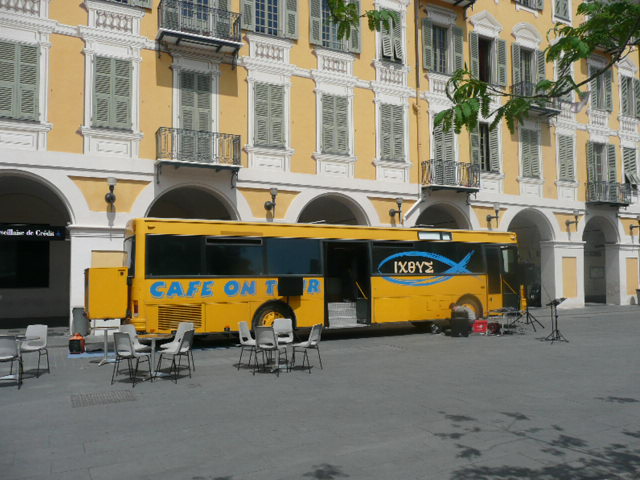
We walk through the old town to Place Garibaldi, a large open square with lots of restaurants and cafes, and a huge statue of Giuseppe Garibaldi in the centre of an impressive fountain. We sit by the fountain and enjoy our picnic lunch. Across the other side of the square is a large yellow bus, with coffee tables set up outside, and a big notice on the side saying ‘Café On Tour’. There is an equally large Christian ‘fish badge’ on the side of the bus with the Greek word for ‘fish’ ‘icthus’ in the centre – the various letters of the word signifying (in Greek) ‘Jesus Christ, God’s Son, Saviour’. Julia immediately marches over, boards the bus, and asks the startled inhabitants who they are and what they are doing? They tell us that they are Pentecostal Christians, drawn from five churches in the surrounding area, and that they are engaged in a summer long evangelistic outreach and youth training programme. The Mayor of Nice, no less, had given them permission to be there and hold an evangelistic event that evening. This is quite something because France is a very secular nation in which Roman Catholicism is tolerated and Pentecostal Christians are considered to be a ‘sect’!? We have a really nice conversation with them and promise to pray for them.

After a few more churches and palaces we wander back to the sea front and the Promenade des Anglais. We fancy an ice cream so go and look at the menus of the beach restaurants. Ice creams cost 10€ each, so we give up that idea straight away. We do discover, however, that all these beach restaurants do still sell ‘Sex on the Beach’ cocktails, and these are only 5€ each?! We make a mental note of this (for Julia’s birthday) and go and find a seat further on down the Promenade des Anglais. I sit on the seat while Julia ventures inland in search of cheaper ice creams. When she returns with the said ice creams, we sit there enjoying the warmth and the sunshine. Suddenly we find ourselves surrounded by Jehovah’s Witnesses?! We know they are Jehovah’s Witnesses because – even though the weather is really hot – they are all wearing jackets and ties, are all red in the face and looking as though they are about to expire, and are all carrying bible cases and copies of the Jehovah’s Witness magazine. Here then is a real ‘sect on the beach’?!

We make our escape and return home to our lovely studio apartment. We sit on our balcony, enjoying some ‘nibbles’ and a glass or two of chilled rose wine. Julia eventually wanders into the kitchen to prepare our dinner … and the power supply to the flat fails! Where are those Pentecostals when you need them!?
 

Leave a comment

NICE IN NICE: Wednesday 8 May 2013: TRAINS AND TRIFFIDS

The Little Train at Nice, France

The Little Train at Nice, France

We are woken early by Julia’s mobile pinging to let her know she has a text message. It is from Swellin to remind us that today is a national holiday in France – it is 8 May of course, Victory in Europe Day, the day WWII officially ended, well here in Europe at any rate, it is still celebrated here in France, although largely forgotten in the UK for some reason – and all the shops will be shut!? We panic because we only arrived in France late afternoon yesterday and we haven’t bothered to get any provisions in?! We jump in the shower, get dressed as quickly as possible, and rush down to the local supermarket. It is open! In fact it will be open all day the shop staff tell us! We load up numerous baskets with stuff we need and make our way to the till. We take up so much space that the shop staff have to open another till! I look at the shop staff and give my Gallic shrug … ‘Ah! Les Anglais?’ I say. Everybody laughs!

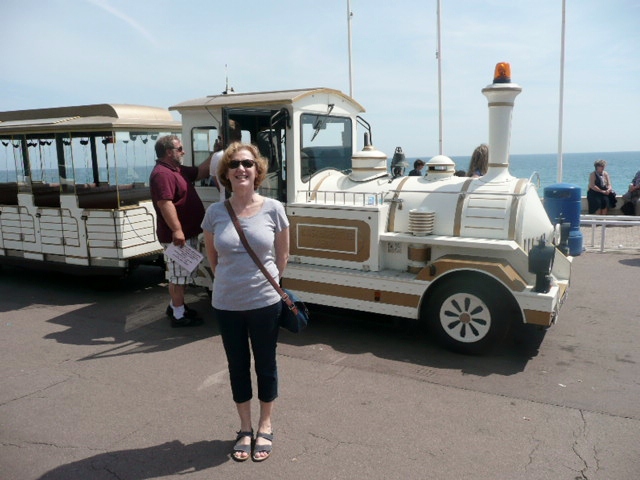
We carry our heavy shopping bags home and decide to have lunch before starting our exploration of Nice itself. Our intention is to wander down to the Promenade des Anglais (built by the English in the 18th century to provide employment for the poor of the area) and then take the Little Train around the main sites of Nice so that we can have an overview of what is worth seeing in this wonderful city. Our lunch is disturbed by the sound of the noon gun! Every day at midday a cannon explodes in Nice. It always takes visitors by surprise especially those who are close by on the castle hill or parts of the old town. You can easily spot the locals, however, as they don’t bat an eyelid. As for the reason for this you may be forgiven for imagining it has military origins, celebrating a victory or warning of attack but no, it’s much more quirky than that. Back in 1861 a British gentleman named Sir Thomas Coventry-More settled in the old town of Nice. He had a wife who enjoyed her morning strolls along the Promenade des Anglais and had a tendency to get back late to prepare lunch. Sir Thomas was having none of this tardiness so he found a rather ingenious way to summon her back – a cannon blast. Having had his plan approved by the Mayor he provided the cannon at his own expense and installed it on the lower terrace of the château. Every day just before midday Sir Thomas would raise a colourful globe on a mast from his home which would be the sign for a municipal employee to set off the cannon. His wandering wife then rushed back home to get his lunch ready pretty damn quick! When the Coventry-Mores left Nice the locals missed the daily detonation and on 19 November 1876 a law was passed making the blast official thereby keeping up this peculiar tradition to this day. Nowadays it’s no longer a cannon but a large firework that is manually set off in the same place as the original cannon, and has been lit by the same man for more than twenty years now. During this time he has only missed it once due to a traffic jam although he has been known to set it off an hour early on April Fool’s Day!?

After lunch we wander down to the Promenade des Anglais and board the Little Train. It is a marvellous trip, taking us round the major sites of the old town and then up to the summit of Castle Hill with its amazing views across Nice and the Mediterranean. Our particular train has the last carriage reserved for members of a school party from Italy. There are so many of them that a second train, filled with the remainder of this school party, follows us. We are very amused to notice, as we round various S bends, that hanging on the back of this second train are a number of kids on skate boards or roller blades hitching an unofficial lift up to the top of caste hill?! We stop for a time at the very top, so that we can take in the amazing views and take photographs, before descending back to the Promenade des Anglais. We walk back to our apartment taking in the amazing buildings that make up this marvellous city.

Julia cooks us a wonderful dinner. We just love this wonderful city and this wonderful studio flat we have found. We eat on the balcony enjoying the late evening sunshine. The people in the apartment directly opposite wave to us and we wave back. We look across to another apartment on the other side of the main road to ours. It has the most incredible roof garden. It looks like the hanging gardens of Babylon with a profusion of stunning flowering trees, shrubs and plants. We have seen no sign of anybody living there and we have come to the conclusion that the plants growing there must be triffids (as in John Wyndham’s post-apocalyptic novel) and they have eaten the residents. We will keep a careful eye on this apartment. We are only here for 10 days, but in that time, at their present rate of growth, these colourful plants may well have made their way over here?

1 Comment

NICE IN NICE: Tuesday 7 May 2013: BEING FAMOUS?

11 Jim and Julia Pre-Dinner Drinks
Julia and I are off to France again – to Nice on the Cotes d’Azur to be exact. We are going for 10 days to celebrate Julia’s 55th birthday on the 15 May. We are flying this time, not driving all the way to the south of France. We have rented a studio apartment and are planning to see as much of Nice as we can … with perhaps a train trip to Mentone as well … and a ‘cunning plan’ to gate crash the Cannes Film Festival which is taking place while we are here.

We get up very early – well very early for us – and load our suitcases into the car. We are still driving around in our old Vauxhall Corsa. It seems relieved that it will not be making the long journey to the south of France this year. It gives a sigh of relief when we load our two suitcases. It is pleased not to be loaded to the gills with camping stuff. Even so, we cannot get both suitcases into the boot of the car. The big case – Julia’s of course, loaded with ‘clothes I really just have to take’ – has to go on the back seat. We can take 40 kilos between us, so my suitcase has to be considerably less in order to accommodate the extra weight of Julia’s case. Reggie Doggie knows something is up. He refuses to leave our side, so we have to shut him in the sitting room while we make our escape. We say goodbye to Olivia, Julia’s mother, and we are off!

The drive to Gatwick is trouble free. Our flight is not until 2.30 p.m. but we want to get there in plenty of time, hence our reason for leaving home early. The other reason for leaving home early is so that we can stop for a ‘full English breakfast’ on the way. Well, it will be a long time before we get the chance to eat another one?! We arrive at the long stay car park in good time, and get the car park bus to the terminal. We check in o.k. and just about make the weight limit with our cases. We are flying Easy Jet again but have pre-booked our seats so that our flight will be hassle free. We get upgraded because they want someone intelligent to sit by the emergency exit doors. This is brilliant because there is great leg room for me. At 6’ 4” I need to be able to stretch my legs out even if the flight is only an hour and a half! The approach to Nice Airport is amazing, flying low over the sea and then swinging in over the city to land in a sea-ward direction. We get a taxi from the airport – blow the expense – and it drops us right at the door of our apartment block.

Sue Ellen, our host, is there to meet us. We are not sure what nationality she is – American, Irish or English. She is married to a French guy, Joel, and has lived in Nice for a number of years. Sue Ellen (now know as ‘Swellin’ to us) is very nice … and the apartment is great. It is on the 6th floor of an old apartment block but has been upgraded to a very high standard and there is a lift! It is only a studio apartment with a sofa bed but has everything we need … and the sofa bed is really top of the range and very comfortable. The apartment has a great balcony with views over the city in one direction and of the Alps in the other. We love it!

After a celebratory glass of wine – courtesy of Swellin – we unpack and then get ready to go out for dinner. Swellin tells us that there is a good restaurant just along from the apartment that serves good food at reasonable prices and that there is a jazz band playing tonight. I have bought a rather snazzy new jacket (from a charity shop in the UK for £8) which really looks the bizz, and I am looking forward to wearing it over a rather snazzy black tee-shirt and black jeans. Julia, as usual, looks gorgeous! The restaurant is packed when we arrive but they manage to find us a nice table for two. No sooner have we sat down than a rather nice young French woman comes over and starts talking to me. She is speaking far too quickly for me to follow what she is saying but seemingly she has recognised me?! I don’t know who she thinks I am, but Julia quickly explains that I am not that person but just someone very ordinary from the UK?! I am conscious that suddenly people are all looking at me? I don’t know who they all think I am but I am not someone famous? Why does this keep happening to me? It is at least the third or fourth time it has happened. Who do I resemble in France? I hope that it is not someone famous from the 70s back in the UK?

We order our meal … and the waiter takes a shine to Julia and comes and sits next to her? I don’t blame him because she is looking stunning! We eventually manage to order our meal … and delicious it is! I try and forget about various people looking at us and we have a great evening. Eventually our waiter comes over and this time sits next to me?! Now I am really getting worried? The jazz music is great, however. It seems that anyone can join in and jam with them if they want to. A saxophonist arrives and joins in. He is really great! Half way through the evening a guy who is the spitting image of Richard Gere walks in … indeed it might well actually be Richard Gere!? He sits at a corner table all on his own. The waiter shows a bevy of French ladies to the same table. They ignore him completely?!

Jim Binney

1 Comment

LEARNING TO WALK WITH A LIMP

Walking with a Limp

Walking with a Limp

When I was young, a favourite character in one of the children’s comics I used to read was Limp Along Leslie – a character who originally emerged in The Wizard from 1951-1955. His real name was Leslie Tomson, and he was a lame sheep farming footballer – who spent his time running Low Dyke Farm, a sheep-farm in the Peak District for his widowed aunt – with a lame dog who won International Sheep Dog Trials and led his team Darbury Rangers to Wembley in successive seasons. Due to a childhood car accident, in which both his parents were killed, his left leg was shorter than his right, and he walked with a slight limp, hence the nickname. Leslie could not move as fast as other players, but what he lacked in speed he more than make up for in skill and craft. Amongst his skills was an amazing ability to bend the ball, something which in those days was largely limited to foreign players. Despite his handicap Limp Along Leslie learned to walk with a limp!

This story in The Wizard reminds me of another story in the Bible – the story of Jacob wrestling with God and ending up with a severe limp as a result (Genesis 32:22-32). Almost a quarter of the Book of Genesis is devoted to the biography of Jacob, the father of God’s chosen people. Jacob lived around 1750 BC. His given name literally means ‘to clutch by the heel’ or ‘to overtake’ because he was born clutching the heel of his elder twin brother, Esau (Genesis 25:26). Jacob was a pretty rum sort right from birth because he went on to live up to his name – ‘to clutch by the heel’ is also a Hebrew idiom for ‘he deceives’ –  by first conning his elder brother out of his birthright (Genesis 25:29-24), and then his father out of the blessing traditionally bestowed on the elder (Genesis 27). Nevertheless Jacob is eventually turned around, through various significant encounters with God, and he goes on to become a key figure in the plan and purpose of God both for the nation of Israel and ultimately for the whole world. One such significant encounter was the occasion mentioned above where Jacob had the audacity to wrestle with God!

We already have a hint here – in the fact that God chose to use Jacob, and even made use of his deceitful ways to get him where God wanted him – that God doesn’t always do things the way we think he should?! Indeed God is clearly a ‘non-conformist’ when it comes to ‘respectability’. No wonder then that God himself tells us, ‘For my thoughts are not your thoughts, neither are your ways my ways … as the heavens are higher than the earth, so are my ways higher than your ways and my thoughts than your thoughts’ (Isaiah 55:8,9). Somehow Jacob’s ‘inappropriate behaviour’ is not only contained within the permissive will of God, but absorbed into the perfect will of God. Jacob, of course, is not the only example of God choosing and using ‘the wrong people’?! King David was an adulterer and a murderer (1 Kings 11), and Saul of Tarsus (who became the Apostle Paul) was an arch-enemy of the infant Church and a murderer to boot (Acts 7:54-8:1; 9:1,2). And there are many more examples of God choosing ‘unsuitable people’ in Scripture that we could quote! Of course, King David had to repent of his evil, and Saul of Tarsus had to have a ‘Damascus Road’ encounter with Christ, and Jacob had to find God in a new way … but in each case their past failures did not prove to be insurmountable barriers to being used by God in a significant way. It is only we Christians sadly, who all too often see past failure in others as an insurmountable barrier to them being used by God!?

For Jacob, the key encounter that changed his life right around occurred when he stopped for the night at a place called Bethel (Genesis 28:10-22). Suddenly aware of the gravity of cheating both his brother and his father, Jacob ‘does a runner’ and flees in fear of his life from his family home in Beersheba and heads for Harran. When night falls Jacob finally feels safe enough to snatch a few hours sleep. As he sleeps he has a dream which shakes him to the core. He sees a stairway leading to heaven, with angels ascending and descending, and God himself standing at the top of the stairway. Although Jacob is still the same Jacob – the deceitful user of other people – God reveals himself, and his plans and purposes for Jacob. This encounter marks the beginning of Jacob’s transformation. ‘Surely the Lord is in this place, and I was not aware of it’ he says, ‘how awesome is this place! This is none other than the house of God; this is the gate of heaven’ (Genesis 28:16,17). There and then Jacob vows to follow God for the rest of his life!

This is by no means the end of the story for Jacob … indeed it just the end of the beginning!? There is still a lot of ‘fight’ left in Jacob – the wrong sort of ‘fight’ that needs to be knocked out of him. We pick up the story several years later. Jacob has settled down, gained a couple of wives and several children in the process, but is still the same old Jacob at heart despite his professed faith in God. After various ‘dodgy deals’ involving his father-in-law (who proves to be just as deceitful as Jacob), Jacob comes to the conclusion that it is time to return home and sort things out with his father and particularly his brother Esau. He knew how violent his brother could be and this anxiety possibly triggered a second key encounter with God – perhaps a more significant encounter even – which led to Jacob becoming the person God always wanted him to be (Genesis 32:22-32)!

On the journey home Jacob arrives at a crossing place on the River Jabbok. He sends his family and servants on ahead of him and remains behind alone. We are not sure why Jacob stops behind – perhaps he is in a reflective mood, or perhaps he has a premonition that something significant is about to happen!? Whatever the reason, the Bible tells us that there on the banks of the Jabbok ‘[God] wrestled with [Jacob] till daybreak’ (Genesis 32:24). Although the narrative says it was ‘a man’ who wrestled with Jacob it is made clear that the ‘man’ in question is in fact God. Later in the story Jacob renames the place ‘Peniel’ – which means ‘face of God’ – because ‘I saw God face to face, and yet my life was spared’ (Genesis 32:30). Whether this was a literal wrestling match, or simply a mental battle, we cannot be certain? In many ways it doesn’t really matter. What matters is that in this place, and at that time, Jacob wrestled with God … and there was a significant, life-changing outcome as a result!

There is so much within this story that is beneficial for us – not least the fact that we see God taking the initiative here. It is God who suddenly comes out of nowhere to meet Jacob at a completely unexpected place and time! It is God who initiates the wrestling match! It is as though, having patiently watched over Jacob all these years and not seen much change in him, that God finally says, ‘Enough is enough! Time to sort yourself out Jacob!’ And so it can be with us. For no apparent reason God suddenly comes to us with a new initiative and takes us into a better, if sometimes a costly, place! We also see that in wrestling with God, Jacob almost prevails! Jacob certainly gains a new name and a new blessing as a result even if he doesn’t actually win the fight! He is given a new name – Your name will no longer be Jacob (deceiver) but Israel (strong one)’ (Genesis 32:28). He also receives God’s personal blessing – ‘[God] blessed him there’ (Genesis 32:29) – not just God’s proxy blessing that he had previously received through his father! Perhaps those commentators, who find here in this story support for importance of prevailing with God in prayer, are not entirely wrong … especially if it leads to us becoming stronger Christians moving in the blessing and anointing of God!

The thing that really strikes me about this story, however – the thing that I believe is the real key to the transformation of Jacob’s life, and therefore the most important lesson that we learn here – is that in order to ‘overpower’ Jacob, God ‘touched the socket of Jacob’s hip so that his hip was wrenched [out of joint]’ (Genesis 32:25)! The thought here (clearer in the Hebrew than in English) is that ‘God prevails’ over Jacob (rather than defeat him with ‘a low blow’ as some suggest). Another possible meaning of the new name of ‘Israel’ that Jacob receives in defeat is ‘God rules’ and this supports this idea.  The secret of being used by God, and the vital lesson Jacob needed to learn, is that God has to rule over our lives, full stop! In some ways it is good to be a fighter, and Jacob was a fighter by nature, but not when we fight against God. This was a painful lesson for Jacob to learn … and from that moment on he carried this lesson with him because for the rest of his life ‘he was limping because of his hip’ (Genesis 32:31).

Both the story of Limp Along Leslie, and particularly the story of Jacob, remind me of a couple of things I read recently. The first was from Rick Warren, the influential American Pastor of Saddleback Church in Orange County, California. He is a man who has known heart break in his own life, not least the recent tragic suicide of his youngest son. Writing around this time Warren shared that ‘I only hire staff who’ve been hurt deeply. People who’ve never suffered tend to be shallow and smug about other’s pain.’ And then I came across a fascinating quote from John Wimber in Ray Simpson’s wonderful little book Church of the Isles: A Prophetic Strategy for Renewal Simpson quotes Wimber as saying, ‘Never trust a leader who walks without a limp!’ Many of us ‘walk with a limp’. It may be the result of a moral failure in the past, a broken marriage or relationship, an ongoing physical illness or mental condition such as depression, a hurtful experience that has permanently scarred us, and so on. Some things are of our own making, such as moral failure, and need to be repented of. Many of these things, however, are simply because ‘stuff happens’ (as Confucius suggests). The important thing is to see that ‘having a limp’ is not an insurmountable barrier to becoming the person God wants you to be, or to being used by God in a productive way. What we need to do is learn to walk with a limp!

As so many characters in comics have to have a second life, if only to vary the plot and to produce situations of conflict, so Limp Along Leslie finds himself eventually faced with a difficult choice. Leslie’s brilliant hat-trick had put the Rangers into the semi-finals of the FA Cup and two England selectors have been watching the game. As a result Leslie is in line for an international Cap against Scotland at Hampden Park! But the Hampden Park match is on the same day as the National Sheep Dog Trial that Leslie has already entered?! Leslie’s late father, had won an International Sheep Dog Trial, and he had also been captain of the Rangers and an England international. Leslie wants to follow in his footsteps but now it looks as if Leslie might have to sacrifice one ambition for the sake of the other?! Accepting that we actually have a limp and determining to learn to walk with a limp will be a difficult choice for us to make as well. Sadly there will always be those who tell us that because we have a ‘limp’ we are therefore ‘unfit for service’. Once again we are faced with a difficult choice? Do we receive this negativity, or rightly refuse to listen to such negative voices even if our ‘limp’ is of our own making? Remember that, because of all that Jesus has done for us, ‘there is therefore no condemnation to those who are in Christ Jesus’ (Romans 8:1)! Learning to walk with a limp may well be difficult but, to quote Rick Warren once again, ‘I’d rather limp through life depending on God’s Spirit than run on my own strength!’ To do so, however, may well result in us (like Limp Along Leslie) winning God’s equivalent of an international cap and a sheep dog trial, or even better (like Jacob) find ourselves somehow playing a significant part in God’s great scheme of things!

Jim Binney

1 Comment

EASTER PEOPLE LIVING IN A GOOD FRIDAY WORLD

Easter Peoeple

Easter People

John Foster tells how an enquirer from Hinduism approached an Indian Bishop. Unaided he had read the New Testament, and the story had fascinated him. In particular he was gripped by the person of Jesus Christ. He felt he had entered a new world. In the Gospels it was all about Jesus … his works, his suffering. In the Book of Acts it was all about the disciples of Christ … what they did, what they taught. They had taken the place Christ had occupied. The Church continued where Jesus left off. ‘Therefore’ this man said to the Bishop, ‘I must belong to the Church that carries on the life of Christ!’

During the last 2,000 years there have been times when the Church has undoubtedly lived up to being this kind of Church. Even today there are parts of the world where the Church is growing phenomenally – China, South America, Africa – primarily because it is carrying on the life of Christ. To be quite honest, however, if the whole Church down through the ages had constantly lived in this way, we would surely have won the whole world to Christ by now?  We need to recover what it truly means, as Christians, to be an ‘Easter people living in a Good Friday World’!

This poignant expression, ‘We are Easter people living in a Good Friday world!’ was first coined by Barbara Johnson in her devotional book, Splashes of Joy in the Cesspools of Life, and she should know. There was sorrow and tragedy connected to each of her three sons, her husband endured a long recovery from a near-fatal car accident, and she fought cancer for six years before succumbing in 2007. She persevered through her life’s difficulties with faith and a strong sense of humour.

As Christians we are indeed an Easter people! We live this side of the historic and significant events of that first Easter. Christ has died, and Christ has risen! As a result everything has been changed, for all time. A power has been released into the world sufficient to change everything, to change all of us, for the better! The Bible implies, in a number of places, that it was through the power of the Holy Spirit that God raised Jesus from the dead, and goes on to tell us that this same power also abides in us as believers. Thus the Apostle Paul, writing to the Church in Rome, tells us that ‘if the Spirit of him who raised Jesus from the dead is living in you, he who raised Christ from the dead will also give life to your mortal bodies because of his Spirit who lives in you’ (Romans 8:11). Jesus himself promised us that we would ‘receive power when the Holy Spirit comes on you’ (Acts 1:8). Power to live victoriously and to witness effectively! Indeed the Apostle Peter tells us that ‘[God’s] divine power has [already] given us everything we need in order to live a godly life through our knowledge of him who called us by his own glory and godliness’ (2 Peter 1:3). We need to be who we are in God … an Easter people!

As Christians, however, we also live in a Good Friday world! In certain respects that which Jesus endured and experienced that first Good Friday perfectly portrays the kind of world we live in. The brokenness, the suffering, the pain, the hurting, the rebellion, the deceit, the sin, the unfairness, the victimisation, and so on. This world, in many ways, is a beautiful place. We understand, to some degree, what God meant when, following the various acts of creation, he stood back and looked at it and ‘saw all that he had made, and it was very good’ (Genesis 1:31). There are many wonderful people in this world – kind people, caring people, loving people, people who like Jesus himself ‘go around doing good’ (Acts 10:38). But even the best of us are sinners who need a Saviour. And probably the really, really good people are in the minority. Two thirds of the world we live in suffers from colossal need – deprivation, starvation, lack of clean water, lack of basic human rights, violence and war, and so on. And even in the so-called ‘civilised countries’ there is considerable corruption, greed, and disharmony of one kind or another. My conviction remains that the vast majority of people, deep down, know that they are sinners, and could and should live more godly, useful lives, but don’t know how to change? Undoubtedly there are literally millions of broken, hurting and needy people out there who really need to hear the Good News we have as Christians, and experience the power of God to change lives for the better for themselves! We live in Good Friday world!

When Jesus looked at the society of his day – in all their sin and need – he did not condemn them but looked at them with compassion. Whilst there may have been those who were ‘demonised’ (for want of a better word), and delighted in doing evil rather than good, the vast majority of people were ‘distressed and scattered like sheep without a shepherd’ (Matthew 9:36). It is vital that we Christians also see people the way Jesus saw them. How is it that so many of us have substituted ‘legalism’ and ‘morality’ for the Good News we are supposed to be sharing with people in their need? John Drane, commenting recently on yet another blog in the social media raising the question of Christians and sex, suggested that it was time we Christians got obsessed with another three-letter-word, G.O.D! How easily we get distracted from what should be our priority as Christians.

In the Sermon on the Mount – preached to a good number of religious people including the scribes and Pharisees as well as to ordinary people – Jesus forcibly underlined the fact that we are all sinners, even those of us who pride ourselves that we live righteously. He tells us here ‘You have heard that it was said to the people long ago, “You shall not murder!” and anyone who murders will be subject to judgment … but I tell you anyone who is angry with a brother or sister will be subject to judgment … You have heard that it was said, “You shall not commit adultery!” but I tell you that anyone who looks at a woman lustfully has already committed adultery with her in his heart’ (Matthew 5:22,23; 27,28). Jesus here is deliberately pulling the rug out from beneath the feet of all those who considered themselves righteous, a ’cut above’ others, superior, judgmental! We are all sinners everyone of us, and the only way we can be righteous in the sight of God is by grace. We are not here to judge others, to moralise, but to share the Good News of the Gospel with sinful people, just like us, who need to find a way out of their hopelessness, a way back to God, a way of living that will glorify God and bless others!   The majority of people don’t need ‘putting right’ … they already know that they are ‘wrong’ … but they don’t know how to change things, how to make things better. And how on earth will they know unless we share the Good News with them? We live in a Good Friday world, but as Easter people, and we have the solution to this world’s predicament – the ability to ‘hold forth the word of life’ (Philippians 2:16)! As Pope John Paul II reminded us several years ago: ‘Do not abandon yourselves to despair, for we are the Easter People, and ‘Hallelujah!’ is our song.’

Jim Binney

3 Comments

THE HARROWING OF HELL (Holy Saturday)

The Harrowing of Hell

The Harrowing of Hell

Two of my grandsons were discussing the meaning of Easter. Their conversation went something like this. George (age 5): ‘Luke, do you know that Easter time is when Jesus died on the cross?’ Luke (age 3)  ‘Yeah … then he fell down a big hole!’ Now in some ways that is not a bad answer. What are we to make of the Saturday between Good Friday and Easter Day? The Western Church has a lot to say about the events of Palm Sunday, Maundy Thursday, Good Friday, and Easter Sunday … but little is said of the Saturday between Good Friday and Easter Day. This Saturday seems a puzzle to many Christians.

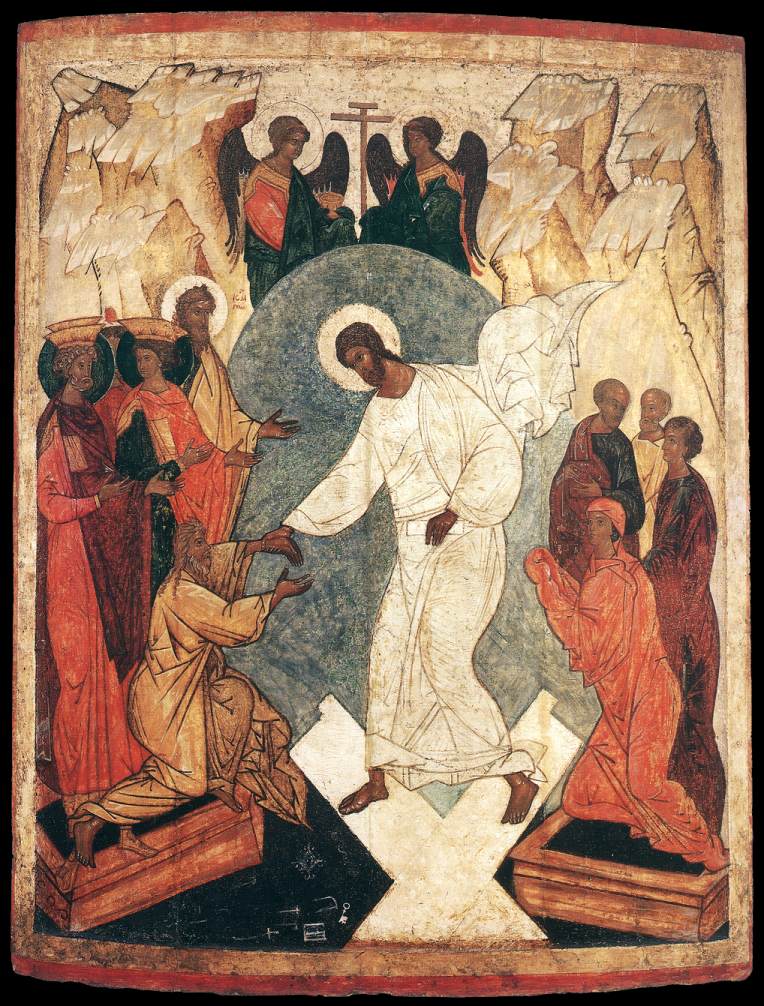
Interestingly, Orthodox Easter icons do not portray the empty tomb which is the typical representation in Western Christianity. Rather, the Easter icons of the Orthodox Church depict what is known as ‘the harrowing of hell’. The harrowing of hell refers to the events between Jesus’ death and his resurrection. The word ‘harrowing’ stems from the word ‘harry’ – a military term meaning ‘to make predatory raids or incursions’ into enemy territory, often with the purpose of rescuing people who were trapped or imprisoned. Specifically, the early church believed that after his death Christ descended into hell and rescued all the souls, starting with Adam and Eve, who had died under the Fall. Jesus breaks down the doors of hell and leads the souls of the lost into heaven.

This is an obscure teaching in the Western Church, but the Bible hints at these events. For example, the Apostle Peter tells us, in his First Letter, that ‘Christ died for sins once for all, the righteous for the unrighteous, to bring you to God. He was put to death in the body but made alive by the Spirit, through whom also he went and preached to the spirits in prison who disobeyed long ago’ (1 Peter 3.18-20a). And later on, in the same Letter, he tells us ‘For this is the reason the gospel was preached even to those who are now dead, so that they might be judged according to men in regard to the body, but live according to God in regard to the spirit’ (1 Peter 4.6). The Apostle Paul also tells us, in his Letter to the Ephesians, ‘This is why it says: “When he ascended on high, he led captives in his train and gave gifts to men.” (What does “he ascended” mean except that he also descended to the lower, earthly regions? He who descended is the very one who ascended higher than all the heavens, in order to fill the whole universe)’ (Ephesians 4:8-10). This belief that Christ descended into hell is also captured in Peter’s Pentecost sermon where Peter reminds his hearers that God could ‘not abandon [his Messiah] to the realm of the dead’ (Acts 2:27,31).

Consequently, the early Apostle’s Creed had the, eventually controversial, mention of the descent into hell:

I believe in God, the Father almighty,
creator of heaven and earth.
and in Jesus Christ, his only Son, our Lord.
who was conceived by the power of the Holy Spirit
born of the Virgin Mary.
suffered under Pontius Pilate,
was crucified, died, and was buried.
He descended into hell.
On the third day he rose again from the dead.
He ascended into heaven
and is seated at the right hand
of God the Father Almighty.
From thence he shall come again to judge the living and the dead …

Early church fathers like Origen (184-254), Tertullian (160-225), and Hippolytus (170-235) expanded upon this cryptic phrase and argued that Christ, after dying, went down to hell and freed all those righteous men and women who lived before his ministry. Their rationale was simple: people must believe in Jesus to gain salvation,  but some way had to be found to save all those good Hebrew biblical types such as Adam, Isaiah, Joseph, David, etc. who didn’t have the opportunity to get in on this new grace. Interestingly however, the Nicene Creed (325 AD) which followed the earlier version of the Apostle’s Creed, removed the mention of the decent into hell. Nevertheless, for fifteen hundred years the majority of Christians, it appears, believed in the harrowing of hell.

The phrase ‘descended into hell’ is very misleading. The idea inherent in the New Testament is not that Jesus descended into hell but rather that he descended into Hades. Hell is the place primarily ‘prepared for the devil and his angels’ (Matthew 25:41) but is also generally used in Scripture as a place of future punishment for all those who conclusively reject the Gospel of our Lord Jesus Christ. Hades, however, particularly in Jewish thought at the time of Christ, was seen as an intermediate state – a twilight shadow-land – into which the spirits of all men and women alike went immediately after death. In later thought, there emerged the idea of divisions or compartments in this shadow-land. For the righteous dead this intermediate state was a pleasant experience – resting in Abraham’s bosom (Luke 16:22-23), or relaxing in ‘Paradise’, the place of blessedness promised to the repentant thief (Luke 23:43) drawn from the Persian word describing a beautiful garden in the Palace of a Great King where guests would be invited to wait before entering the immediate presence of the Great King himself. For the unrighteous dead this intermediate state was a kind of prison-house in which they were held until the Day of Judgment and the final punishment (Isaiah 24:21,22; 2 Peter 2:4-6). So then, in this whole matter therefore, we must think not in terms of hell (as we understand the word) but in terms of Christ going into the twilight shadow-land of the dead that first Holy Saturday.

What was Christ’s purpose in descending into Hades on that first Saturday after Good Friday? For Peter it was primarily to ‘preach to the imprisoned spirits’ whose abode was in Hades (1 Peter 3:19), to ‘preach the Gospel even to those who were already dead’ (1 Peter 4:6). For Paul it was so that Jesus might ‘capture captivity itself’ (Ephesians 4:8), that is, set free those imprisoned in this twilight shadow-land and thus enable them to ascend with him to Glory! Some commentators understand this as Jesus ‘proclaiming his victory’ over Satan, sin and death for everyone, thus providing universal salvation for all! Others understand this as Jesus ‘preaching the Gospel’ to those imprisoned in Hades thus offering those, who have died without responding positively to the Gospel, a second chance. Others understand this in terms of Jesus ‘proclaiming his victory’ in the sense of liberating the ‘righteous dead’ alone, and leading them out of Hades and into Heaven! For Augustine of Hippo (354-430) the passages in 1 Peter are to be understood spiritually rather than literally – Christ preaching the Gospel to those who are ‘spiritually dead’ throughout the generations, whilst for John Calvin (in the 16th century) the ‘descent into hell’ meant that during the three hours on the cross, Christ’s soul descended into the hell of damnation, and was subjected to torments there from the wrath of God, the fear of eternal damnation, and the devil’s power.

Personally speaking, I would love to believe that those who have neglected or rejected Jesus Christ in this life have a second chance to put that right beyond the grave. I suspect, however, that even if that were possible there would still be those who would choose to spend eternity separated from God rather than in his presence. As the great Christian apologist C S Lewis has pointed out, ‘The gates of hell are barred from the inside, not from the outside!’. Even more so, I would love to believe that the grace of God extends much further than even the best of us have dreamed possible, and that in the end everyone will be saved. I find no conclusive evidence for either of these aspects in Scripture, however, and therefore even though I may hope for them I cannot preach them. I can only urge men and women everywhere to respond to the Gospel invitation and commit their lives to Christ right here, right now, and seek to spend the rest of their lives in serving Christ and our generation. As Paul exhorts us, ‘Now is the accepted time! Now is the day of salvation!’ (2 Corinthians 6:2).

What we can, and should, take with us from the events of that first Holy Saturday, however, is an overwhelming sense of the power and extent of the victory Jesus has won for us through his death on the Cross. The fact that he descended to the depths of human hell and proclaimed the Good News to those, who in our eyes at least, were ‘beyond redemption’ is absolutely mind-blowing! I recall many years ago seeing Salvation Army Commissioner, Catherine Bramwell-Booth being interviewed by Michael Parkinson on TV. I think she was 96 years old at the time. ‘What if when you die you find yourself in hell and not in heaven?’ Parkinson asked her. ‘Why, Mr Parkinson,’ replied Catherine Bramwell-Booth, ‘I would simply preach Jesus … and then it wouldn’t be hell any more, would it!’

In Western churches the empty tomb is what you will see depicted on Easter Sunday. But Orthodox services recreate the harrowing of hell. The priest exits the church with a cross. The sanctuary is immersed in darkness and the doors are closed. The priest then knocks on the door and proclaims, ‘Open the doors to the Lord of the powers, the King of glory!’ Inside the church the people make a great noise of rattling chains which conveys the resistance of hell to the coming of Christ. Eventually, the doors are opened up, the cross enters, and the church is lit with brightly burning candles and filled with incense. This Orthodox focus on the harrowing of hell helps fill in what is often left out of the Western focus on the empty tomb. I have to say I wish that some of our Western services contained some of this vibrant symbolism depicting the power and extent of the victory Jesus has won for us!

Up from the grave he arose;
With a mighty triumph o’er his foes;
He arose a victor from the dark domain,
And he lives forever, with his saints to reign.
He arose! He arose! Hallelujah! Christ arose!

~ Robert Lowry (1826-99)

Jim Binney

2 Comments

HIDDEN BEHIND THE DOOR

Contemplating the Cross

Contemplating the Cross

The Boys’ Choir in a fashionable city church were going to sing ‘Onward Christian Soldiers’ for the Processional in the Sunday Morning Service. After the Saturday rehearsal several of the boys had an idea. They would make some crosses to carry down the aisle as they sang. Out came the hammer and nails, and soon twelve crosses were made. They could hardly wait to dramatise their song. The next morning the Choir Master was horrified at what he saw. ‘You can’t do this boys!’ he said. ‘Put the crosses behind the door!’ But the boys had their revenge as they processed down the aisle singing:

‘Onward Christian soldiers, Marching as to war,
With the Cross of Jesus, Hidden behind the door!’

For me, as a Christian, Holy Week – the last week of Lent and the week before Easter Day – is the most precious week of the year. Personally, I love to take time to prayerfully and thoughtfully journey with Jesus, following the same route he took 2,000 years or so ago, pondering the meaning and significance of Palm Sunday, Maundy Thursday, Good Friday, Holy Saturday … before finally rejoicing in the amazing events of Easter Sunday! When I was a young Christian I couldn’t get to Easter Sunday fast enough, but as I have got older I have found myself spending more and more time reflecting on the earlier events of Holy Week, particularly Good Friday.

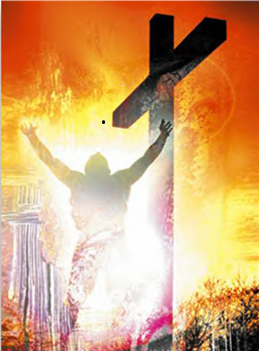
I remain disturbed by the number of Christians who, particularly during Holy week, only seem interested in the events of Easter Sunday. An inveterate Face-booker and Tweeter, I have been saddened by the number of my Christian friends and followers who posted stuff about Easter Sunday and the resurrection of Jesus Christ from the dead even before we got to Palm Sunday?! Typical of this has been the number of links posted to Tony Campolo’s best known sermon, entitled ‘It’s Friday but Sunday’s Coming!’ It’s a great sermon without doubt – although actually Tony Campolo cribbed it from another Pastor as he openly confesses – and it carries a great message. We are indeed ‘an Easter Sunday people living in a Good Friday world’ … but the sermon was never intended to distract us from the importance of the events of that first Good Friday. It therefore seems inappropriate to refer to it to justify hurdling the various events of Holy Week – especially Good Friday – in order to get to Easter Sunday as quickly and as painlessly as possible.

When Julia and I were the Pastors of Beckenham Baptist Church, Holy week was always a ‘big event’ in the life of the church. If Christmas was primarily for ‘outsiders’ – and we certainly attracted a large number of people into the church during the Christmas period – Holy Week and Easter was for the members of the church and congregation. For several years we travelled the road to Jerusalem together with Jesus … and they were precious times for us all. One of the highlights was the silent March of Witness through the town on Good Friday culminating with a short open-air service on The Green. It was a powerful and moving occasion to see several hundred Christians – drawn from all the local churches – walking together in silent procession behind a large wooden cross. The police stopped the traffic for us, people witnessed our walk, some stopped and bowed their heads in prayer as we passed, and others joined us on The Green to worship. This was a real contrast to a neighbouring town where on the same day some of the local churches – mainly Charismatic or New Churches it has to be said – held a rather different ‘Walk of Witness’. Even though it was Good Friday they chose to celebrate the Resurrection of Jesus with banners and flags, tambourines and trumpets, and lots of singing and shouting! Now I am not against ‘Praise Walks’ (as I believe they are called) but for me Good Friday is not the day to hold them. Here it would seem is just another example of professing Christians seeking to bypass the painful events of Holy Week in order to get to Easter Sunday as soon as possible?!

The Apostle Paul writes to the Christian Church in Galatia and concludes what he has to say to them by pointing them to the Cross: ‘God forbid’ he says, ‘that I should glory, but in the cross of our Lord Jesus Christ’ (Galatians 6:14). Paul does not say, ‘God forbid that I should glory, but in the resurrection of Jesus Christ from the dead’ even though he believed totally in the resurrection and saw it as essential! For example, in 1 Corinthians 15, Paul explains in detail the importance of the resurrection of Christ. For Paul, however, it is the Cross that is the key to our salvation – the key to everything in fact – that which lies at the very heart of the ‘divine exchange’ which changed everything for the world and for us!

Paul writes these words at the end of his Letter to the Galatians in his own hand (Galatians 6:11). Normally Paul made use of an amanuensis (or secretary) to whom he dictated his various letters. Here, however, he takes the pen himself to write this concluding section, because what he has to say about the Cross is so important. The members of the Christian Church in Galatia had been squabbling amongst themselves. The Jewish believers prided themselves in their adherence to the Jewish Law, and the Gentile believers prided themselves in their freedom from the Jewish Law. Both sides were boasting about their respective positions. Paul is clearly fed up with the shallowness of both sides. He deliberately pulls the rug from under their feet by pointing them to the Cross – the Cross where Jesus died a horrendous death in order to save them from the very self-centredness, that they were exhibiting. The sinful self-centredness that is at the root of all this world’s troubles and pain! ‘If you must boast’ Paul tells them, ‘boast in the Cross of our Lord Jesus Christ’ (Galatians 6:14)!

How easy it is for us to take our eyes away from the Cross of our Lord Jesus Christ, How easily we get distracted by other things – not just the theological minutiae but seemingly even the other great truths of the Gospel such as the Resurrection?! Of course you cannot really separate the Cross and the Resurrection – they are head and tails of the same coin – so why is it that some Christians seem to want to concentrate on the Resurrection to the detriment of the Cross? Is it to avoid the pain, the cost? Is it because they have bought into the ‘triumphalism’ that is so prevalent today? Whatever the reason, it is surely time to take the Cross out from behind whatever door we have hidden it?!

The Puritans had a saying: ‘Never further than Thy Cross, never higher than Thy feet!’. Let’s not be in too much of a hurry to get to Easter Sunday that we bypass the other significant events of Holy Week, especially Good Friday. Let us deliberately take time to prayerfully contemplate the Cross of our Lord Jesus Christ. Exactly what happened on that day when the ‘great exchange’ was enacted, we will never be able to fully grasp this side of Glory. It remains a mystery – but not a mystery that leaves us totally baffled, but a mystery that leaves us in absolute awe of the magnitude and grace of a God who could do such a thing for a such a sinful people like us, and such a rebellious and broken and hurting world that we live in!?

All ye that pass by, to Jesus draw nigh:
To you is it nothing that Jesus should die?
Your ransom and peace, your surety He is:
Come, see if there ever was sorrow like His.

He dies to atone for sins not His own;
Your debt He hath paid, and your work He hath done.
Ye all may receive the peace He did leave,
Who made intercession, My Father, forgive!

For you and for me He prayed on the tree:
The prayer is accepted, the sinner is free.
That sinner am I, who on Jesus rely,
And come for the pardon God cannot deny.

His death is my plea; my Advocate see,
And hear the blood speak that hath answered for me.
My ransom He was when He bled on the cross;
And losing His life He hath carried my cause.

~ Charles Wesley

Jim Binney

Leave a comment

MAN OF SORROWS

Jerusalem from the Mount of Olives

Jerusalem from the Mount of Olives

When tears started trickling down the face of a statue of Jesus Christ at a Catholic church in Mumbai last year, locals were quick to declare it a miracle. The Church of Our Lady of Velankanni became a site of pilgrimage and visitors began collecting the tears in bottles believing it to be holy water. Unfortunately it turned out that this miraculous phenomena was not so much a case of holy water as holey plumbing. The ‘tears’ trickling down the face of Christ were not because Jesus wept but because of clogged drainage pipes situated behind the statue?! Sanal Edamaruku, the poor chap who discovered the real cause of the ‘miracle’ was accused of blasphemy, charged with offences that carry a three-year prison sentence and eventually, after receiving death threats, had to seek exile in Finland.

Personally, I have little time for such mumbo jumbo as weeping statues and the like. A faith based simply on superstition, rather than reality, is ultimately of little or no value. The Bible, on the other hand, records various occasions when, during his incarnation, Jesus did weep. The most well know occasion, of course, is that especially associated with the actual phrase ‘Jesus wept’ (John 13:5) – a phrase famous for being the shortest verse in the King James Version of the Bible (although not the shortest in the original languages) – Jesus’ response to the sad news of the death of his friend Lazarus! It is not this incident when Jesus shed real tears, however, that I want to draw our attention to, but to another occasion more appropriate for the Holy Week narrative.

Holy Week begins with what is known as the Triumphal Entry of Jesus into Jerusalem. Luke tells us a few days before his arrest, trial, and crucifixion, Jesus entered Jerusalem riding on a donkey – the sign of a King entering a conquered city in peace – to be met with a rapturous welcome by the inhabitants of the city (Luke 19:28-40). Understandably our Palm Sunday sermons and homilies concentrate on the meaning and significance of this triumphal entry. But, as a result, all too often we miss – what to me is a very significant occurrence – something Luke records as taking place as Jesus comes over the brow of the Mount of Olives and sees the city of Jerusalem spread out before him for the first time on that first Palm Sunday. Luke tells us that ‘As [Jesus] approached Jerusalem and saw the city, he wept over it!’ (Luke 19:41).

On a number of occasions I have stood on the Mount of Olives and looked out over the city of Jerusalem. It is one of the most wonderful sights to be seen. Every time I see it, it takes my breath away and brings tears to my eyes – so much history, so much pain even today! The last time I was there, just a few months ago, I found myself simply standing there, looking over the city, prayerfully pondering the past, the present, and the future for this city. Time simply slipped by for me. But what I felt, was as nothing compared to what Jesus felt as he too looked over Jerusalem that first Palm Sunday … and wept! The word ‘wept’ here is a very strong word in Greek (the language of the New Testament). Literally it means ‘the heaving of the breast’ or ‘the sob and cry of someone in agony of soul’. Jesus was clearly deeply, deeply moved by the sight of the city. Why was this so? What was it about Jerusalem and its people that moved Jesus to tears in this way?

Fortunately Jesus explains himself in the next few verses: ‘If you, even you, had only known on this day what would bring you peace – but now it is hidden from your eyes. The days will come on you when your enemies will build an embankment against you and encircle you and hem you in on every side. They will dash you to the ground, you and the children within your walls. They will not leave one stone on another, because you did not recognise the time of God’s coming to you’ (Luke 19:42-44). Jesus burst into sobbing at the sight of Jerusalem because in that moment he foresaw both the immediate response of the people of Jerusalem to his arrival – their rejection of him as God’s Messiah – and the eventual destruction of the city by Rome in AD 70. Jesus lamented both the horrendous lost opportunity for the city, and the inevitable tragedy that would ultimately befall them as a result.

Jesus’ tears on this occasion were not angry tears but tears of compassion. As he looked down on that city – as on another occasion – ‘he had compassion on them, because they were harassed and helpless, like sheep without a shepherd’ (Matthew 9:36). Jesus did not weep with anger knowing full well that the cries of ‘Hosanna!’ which would greet his entry into Jerusalem would quickly turn to cries of ‘Crucify!’ within just a matter of days. There was an inevitability about this because as the Apostle John tells us, reflecting some 60 years or so later on the coming of Christ – the true Light of God that came into the world in the person of Jesus in order to give light to everyone – ‘he was in the world, and though the world was made through him, the world did not recognise him. He came to that which was his own, but his own did not recognise him’ (John 1:10,11).

Jesus wept with compassion for a city, for a people – to whom God’s Messiah, the Saviour of the world, was revealing himself in a unique way – because he saw that they would completely miss this God-given opportunity. They would fail to recognise Jesus for who he truly was!? As Jesus looks over the city his emotions cannot be contained and he speaks out loud that which he feels deep within: ‘If you, even you, had only known on this day what would bring you peace?’ (Luke 19:41). The word ‘peace’ here in Greek signifies a special kind of peace. It means ‘the peace that comes from knowing that our lives are held secure in the hand of God himself’. It is a special peace because it is the kind of peace that we only find in and through Jesus Christ. As Jesus himself promised his disciples on another occasion: ‘My peace I give you. I do not give you the kind of peace the world offers you. Do not let your hearts be troubled and do not be afraid’ (John 14:27). The peace that Jesus brings is ‘peace with God’ (Romans 5:1). It is ‘peace which passes all understanding’ (Philippians 4:7). It is a unique kind of peace found only in and through Jesus Christ. It is a peace that the people of Jerusalem rejected through ignorance!?

There is a sad irony here because the name ‘Jerusalem’ has ‘peace’ as part of its meaning. But those in the city of peace did not know what made for peace! Especially important in the Hebrew understanding of ‘peace’ is its emphasis on peace with God – right relationship between the creature and the Creator as a vital ingredient in true peace. It was this that the people of Jerusalem failed to realise. And their failure to get to grips with the message of God had a sense of finality about it. The destruction of the city is inevitable as a consequence of the people’s rejection of Christ (Luke 19:43,44). Not because God judges them in anger but because they bring destruction down upon themselves as a direct result of rejecting God’s way in favour of their own way. The Jews of Jesus’ day saw ‘peace’ in terms of victory over their Roman oppressors and the re-establishing of the nation of Israel as ‘top dog’ in the region?! God saw ‘peace’ in terms of an inner peace that enables us to cope with any and every situation however difficult that situation may be – a peace that is available to all in and through Jesus Christ. The people of Jerusalem rejected that way as being too ‘milksop’, too ‘lily-livered’. The repetition of the word ‘you’ here – ten times in two verses – underlines the fact that it was the stubbornness of the people of Jerusalem that ultimately brought destruction upon themselves. In rejecting God’s way of peace, and picking an unwinnable fight with Rome instead, meant that the destruction of the city was inevitable. Jesus sadly concludes that all this was to happen ‘because you did not recognise the time of God’s coming to you’ (Luke 19:44)!

Jesus wept with compassion at this time because at that moment Jerusalem represented the crystallised centre of all humanity in its negative attitude towards him, right down through the centuries to the present day. Jesus wept not with anger but with compassion. Jesus wept because he was the ‘man of sorrows’ (Isaiah 53:3) who came into the world, as God Incarnate, in order to both make God known to us and provide a way of salvation for sinful people like us. As Peter tells us: ‘Christ died for sins once for all, the righteous for the unrighteous, to bring us to God!’ (1 Peter 3:18). The destruction of Jerusalem in AD 70 resulted in such devastation that it is said a plough was drawn across the city. The tragedy was that if only the Jews had abandoned their dreams of political power and had taken the way of Christ it need never have happened. The tears of Jesus we see here are the tears of God when he sees the needless pain and suffering in which we involve ourselves through our foolish rejection of his ways, particularly our rejection of his Son, Jesus. Perhaps this Easter we need to ask ourselves the question first posed by Pilate just a few days later: ‘What shall I do with Jesus who is called the Christ?’ (Matthew 27:22).

‘Man of Sorrows, what a name
For the Son of God who came
Ruined sinners to reclaim!
Hallelujah! what a Saviour!

Bearing shame and scoffing rude,
In my place condemned He stood;
Sealed my pardon with His blood;
Hallelujah! what a Saviour!

Guilty, vile, and helpless, we,
Spotless Lamb of God was He;
Full redemption—can it be?
Hallelujah! what a Saviour!

Lifted up was He to die,
‘It is finished!’ was His cry;
Now in heaven exalted high;
Hallelujah! what a Saviour!

When He comes, our glorious King,
To His kingdom us to bring,
Then anew this song we’ll sing
Hallelujah! what a Saviour!

~ Philip Bliss (1838-76)
Jim Binney

Leave a comment

FAITH IS SPELLED R.I.S.K.

Faith
The recently elected Pope Francis I, the former Cardinal Jorge Mario Bergoglio of Buenos Aires, chose the name ‘Francis’ in honour of one of his heroes (if Popes are allowed to have heroes), Saint Francis of Assisi (1181-1226). Saint Francis is said, at one time in his life, to have had a deep fear of leprosy. One day, when riding outside the walls of Assisi, he saw a leper coming towards him. G K Chesterton (in his biography of Francis of Assisi) tells us, ‘Francis saw his fear coming up the road towards him – the fear that comes from within, not from without!’ Francis immediately realised that this was both a challenge to his faith, and yet at the same time a God-given opportunity for him to face his fear once and for all. Francis jumped from his horse, ran to the leper, embraced him, and gave him what money he had, before continuing on his journey. We do not know how far he rode, or with what sense of the things around him, but it is said that when he finally looked back … he could see no figure on the road!

‘Faith’ is a funny thing! ‘Personal faith’ is considered a priority for Christians (especially Protestant Evangelicals). The Church is spoken of as a ‘faith community’. Scripture exhorts us to ‘live by faith and not by sight’ (2 Corinthians 5:7). And yet many Christians seem to remain very confused about it?! It appears to be one of those concepts that every Christian talks about but doesn’t really understand. When, as a teenager, I became a Christian – more than 50 years ago now – there was a lady Deacon in the church where I worshipped who talked a lot about faith. She was always exhorting us young people to ‘have faith’. One day, someone asked her what she meant by ‘faith’ … and she didn’t know?! Perhaps it is because of our confusion about ‘faith’ that we seem to exercise so little of it? It seems to me that we rarely move out of our ‘comfort zones’ as Christians and churches, preferring a more cautious, safety first approach … just in case?! As I once heard the chairperson of a Church Meeting declare – summing up the discussion and the  vote that followed on the issue in question – ‘The decision is ‘maybe’ … and that’s final!’

Part of the problem probably lies with the lack of erudite theological explanation within much Christian preaching and writing over recent years. We use words like ‘faith’ but rarely explain what we mean by them in succinct clear ways. Thus we end up talking a lot about ‘faith’ without actually understanding exactly what it means to exercise faith. The Greek word for ‘faith’ in the New Testament means ‘trust’ or ‘firm persuasion’ and is used to describe the many-sided relationship into which the Gospel calls women and men – that of trust in God through Jesus Christ. As already suggested, it is a key New Testament concept, the complexity of which, however, is reflected in the variety of constructions used in connection with the verb ‘to believe’. Thus it is used to express truth believed, restful reliance on that to which credit is given, or trust that reaches out for the object of its confidence. In the New Testament alone we see it being used in a variety of ways. It is used of what we might call Saving Faith – that initial act of faith in which we trust Christ, and Christ alone, for our salvation (Ephesians 2:8,9). It is used of the Fruit of Faithfulness – that constant day after day trust in the Living God, that consistent walking by faith (Galatians 5:22.23). It is used of the Gift of Faith – that specific endowment that accompanies the call of God to some specific venture such as those described in the list of ‘Heroes of Faith’ in Hebrews 11 (1 Corinthians 12:7-11). It is used of the Doctrines of the Faith – those key truths once and for all entrusted to the saints that can never be changed (Jude 3). Each of these four areas of faith can be shaky ground for us – we can be very uncertain as whether we are really ‘saved’ and we can argue ‘until the cows come home’ as to what constitutes ‘sound doctrine’ – but probably it is the areas of consistent Christian living, and stepping out of our comfort zone in response to God’s call, that give us most trouble!

The problem is not new. Luke tells us of an occasion when the apostles said to the Lord, ‘Increase our faith!’ (Luke 17:5). Jesus had been talking to them about the importance of being stepping stones, not stumbling blocks, to other people in their journey of faith. Jesus had been talking to them about the importance of forgiveness (Luke 17:1-4). Faced with such demanding duties, and conscious of their own lack of consistency in doing this, and their inability to take this next step forward, the apostles ask Jesus to increase their faith. Jesus’ response is interesting: ‘If you have faith as small as a mustard seed, you can say to this mulberry tree, “Be uprooted and planted in the sea!” and it will obey you (Luke 17:6). Yet again we see Jesus most probably making use of things around him to illustrate his point: a mustard seed, a mulberry tree, and even the fact that the Dead Sea could be seen from the Mount of Olives (where this incident was taking place). The mustard seed was the smallest known thing of the day. The mulberry tree was renown for the depth of its roots and the virtual impossibility of entirely eradicating it from ground where it had rooted itself. Jesus is not suggesting that his followers occupy themselves with pointless things like transferring trees into seas. His concern is with the difficulty. He is saying that nothing is impossible to faith! Genuine faith can accomplish what experience, reason, and probability would deny, if it is exercised within God’s will!

In effect Jesus is saying that what is needed here – for the apostles, and for every Christian or church faced with the challenge to step out of our comfort zone and move on to what God is calling us to – is not the increase in faith but the exercise of faith! It is not a question of needing more faith. Every Christian already has enough faith! If we have enough faith to get saved in the first place, we have enough faith! Even if we feel our faith is minute – only the size of ‘a mustard seed’ – we have enough faith! The apostles already had faith. They were not asking for initial faith. They were asking for additional faith. But what they really needed was to make use of the faith they already had! We also need to make sure that what faith we do have is directed towards God. Our faith needs to be directed away from ourselves and towards God. It is not great faith that is required but faith in a great God. It is not faith in ourselves, or even faith in faith, that we need but faith in God! Jesus encourages us all here to turn them away from the concept of ‘a less and a more in faith’ to the question of ‘faith’s genuineness’. If there is real faith then effects follow, obstacles are removed, barren land is made fruitful, the impossible becomes achievable! A risky business you say? Quite so! But then again, as the late John Wimber once suggested, ‘Faith is spelled R.I.S.K.’

Lord, you have always given
Bread for the coming day,
And though I am poor,
Today I believe!

Lord, you have always given
Strength for the coming day,
And though I am weak,
Today I believe!

Lord you have always given
Peace for the coming day,
And though of anxious heart,
Today I believe!

Lord you have always kept
Me safe in trials,
And now, tried as I am
Today I believe!

Lord, you have always marked,
The road for the coming day,
And though it may be hidden,
Today I believe!

Lord you have always lightened
This darkness of mine,
And though the night is here,
Today I believe!

Lord you have always spoken
When the time was ripe,
And though you may be silent now,
Today I believe!

Jim Binney

Leave a comment

CHANNELS OF GOD’S GRACE

Filled with God

Filled with God

Once upon a time, in the heart of a great Kingdom, lay a beautiful garden. And there in the cool of the day the Master of the Garden went to walk. Of all the occupants of the garden, the most beautiful and beloved was a gracious and noble Bamboo. Year after year the Bamboo grew more noble and gracious, conscious of his Master’s love and watchful delight, but modest and gentle as well. And often, when the wind came to revel in the garden, the Bamboo would cast aside its grave stateliness to dance,  swaying and leaping and bowing in joyous abandon, leading the great dance of the Garden which most delighted the Master’s heart.

One day, the Master himself drew near to contemplate his Bamboo with eyes of curious expectancy, and the Bamboo, in a passion of adoration, bowed his great head to the ground in loving greeting. The Master spoke, ‘Bamboo, I wish to use you in a way that will bring glory to me and blessing to others.’ The Bamboo flung its head to the sky in utter delight – the day of days had come, the day for which it had been made, the day to which it had been growing hour by hour, the day in which it would find its completion and destiny. ‘Master, I am ready … use me as you will’ the Bamboo responded

The Master’s voice was grave, ‘Dear Bamboo, I wish to take you and cut you down!?’ A trembling of great horror shook the Bamboo: ‘Cut… me… down? Me… whom you, Master, has made the most beautiful in all your garden? ‘ Not that, not that. Use me for your joy, O Master, but please do not cut me not down!’  The Master’s voice grew graver still: ‘Beloved Bamboo … if I cannot cut you down I cannot use you!’ The garden grew still. Wind held its breath. The Bamboo slowly bent its proud and glorious head. There came a whisper: ‘Master, if the only way you can use to fulfil your purpose for my life is to cut me down… then… do your will and cut!’

So the Master of the Garden took the Bamboo out and cut it down, hacked off its branches, stripped off its leaves, divided it in two and cut out its heart. And lifting it gently, carried the Bamboo to where there was a spring of fresh, sparkling water in the midst of his dry fields. Then putting one end of the broken Bamboo in the spring and the other end into the water channel in his field the Master laid down gently his beloved Bamboo. And the spring sang welcome and the clear sparkling waters raced joyously down the channel of the Bamboo’s torn body into the waiting field. Then the rice was planted, and the days went by, and the shoots grew and the harvest came. And in that day, the Bamboo, once so glorious in its stately beauty, was yet more glorious in its brokenness and humility. For in its beauty, it was life abundant, but in its brokenness it became a channel of abundant life to his Master’s world.

I suspect, that deep in our hearts, we all want to be used by God to make a difference in this broken and hurting and needy world that we live in.  Somehow to be a channel of God’s blessing to others. This is a good and godly desire to have. It is something born of God’s Spirit. We know that, in and of ourselves, we cannot be the source of blessing. The word of the Lord that came to Zechariah in one of his night visions is as relevant now as it was then, 500 years before Christ: ‘“Not by might, nor by power, but by my Spirit” says the Lord Almighty’ (Zechariah 4:6). We can no more bless others, or do them real good, or build anything significant for God, than Zerubbabel (the leader of the tribe of Judah in Zechariah’s day) could re-build the Temple in Jerusalem in his own strength. This truth is reinforced by the words of Jesus to his disciples during his Upper Room Discourses shortly before his arrest and trial: ‘I am the vine, and you are the branches of the vine. If you remain in me and I in you, you will bear much fruit. But apart from me you can do nothing!’ (John 15:5).  The good news, however, is that we can all be instruments in God’s hands, channels of his blessing to others. God works in wonderful ways, not always in very dramatic ways, sometimes in seemingly very ordinary ways, often in ways we do not anticipate. It can happen to anybody. Being used of God is not confined to Pastors, Preachers or Teachers. Anybody can be an instrument in God’s hands.

Writing to his young protégé, Timothy – a young man with great potential but low self-esteem – the Apostle Paul reminds him (and reminds all of us) that ‘In a large house there are articles not only of gold and silver, but also of wood and clay; some are for special purposes and some for common use.Those who cleanse themselves from the latter will be instruments for special purposes, made holy, useful to the Master and prepared to do any good work.’ (2 Timothy 2:20,21). Although written 2,000 years ago this analogy stands the test of time. The majority of us may not literally use jugs or goblets or cutlery of gold and silver today, although we use china cups and plates, and even wooden platters are becoming fashionable again in many restaurants. But we all have articles in our homes that we use every day that are ‘worth their weight in gold’, things that are essential to us in one way or another. Some of these have a special use – the best dinner service for when we entertain guests perhaps. Others have a less spectacular use – the plastic bucket we keep under the sink, hidden from sight, into which we put the vegetable peelings etc. prior to taking them to the compost heap?!

On one hand here, Paul is attempting to explain why the Church – most commentators take the reference to ‘a large house’ to refer to the Church – is always made up of a mixed bunch of people. On the other hand he is seeking to encourage Christians – like Timothy – who feel they haven’t got much to offer, to see that God can still use them as his ‘instruments’ and that they can still be ‘useful to the Master’ whether they are made of ‘gold and silver’ or ‘wood and clay’. Some may indeed be used for ‘special purposes’ although the majority of us will probably be for ‘common use’. What counts, however, is that we make ourselves available!  Every person, who names the Name of Jesus, is a potential vessel for God to use. Personally, I have found what is both encouraging and humbling at the same time is that the Bible suggests that God is not too choosey about whom he uses. Scripture reveals that God uses people like King David (an adulterer and a murder), a pagan such as King Cyrus, a religious hypocrite such as Caiaphas, someone as rash and flaky as Peter, and even Balaam’s donkey … as well as those we consider to be ‘good and Godly’. And even those we consider as ‘good and Godly’, like the Apostle Paul himself for example, often saw themselves somewhat differently. Paul may have begun his ministry exhorting others to ‘be you followers of me’ (1 Corinthians 11:1) but he concluded it by confessing himself to be the ‘chief of sinners’ (1 Timothy 1:15).

Furthermore, as Christians, we already have within us that with which we can bless others, do them real good, build something significant for God! The Apostle John tells us that at the conclusion of the Feast of Tabernacles – just as the Temple Priests poured the water they had drawn from the Pool of Siloam on the altar recalling the water drawn from the rock during the wilderness wanderings (Exodus 17) – Jesus stood where all could see him, and shouted in a loud voice, ‘Let anyone who is thirsty come to me and drink. Whoever believes in me, as Scripture has said, rivers of living water will flow from within them’ (John 7:37,38). John goes on to tell us that, ‘By this (Jesus) meant the Spirit whom those who believed in him were later to receive’ (John 7:39). We, of course, live this side of that first Day of Pentecost in the Christian era. As Christians we have God the Holy Spirit living within us, we have those ‘rivers of living water’ welling up within us wanting to overflow from us to bless others, to irrigate dry and barren ground, to make us channels of abundant life to the Master’s glory and for the good of others!

How I praise Thee, precious Saviour,
That Thy love laid hold of me;
Thou hast saved and cleansed and filled me
That I might Thy channel be.

Channels only, blessed Master,
But with all Thy wondrous power
Flowing through us, Thou canst use us
Every day and every hour.

Just a channel full of blessing,
To the thirsty hearts around;
To tell out Thy full salvation
All Thy loving message sound.

Emptied that Thou shouldest fill me,
A clean vessel in Thy hand;
With no power but as Thou givest
Graciously with each command.

Witnessing Thy power to save me,
Setting free from self and sin;
Thou who boughtest to possess me,
In Thy fullness, Lord, come in.

Jesus, fill now with Thy Spirit
Hearts that full surrender know;
That the streams of living water
From our inner self may flow.

Mary E. Maxwell

Jim Binney