Leave a comment

EAR PLUGS AND EYE MASKS

The Conversion of St Paul

The Conversion of St Paul

Well I have been back in hospital again! I have to confess that it was my own fault. As regular readers of our blog know, I had a heart attack back at the end of February and ended up in hospital for a week as a result. I am now waiting for a triple heart bypass operation sometime in July. Eighteen weeks is a long time for me to be sitting around doing nothing, however, and so the other week I succumbed to the temptation to do at least some of the jobs that needed doing? I had a wonderful week … rebuilt an old stone wall, cleared a lot of junk from the garage, dug up several old rose bushes that had gone wild again in the rose bed, and so on. ‘Push the boundaries!’ I subconsciously told myself, ‘Your heart will tell you when you have had enough!’ Unfortunately my heart didn’t tell me at the time … only later on when I was sitting on the patio enjoying a nice glass of wine!? And 12 hours later I found myself in an ambulance on the way to hospital with pain across my shoulders, up my neck, and down my arms … signs I now know well of my heart rebelling again!

I was sent to the Emergency Medical Unit (EMU) at Dorchester Hospital because there were no spare beds in the heart unit. EMU is the place where newly admitted patients normally end up for treatment before they get ‘shipped out’ to the appropriate unit for their particular problem when a bed becomes available. Consequently there are all sorts of ‘odd bods’ in EMU at any one time. There are three wards in EMU, plus a few single bed rooms. In our ward there were a couple heart cases like me, but the rest all had various different problems. There is usually quite a turnover of patients with some only being in EMU for 24 hours at the most before either being moved to another unit or sent home. I was in EMU for four days and was one of the ‘longest serving inmates’. In this number there were quite a few ‘characters’ including one literal ‘inmate’ – a guest of her Majesty no less – who was accompanied by two Prison Warders. He was around 19 or 20 years of age, and claimed to have swallowed some heroin. He refused to be x-rayed (because he thought his sentence would be increased if they found any heroin) but also refused to be discharged (because he would be taken back to prison). He gave the hospital staff a horrendous time and in the end had to be removed by hospital security. His chief complaint … much to the amusement of staff and patients alike … was that he hadn’t been given enough ‘porridge’ (a UK slang term for serving time in prison, as well as a cereal food) earlier that morning?! Quite a few of the patients that have ‘passed through’ EMU, however, were elderly, and suffering from dementia. Now there are various types of dementia and we should not ‘lump’ every sufferer together. Some people with dementia are incredibly happy in their own world, but others are very sad cases indeed. Since being in EMU I have gained a new and deeper understanding of elderly people with dementia, and a greater appreciation of just how wonderful our NHS medical staff are, especially our nurses who cope so brilliantly with all that comes their way day after day!

When I first came into EMU I found sleeping at night very difficult. There were people being admitted to the ward all times of the day and night, and on top of this there were daily ‘incidents’ to cope with as well, often occurring during the night hours. One night, for example, we had a lady threatening to ‘murder all the staff’ and a naked man attempting to get into another patient’s bed?! Sometimes the mid-night hour antics could be very amusing, but more often than not they were distressing and annoying. Fortunately, for me, my problem was solved by the acquisition of some excellent ear plugs and a wonderful padded eye mask. The ear plugs we bought in France a few years ago, specifically for use on the French campsites. You can’t get these particular ear plugs in the UK so we make a point of buying a couple of boxes nearly every time we go to France. They are made up out of a mixture of wax and cotton wool and cut out all sound very effectively. The eye mask is well fitted, padded and scented slightly with lavender and cuts out the light completely. I used both after a couple of nights and slept more-or-less right through, only waking up twice when the nurses woke me for ‘procedures’. I slept so soundly that I even missed all the ‘entertainment’ mentioned above … I only learned about it after the event?!

Reflecting on the effectiveness of my ear plugs and eye mask – one has a lot of time to reflect whilst lying on one’s hospital bed – I found myself thinking about the positive and negative effects of both? True that using my ear plugs and eye mask enabled me to have a good night’s sleep; true that they enabled me to remain completely unaware of all the shenanigans going on around me during the night … but what if some deranged woman wanted to murder me, or what if a naked man had tried to get into my bed, or what if a fire had broken out in the ward … I would have remained completely oblivious to all of it?! I exaggerate of course, but the point is made!

The Apostle Paul, or Saul of Tarsus as he was known then, was someone who was totally deaf and blind … when it came to the things of God and God’s great purpose for him in life! His story is told several times in the New Testament, particularly in the Book of Acts, penned by Luke, and in the autobiographical sections of the various Epistles or Letters attributed to Paul himself. Two particular passages in Acts are especially revealing about this matter of hearing and seeing God. It is clear (from the various Biblical accounts cited above) that prior to his conversion Saul, although ‘a young man’ by Jewish standards, had already achieved prominence. He was a highly educated Roman Citizen, a prominent business man working in the leather industry, and an extremely zealous religious leader within the Jewish Community. Despite all this, by his own admission, he was spiritually deaf and blind!

As a member of the Jewish Sanhedrin or High Council, Saul was present when Stephen, one of the foremost leaders in the embryonic Christian Church, was called before them to give account, following a complaint from one of the Synagogues in Jerusalem (Acts 6:8-12). Stephen took the opportunity, not only to tell the members of the Sanhedrin a few ‘home truths’, but to share the Gospel of Jesus Christ with them. Unfortunately for Stephen their reaction was a violent one. Luke tells us that even before Stephen had finished his defence, ‘they put their hands over their ears and began shouting. They rushed at him and dragged him out of the city and began to stone him. His accusers took off their coats and laid them at the feet of a young man named Saul’ (Acts 7:57,58). ‘They put their hands over their ears and began shouting!’ These members of the Sanhedrin, including Saul, deliberately blocked off the sound of God’s Good News by putting their hands over their ears and drowning out Stephen’s words by shouting more loudly themselves! It was, if you like, the spiritual equivalent of putting ear plugs into your ears!

At this time Saul of Tarsus was not only spiritually deaf but spiritually blind, as well. Luke tells us that when Saul had his now famous encounter with the Risen and Ascended Lord Jesus Christ on the Damascus Road, he ‘got up from the ground, but when he opened his eyes he could see nothing’ (Acts 9:8). His physical blindness, however, simply mirrored his spiritual blindness. Later on in the story, Luke tells us, that when Ananias (a Christian disciple who lived in Damascus) laid hands on Saul and prayed for him – Saul’s conversion was a process and not instantaneous as some would have us believe – ‘something like scales fell from Saul’s eyes, and he could see’ (Acts 9:18) both physically and spiritually! We cannot be sure exactly what these ‘scales’ that blinded Saul of Tarsus were. The Greek word has many meanings – the shell of an egg, the skin of an onion, the scales of a fish, and so on. What we can be sure of is that for various reasons, prior to this encounter with the risen and ascended Christ, Saul was physically and spiritually blind. His physical blindness simply mirrored his spiritual blindness. For all his achievements, intellect, and religious fervour, Saul of Tarsus was ‘blind’ to God and the things of God! To all pretence and purpose, it was, if you like, the spiritual equivalent of covering your eyes with an eye mask!

Of course this kind of spiritual deafness and blindness was not the sole preserve of Saul of Tarsus. All of us at some time or other have suffered from the same complaint, and many still do?! Perhaps this thought, based on his own experience, prompted the Apostle Paul (as Saul of Tarsus eventually became following his conversion) to enlighten the Church at Corinth by telling them that ‘the god of this age has blinded the minds of unbelievers, so that they cannot see the light of the gospel that displays the glory of Christ, who is the image of God’ (2 Corinthians 4:4). The phrase ‘blinded the minds’ here suggests ‘a dulling of the intellect’ or ‘an inability to think things through properly’ and implies a failure to make correct use of our God-given senses such as sight and hearing. What exactly Paul had in mind by the ‘god of this age’ is also hotly debated amongst commentators. Some suggest that this is a reference to Satan – the fallen arch-angel who sought to exalt himself above God, and who remains the arch-enemy of God and the things of God – whilst others think that this is a reference to the prevalent ‘spirit of the age’, in this case most probably materialism. There is not really a contradiction here – Satan will use numerous means to prevent us taking seriously the person of Jesus Christ and his claim upon our lives! Materialism today, as in 1st century Corinth, remains one of the many things that ‘blinds our minds’ to the relevance of the Gospel! And, of course, it is not just ‘unbelievers’ who are ‘blinded’ to the call of God!? Many ‘believers’ too easily slip back into a place where human reason and effort take the place of ‘waiting on God’ for direction, and ‘catching God’s vision’ for our lives or church?! Where, in today’s Church, are those who ‘wait upon the Lord’ (Isaiah 40:31), waiting for him to speak and give us direction? Where are those who ‘dream dreams and see visions’ (Acts 2:17) rather than simply ‘do our own thing’?!

Fortunately for Saul of Tarsus God was not content to leave him in such ignorance. It is clear that what concluded in the house of Ananias (Acts 9:17-19) actually began much earlier with the stoning of Stephen (Acts 7:54-8:1). Although Saul ‘approved’ of the murder of Stephen, he was unable to forget what he saw and heard that day! And finally, on Damascus Road, Saul of Tarsus ‘cracked’. He finally saw the Risen and Ascended Lord Jesus in all his glory (Acts 9:3)! He finally heard the voice of God and responded to what he was told (Acts 9:4,5)! And thankfully God still reveals himself to us today – whether we are ‘unbelievers’ who have never, until this moment, recognised or responded to the call of God in Christ to us, or ‘believers’ who need to catch a ‘fresh vision’ of God or hear a ‘fresh call’ from God, for the future!

‘Open our eyes Lord
We want to see Jesus,
To reach out and touch Him
And say that we love Him.
Open our ears Lord
And help us to listen,
Open our eyes Lord
We want to see Jesus.

~ Robert Cull (1949-)

Jim Binney

2 Comments

ON YER BIKE!

On Yer Bike!

On Yer Bike!

In the aftermath of the 1981 riots in Handsworth and Brixton, Norman Tebbit (Employment Secretary in Margaret Thatcher’s Government at the time) responded to a suggestion by a Young Conservative that ‘rioting was the natural reaction to unemployment’ by saying, ‘I grew up in the 1930s with an unemployed father. He didn’t riot. He got on his bike and looked for work, and he kept looking till he found it!’ This exchange is supposedly the origin of the slogan, ‘On yer bike!’ Tebbit is often misquoted as saying directly to the unemployed ‘get on your bike and look for work!’ Although this is not what Tebbit actually said, it is arguably what he was implying.

Back in the 1960s – 20 years before Tebbit’s advice – I recall an incident when someone literally did ‘get back on his bike’ … not to seek employment, but in the service of God. I was around 17 or 18 years of age and had only been a Christian for a year or two. Some weekends I would travel across London on the Central Line from my home in Greenford, Middlesex to Chigwell, Essex to help out with the work of Operation Mobilisation, an evangelistic outreach dedicated to distributing Christian literature across Europe and around the world. OM (as it was known for short) was in it’s infancy in those days in the UK and there were only a handful of people involved then. George Verwer (the founder of OM) was largely unknown at the time. We largely spent our time in Chigwell, packing books, doing ‘door-to-door’ visitation, and praying for the nations. I recall George telling us one day of a man he knew who was a ‘Colporteur’ – a peddler of Bibles and Christian tracts and books. Apparently this man had spent most of his working life cycling round Mexico distributing Christian literature in the various villages and towns. At the age of 90 he had finally been persuaded to retire. After just three months of ‘retirement’ however, he had become so frustrated with the decadence of the Church in the West, and so burdened for the people of Mexico, that he gave up on being ‘retired’ and returned to Mexico and ‘got back on his bone-shaker of a bicycle’ and carried on where he had left off – distributing Christian literature around the various villages and towns, and sharing the Gospel with anyone who would ‘lend him an ear’. As far as I know he probably ‘died in the saddle’ doing the work he loved, and felt called to by God!

Another prominent Christian who ‘got on his bike’ – both literally and spiritually – was Charles Thomas Studd (1860-1931), affectionately known as C T Studd, the famous English cricketer turned pioneer missionary. Studd’s story is too long to tell here, but is well worth a read. You can find various versions of his story on the internet. Studd was one of my ‘heroes’ as a teenager, recently come to faith in Jesus Christ, perhaps because he was a cricketer as well as a Christian. He came from a privileged background, was educated at Eton and Cambridge University, played for England in the famous ‘Ashes’ match against Australia, went to China as one of the ‘Cambridge Seven’ pioneer missionaries, gave away a financial fortune, overcame various illnesses to also serve God in India and Africa, rode through cannibal territory in the Congo on a bicycle to take the Gospel to the local tribes, came out of retirement twice to continue his missionary work, became the founder of WEC International, and finally died in Africa in his 70s, still dynamically involved in the work of God!

‘Where is this all leading?’ you may ask. Well, I too am 70 years of age, and my wife Julia, who is considerably younger than me, being a mere 56 years of age, is in the process of returning to the Baptist Ministry. As an ordained and accredited Baptist Minister, Julia was forced to take a period of ‘time out’ from the ministry because of ill health. Now fully recovered, she is back in what is called the ‘Settlement Process’ and has been approached by a number of vacant churches in recent days. She is actually ‘preaching with a squint’ at a Baptist Church in Cambridge in a couple of week’s time. Whether we end up in Cambridge or not is yet to be decided … but without any shadow of doubt, Julia will be returning to the ministry somewhere or other shortly. With Julia’s imminent return to ministry in mind, therefore, I have been wondering where I fit in, in the ‘equation’? We have always operated as a team in the past, and even though things have obviously changed in as much as Julia will be the ‘Minister’ in any new situation, we are both wondering where I will fit in, in the future? Will I be ‘recognised’ as an ‘Associate Minister’ by the church in question, perhaps? I certainly don’t want to ‘get in Julia’s way’ – she is only half way through her ministry, whilst mine is coming to it’s end – but on the other hand I think she would like to have me there in some ‘official’ capacity as a support, and ‘backup’ even, as she returns to ministry. ‘It’s a no-brainer!’ someone said to me recently, ‘You are a BOGOF (Buy One, Get One Free)! Any church would be daft not to have you as well!’ Personally, I am not so sure!? Some churches we have talked to really like the idea of having me ‘on board’ as well. Other churches seem not so sure? I just want to do the right thing, God’s thing, hence my dilemma.

Praying about this over the last few months, I have had a growing sense that God hasn’t finished with me yet! The last three years ‘retirement’ for me has been good in a number of ways, not least the opportunity it has provided for us to travel – extended visits to France over the summers, and a month-long ‘sabbatical’ in Israel, for example. But in other ways I have found ‘retirement’ rather boring, and long to be back in the ‘thick of things’ again, as far as sharing the Good News of the Gospel with others goes. I know that there are other Baptist Ministers for whom retirement cannot come quickly enough. Some, I know, cannot wait to ‘escape from the church’ and it’s responsibilities. I am not like that. All I can see is the great need that exists in the country and in the Church. I still feel as passionately as ever about the Gospel and my call to ministry. As Paul tells us in his Letter to the Romans, ‘God’s gifts and his call are irrevocable!’ (Romans 11:29)! I am constantly encouraged by the fact that whenever I do get the opportunity to preach, or am consulted pastorally, people continually affirm me in the most effusive terms!

Of course, these feelings could all be ‘simply me’ – just another ‘old codger’ who thinks he could ‘do it better’ than most of those filling our pulpits today?! Feelings alone can never be enough in discerning the will, plan and purpose of God? Neither, can the ‘opinions’ of others. For every person who has told me that I ought to continue in ministry, there have been others who are adamant that I ought to ‘retire’ properly, and even some who would like me to ‘roll up in a corner somewhere or other, and die’ preferably?! Having prayed a lot about this, God led me to two passages of Scripture recently. Both passages refer to God’s dealings with Abraham.

The Writer to the Hebrews tells us that, ‘By faith Abraham, even though he was past age – and Sarah herself was barren – was enabled to become a father because he considered him faithful who had made the promise. And so from this one man, and he as good as dead, came descendants as numerous as the stars in the sky and as countless as the sand on the seashore’ (Hebrews 11:11,12).

And the Apostle Paul, writing on the same subject, tells us that, ‘Even when there was no reason for hope, Abraham kept hoping – believing that he would become the father of many nations. For God had said to him, “That’s how many descendants you will have!” And Abraham’s faith did not weaken, even though, at about 100 years of age, he figured his body was as good as dead – and so was Sarah’s womb. Abraham never wavered in believing God’s promise. In fact, his faith grew stronger, and in this he brought glory to God. He was fully convinced that God is able to do whatever he promises. And because of Abraham’s faith, God counted him as righteous. And when God counted him as righteous, it wasn’t just for Abraham’s benefit. It was recorded for our benefit, too, assuring us that God will also count us as righteous if we believe in him, the one who raised Jesus our Lord from the dead. He was handed over to die because of our sins, and he was raised to life to make us right with God’ (Romans 4:18-25).

There are so many parallels here for me. Abraham was 30 years older than me at the time, and it was only when he was 100 that his life’s major work in many ways commenced. Abraham was ‘as good as dead’ Paul tells us, but that did not stop him from becoming ‘the father of many nations’. So here I am at 70 years of age, about to go into hospital to have a triple heart bypass operation, still believing that God wants to use me for something dynamic in terms of the kingdom of God!? My doctors assure me that, following the operation, I will be fitter and more full of energy than I have been for many a year. So I am believing God for a further 10 years at least of dynamic, effective ministry! How this will all ‘pan out’ I don’t know – continuing to work alongside Julia as her Associate Minister, or branching out in a completely new direction, or doing something that I haven’t perceived thus far … who knows? God knows, of that I am sure, and he will make it abundantly clear in due course! And of course, if we do end up in Cambridge … I will definitely need a bicycle! Although, I will probably buy an electric one!?

‘Some want to live
within the sound
of church or chapel bell;
I want to run
a rescue shop
within a yard of hell’

~ C T Studd (1860-1931)

Jim Binney

Leave a comment

A ROAD LESS TRAVELLED

Emmaus Road

Emmaus Road

The 20th Century American poet, Robert Lee Frost’s most well known poem, The Road Not Taken, concludes with the words, ‘Two roads diverged in a wood, and I—I took the one less travelled by … and that has made all the difference!’ Frost spent the years 1912-1915 in England, where among his acquaintances was the writer Edward Thomas. Thomas and Frost became close friends and took many walks together. After Frost returned to New Hampshire in 1915, he sent Thomas an advance copy of this poem – intended by Frost as a gentle mocking of indecision, particularly the indecision that Thomas had shown on their many walks together whenever they came to a junction in the path they were following and Thomas could never decide which path to take! Frost later expressed chagrin that most people seemed to take the poem more seriously than he had intended? Perhaps, in part, this was because Thomas himself took it seriously and personally, and it provided the impetus for Thomas’ decision to enlist during World War I – a decision that resulted in Thomas being killed two years later in the Battle of Arras.

The poem itself symbolises that life always gives us two choices. The final lines ‘I took the one less travelled by … and that has made all the difference!’ are often quoted as encouraging an individualist spirit of adventure! This interpretation is questionable, however, for whatever difference the choice might have made, it was not made on the basis of a discerned difference between the two paths that opened up before the traveller. The traveller confesses earlier in the poem that both paths may be equally worn and equally leaf-covered, and it is only in hindsight that the traveller can call one of the two roads – the one the traveller took – a road ‘less travelled by.’

Reflecting, during this Easter period in the Church Year, on the various ‘Resurrection Appearances’ of Jesus recorded in the Gospels, I found myself thinking about the story of Jesus’ appearance to the two travellers on the road to Emmaus (Luke 24:13-35) in the light of Frost’s poem. This story of two people travelling home on that first Easter Sunday, to the small village of Emmaus just a few miles from Jerusalem where they had been staying, is one of my favourite Biblical stories. I think that it is one of my favourites because in microcosm it typifies the journey that everyone of us is on – the journey of life. What is significant for me about this story – particularly in the light of Frost’s poem – is that although Cleopas and his companion are travelling on a single road, their journey actually contains two possible ways?!

Luke tells us here that as these two travellers – I like to think of them as Cleopas and Mrs Cleopas (although I could be wrong about them being husband and wife?) – were returning to Emmaus late on that Sunday afternoon, they were discussing the tumultuous events that had taken place over the previous few days in Jerusalem (v.14). We cannot be sure if these two were ‘card carrying’ disciples of Jesus, or simply ‘god-fearers’ – enquirers attracted to the mono-theism of Judaism in general and the unique claims of Jesus himself to be the ‘God-man’ or Promised Messiah in particular? Whatever … their hopes had seemingly been dashed by the arrest, trial, and crucifixion of Jesus (vs.19-21). Even the rumours about his supposed resurrection from the dead had done little to lift the ‘slough of despond’ and depression that they had sunk into (vs.22-24)!?

As they travel along the road to Emmaus they are debating the various events that have taken place – going over and over what had happened, again and again – without finding any answers or coming to any satisfactory conclusion? Luke tells us that as these two were engrossed in their conversation the Risen Jesus joins them and walks along with them on their journey … but they fail to recognise him for who he really is (vs.15,16)!? There have been many suggestions as to ‘why’ they failed to recognise Jesus – everything from the setting sun in their eyes making it difficult for them to see properly, to the fact that they were so depressed and inward looking that they couldn’t see any further than themselves at the time?! Perhaps the fact that we cannot be sure whether these two were ‘believers’ or ‘seekers’, or exactly ‘why’ they failed to recognise Jesus on the road with them, are both good things … especially when it comes to the application of this story for us today?! The simple fact of the matter is that in this ‘journey of life’ that we are all on, we are all ‘different’ when it comes to matters of ‘faith’ or ‘belief’, and equally there are a multiplicity of reasons why so many of us fail to recognise that Jesus is walking alongside of us in this journey?

As this story of Cleopas and his companion unfolds, it is made very clear that these two could have reached the end of their journey … only to have missed out completely because they failed to recognise that all the time Jesus himself was alongside them as they travelled along? Luke tells us here that ‘As they approached the village to which they were going, Jesus continued on as if he were going further’ (v.28). If these two had not ‘invited’ Jesus into their home (v.29) he would undoubtedly have passed on by!? How many of us – down through the last 2,000 years, and across the world today – I wonder, travel along the road of life, without giving a second thought to the fact that Jesus himself, by his Spirit, is walking alongside of us simply waiting for us to invite him to come in and ‘stay with us’ (v.29)? What a difference it would make, along our journey, if only we were to walk it conscious of the presence of Jesus with us every step of the way?

Wonderfully, this story also reveals how Jesus repeatedly takes the initiative – provides various pointers – time and again, to help Cleopas and his companion ‘join up the dots’ that make the picture clearer. Reflecting on this later, Cleopas and his companion recall how during the journey Jesus ‘opened the Scriptures to us’ (v.32), and how ‘our hearts burned within us’ as he did so (v.32), and how Jesus was ‘made known to them’ when ‘he took bread, gave thanks, broke it, and gave it to them’ (v.30)! And it is much the same for us today – whoever we are, and whatever we believe at this precise moment in time?! God still speaks to us through the Bible, the ‘Holy Scriptures, which are able to impart the wisdom that leads us to salvation through faith in Christ Jesus’ (2 Timothy 3:15)! God is still at work in the world today by his Spirit, who continues to ‘convince the world that Christ has paid for our sin, that God’s righteousness is now available to us in Christ, and that Christ has taken the judgment, rightly ours, upon himself’ (John 16:8)! God still makes himself known to us through the Breaking of Bread (or the Lord’s Supper or Communion or the Eucharist, as the sacrament is variously known) in bread and wine symbolising the broken body and poured out life-blood of Jesus Christ himself on the cross (John 6:53-58)!

It is, of course, easy to be wise in hindsight, and it is only in retrospect that these two travellers realise the various ways in which Jesus sought to enlighten them (v.32). Perhaps they had a growing subliminal sense as they travelled along the road together with this ‘stranger’ – and especially as he ‘opened the Scriptures’ for them – that this man was different? It was, however, only when they stopped and ‘invited’ Jesus to come in to ‘stay’ (v.29) that they finally recognised him for who he truly was!? And it is one thing for us to travel through life with a vague sense that ‘God is with us’ somewhere or other on our journey, and quite another thing to know for certain that he is there in the Person of Jesus! It is the stopping, and the inviting, and the recognition that ‘makes all the difference’!

We are all involved in this journey we call life. The real question is not ‘are we on this journey’, but ‘which path will we choose?’ Will we recognise Christ’s presence … or will we neglect or even reject him? As we have already seen, the final verse of Frost’s poem concludes with the oft quoted lines, ‘Two roads converged … I took the one less travelled by … and that made all the difference!’ That final verse, however, begins with the line, ‘I shall be telling this with a sigh’ suggesting that the traveller is looking back over his or her life and reflecting on its value? The ‘sigh’ can be interpreted as one of regret or of self-satisfaction. Whichever the case, the irony lies in the distance between what the traveller has just told us about the similarity of the two paths before him or her, and what his or her later claims will be?! When the traveller made that initial choice … did he or she make the right choice? Whatever the choice of path was … it made a difference …for good or bad?!

For Cleopas and his companion the recognition that Jesus Christ had risen from the dead, that he was alive and with them in their journey, made all the difference! From a place of dejection, despair and hopelessness, we find them transformed. They are now full of faith, confidence, hope and purpose – so much so, Luke tells us, that there and then they rush all the way back to Jerusalem, despite the fact that darkness has fallen, to share the Good News with their equally despairing friends and acquaintances whom they had left behind just a few hours earlier (Luke 24:33,34)!

And it will be just the same with us when we too recognise that Jesus himself is with us in the journey we call ‘life’ – opening up the Scriptures to us, filling us with his Spirit, feeding us with his grace! And with this discovery comes a new understanding as to the meaning of life, and a new purpose for living that life to the full! What is more, at every juncture in our journey – and life has many such junctures – he will help us to make the right decisions and take the right path.

Of course to recognise the presence of Jesus Christ in life, and to respond to his call to walk through the rest of life with him, may well be in and of itself to choose ‘a road less travelled’. On another occasion Jesus suggested that this way is a ‘narrow way’ and that sadly, only a minority of people choose this path (Matthew 7:13,14). Nevertheless recognising the claim and the call of Jesus Christ on our lives – as well as his presence with us on life’s journey – does indeed ‘make all the difference’ both in this life and in the life to come! God forbid that any of us should reach the end of our life journey, only to look back with a ‘sigh’ realising that we have simply lived life as a wasted journey?! Fortunately, for most of us, there is always time for us to rectify things, and graciously God can ‘restore the years that the locusts have eaten’ (Joel 2:25). The wealthy Victorian, Edward Studd (the father of Charles Studd, the famous England cricketer and missionary,and founder of WEC) became a committed Christian only late in life. He only lived for three years after his conversion, but it is said that he achieved more in those last three years of walking with Christ than he had in all the previous years of his life put together!

We do not know how old Cleopas and his companion were? I would suggest that neither of them were ‘spring chickens’? Possibly the majority of the years of their lives now lay behind them … but without doubt, the best years of their lives now lay before them! As Philipps Brooks – another American of a bygone generation, a preacher this time – once famously said about those who feel that they have wasted most of life’s opportunities: ‘The only thing you can get out of a life you are ashamed of is a future!’ It’s never too late to start afresh!

Two roads diverged in a yellow wood,
And sorry I could not travel both
And be one traveller, long I stood
And looked down one as far as I could
To where it bent in the undergrowth.

Then took the other, as just as fair,
And having perhaps the better claim,
Because it was grassy and wanted wear;
Though as for that the passing there
Had worn them really about the same.

And both that morning equally lay
In leaves no step had trodden black.
Oh, I kept the first for another day!
Yet knowing how way leads on to way,
I doubted if I should ever come back.

I shall be telling this with a sigh
Somewhere ages and ages hence:
Two roads diverged in a wood, and I—
I took the one less travelled by,
And that has made all the difference.

~ Robert Frost (1874-1963)

Jim Binney

Leave a comment

SEEING IS BELIEVING?


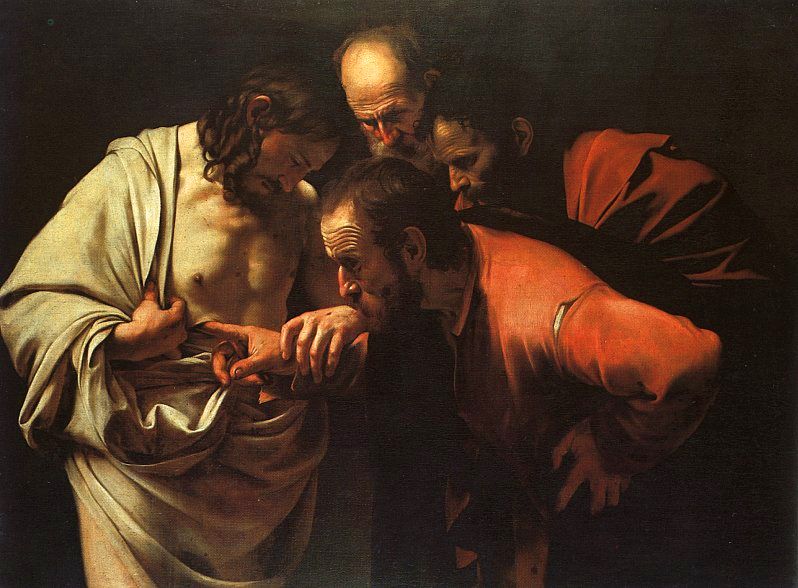
Jesus and Doubting Thomas

Jesus and Doubting Thomas

Denis Diderot was an 18th century French atheist. Referring to his life he wrote, ‘Wandering in a vast forest at night, I have only a faint light to guide me. Then a stranger appears and says to me “My friend, you should blow your candle out so you can find your way more clearly!?”‘ This is not only relevant to 18th century French atheists. So many people go through life like this today, not knowing what they are doing or where they are going, as if they are wandering around aimlessly in a forest in the dark with just a tiny light, and other people being less than helpful? But it does not have to be like that!

Recently we have celebrated Easter Day, the Day of the Resurrection, the greatest day in history. Jesus had died on the cross and three days later was raised to life again. Death could not hold him then and death cannot hold him now. He is alive for evermore. In terms of the Church Calendar the Easter period continues from Easter Day through to Pentecost. So it is both right and good to spend some time during this period looking at what are known as the ‘Resurrection Appearances’. These are the occasions when Jesus met with his disciples and spent time with them after he had risen. We have a wonderful example of one of these in John 20:19-31

It is the evening of Resurrection Day. The disciples are huddled together in the Upper Room, scared witless that Jewish Authorities are going to come and arrest them and put them to death as well. Then, even though the doors locked, suddenly Jesus comes and stands in the midst of them. He greets them with the words, ‘Peace be with you’ (vs.19,21). Jesus, the Prince of Peace speaks peace into their traumatised hearts to dispel their fear. This is not just any kind of peace; it is a special peace. The Hebrew word for it is shalom, which means far more than merely the absence of trouble. It is so much fuller and means complete peace, well-being, contentment, welfare, harmony. It is the peace that comes from knowing and being assured that our lives are safe in the hands of God. No more wandering in the dark forest of life blind and vulnerable. As the psalmist put it in Psalm 27:1 – ‘The Lord is my light and my salvation – whom shall I fear. The Lord is the stronghold of my life – of whom shall I be afraid?’ Paul tells us that this peace is made available ‘through the blood of cross'(Colossians 1:20), which is why Jesus then shows his disciples his hands and his side – the scars of the cross.

This is no ghostly appearance. Jesus is a physical being and his wounds are real. Peace with God is now available for sinful people which we all are. As we read in Ephesians 2:14 – ‘For Jesus himself is our peace who has destroyed the barrier, the dividing wall of hostility’. It is sin that separates us from God as if there is an insurmountable wall between us and God. This sin was dealt with on the cross so destroying this barrier. Because of the death and resurrection of Jesus, we are at one with God again, at peace with him. Because of Jesus, our sins are forgiven and the relationship between God and us is restored. When we receive peace with God, we also experience the peace of God. This peace is not as the world gives Jesus tells us (John 14:27) but, as we read in Philippians 4:7, it is ‘peace (that) passes or transcends all understanding.’ The Message translation describes this peace as ‘a sense of God’s wholeness, everything coming together for good, coming and settling you down.’

What a wonderful thing it is to experience this kind of peace in a world that knows so little peace. Life no longer experienced as a dark, mysterious, forest of unknowingness. Into this fearful place, God makes himself known as light breaking into darkness – light to guide us and show us the way. This light is ‘the light of the knowledge of the glory of God in the face of Christ’ (2 Corinthians 4:6). Life no longer mere physical existence, but life as it is meant to be – full, abundant and eternal – life that takes us from insecurity and fear to certainty and assurance, from doubt to faith. God is there and God does love us! With such peace – the peace of God – comes love, purpose, meaning, hope and joy. This is what the disciples experienced. As we are told here, ‘Thedisciples were overjoyed when they saw the Lord’ (v.20)!

All that is except Thomas – ‘Doubting Thomas’ as he is known, because he is not there (v.24). Where is he? Is he just too depressed after the death of Jesus and does not want to be with the others? Does he just want to be alone with his grief? Perhaps we have all felt like that at some point in our lives. Thomas always was a bit of a depressive and somewhat negative. For example, when Jesus’ friend Lazarus died, and Jesus was going to go to him so he could perform the great miracle of bringing Lazarus back to life, Thomas says, ‘Let us go too, that we may die with him’ (John 11: 16)!? This is verycourageous no doubt, but a somewhat pessimistic. So when the other disciples tell Thomas here, that they have seen Jesus, Thomas just does not believe them. He is full of doubt. Unless he sees for himself, he is not going to believe it?! Unless he sees the nail prints in Jesus’ hands where the nails were hammered onto the wooden cross, unless he thrusts his hand into Jesus’ side where the spear pierced Jesus’ flesh, he’s not going to believe?! For Thomas, ‘seeing is believing.’

Interestingly, this phrase – ‘seeing is believing’ – was first recorded in 1639, and suggests that ‘only physical or concrete evidence is convincing.’ This is such a modern scientific concept, and therefore surprising that it has been around for such a long time. In way it is totally understandable. It is so much easier for us to trust in our own physical eyes and to doubt everything else. Doubting Thomas is such a sympathetic character, so human, we can all identify with him because we all know what it is to doubt – to doubt what we believe or even if we believe anything at all?

But it is OK to doubt. To say we don’t doubt would be dishonest. And what Thomas is, is honest about it. He doesn’t believe just because other people say so, or because he thinks he should. There is nothing worse than pretending to believe when we don’t. Going through the motions, repeating the creeds by rote, thinking that that’s enough, and God doesn’t know what we really think! But God wants us to be honest with him and with ourselves. Alfred Lord Tennyson, the Victorian poet laureate of the Lady of Shallot fame wrote, ‘There lives more faith in honest doubt, believe me, than in half the creeds.’

Thomas could be described as an ‘honest doubter’. He wants to believe but he finds it hard. I think Jesus knew this and understood, because a week later when the disciples were in the house again, and Thomas is with them this time, Jesus comes among them and again speaks ‘Peace’ to them – ‘Peace be with you’ (v.26). He doesn’t say ‘what’s wrong with you Thomas? Why didn’t you believe’? No! Rather, so kindly and so gently, he says, ‘Thomas, put your finger here; see my hands. Reach out your hand and put it into my side. Stop doubting and believe!’ And Thomas does just that. He says to Jesus – and we can imagine him falling on his knees as he says it – ‘My Lord and my God!’ (v.28). He sees Jesus, recognises him, and calls him ‘Lord’ and ‘God’.

This is the thing about Thomas. With him there is no halfway house. When he was sure, he went the whole way. Well either Jesus is ‘God’ is true or it isn’t!? There is no halfway house, no sitting on the fence! There is such a thing as ‘dishonest doubt’ – when our ‘doubts’ are really simply ‘excuses’ for our refusal to believe or commit? When we foster doubts and feed them, when we enjoy them and insist on being negative and thinking the worst. Thomas Baird wrote a response to Tennyson’s verse about ‘honest doubt’ part of which goes as follows:-

‘There is more faith in honest doubt,
believe me, than in half the creeds;
so penned a poet (witless lout)
to praise the doubter’s doubtful deeds.

But let me whisper in your ear,
There’s no such thing as honest doubt;
For doubt will doubtless disappear
if it is honest out and out.

For doubt is very much like gout –
the more ’tis nursed, the more it grows.’

Thomas doubted in order to be sure and when he was sure, he surrendered to certainty. He gave Jesus his all, holding nothing back. It is suggested that Thomas became the first missionary to India. For him this assurance came about due to a personal encounter with the risen Christ. And the final answer to doubt is a personal experience of the Living Lord Jesus. So how does that help us?

Jesus said to Thomas, ‘So, you believe because you’ve seen with your own eyes. Even better blessings are in store for those who believe without seeing’ (v.29 The Message). Can we believe without seeing? Instead of ‘seeing is believing’ it becomes ‘believing is seeing’! We see with the eyes of faith. According to Hebrews 11:1, ‘Faith is being sure of what we hope for and certain of what we do not see.’ Thomas saw and believed. And Jesus calls us ‘blessed’ when we believe even though we do not see. We don’t see with our physical eyes, concrete evidence to convince us, but we can see with our inner spiritual eyes – which is actually just as convincing! We believe and our doubts are dispelled, when we have a personal encounter with the Risen Christ!

Now not everyone experiences this in the same way Saul of Tarsus (who became the Apostle Paul) did on the road to Damascus (Acts 9). It more usually happens as a growing awareness that God is there, that what it says in Scripture is true, that Jesus really did rise from the dead and so is still alive today and with us by his Spirit. Jesus promised ‘I will be with you always’ (Matthew 28:20), and it remains true, even today!Jesus is here! When we are honest with God, and with ourselves, and really open our hearts to him, we may experience his peace and loving presence as a living reality! We can know and be assured that our lives are safe in hands of God. No more wandering in the dark forest of life blind, vulnerable and alone! St Augustine wrote, ‘Faith is to believe what you do not see, the reward of faith is to see what you believe.’ When we feed faith and starve doubt, when we look into it positively with hope, anticipation and expectation, rather than with negativity and presuming the worst, Jesus becomes more and more real to us – as real as the person sitting next to us. We can have our own encounter with the Risen Christ, right here, right now, through the Holy Spirit. This is the testimony of countless millions of people throughout the world today and over the past 2000 yrs. As the old song goes:-

‘He lives, he lives,
Christ Jesus lives today!
He walks with me and talks with me
along life’s narrow way.
He lives, he lives
Salvation to impart!
You ask me how I know he lives?
He lives within my heart!’

~ Alfred Henry Ackley (1887-1960)

Julia Binney


Leave a comment

CHRIST IN THE CAR PARK

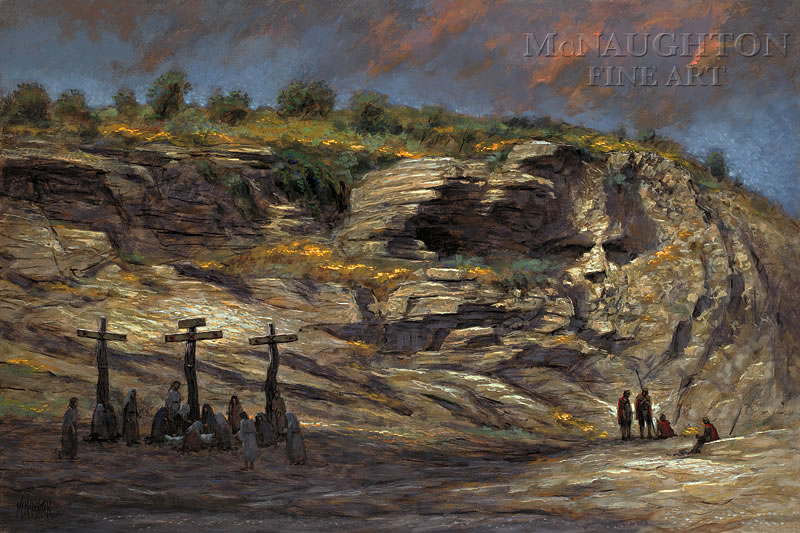
Skull Hill

Skull Hill

One of my favourite places in and around Jerusalem is a lovely garden known as ‘The Garden Tomb’ which houses a rock-cut tomb, unearthed in 1867, and which has subsequently been considered by some Christians to be the site of the burial and resurrection of Jesus. The Garden Tomb is adjacent to a rocky escarpment which since the mid-nineteenth century has been proposed by some scholars to be Golgotha (it is also known as ‘Skull Hill’ or ‘Gordon’s Calvary’). This, of course, is in contradistinction to the Church of the Holy Sepulchre – which, since the 4th century, has traditionally been recognised (primarily by Catholic and Orthodox Churches) as the site where the death and resurrection of Christ are believed to have occurred. During the 19th century doubts were raised concerning the authenticity of the traditional site, the Church of the Holy Sepulchre. These concerns motivated some Protestants to look elsewhere for the site of Christ’s crucifixion, burial and resurrection.

In 1842, near to the Damascus Gate, a German scholar named Otto Thenius noticed a rocky escarpment which, in his opinion, resembled the face of a skull. Since ‘golgotha’ is the Aramaic word for ‘skull’ Thenius concluded that the biblical references to the place of Jesus’ execution being at a place named ‘Golgotha’ (Matthew 27:33; Mark 15:22; John 19:17) possibly referred to the shape of the place, and that therefore this rocky escarpment may well have been the Golgotha. Such a view seemed to be supported by the fact that Sephardic Jews regarded the site as traditionally being a place of execution by stoning. Perhaps the most famous proponent of this view that this was indeed the genuine site of Christ’s crucifixion, however, was Major-General Charles George Gordon – Gordon of Khartoum – who visited Jerusalem in 1883. Since 1894 the Garden Tomb and its surrounding gardens have been maintained as a place of Christian worship and reflection by a Christian non-denominational charitable trust.

It is impossible to say with absolute certainty whether either of these two places – the Church of the Holy Sepulchre or the Garden Tomb – is the genuine site of Jesus’ death and resurrection, or indeed exactly where these two pivotal events in the history of the world took place. In many ways, knowing the exact location of the sites is not important. What is important is that at this particular point in history ‘Jesus died and rose again’ (1 Thessalonians 4:14) in order to make a way of salvation possible for all who truly believe! Having said that, there is still something very wonderful about visiting ‘the Holy Land’ and being able to visit the ‘key places’ where the events recorded in the Bible took place, and ‘walk where Jesus walked’! Though acceptance of the validity of the traditional site, at the Church of the Holy Sepulchre, is not a tenet of faith for any major Christian denomination, many Catholic and Orthodox Christians ignore the potential of the Garden Tomb, and hold fast to the traditional location. Nevertheless, the Garden Tomb has become a popular place of pilgrimage, especially among Protestant Christians, and for me, personally, carries a much deeper and more meaningful ‘atmosphere of reality’ than the Church of the Holy Sepulchre.

To be honest with you, I intensely dislike the atmosphere you find in the Church of the Holy Sepulchre, riddled as it is with ‘religious infighting’ between the various ‘Christian’ denominations that claim the right to be there, and the rowdy ‘pushing and shoving’ orchestrated by dreadful tour guides all trying to get their respective ‘tour  parties’ through the church as quickly as possible in order to ‘move on’ to the next site in their itinerary?! We have Christian friends in Israel who refuse to enter the Church of the Holy Sepulchre anymore, simply because they find it so ‘unholy’ nowadays?! In contrast the Garden Tomb – even though it too has become more ‘commercialised’ today than it was 10 years ago when we first visited – essentially remains a very special, serene garden with places set apart to have time to pray, or take communion, or ponder the events that possibly transpired there over 2000 years ago. Taking as much time as you like to sit overlooking ‘Skull Hill’ or to stand in the Empty Tomb with its wonderful sign by the door, ‘He is not here for He is Risen!’, transports you back to the reality of the events of that first Easter and its significance, in a way that the Church of the Holy Sepulchre fails to do!

The last time I visited the Garden Tomb -18 months ago – I was struck by something that I somehow had failed to recognise before. Stupidly, I had always thought that Jesus was crucified on the brow of Golgotha or ‘Skull Hill’ – now a Muslim Cemetery. Perhaps it was because of the subliminal influence of such hymns as Cecil Francis Alexander’s, ‘There is a green hill far away, outside a city wall’ – it has been suggested that most of us get our theology from the hymns and songs that we sing rather than from the Bible – that I have been singing for decades? Our very helpful guide, however, pointed out that in fact Jesus would have been crucified at the foot of the hill, not on the top of the hill. It would have been alongside the path where ordinary people passed by on a daily basis? It was near to the local ‘rubbish dump’ where the people passing by would have gone to get rid of their refuse? In hindsight, of course, this is obvious!

Reflecting on this, my mind went immediately to that scripture in the Book of Lamentations – ‘Is it nothing to you, all you who pass by? Look around and see. Is any suffering like my suffering that was inflicted on me, that the Lord brought on me in the day of his fierce anger?’ (Lamentations 1:12). Lamentations is a small poetic book, attributed to the Prophet Jeremiah, bewailing the destruction of Jerusalem and the desolation of Judah in 587 BC, incorporating a sorrowful commentary on the sufferings experienced by the Judeans both during and after the siege of Jerusalem, and also containing a representative confession of national sin – the real cause of Judah’s downfall! Lamentations 1:12 has become a classic expression of grief … and the parallel to the lament of Jesus Christ over heedless Jerusalem is striking – ‘Jerusalem, Jerusalem, you who kill the prophets and stone those sent to you, how often have I longed to gather your children together, as a hen gathers her chicks under her wings … but you were not willing?!’ (Matthew 23:37). It was this thought, of course, that inspired the 18th century clergyman Charles Wesley, to pen the words of the famous hymn that begins, ‘All you that pass by, to Jesus draw nigh; to you is it nothing that Jesus should die?’

Today Golgotha or ‘Skull Hill’ is situated just behind a bus terminal, which is smelly and dirty, near to Muslim market stalls selling fresh fruit and fresh bread and lots of sweets. The large car park adjacent to the place where Jesus was possibly crucified is ostensibly for buses, but locals also park their cars there. It is all very bustling and busy … this place where Christ died for the sins of the world … and still the vast majority of people pass by oblivious to the significance of those events 2,000 years ago?! Somehow, all this seems so appropriate for me! Christ in a car park! Christ dying on a cross for sinful men and women like you and me! Christ dying for ordinary people who travel on buses, drive cars, and shop at markets, etc! Christ dying in a former ‘rubbish dump’ … even for people considered as ‘refuse’ by the rest of society! What is not appropriate, however … is that any of us should simply ‘pass by’ … without giving Jesus Christ a second thought?

All you that pass by,
to Jesus draw nigh;
to you is it nothing that Jesus should die?
Your ransom and peace,
your surety he is,
come, see if there ever was sorrow like his.

He dies to atone
for sins not his own.
Your debt he has paid, and your work he has done:
you all may receive
the peace he did leave,
who made intercession, ‘My Father, forgive.

For you and for me
he prayed on the tree:
the prayer is accepted, the sinner is free.
The sinner am I,
who on Jesus rely,
and come for the pardon God cannot deny.

His death is my plea;
my advocate see,
and hear the blood speak that has answered for me:
he purchased the grace
which now I embrace;
O Father, you know he has died in my place!

Charles Wesley (1707-88)

Beneath Golgotha

Beneath Golgotha

Jim Binney

Leave a comment

IT IS FINISHED! (Jesus’ Seven Sayings from the Cross 7)

It is finished!

It is finished!

The last words, according to John, Jesus said before he died were, ‘It is finished!’ (John 19:30).  Not ‘I am finished’ but, ‘IT is finished!’ This is the great guttural Aramaic shout ‘TETELESTAI!’ No matter how hard we may try, it is impossible to shout loudly, our English translation, ‘It is finished!’  But in the Aramaic … well ‘TETELESTAI’ is a word you can really get your teeth into. It is a word meant to be shouted loudly!

Jesus is not a victim, but a servant doing God’s bidding. This is not a cry of desolation – ‘At last its over’ but a cry of triumph! It is a triumphant declaration – it is finished, it is done, it is accomplished! The sacrifice for the salvation of the world is made. His resurrection from the dead three days later is simply God’s ‘Amen’ to the sacrifice Jesus has made on our behalf!

With that, he bowed his head, he released his spirit – he let it go – and he died. Alleluia! What a Saviour!

‘Man of Sorrows,’ what a name
For the Son of God who came
Ruined sinners to reclaim!
Alleluia! what a Saviour!

Bearing shame and scoffing rude,
In my place condemned He stood;
Sealed my pardon with His blood;
Alleluia! what a Saviour!

Guilty, vile, and helpless we,
Spotless Lamb of God was He;
‘Full atonement!’ – can it be?
Alleluia! what a Saviour!

‘Lifted up’ was He to die,
‘It is finished!’ was His cry;
Now in heaven exalted high;
Alleluia! what a Saviour!

When He comes, our glorious King,
All His ransomed home to bring,
Then anew this song we’ll sing:
Alleluia! what a Saviour!

Philip Bliss (1838-76)

Julia Binney

Leave a comment

INTO YOUR HANDS (Jesus’ Seven Sayings from the Cross 6)

Father ... Into Your Hands

Father … Into Your Hands

‘Father, into your hands I commit my Spirit’ (Luke 23:46). This penultimate saying – this piece of the mosaic comprised by these Seven Sayings of Jesus from the Cross – starts to paint a different picture from that we have seen thus far. Jesus is in command of himself. He who freely gave himself into the hands of his executioners, is now committing himself into the hands of God! In life he always submitted to God’s will …  and now in death it would be no different. In life, in death … in God’s hands!

Is this the same for us? Jesus’ last words, according to Luke, are words of complete faith as he entrusts himself to God. They are exactly the same words we find in Psalm 31:5 where we read the Psalmist saying, ‘Into your hands I commit my spirit’. They are exactly the same … apart from the inclusion of one vital word – Father!

This verse from Psalm 31, taught to them from an early age, was repeated by every Jewish child in the darkness of night just before they went to sleep. Jesus begins his prayer with the word ‘Father’. The forsaken feeling has gone. He is no longer alone. He is dying with a prayer on his lips like a child falling asleep in his Father’s arms!

Julia Binney

2 Comments

FORSAKEN? (Jesus’ Seven Sayings from the Cross 5)

My  God, My God

My God, My God

‘My God, my God, why have you forsaken me?!’ (Matthew 27:46). What a cry! And what a staggering sentence … perhaps the most staggering in all the Gospels. ‘Forsaken’ is such a wretched and pitiful word and experience. ‘God forsaken’ is even worse?! Abandoned, rejected, despised, left helpless. This is how Jesus felt in this moment. His cry is a mixture of Aramaic and Hebrew, calling on the name of Elijah, the one believed to come to rescue the innocent. And it is loud! He wants people to hear.

These are the only words both Matthew and Mark record Jesus saying from the cross. They could best be understood as God talking to himself. Not like a mad person. More like God talking … and we listen. When we hear these desolate words we can only bow in reverence. How can God forsake God? It is such a profound mystery. But we ask the question anyway and try to answer the unanswerable.

There have been various attempts to penetrate behind the mystery, such as that Jesus is again quoting a Psalm. ‘My God, my God, why have you forsaken me?’ is the first verse of Psalm 22. The whole psalm is interwoven throughout the crucifixion narrative … and is actually a song of trust and confidence. Is this Jesus repeating the whole Psalm to himself? Reciting encouraging poetry to himself?

Alternatively, the feeling of abandonment is real. Here is Jesus on the cross bearing the sin of the whole world on his shoulders. Sin separates us from God. He who knew no sin was made sin for us. This sin distanced Jesus from God and left him helpless – an experience he had never had before. The eternal relationship with the Father broken!

In this moment Jesus would have understood the heart cry of every single human being on earth separated from God as we are by our sin. We see the human Jesus here – the agony, the torment. He foresaw it in the Garden of Gethsemane when he prayed, ‘My soul is overwhelmed with sorrow’ (Mark 14:34). Jesus plumbed the depth of human experience! However abandoned by God we may feel at times, whatever we go through, whatever depths we may sink to, there is no place where Js has not been before!

But had God truly forsaken Jesus? Surely God could not abandon Jesus? God has not abandoned us. How can God forsake God? It is still a profound mystery. If Jesus suffered death, felt abandoned by God … then the Father suffered too, the death of his son. The Son was ‘given up’ by the Father thro the Holy Spirit (Romans 8:32) and the Father suffered his own abandonment from the Son. The pain of the cross is the pain of God … Father, Son and Holy Spirit. This is who God is … the God of infinite love who gave himself for us!

Julia Binney

Leave a comment

I THIRST! (Jesus’ Seven Sayings from the Cross 4)

I Thirst

I Thirst

It is interesting that of all the physical sensations Jesus must have been feeling as he hung there on the cross, one would not necessarily have put ‘thirst’ at the top of the list? But when things are reaching their conclusion … this is what he cries. According to the Apostle John (and he should know because of all Jesus’ disciples he was the only one who remained there), Jesus said ‘I am thirsty!’ (John 19:28).

Up to this point, pain had certainly been there for Jesus … and lots of people also were there. In fact the whole of humanity was represented there – the two thieves were there, his mother and beloved disciple were there, the crowds were there … but now, in and of himself, Jesus feels truly alone. This is an intensely personal moment for Jesus. A moment when Jesus turns his attention on himself. ‘I am thirsty’ he says.

Apparently, when the human body is under massive strain, the reaction is most acutely felt in the mouth, we are led to believe. The most sensitive part of the mouth, the tongue, goes dry. This reflects the ‘thirst’ of Psalm 22:15 where the Psalmist says, ‘My strength is dried up like a potsherd, my tongue sticks to the roof of my mouth, you lay me in the dust of death.’

The soldiers at the cross, hear the cry and give Jesus some vinegary wine in a sponge held on the end of a stick. The drink offered is not the narcotic mixture prepared to dull the senses and lessen the pain that he was offered to Jesus before his crucifixion, and refused. This is the ‘cheap plonk’ that the soldiers would have been drinking themselves as they waited for Jesus and the two thieves to die.

But is there more to this than is immediately apparent? This cry of thirst is not just a desperate word from a dying man under a Middle Eastern sun. This is Jesus speaking at this precise moment in fulfilment of scripture. ‘I thirst’ recalls Psalm 69:21 where we read, ‘They put gall in my food and gave me vinegar for my thirst’. This saying is part of a lengthy description of the utter desolation, isolation, and scorn experienced by the ‘Righteous Sufferer’ in the Psalm, and the drink forms part of the torment. In this cry of desolation recorded here in John 19:28, Jesus is identifying himself with the ‘Righteous Sufferer’ foretold in Psalm 69!

For the soldier who offered Jesus this sponge filled with vinegar wine, however, this gesture was not intended to add to Jesus’ torment!?  For this soldier, the giving of his own wine appears to be a spontaneous act of kindness in response to this heartfelt cry! A strange thing for a member of the Roman execution squad to do? This man had been involved in the horrific, violent, abusive treatment Jesus had received. Ordered by the authorities, he had not only been responsible for the initial beating and abuse Jesus has received but he would then have hammered iron nails through his hands and feet on to a wooden cross!?

But his heart seems to have been touched by Jesus’ suffering! He would have seen this punishment countless times before? But what else did he see? What else did he hear? What was it that touched his heart and changed his life forever? Perhaps it would be better to say, ‘Who was it that touched his heart and changed his life forever?

Was this soldier in fact not just a common soldier, but the centurion in charge of the whole proceedings?  The very same man who, according to Mark, stood in front of Jesus as he hung on the cross … and as he witnessed Jesus pouring out his life in death for sinful people like us, responded, ‘Surely, this man was the Son of God!’ (Mark 15:39).

Julia Binney

Leave a comment

WOMAN, BEHOLD YOUR SON! (Jesus’ Seven Sayings from the Cross 3)

Woman, Behold Your Son!

Woman, Behold Your Son!

Standing near the cross are the women who were closest to Jesus. Confusedly most of them are called Mary. They are standing by Jesus when all but one of his disciples have fled and abandoned him. His mother is there, of course. Jesus looks up and sees her there … and standing right next to her is the disciple whom he perhaps loved most of all – John. Seeing them there together, Jesus says to his mother, ‘Dear woman, here is your son’ … and to his disciple, he says ‘here is your mother.’ (John 19:26,27). Jesus’ brothers had left him we are told earlier in John’s Gospel (John 7:5) and since Joseph had most probably died by this time, Mary was alone. So Jesus asks his dearest friend to take on the responsibility for the care of his mother.

Unjustly impaled on a cross, in utter agony of body and spirit, Jesus thinks not of himself but of the needs of his mother – his first and last touch with his incarnation. Jesus’ love is always rooted in the practical, the personal … in intimate relationship and reality. For Jesus ‘love’ is not a concept, a thought or philosophy? It is always eminently practical and personal! And as an outpouring of our love for God, we too must never ignore the responsibilities we carry in all our relationships – with both God himself and other people – and that that love must be rooted in the practical and personal!

Imagine how Jesus’ mother must have felt seeing her son there on the cross – his face and body bruised almost beyond recognition by the beatings, blood pouring from his wounds, his breathing shallow, his life slowly ebbing away. When Mary and Joseph had presented Jesus as a baby at the temple, Simeon had prophesied that Mary’s heart would be pierced (Luke 2:35). And pierced indeed, it was!

It has been said that ‘Christianity cannot be lived without a pierced heart!’

Julia Binney