1 Comment

JUST A COUPLE OF NANCY BOYS (Tour de France 1)

Stanislas Place, Nancy

Stanislas Place, Nancy

We are off to France once more … for seven weeks … camping! We never thought we would be able to do it yet again. We have enjoyed extended camping holidays in France every year since 2011. Major heart surgery for me last year prevented us going in 2014, and we thought that it would probably prevent us going camping ever again, even for just a couple of weeks. At the same time, Julia’s ‘conversations’ with a couple of Baptist Churches earlier in the year, concerning the possibility of her returning to the Pastorate looked as though they might prove fruitful. But, I have made an amazing recovery, and both ‘possibilities’ for Julia ultimately came to nothing … and with the diary clear for the foreseeable future … so we thought, ‘Why not fit in another extended camping holiday in France?’ So we sorted out all our camping gear, booked various campsites and our passage through the Tunnel, packed the car to the gills, left Julia’s two sisters to keep an eye on Julia’s mother and Reggie Doggie … and off we go!

We are heading for the Alsace-Lorraine region in the north of France on the German border. We are breaking our own ‘rules’ to do this because we normally always head south of Limoges to be sure of the sun. Alsace-Lorraine is a region of France we have never been to before, however, and we have been told that it is both beautiful and full of history. Our first major campsite will be at Kaysersberg but it is too far to drive in one day so we plan to ‘overnight’ in a campsite in Nancy. We have decided to forsake our usual routine of staying in cheap ‘budget hotels’ en route to our main campsites this year. Budget hotels are not that cheap these days, and by the time we have paid for the hotel and a meal it costs us around 100€ a night. So we have bought ourselves a ‘pop-up tent’ and a small gas cooker so that we can ‘overnight’ in campsites along the way. Julia’s mother keeps referring to these as ‘one night stands’? We have given up trying to explain that this is not quite the ‘correct term’?

Our first ‘one night stand’ is on the edge of the beautiful city of Nancy situated on the Lorraine plateau. The thought of staying in Nancy reminds me of an episode in one of my favourite TV programmes of all time, ’Allo,’Allo. Set in France during WWII, it is an hilarious comedy centring on the activities of the hapless café owner, Rene. For years it was never shown on French TV because of the way in which tends to ‘send up’ the French. In recent years, however, it has been shown … and the French absolutely love it! The scene from one of the episodes … which I can’t seem to get out of my mind … features a conversation between Rene and the effete German officer, Lieutenant Gruber. Rene is pretending be his twin brother, also called Rene (the ‘plot’ is too weird to explain here), and Gruber asks him where he and his brother were born? Rene somewhat hesitantly (and to Gruber’s delight) responds, ‘Well we are just a couple of … Nancy boys … really?’ Those au fait with the use of double entendre in British humour will understand why I can’t get this out of my mind at the prospect of staying in Nancy ourselves?

But before we actually manage to leave the UK for France there are a couple of ‘emergencies’ that have to be dealt with. Right ‘out of the blue’ a church that we had ‘ignored’ when we were sent their profile phones up and wants to meet us. The only date that suits us both is the day before we are due to leave for France. We arrange to meet them in the morning and delay packing our car until the afternoon. We have a good meeting … but they are seeing two other people as well as us … so we anticipate that one of the two ‘other candidates’ will win yet again?! The other (and more frightening ‘happening’) is that we are overnighting at Julia’s elder sister Gina’s in London before driving down to the Tunnel the next day. Julia has made some bedroom curtains for Gina (to match the cushions she has already made) and wants to hang them herself. Blow the possibility of going to a new church … the hanging of the curtains  is the real concern. Will they fit? Will Gina like them? These are the important questions? Thankfully all is well. The curtains are great! They fit perfectly! Gina loves them! Crisis averted.

We leave early the next morning and (via stops for a final ‘Full English’ for seven weeks, and coffee) arrive at the Channel Tunnel to catch our train for France. We are early so there is just time for another coffee … which I manage to throw all over myself rather than drink? I need a holiday! We drive on to the train and 35 minutes later we are in France and on our way to Nancy. We stop for a picnic lunch in one of the wonderful French motorway airies … and eventually arrive at our overnight campsite on the outskirts of Nancy. We unpack our new ‘pop up’ overnight tent … our big tent would take too long to erect … and it is so easy. It literally takes 10 minutes at the most. We buy some food from the camp shop and utilise our new ‘easy to use’ gas cooker to cook an evening meal. We are in an area of the camps site where everyone is ‘overnighting’ on the way to somewhere else. I have great fun attempting to work out which nationality is which simply by what they are wearing. The Germans are in vests and shorts, the Dutch have really jazzy shorts, the French have polo shirts, trousers, and sandals with socks? We play the same game at breakfast … but this time with what people eat for breakfast. The Germans have meat, the Dutch have cheese and other weird and wonderful things … all covered in chocolate sprinkles, and the French have small cups of strong black coffee, bread… and a fag!?

After breakfast we pack our car and drive down into the centre of Nancy where we spend a very pleasant hour or two wandering around this beautiful city. Nancy is the former capital of the dukes of Lorraine and offers visitors elegant 18th century town planning, aristocratic architecture and beautiful vistas including the famous Place Stanislas (a World Heritage Site since 1983) with its amazing heavily gilded, wrought iron railings and ornate fountains. It is stunning and well worth a visit. We think we will come back here sometime in the future, maybe for a city break or long weekend. Perhaps being a Nancy boy is not such a bad thing after all! 

Jim Binney 

Leave a comment

AN OPEN TABLE (Trinity Sunday)

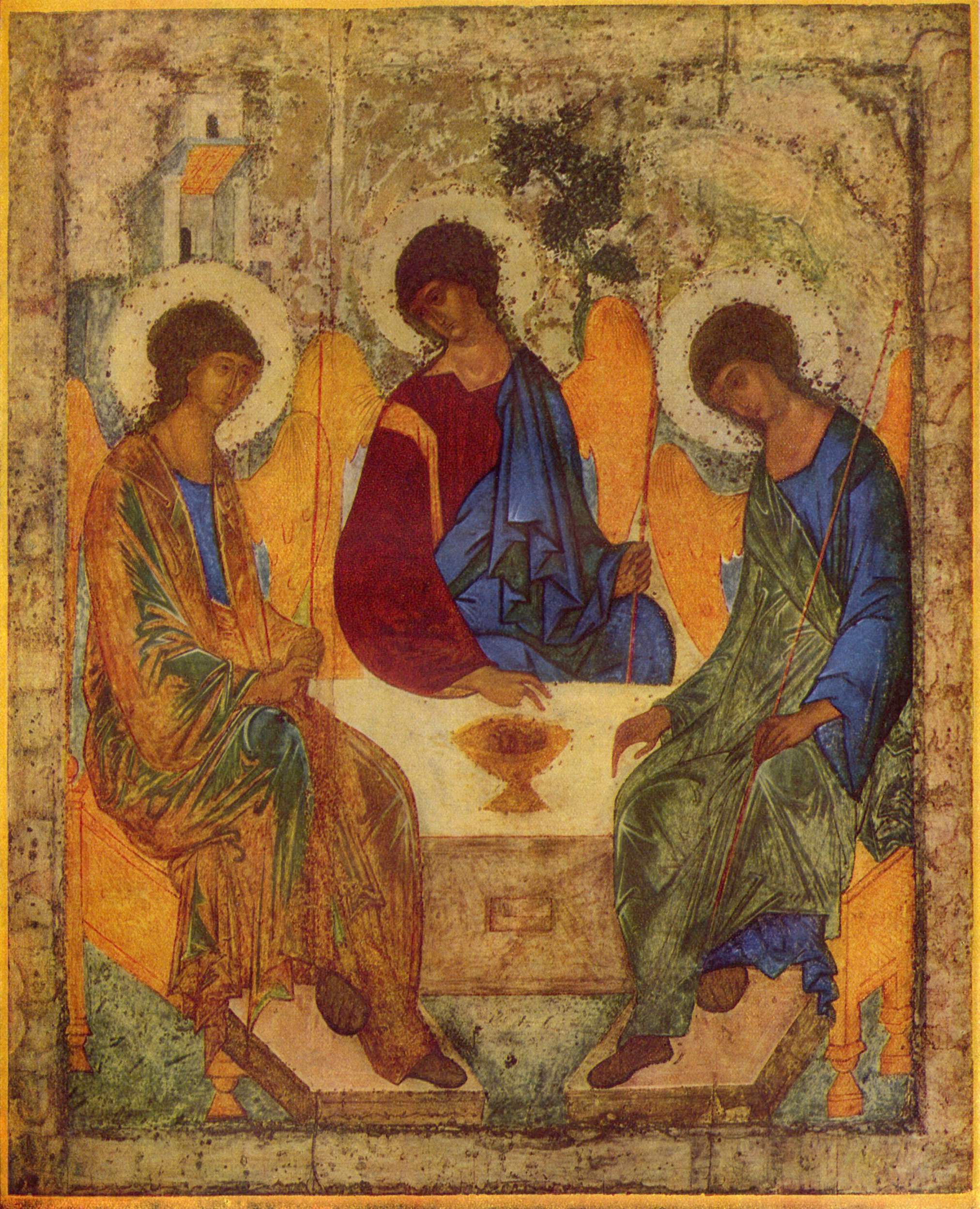
Rublev's Trinity

Rublev’s Trinity

The former Roman Catholic Archbishop of Boston, the late Cardinal Richard Cushing tells how early in his career, when he was a parish priest, he was called to a home to give the last rites to a man who was dying. Following the custom of the Roman Catholic Church, he knelt by the man and asked him, ‘Do you believe in God the Father, God the Son, and God the Holy Spirit?’ The man stirred a little, opened one eye, and replied, ‘Here I am dying and you ask me a riddle?’

Today is Trinity Sunday, the one Sunday in the entire Church Year set aside for us to focus on, not a particular individual or event but rather, an important, albeit somewhat difficult to comprehend, doctrine. Lots of the people have a really hard time trying to understand the triune nature or person of God. Christianity is one of the three great ‘monotheistic’ religions, along with Judaism and Islam. Christianity alone, however, understands this ‘One God’ as existing as ‘Three Persons’ – God the Father, God the Son, and God the Holy Spirit. The concept of God in Three Persons, whilst one of the deepest truths of the Christian Faith, is also on of the most perplexing truths of the Christian church to try to teach or explain.

Down through the generations there have been various attempts to illustrate how God is Trinity in order to make it easier for people to comprehend this truth. Everything from Saint Patrick’s use of a three leaf shamrock to demonstrate the three in one nature of God, to the diagrammatic ‘Trinity Triangles’ comparing God to the chemical symbol H2O and the Father, Son, and Holy Spirit to ice, water and steam. I have to confess (God forgive me) to probably having used these kind of illustrations in my earlier years to try and make the doctrine of God as Trinity easier to understand for both children and adults alike. Sadly, nearly all of these ‘illustrations’ are actually heretical. In virtually every case they are guilty of  ‘modalism’. Modalism is probably the most common theological error concerning the nature of God. In effect it is a denial of the Trinity. Modalism states that God is a single person who, throughout biblical history, has revealed Himself in three modes or forms, rather than three persons in one Godhead.

Some years ago my friend John Colwell introduced me to ‘Rublev’s Trinity’ (see the picture above) as a helpful way of understanding and illustrating God as Trinity. Rublev’s Trinity is an Icon attributed to the Russian painter Andrei Rublev in the 15th century. Ostensibly it depicts the story of the three angels who visited Abraham at the Oak of Mamre (Genesis 18:1-15) but in reality the painting is full of symbolism and (since it was painted at a time when creating images of God in this way was officially ‘not the done thing’) is interpreted as an Icon surreptitiously depicting the Holy Trinity. Icons are not meant to be venerated but (as with other religious paintings) are primarily meant to be a vehicle through which we are enabled to recognise the deeper spiritual truths about God and his ways. Ideally we are meant to ‘look through’ the Icon to the truths beyond it. For me, this is very much how I see the Bible actually. We are not meant to ‘worship the Bible’ but the God of the Bible. Whenever we read Scripture, or expound it, we are meant to ‘see through’ the actual printed word to the various truths contained within its pages.

Over the years Julia and I have grown to love Rublev’s Trinity. We have a large copy of it hanging on the wall of our Den – our office, come study, come prayer place – and we both frequently use it both illustrate and explain the doctrine of the Trinity to others and to meditate upon ourselves. There is so much to learn about the nature and activity of our God from this Icon. You can find all sorts of explanations – and helpful meditations based on the Icon – on the Internet. Some are more helpful (and less fanciful) than others, but I would encourage you to search the more helpful interpretations out and make good use of them.

For me, art – particularly paintings that thoughtfully depict biblical scenes and truths – is often an extremely helpful way of getting to grips with the deep truths of God. God (our Creator) is so ‘other’ to us (his creation), that, apart from his self-revelation to us, it is  impossible for us to comprehend him and his ways. As God himself tells us through his Prophet Isaiah: ‘My thoughts are not your thoughts, neither are your ways my ways, declares the Lord. For as the heavens are higher than the earth, so are my ways higher than your ways and my thoughts than your thoughts (Isaiah 55:8.9). No wonder then that the Orthodox Church begins its Communion Services with the words: ‘Welcome to this Mystery’, and John Calvin tells us (in his Institutes) that God speaks to us in ‘baby language’ because this is all we are capable of understanding. At best then our grasp on God and the things of God can only be tentative – rather like holding on to a wet bar of soap. It can be ‘held’ but it has to be held gently, carefully? In much the same way pondering something like Rublev’s Icon (as we could also ponder a passage of Scripture) tentatively, sensitively, allowing God to reveal himself and his truths through what is before us in picture (or narrative) enables the Holy Spirit to open our eyes and ears, our hearts and minds, to God and the things of God.

There is much that could be said about some of the more obvious truths illustrated by Rublev’s Icon. The fact that there are Three Persons, gathered around a table, obviously in a special loving and harmonious relationship with each other but where it is not obvious (at first glance) to tell which is the Father, which is the Son, and which is the Holy Spirit. The fact that there is a simple chalice on the table – symbolising the broken body and poured out life-blood of Jesus Christ – which reminds us all that the ground of our salvation is the gracious work of God in the Cross rather than in anything in and of ourselves.

For me, however, the most wonderful thing about this Icon is that it depicts a four-sided table. The Three Persons of the Trinity sit facing each of three sides of the table but the fourth side – the side facing outwards towards us –  is open. It is as if the Living God is inviting us to enter in and sit at his table? To come and share in this loving, harmonious relationship that already eternally exists within the Trinity itself. No wonder then that the Writer to the Hebrews encourages us  to  ‘approach God’s throne of grace with confidence’ because we will ‘receive mercy and find grace to help us in our time of need’ there (Hebrews 4:16).

One of the things I love about the Baptist Church (well the kind of Baptist Church that I associate with) is the concept of what is called ‘the open table’ at Communion. The famous Baptist writer and preacher, John Bunyan (1628-88), the author of the religious allegory The Pilgrim’s Progress, was the great champion of this. He believed, and taught, that anyone could attend ‘the Lord’s Table’ and take Communion. It was down to the person concerned to determine if he or she was ‘worthy’ in the light of the Apostolic injunction that ‘Everyone ought to examine themselves before they eat of the bread or drink of the cup’ (1 Corinthians 11:28) in coming to Communion. Some time ago I attended a very Reformed Church where I was not allowed to take Communion without a letter from my Pastor to say that I was ‘worthy’ enough to take Communion. For a brief moment I though seriously about writing myself such a letter right there and then and handing it to the rather officious steward hovering over me having given me the ‘good news’?! In the end I just though ‘Stuff it!’ and walked out, vowing never to go back to that particular church again! For me ‘closed communion’ is the very antithesis of what Scripture actually teaches, and what we see portrayed in Rublev’s Icon. As Jesus himself said on one occasion: ‘Come to me, all you who are weary and burdened, and I will give you rest. Take my yoke upon you and learn from me, for I am gentle and humble in heart, and you will find rest for your souls’ (Matthew 11:28,29).

In the Beginning, not in time or space
But in the quick before both space and time,
In Life, in Love, in co-inherent Grace,
In three in one and one in three, in rhyme,
In music, in the whole creation story,
In His own image, His imagination,
The Triune Poet makes us for His glory,
And makes us each the other’s inspiration.
He calls us out of darkness, chaos, chance,
To improvise a music of our own,
To sing the chord that calls us to the dance,
Three notes resounding from a single tone,
To sing the End in whom we all begin;
Our God beyond, beside us and within.

~ Malcolm Guite

Jim Binney

Leave a comment

LOWER YOUR BUCKETS! (Pentecost Sunday)

Pentecost

Pentecost

The story is told of a sailing ship during the 19th century on a voyage from Great Britain to South America. Towards the end of its journey it was blown off course in  great storm and, to make matters worse, their water supply was contaminated by sea water. After more than a week with no fresh water to drink things were pretty desperate, and the crew were ecstatic when another sailing vessel hove into view. A signal was immediately sent by semaphore: ‘Fresh water urgently needed!’ To their surprise back came the answer: ‘Lower your buckets!’ What the crew had not realised was that they had sailed into the mouth of the great River Amazon where fresh water flowed out into the Atlantic Ocean. All that the crew had needed to do if they wanted fresh water was simply to lower their buckets and they could have had all the fresh water they wanted.

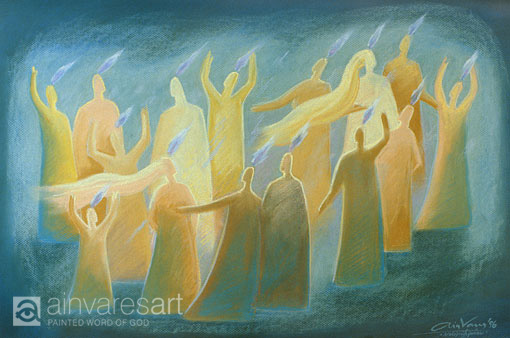
This coming Sunday (24 May 2015) Roman Catholic and Protestant Christians across the world will celebrate the Feast of Pentecost. Pentecost is not as well-known or as popular as the Christmas and Easter, nevertheless it commemorates a watershed event in Christian history. But what is the Christian Celebration of Pentecost all about? For Christians, Pentecost is the day when we commemorate God’s great outpouring of the Holy Spirit on the embryonic Christian Community and into the world at large, in a powerful new way. The event is recorded in the New Testament book known as The Acts of the Apostles. Luke (the author of the book) tells us that ‘When the day of Pentecost had come, [the first followers of Jesus] were all gathered together in one place. All of a sudden, a sound came from heaven, like a strong wind, filling the house where the people had gathered. Something like tongues of fire rested on their heads and they were all filled with the Holy Spirit and began to speak in other languages as the Spirit gave them the ability to speak’ (Acts 2:1-4).

Our English word ‘Pentecost’ is a transliteration of the Greek word pentekostos which means ‘fifty’. It comes from the ancient Christian expression pentekoste hemera which means ‘fiftieth day’. Christians, however, did not invent the phrase ‘fiftieth day’, we borrowed it from Greek-speaking Jews who used the phrase to refer to a Jewish Festival known as the ‘Feast of Weeks’ or more simply just ‘Weeks’. This name comes from an expression in Leviticus 23:16, where God instructs his people to count seven weeks or ‘fifty days’ from the end of Passover to the beginning of the next significant Festival. ‘Weeks’ was the second great feast in Israel’s yearly cycle of Festivals. Originally a harvest festival, it became, over time, a day in which the giving of the law on Mount Sinai was commemorated. This day became especially significant for Christians because, seven weeks after the resurrection of Jesus, during the Jewish celebration of Weeks, the Holy Spirit was poured out upon his first followers, thus empowering them for their mission and gathering them together as a church. Jesus himself promised his disciples, on a number of occasions, that God would pour out the Holy Spirit upon the Church, and into the world, in a new and powerful way. Prior to this first Pentecost in the Christian era, God had empowered various individuals through the gift of the Holy Spirit for a specific task. For example, Samson (Judges 13:24,25), but oftentimes this ‘gift of God’s Spirit’ was only for the task in hand and not permanent.

Something more permanent, more long-lasting, was both needed … and promised.  In what is called his ‘Upper Room Discourses’ (John 14-16) Jesus repeatedly made reference to the fact that when the time finally came for him to leave his disciples (following his death, resurrection, and ascension), he would not leave them alone but would send them ‘another Counsellor to help you and to be with you for ever’. This ‘Counsellor’ would be no ordinary person but none other than God the Holy Spirit, the Third Person of the Trinity, co-equal with God the Father and God the Son. The actual word Jesus uses here, translated as ‘Counsellor’ or ‘Comforter’ or ‘Advocate’ in English, is ‘Paraclete’ in Greek – literally ‘One who stands alongside of us in order to help’! It would be the role of this Person, from Pentecost onwards, to make everything Jesus made possible for us, through his Incarnation and Passion, a living reality in personal experience. Earlier, at another Jewish Feast, the Feast of Tabernacles, Jesus had also foretold this remarkable outpouring of God’s Spirit.

The Apostle John tells us that, ‘On the last day, the climax of the Festival, Jesus stood and shouted to the crowds, “Anyone who is thirsty may come to me! Anyone who believes in me may come and drink! For the Scriptures declare, ‘Rivers of living water will flow from their heart.'” (John 7:37,38). Explaining what Jesus meant by this, John goes on to say, ‘When he said “living water,” he was speaking of the Spirit, who would be given to everyone believing in him. But the Spirit had not yet been given, because Jesus had not yet entered into his glory’ (John 7:39). Here Jesus likens the experience of receiving the gift of the Holy Spirit, metaphorically, to having our thirst quenched by rivers of living water flowing up from within. Just as those parched and dying sailors in the incident cited earlier were able to quench their thirst by lowering their buckets and drawing fresh water from the mouth of the great River Amazon, so all those who are spiritually parched and dying are able to quench their spiritual thirst by drinking from those rivers of living water that our great God has provided for us through the outpouring of his Holy Spirit at Pentecost 2,000 years ago!

Discussing the impact that experiencing this wonderful Gift from God would bring, Jesus told his disciples ‘You will receive power when the Holy Spirit comes upon you’ (Acts 1:8). The word for ‘power’ here is the Greek word dunamis from which we get our words ‘dynamo’ and ‘dynamic’. What we have here is Jesus’ promise that the Gift of the Holy Spirit will enable us to live effective lives for the glory of God and the blessing of others, both individually as Christians and corporately as the Church. What is more, this promised experience is not just for the moment but permanent, not just for ‘believers’ but for everyone. After his own experience of receiving the Gift of the Spirit that first Pentecost the Bible records that Peter, one of the leading followers of Jesus, stood up and preached his first sermon, interpreting the events of that morning in light of a prophecy of the Hebrew prophet Joel (Joel 2:28-32) where God promised to ‘pour out his Spirit on all flesh’ empowering diverse people to exercise divine power. As a result Peter tells us all that the same Gift is freely available to all who will turn to God: ‘Repent and be baptised, every one of you, in the name of Jesus Christ for the forgiveness of your sins. And you will receive the gift of the Holy Spirit for the promise is for you and your children and for all who are far off – for all whom the Lord our God calls‘ (Acts 2:38,39). Luke goes on to tell us that ‘about 3,000 people were added to the church that day’ (2:41). Not a bad response to someone’s first ever sermon!

So here is a question for you: Have you received the Gift of God’s Holy Spirit? At Pentecost, 2,000 years ago, God poured out his Holy Spirit in a remarkable way, a way in which it was made possible for anyone and everyone to enter into all that God made possible for us through Jesus Christ in dynamic personal experience. The Spirit of God is at work in the world in a significant way today. God is literally ‘only a prayer away’. All we have to do is ‘lower our buckets’ … and drink!

Today we feel the wind beneath our wings
Today  the hidden fountain flows and plays

Today the church draws breath at last and sings
As every flame becomes a Tongue of praise.
This is the feast of fire, air, and water
Poured out and breathed and kindled into earth.
The earth herself awakens to her maker
And is translated out of death to birth.
The right words come today in their right order
And every word spells freedom and release
Today the gospel crosses every border
All tongues are loosened by the Prince of Peace
Today the lost are found in His translation.

~ Malcolm Guite

Jim Binney

Leave a comment

BECOMING PART OF HEAVEN’S STORY


Jesus Ascending Into Heaven

Jesus Ascending Into Heaven

Mark Warburton, the manager of Brentford FC, has enjoyed a successful two seasons in charge, taking the club to promotion from Division 1 into the Championship during his first year, and into the Play Offs for a place in the Premiership during his second year. Acknowledging that Warburton’s team play in a particular attacking style, a reporter recently asked Warburton if he had a Plan B if Plan A failed. ‘Yes’, replied Warburton, ‘Plan B is to do Plan A better!’

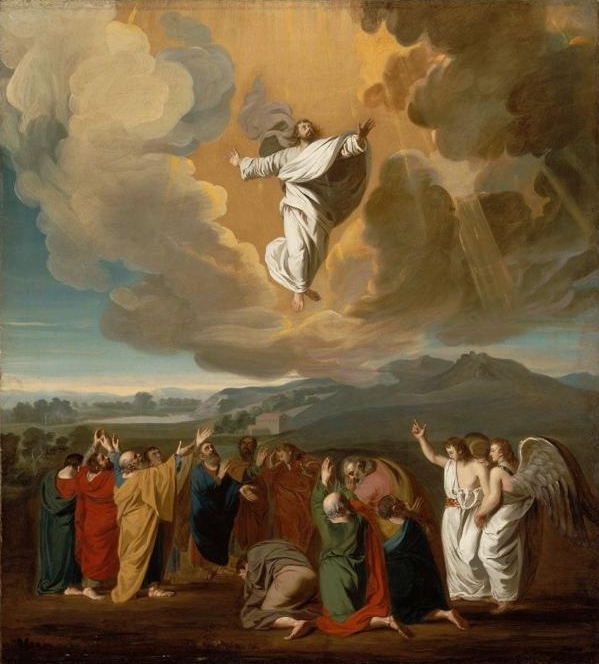
This week (on Thursday, 14 May) the Church celebrates ‘The Feast of the Ascension’, which commemorates the bodily Ascension of Jesus into heaven. Ascension Day is traditionally celebrated on a Thursday, the fortieth day of Easter (following the count given in Acts 1:3). Luke tells us in his Gospel that on the day in question Jesus led his disciples out to the region around Bethany. He then lifted up his hands and blessed them and ‘while he was blessing them, he left them and was taken up into heaven’ (Luke 24:50,51). In his follow up book The Acts of the Apostles, Luke expands on this remarkable event (Acts 1:1-11), not only filling in the detail somewhat but also placing it within the context of the promised gift of the Holy Spirit (which was to be poured out upon the early church in a matter of days at Pentecost) and the promised return or Second Coming of Christ (which we still await).

Over the years I have heard very few sermons (apart from those I have preached myself) about the Ascension. Perhaps this is due to my spiritual roots being in the Baptist-Pentecostal tradition, rather than the Anglican or Roman tradition, where the Church Year is only followed by a few of us. The bodily Ascension of Jesus into heaven, however, remains, for me at least, a very important event with much to teach and encourage us. Malcolm Guite suggests that ‘In the mystery of the Ascension we reflect on the way in which, in one sense Christ leaves us and is taken away into Heaven, but in another sense he is given to us and to the world in a new and more universal way. He is no longer located only in one physical space to the exclusion of all others. He is in the Heaven which is at the heart of all things now and is universally accessible to all who call upon him. And since his humanity is taken into Heaven, our humanity belongs there too, and is in a sense already there with him … In the Ascension Christ’s glory is at once revealed and concealed, and so is ours.’

Properly understood, the bodily Ascension of Jesus into heaven is a great encouragement to all who truly believe in Jesus. To begin with Christ’s Ascension into heaven, where he is right now ‘seated at the right hand of God’ (Hebrews 12:2) is, in many ways, the culmination of his saving work on our behalf. The Writer to the Hebrews also tells us elsewhere in his Letter that as a result of his Ascension, Jesus ‘is [now] able to save completely those who come to God through him, because he always lives to intercede for them (Hebrews 7:25). There is right now, at this very moment, a man in heaven whose very presence is intercession before God for sinful people like us. On that Day when we all have to stand before God, and give an account – on that Day when God will ask us all ‘why’ he should let us into his heaven – we will not have to say a single word but only point to the One seated next to him in Glory, the One who through his sacrifice on our behalf on Calvary’s Cross has made salvation possible for all who will turn to Christ!

Christ’s intercession on our behalf can also be understood in another way. Right now, this very moment, Jesus is praying for us. If nobody else prays for us, ever, we can be sure of this – Jesus himself is praying for us. As we have already seen, the Writer to the Hebrews tells us, ‘[Jesus] always lives to intercede for [us]’ (Hebrews 7:25). It is because of his prayers for us that we are enabled to ‘keep, keeping on’ in the Christian walk. Jude (one of Jesus’ brothers) commends us ‘To him [Jesus] who is able to keep you from falling away, and who will present you before [God’s] glorious presence without fault and with great joy’ (Jude 24). And part of the reason why we can faithfully continue and complete our Christian journey is because of the ongoing prayerful intercessions of Jesus for us!

This, however, is not the only benefit of the bodily Ascension of Jesus into heaven. The Apostle Paul tells us that by becoming Christians, God has not only  ‘raised us from the dead along with Christ’ but also ‘seated us with him in the heavenly realms’ (Ephesians 2:6). We ourselves are now able to see things in a completely new way. We see things from God’s point of view. We are now able to truly ‘have the mind of Christ’ (Philippians 2:5). We are now capable of really understanding that God has not only saved us from ‘an empty and wasted way of life’ (1 Peter 1:18) but that he has a meaningful plan and purpose for us (Romans 8:28). What is more, being ‘seated with Christ in the heavenly realms’ means that we have a new power to overcome all that which would stand against us.  Earlier on in his Letter to the Ephesians, Paul tells us that when God raised Jesus from the dead, and seated him in the heavenly realms, he also ‘placed all things [every earthly and spiritual power and authority] under his feet’ (Ephesians 1:22). Seated with Christ in those same heavenly realms means that we too, in some way, share (in Christ) that same power and authority over everything that would oppose us fulfilling the plans and purposes of God!

How does this work itself out? Well, the bodily Ascension of Jesus into heaven also helps us to understand this. Once again, in his Letter to the Ephesians, the Apostle Paul explains that one of the reasons Christ ‘ascended on high’ was so that he might ‘give gifts to his people’ (Ephesians 4:8). Paul goes on to single out the specific ‘ministry gifts’ of ‘apostles, prophets, evangelists, and pastor-teachers’ (Ephesians 4:11). We know, of course, that these are not the only ‘giftings’ mentioned in Scripture –  there are many others listed, elsewhere – and (as a result) we can be assured that every Christian has at least one gift that he or she can use for the glory of God and the blessing of others. In fact Paul goes on to speak in terms of God’s people being ‘equipped for works of service’ (Ephesians 4:12), as a result of Christ’s gifting.

The greatest Gift of all, however, and the source of all these other ‘giftings’, is that alluded to here in the earlier part of the Ascension Day passage in Acts 1:1-11. It is the ‘gift of the Holy Spirit’ himself. As Jesus tells us here ‘You will receive power when the Holy Spirit comes upon you, and you will be my witnesses’ (Acts 1:8). Previously, during various conversations in the Upper Room Jesus warned his disciples that he would soon be leaving them, but promised them also that when he ascended into heaven he would not leave them alone but would send them ‘another Comforter’ (John 14-16). Jesus was speaking here of God the Holy Spirit. ‘Comforter’ or ‘Counsellor’ (titles used to describe the Holy Spirit’s role here) literally translates as ‘One who stands alongside us in order to help us’. What a good description of the way in which the Holy Spirit both empowers us and enables us to live out our lives effectively for God!

All this, of course, is also in the context of the promised Second Coming of Christ. As the disciples witness the bodily Ascension of Jesus into heaven they are joined by two angelic beings who tell them that one day (well into the future, in turns out) ‘this same Jesus … will come back in the same way you have seen him go into heaven’ (Acts 1:11)! That day will see the glorious culmination of everything God has been working towards in time and eternity. Until that day, however, we can affectively live out our lives for the glory of God and the good of others. The bodily Ascension of Jesus into heaven assures us of this!

An old legend imagines Jesus arriving in heaven right after the Ascension, welcomed by all the angels. Then the angel Gabriel asks Jesus, ‘You suffered much, dying for the sins of humankind. Does everyone down on earth know it? ‘Oh, no,’ replied the Lord, ‘just a handful of people in Jerusalem and Galilee know about it.’ ‘Well, Master,’ continued Gabriel, ‘what is your plan for everyone to know of your great love? Jesus replied, ‘I asked all my disciples to carry the message into all the world. I told them to tell others, who will in turn tell others until the last person in the farthest corner has heard the story.’ Gabriel’s face clouded over as he spotted a flaw in the plan. ‘What if after a while Peter forgets, and goes back to his fishing on Galilee, also James and John and Andrew? Suppose Matthew returns to his tax booth in Capernaum, and all the others lose their zeal and just don’t tell others. What then?’ After a pause came the calm voice of the Lord Jesus, ‘Gabriel, I have no Plan B!’

‘We saw his light break through the cloud of glory
Whilst we were rooted still in time and place
As earth became a part of Heaven’s story

And heaven opened to his human face.
We saw him go and yet we were not parted
He took us with him to the heart of things
The heart that broke for all the broken-hearted
Is whole and Heaven-centred now, and sings,
Sings in the strength that rises out of weakness,
Sings through the clouds that veil him from our sight,
Whilst we our selves become his clouds of witness
And sing the waning darkness into light,
His light in us, and ours in him concealed,
Which all creation waits to see revealed.’

~ Malcolm Guite

Jim Binney

2 Comments

A WINDOW ON FORGIVENESS

The Forgiveness Window

The Forgiveness Window


One of the delights of living in rural West Dorset are the various little gems we have discovered on our travels. The Church of St Nicholas and St Magnus at Moreton, and its amazing etched glass ‘Forgiveness Window’, is one such gem. It has been suggested that ‘Forgiveness is the chief characteristic of the Christian!’ I wonder if you would agree with this? Perhaps, more to the point, do those of us who profess to be Christians actually practise forgiveness? I have often heard it said, ‘Well, I will forgive … but I won’t forget!’ But if we don’t ‘forget’ have we really ‘forgiven’? After all the Bible tells us that ‘as far as the east is from the west, so far has [God] removed our transgressions from us’ (Psalm 103:12) and ‘[God] will again have compassion on us; [he] will tread our sins underfoot and bury all our iniquities in the deepest sea’ (Micah 7:19). So when God forgives, it would seem, he also forgets!

St Nicholas’ Church, Moreton, was a normal little church with the usual amount of local history attached to it until a direct hit from a German bomber in 1940 – believed to have been intended for a nearby military base – destroyed much of it. Originally the church had conventional stained glass windows, but when the church was rebuilt (it took 10 years to rebuild it) the windows were replaced with small panes of green glass like an old fashioned bathroom. The locals hated the windows and an architect suggested that Laurence Whistler (brother of the artist Rex Whistler) renowned for his recreation of lost glass engraving techniques, might be consulted. Gradually over the next 30 years the church or donors commissioned Whistler to replace all the windows with designs of increasing complexity, engraved from both sides of the glass creating a spectacular three-dimensional effect that changes in every light. The result today is the creation of a spectacular church interior that is well worth a visit. Not only are the windows themselves world famous, and a sight to see in their own right, but the transformation of the inside into a place of light and space is magical.

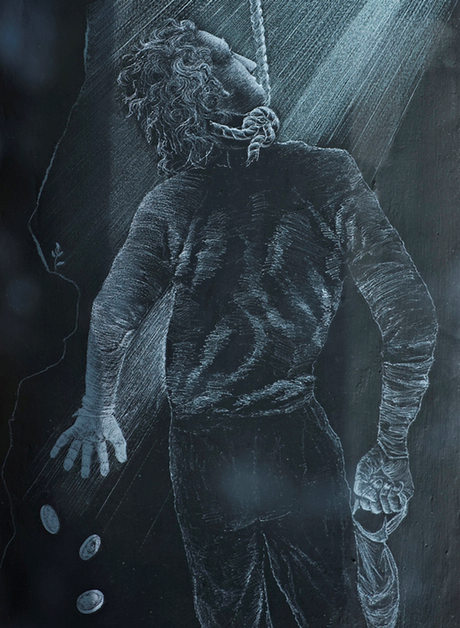
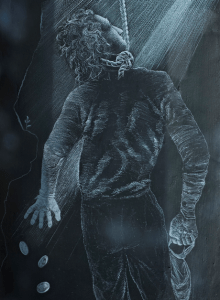
In February 1987, when Laurence Whistler had completed 12 full sized windows, he wrote a letter to the then Rector offering to create and donate a ‘thirteenth window’ to the church – an engraved window depicting Judas Iscariot. In his letter he made the point that many mediaeval churches often had uncouth and unholy figures sculptured on the outside, as if in contrast with holy scenes on the inside. He went on to refer to the thirteenth window near the south-east corner which was glazed but walled up. Adding that Judas was (in his opinion) ‘the thirteenth disciple’, Whistler went on to say that he would like to engrave on that window, to be seen only from the outside, ‘a shadowy figure, not clearly defined but sketchy, of Judas hanging with the thirty pieces of silver falling from his hand and turning into flowers on the ground.’ That would be the point – a hint that possibly even Judas might, at the moment of death, have sought and found God’s forgiveness?

The reaction of the Rector and the Parish Church Council at the time, however, was far from encouraging. Whistler’s treatment of Judas was seen as so startling that it divided the Parish Council and the village, with some regarding the window as unacceptably ugly, and others genuinely shocked. The PCC was split, the Rector opposed it, and the Diocesan Chancellor (who could have granted the necessary permission) appeared indifferent. The original objection, from 44 parishioners, backed by their vicar and eventually the local bishop, was because they didn’t want Judas darkening the doors (or windows) of St Nicholas, since the theme of the other dozen designs was ‘light’. Judas represented darkness. He was the devil’s henchman, the human face of evil. More particularly, they didn’t like Whistler’s image, as it suggested that there might be hope for Judas after all. Back then, many people also regarded suicide as an ‘unforgivable sin’. Even though Whistler, dubbed the window the ‘forgiveness window’, and showed the silver coins turning into flowers before they touched the soil, church authorities at the time deemed the subject of suicide unfitting. The Roman Catholic Church refused to bury suicides. The Jesuit theologian Cardinal Avery Dulles argued that the gospel descriptions of Judas ‘could hardly be true if the traitor had been forgiven’!  Sadly, these views were shared by Anglo-Catholics and many others within the Anglican Church and other Protestant Churches at that time.

Undaunted Whistler put his idea into effect and by September 1993 had engraved the panel which he subsequently called ‘The Forgiveness Window’. Whistler renewed his offer of the gift and meanwhile put it on view in an exhibition in Salisbury. After considering the offer once again, the PCC was still divided and, when it looked as though the issue would go to a church court, Whistler shelved the whole project rather than cause further unhappiness. He loaned the window to the county museum in Dorchester but insisted that if the church ever changed its mind it should go to Moreton.

So what are we to make of Judas Iscariot? According to the New Testament, Judas was one of the Twelve original disciples of Jesus Christ. The son of Simon Iscariot, he is known for the kiss and betrayal of Jesus to the Sanhedrin for 30 silver coins (Matthew 26:14-16;47-50). His name is often invoked to accuse someone of betrayal. Though there are varied accounts of his death, the traditional version sees him as having hanged himself following the betrayal (Matthew 27:1-10). His place among the Twelve Apostles was later filled by Matthias (Acts 1:12-26). Despite his notorious role in the Gospel narratives, Judas remains a controversial figure in Christian history. Judas’ betrayal, for instance, is seen as setting in motion the events that led to Jesus’ Crucifixion and Resurrection, which, according to traditional Christian theology, brought salvation to humanity. Gnostic texts (rejected by the mainstream Church as heretical) praise Judas for his role in triggering humanity’s salvation, and view Judas as the best of the apostles (The Gospel of Judas). In contrast to this, traditional Christian theology questions the genuineness of Judas Iscariot’s commitment from the beginning (his highest title for Jesus was ‘Rabbi’, never ‘Lord’), and sees him as a ‘son of perdition’ (John 17:12), demonised (John 13:27), and someone who (following his suicide) ‘went to his own place’ (Acts 1:25) wherever that may be, presumably Hell? On the other hand we ought not to doubt the sincerity of Judas Iscariot’s call to follow Jesus. Clearly Jesus, at the beginning, viewed Judas as a potential follower and disciple. To suggest that Jesus deliberately called Judas in order that he might eventually betray Jesus (in order to fulfil Old Testament prophecy) does despite to the character of Jesus himself. Our Lord’s foreknowledge concerning Judas does not imply fore-ordination that Judas must inexorably become a traitor. Surely Jesus’ repeated appeals to Judas, summed up in the offering of the ‘choice morsel’ to Judas at the Last Supper (John 13:26) demonstrating a final gesture of Jesus’ undying love for Judas, are evidence that ‘God desires everyone to be saved and brought to a knowledge of the truth’ (1 Timothy 2:4). Is it possible – given that ‘when Judas, who had betrayed him, saw that Jesus was condemned, he was seized with remorse and returned the thirty pieces of silver to the chief priests and the elders’ (Matthew 27:3) – might, at the moment of death, have sought and found God’s forgiveness?

It is, of course, our approach and attitude to forgiveness that Laurence Whistler sought to challenge through this engraved window featuring Judas Iscariot’s last moments. In his original offer to the church, Whistler, who died in 2000, said, ‘To my mind, a church is one place where the conflict of good and evil, life and death should be felt at its sharpest.’ In what he called the ‘Forgiveness Window’, Whistler offered a direct challenge – even without the title – to the traditional fate of Judas.

Taking as its inspiration the moment of his lonely suicide, described in Matthew’s gospel, Whistler’s window has the traitor dressed in ‘everyman’s clothing’ as he hangs at the end of a rope. His back is turned, with a shaft of light from heaven illuminating both his face in side-profile and the ill-gotten coins as they fall to the ground. Flowers spring up to mark the spot where they land. For Whistler, this is Judas redeemed. However terrible his sin of betrayal, it can still be forgiven.

The ‘Forgiveness Window’ faces us with some key questions we need to answer. So, before you write me off (along with Laurence Whistler) as a ‘heretic’, consider some of these questions:

Is suicide a sin? Is it not true that some people attempt or even commit suicide, not because they are ‘sinful’ but because they are ill, or mentally disturbed, or desperately lonely, or feel they have nowhere or no one to turn to? Do they shy away from the church in their final hours because they believe that they would receive no understanding, or sympathy, or help?

Is it not equally true that – like Whistler’s ‘Forgiveness Window’ which is, in effect, outside the church (since it can only be viewed externally not internally) – we Christians have become too obsessed with ourselves? Have we become ‘a holy huddle’? Are we too caught up with ‘spiritual navel gazing’ rather than reaching out to the lost and broken and hurting? Has our understanding of the church as being the ‘gathered church’ (‘belief’ before ‘belonging’), rather than the ‘gathering church’ (‘belonging’ leading to ‘believing’) actually been counter-productive in terms of growing the Kingdom of God? Has our quest for maintaining ‘the purity of the church’ – how many sermons have you heard about the necessity of avoiding ‘sin in the camp’ (Joshua 7-9) – actually proved to be a barrier to numerical and spiritual growth rather than ‘usher in Revival’?

Are we very good at loudly promoting a countercultural message of forgiveness in a generally unforgiving world – some (as suggested earlier) even claim forgiveness as the distinguishing Christian virtue – but curiously, then find it so hard to practise, as Christians and churches, what we preach? Remember, Jesus himself taught us that ‘if you forgive others when they sin against you, your heavenly Father will also forgive you. But if you do not forgive others their sins, your Father will not forgive your sins.’ (Matthew 6:14,15). And … was not ‘Father forgive them, for they do not know what they are doing’ (Luke 23:34) amongst Jesus’ final words from the Cross?

Do we really believe that ‘God desires everyone to be saved and brought to a knowledge of the truth’ (1 Timothy 2:4)? If so, we should never ever ‘give up’ on anyone. We should keep on praying, and keep on witnessing and testifying to others in the conviction that ‘the Gospel is still the power of God for the salvation of all who believe’ (Romans 1:16), and that ‘With God, there is always a way out, always a way back, always a way up!’

Laurence Whistler was an optimist, but that must have been sorely tested in his later years, for he did not live to see the offending window finally installed (he died in 2000). In 2013, however, the peace-making efforts of a new, female vicar, the Revd Jacqueline Birdseye, finally resolved the dispute. The ‘Forgiveness Window’ was finally installed – exactly where Whistler envisaged it being placed – 13 years after Whistler’s death and almost 30 years after the artist first offered it to the parish. The decision of the Parish Church Council was unanimous and the church has subsequently had nothing but positive comments made by visitors since the installation. This is unsurprising because to simply stand in the graveyard, contemplating this remarkable engraved window, is a tremendously powerful and moving experience. Perhaps like me (and probably Laurence Whistler) they too agree that ‘Forgiveness is indeed the chief characteristic of the Christian!’

There’s a wideness in God’s mercy,
Like the wideness of the sea;
There’s a kindness in His justice,
Which is more than liberty.

There is no place where earth’s sorrows
Are more felt than up in Heaven;
There is no place where earth’s failings
Have such kindly judgment given.

For the love of God is broader
Than the measure of our mind;
And the heart of the Eternal
Is most wonderfully kind.

But we make his love too narrow
by false limits of our own;
and we magnify his strictness
with a zeal he will not own.

There is plentiful redemption
In the blood that has been shed;
There is joy for all the members
In the sorrows of the Head.

If our love were but more simple,
we should take Him at his word;
and our lives be filled with gladness
from the presence of the Lord.

~ Frederick W Faber (1814-63)

Jim Binney

Coins into Flowers

Coins into Flowers

Leave a comment

FORTY DAYS OF GREY

Forty Days of Grey

Forty Days of Grey

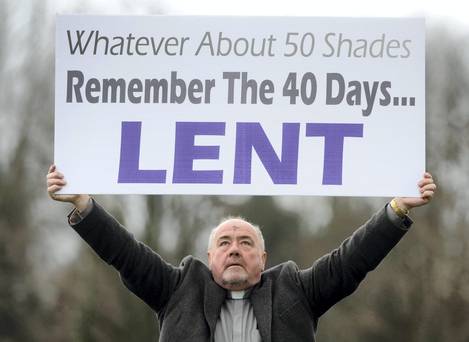
Fifty Shades of Grey is a film, currently doing the rounds in British cinemas, produced by Universal Pictures. It is based on an erotic romance novel by British author E L James, first published in 2011, the first instalment in the Fifty Shades Trilogy that traces the deepening relationship between a college graduate, Anastasia Steele, and a young business magnate, Christian Grey. It is notable for its explicitly erotic scenes featuring elements of sexual practices involving bondage, dominance, sadism and masochism (BDSM). Fifty Shades of Grey topped best-seller lists around the world, including those of the United Kingdom and the United States. The series has sold over 100 million copies worldwide and been translated into 52 languages, and set a record in the United Kingdom as the fastest-selling paperback of all time.

I confess that I have not seen the film, but I have read all three volumes of the Trilogy. The film has had poor reviews with filmgoers saying that the best thing about going to see it was the popcorn they bought to eat whilst watching the film? Apparently the sex scenes are unintentionally funny, with audiences dissolving into laughter at the ridiculous activities Anastasia and Christian get up to at times. One critic I recently listened to on the radio reported that the film was so bad that, during the screening she attended, half the audience left well before the end of the film. I will not be going to see the film. To be quite honest, the books were bad enough in themselves. The plot (which runs through all three books) is thin, the quality of the prose is poor, and the much vaunted sex scenes themselves, are frankly boring. After reading the first few I skipped the rest in an attempt to follow the plot. On a more serious note I really wonder why the books are so popular, given the colossal growth of gender based violence world-wide at this moment in time. Books and films featuring BDSM surely only feed and encourage this kind of awful behaviour? Fifty shades of grey it is indeed … and more!

We are currently in what is known in the Church Year as the Season of Lent. Lent is a religious observance in the Liturgical Calendar of many Christian denominations that begins on Ash Wednesday and covers a period of approximately six weeks before Easter Sunday. The traditional purpose of Lent is the preparation of the believer, through prayer, penance, repentance of sins, almsgiving, atonement and self-denial, for the events of Holy Week. Lent, along with its pious customs is observed by Christians in the Anglican, Calvinist, Lutheran, Methodist, and Roman Catholic traditions, and today, even some Baptist and Evangelical Churches also observe the Lenten season. During Lent, Roman Catholic and some Protestant churches often remove flowers from their altars, while crucifixes, religious statues, and other elaborate religious symbols are veiled in violet fabrics in solemn observance of the event. Lent is traditionally described as lasting for forty days, in commemoration of the forty days which, according to the three Synoptic Gospels, Jesus spent (before beginning his public ministry) fasting in the desert, where he endured temptation by the Devil (Matthew 4:1-11; Mark 1:12,13; Luke 4:1-13). Because of the fact that many Christians obsess with the idea of ‘giving up things for Lent’, and with many churches deliberately making their buildings as dull and colourless as possible, Lent could well be described as Forty Days of Grey?

To be honest, I find myself in somewhat of two minds about this ‘negative approach’ to the Season of Lent. Part of me finds the whole idea of ‘giving up things for Lent’, and deliberately making our church buildings (and oftentimes our church programmes during Lent) as ‘dull as dishwater’, both depressing and infuriating at one and the same time. I get really fed up with people telling me what they are giving up for Lent – everything from chocolate to posting on Facebook – and too many churches come across as ‘out of date’ and ‘cold’ (literally and spiritually) as it is, without enhancing this perception during Lent. On the other hand, I find myself coming round, more and more, to the idea of Lent being a season in the year when we deliberately take time out to think seriously about the meaning of life and the cost of all that God did for us in the gift of his ‘only begotten Son’ to both the manger and the cross!

This change of heart is partly because I have become increasingly concerned about the ‘shallow triumphalism’ of much evangelical and charismatic Christianity in recent years. I am even struggling these days with the current trend in a growing number of churches to advertise the Sunday Morning Worship Services as a ‘Celebration’? To be honest, there are some Sunday Mornings when I just don’t feel like celebrating; some Sunday mornings when it is actually a ‘struggle’ to even ‘get up’ and ‘go to church’. And some Sunday mornings, the way the Holy Spirit seems to lead us in our act of corporate worship, is much quieter and contemplative. For me, this is often when we gather around the Lord’s Table for Communion. These are times for quiet reflection, not ‘celebration’. There are times for us to ‘let our hair down’ and really celebrate as Christians – Easter Sunday being one of them! But not necessarily every Sunday? We need to be more sensitive to the leading of the Holy Spirit. To go where he leads us. To ‘go with the flow of the Spirit’!

Now I desperately want to be a ‘part of the solution not part of the problem’ person, but I really do think we desperately need a more ’rounded’ or ‘holistic’ approach to both the Easter message, and the whole of the Christian Life for that matter. There is too much ‘skewed’ Christianity going on these days, for me. As far as our understanding of Easter goes, this came home to me a few years ago when I was invited to preach in another church and was sent a copy of the Church Magazine. In this magazine the Minister of the Church had written about Easter, and the gist of the message was that since the events of that first Easter took place more than 2,000 years ago, and we were therefore now an ‘Easter People’, basking in the reality of the Resurrection of Jesus, the quicker we moved on from the events of Good Friday to those of Easter Sunday, the better. I understand what the Minister was trying to say, but think that the sentiment was misplaced in as much as I believe we need to contemplate the Cross just as much as we need to rejoice in the Resurrection.

Another example of this trend to get to Easter Sunday as quickly as possible was brought home to me during our time in Beckenham. Every Good Friday the Baptist Church, along with the majority of other Christian Churches in Beckenham, took part in a ‘March of Witness’ through the main street of the town. We began with a United Act of Worship at the Roman Catholic Church, walked silently through the town following someone carrying a large wooden cross, and concluded with a short Act of Worship on the Green in the centre of the town. Several hundred people took part, and it was a wonderfully solemn and moving occasion which made an impression on all those who witnessed it. At the same time, however, in another nearby London suburb, various other churches also held a ‘March of Witness’ on Good Friday. Their ‘March of Witness’ was very different to ours, however. They waved banners and flags, blew whistles and banged tambourines, sang ‘Praise Songs’ and shouted ‘Triumphant Chants’ … because they too were an ‘Easter People’ and they were celebrating the fact that ‘Jesus is Alive!’ Now, I am not against this kind of ‘March of Witness … it is just not appropriate for Good Friday!

Certainly the seemingly negative approach to Lent – the giving up of things by individual Christians, and the deliberate ‘colourlessness’ of many local churches – can appear to turn this season in the Church Calendar into 40 days of grey. But is this really a bad thing, after all? Applied properly, this more sombre approach to Lent can perhaps underline two very important matters that surely need our attention in these days of ‘shallow triumphalism’ and ‘easy believe-ism’.

Firstly, it can force us to face up to the seriousness of exactly what God did for us in allowing his one and only Son to die on Calvary’s Cross for us. I am not a great fan of the 2004 Mel Gibson film The Passion of the Christ which covers primarily the final 12 hours of Jesus’ life, beginning with the Agony in the Garden of Gethsemane and ending with a brief depiction of his resurrection. Personally I found the extreme violence in the film – particularly the scourging of Jesus – gratuitous and over-long. Nevertheless, it does bring home to us something of the cost of our salvation. I had the privilege of being invited to the initial showing of the film in London, and still recall the absolute silence of the packed cinema at the end of the film. I don’t think this silence was because of the extent of the violence depicted towards Jesus, but rather the powerful awareness of all that Jesus had endured for our sakes. We all need to be made aware of this time and again simply because of our tendency to all too easily forget. As Charles Wesley’s famous hymn (based on Lamentations 1:12), challenges us, ‘All ye that pass by, To Jesus draw nigh: To you is it nothing that Jesus should die?’

And secondly, a more sombre approach to Lent, encourages us to take a more serious view of what it truly means to follow Christ. One of my heroes (if Christians are allowed to have heroes) is Dietrich Bonhoeffer (4 February 1906 – 9 April 1945), a German Lutheran Pastor, theologian, and anti-Nazi dissident. A key founding member of the Confessing Church, his writings on Christianity’s role in the secular world have become widely influential, and his book The Cost of Discipleship has become a modern classic. Bonhoeffer was known for his staunch resistance to the Nazi dictatorship, including his vocal opposition to Hitler’s euthanasia programme and genocidal persecution of the Jews. Arrested in April 1943 by the Gestapo he was imprisoned at Tegel Prison for 18 months, and then transferred firstly to Buchenwald Concentration Camp, and finally to Flossenbürg Concentration Camp, where he was executed by hanging on 9 April 1945 as the Nazi regime collapsed, just two weeks before Allied forces liberated the camp and three weeks before Hitler’s suicide. Bonhoeffer believed that as Christians we should take seriously the call to true Christian discipleship. He clearly demonstrated this both by the way he lived … and the way he died! In The Cost of Discipleship he challenges us to think very seriously indeed about how we respond to the wonderful grace of God given so freely to us in Christ. Is this grace, ‘cheap grace’ or ‘costly grace’ to us? For Bonhoeffer, ‘Cheap grace is the grace we bestow on ourselves. Cheap grace is the preaching of forgiveness without requiring repentance, baptism without church discipline, Communion without confession … Cheap grace is grace without discipleship, grace without the cross, grace without Jesus Christ, living and incarnate … Costly grace is the gospel which must be sought again and again and again, the gift which must be asked for, the door at which a man must knock. Such grace is costly because it calls us to follow, and it is grace because it calls us to follow Jesus Christ. It is costly because it costs a man his life, and it is grace because it gives a man the only true life. It is costly because it condemns sin, and grace because it justifies the sinner. Above all, it is costly because it cost God the life of his Son: “Ye were bought at a price”, and what has cost God much cannot be cheap for us. Above all, it is grace because God did not reckon his Son too dear a price to pay for our life, but delivered him up for us.’

By gracious powers so wonderfully sheltered,
And confidently waiting, come what may,
We know that God is with us night and morning
And never fails to greet us each new day.

Yet is this heart by its old foe tormented,
Still evil days bring burdens hard to bear;
O give our frightened souls the sure salvation
For which, O Lord, You taught us to prepare.

And when this cup You give is filled to brimming
With bitter suffering, hard to understand,
We take it thankfully and without trembling,
Out of so good and so beloved a hand.

Yet when again in this same world You give us
The joy we had, the brightness of Your sun,
We shall remember all the days we lived through,
And our whole life shall then be Yours alone.

~ Dietrich Bonhoeffer (1906-45)
[This hymn was written by Bonhoeffer whilst in the Concentration Camp just a few weeks before his martyrdom]

Jim Binney

Leave a comment

EMBRACE THE MIDDLE EAST (Lent 2015)


Lent

‘Well!’ said the Roman Catholic Priest, pointing his finger at me during an Ecumenical Ministers’ Fellowship, ‘And what is it that you are giving up for Lent?’ ‘Sin, Father!’ I replied, ‘Just sin!’ My response caused much amusement amongst my fellow Clergy, especially in the light of the Priest’s well-known love for a tipple or six. In truth, my retort was not aimed at the Priest in question. It was aimed more at the whole concept of ‘giving up things for Lent’. In my youth it was all about giving up meat, or chocolate, or smoking, or alcohol, etc. for the whole of the Lent period. Today (it would seem from the Social Media) it is all about giving up Facebook or Twitter. A number of my ‘Facebook Friends’ and ‘Twitter Followers’ have already informed me that I won’t hear anything from them until after Easter. For me, this whole idea of ‘giving up things for Lent’ is very negative and inward looking. For a number of years now I have taken a different stance, which I commend to you. Don’t give up something for Lent … take something on! Do something positive! Support a worthwhile cause financially, or give up a couple of hours a week to go help out in a Charity Shop, or get involved in one of the church organisations or outreach ministries, or even join the church cleaning rota, etc., etc. I don’t care what it is … just do something positive during Lent!

Lent is a religious observance in the Liturgical Calendar of many Christian denominations that begins on Ash Wednesday and covers a period of approximately six weeks before Easter Sunday. The traditional purpose of Lent is the preparation of the believer, through prayer, penance, repentance of sins, almsgiving, atonement and self-denial, for the events of Holy Week. Lent, along with its pious customs is observed by Christians in the Anglican, Calvinist, Lutheran, Methodist, and Roman Catholic traditions, and today, even some Baptist and Evangelical Churches also observe the Lenten season.

Lent culminates in the annual commemoration of Holy Week, marking the death, burial and resurrection of Jesus, which recalls the tradition and events of the New Testament climaxing with Jesus’ crucifixion on Good Friday, and culminating in the joyful celebration on Easter Sunday of the Resurrection of Jesus Christ. During Lent Roman Catholic and some Protestant churches often remove flowers from their altars, while crucifixes, religious statues, and other elaborate religious symbols are veiled in violet fabrics in solemn observance of the event. Lent is traditionally described as lasting for forty days, in commemoration of the forty days which, according to the three Synoptic Gospels, Jesus spent (before beginning his public ministry) fasting in the desert, where he endured temptation by the Devil (Matthew 4:1-11; Mark 1:12,13; Luke 4:1-13).

One of the positive things Julia and I will be doing for Lent this year is to join with the Anglicans and Methodists in our Parish for their Lenten Studies. These are times of discussion, sharing and prayer around apposite Biblical themes, that take place each week in various homes throughout the Parish. The theme selected by Churches Together in Britain and Ireland for Lent this year is ‘Walking and Praying with Christians of the Middle East’, which seems to us to be very appropriate, given all the tumultuous happenings there at the present time. The Christian churches of the Middle East are facing a crisis unparalleled in recent history. As a result of a set of complex religious and political factors, the number of Christians in the region has fallen dramatically as many have sought refuge in other parts of the world, especially the West. However these are ancient communities that trace their origins back to the very beginnings of Christianity. The present conflicts and political instabilities in countries such as Egypt, Iraq, Syria, Lebanon, Israel and the Palestinian Territories have had a profound impact upon these Christian communities. Many Church leaders in the region believe that without a Christian presence, the future of the Middle East looks very bleak indeed. At the same time our knowledge in the Western churches of these Christian communities remains minimal, and often we are unaware of who Middle Eastern Christians are, and what issues they face in today’s world. In popular perceptions of the Middle East, Arab equals Muslim and rarely Christian. Our knowledge of our Christian sisters and brothers in the region is an important factor in their survival.

‘Walking and Praying with Christians of the Middle East’ encourages us to join in walking with them and praying for and with them. It provides an opportunity for us to remember the lands in which Christianity has its roots – Syria, Lebanon, Egypt, Israel, Palestine, and above all Jerusalem, are names that remind us of crucial events in the Bible, but also names that dominate our news today. This Lenten Resource is intended for ecumenical groups, church groups and individuals. It attempts to offer a traditional course that picks up on Lenten themes whilst at the same time praying with Christians of the Middle East. This Lent resource has been written in partnership with Embrace the Middle East, a non-governmental, inter-denominational charity working to improve the lives of vulnerable and disadvantaged people in the Middle East, that partners with local Christians who provide health, education and community development programmes to those in need – regardless of their faith or nationality.

Each study contains a blend of factual information about Christians in the Middle East and the issues they face today, stories of Christians in the Middle East, Biblical Reflections, points for discussion and further action, a ‘call’ from a Christian from the region in each week, together with prayers from Christians living in the region. The resources for each week follow the readings of the three year Revised Common Lectionary so they can also be a resource for Sunday worship and preaching. You can find all this information, and the various studies themselves, on the internet at http://www.ctbi.org.uk/688 all of which can be easily downloaded. So why not take a look, join a local ecumenical study group, or even set aside an hour a week to do the studies on your own or with friends? During this Lenten Season why not, quite deliberately, make a positive move and take some time out to think quietly and prayerfully about life, about God, about others? And, by the way, please don’t worry that those people who have given up reading Facebook or Twitter for Lent will be offended by what I have said here? They won’t be reading this because they have probably given up reading ‘blogs’ for Lent as well!

Life is not hurrying on to a receding future,
nor hankering after an imagined past.
It is the turning aside like Moses
to the miracle of the lit bush,
to a brightness that seemed as transitory
as your youth once,
but is the eternity that awaits you!

~ R S Thomas

Jim Binney


Leave a comment

THE WELL IS DEEP (Week of Prayer for Christian Unity)

Centred on Christ

Centred on Christ

The ‘Week of Prayer for Christian Unity’ is traditionally observed from the 18th to the 25th January. It is a week when, here in the UK, member churches of ‘Churches Together in Britain and Ireland’ get together to celebrate our common Faith, and talk and pray about how Christian Unity can be further developed in meaningful ways. This year’s theme comes to us from the churches of Brazil. Brazilians, who have traditionally been tolerant of their various social classes and ethnic groups, are now living through a time of growing intolerance made manifest in high levels of violence, especially against minorities and the vulnerable. The logic that undergirds this kind of behaviour is competition for the religious market. Increasingly, in Brazil, some Christian groups compete with one another for a place on the mass media, for new members and for public funds. The Brazilian churches, however, have begun to recognise that intolerance should be dealt with in a positive way – respecting diversity and promoting dialogue as a permanent path of reconciliation and peace in fidelity to the gospel. Although the competition between churches is less obvious in the UK, we are well aware that competition and discrimination lie beneath the surface of our lives together. Jesus challenges us to acknowledge that diversity is part of God’s design, to approach one another in trust and to see the face of God in the face of all.

Sadly, the Baptist Church where Julia and I are members does not officially participate in the various events and services being organised for the Week of Prayer for Christian Unity in our locality, although as individuals we are free to attend these meetings if we want to. Although a growing number of Baptist Churches are affiliated to ‘Churches Together’ these days, I still question just how ‘enthusiastic’ Baptist-Christians are about Christian Unity? I suppose this is not surprising given the old adage that ‘If you put two Baptists in the same room … you will end up with three opinions!’ Unfortunately, the proliferation of ‘new churches’ in the last 30 years appears to have added to the problem, rather than helped, given that many of these churches are ‘restorationist’ in ecclesiology, that is, they believe and teach that ‘God has finished with the older denominations, and is restoring a more authentic New Testament church’ … namely churches just like them?

Reflecting on the Week of Prayer for Christian Unity reminded me of the situation that existed many years ago when I first became a Christian in 1960. It just so happened that I was converted in a Baptist Church in West London. In those days the ‘ecumenical movement’ was fairly new and there was a fair amount of ‘suspicion’ right across the denominational board, covering just about everyone from ‘Evangelicals’ to ‘Romans’. As a teenager – converted as a result of what could have been called ‘hormonal evangelism’ – I tended to see the relationship between the various denominations, at that time, in terms of ‘romantic flirtation’? As Baptist we were in love with the Methodists (the Anglicans were a bit ‘out of our reach’ in those days) and although we had the occasional ‘date’ (usually getting together for a ‘united service’ on Good Friday and Christmas Day) we longed for a deeper relationship. We were so ‘besotted’ with the Methodists that we completely missed the fact that we had ardent admirers in the Congregationalists and the Independents who often fluttered their ‘theological eyelashes’ in our direction and would have loved to have taken things further with us, given the chance. Unfortunately for us Baptists, the Methodists were already ‘in love’ with the Anglicans and spurned our advances, dead set on pursuing the object of their desires. The Anglicans themselves, however, were not that ‘keen’ on the Methodists. Even though there were some people working very hard to ‘marry the two of them off’, the Anglicans were totally infatuated with the Roman Catholics and spent their days dreaming of a ‘rose tinted future’ together. All this was to no avail, however, because the Roman Catholics were only in love with themselves! Times (and ‘denominations’) may have changed significantly in the 50 plus years since then, but one cannot help but think, sadly, that something of this same ‘spirit’ still lives on today.

Personally, I am a self-confessed ‘ecumaniac’ – I believe that there is only ‘one church’, and that that ‘church’ consists of all those who have been redeemed through the sacrifice of Jesus Christ on Calvary 2,000 years ago. It is this great truth that forms the basis of Jesus’ wonderful ‘High Priestly Prayer’ in John 17. The whole prayer is magnificent, and worthy of in depth study and thought, but the heart of the prayer is for the ‘church’ – for those who are truly Christ’s redeemed people – and particularly that ‘they will all be one, just as you and I are one – as you are in me, Father, and I am in you … so that the world will believe you sent me’ (John 17:21). Any move that helps us to affirm this truth, and enables us to become that ‘one church’ is to be welcomed. Some years ago I was present at a Prayer Meeting where one brother started to pray for ‘God’s mercy to be poured out on our various denominations’. Unfortunately for him, he got his words a bit mixed up and actually prayed for ‘God’s mercy to be poured out on our various abominations‘? I thought at the time (and still believe) that he was nearer the truth than he realised! I deplore any kind of ‘one-upmanship’ by any church or denomination that has the audacity to suggest that they are better than the rest of us – whether that is the kind of Roman Catholicism that sees other Christians as ‘lesser brethren’, or the Anglicanism that pompously refuses to accept the ‘ordination’ of the clergy of non-conformist denominations, or the arrogance of the Restorationist churches who believe that God has replaced the historic denominations with them? These are only a few of the various ‘abominations’ that sadly abound, and I daresay that we Baptist-Christians can, at times, be just as bad – perhaps not least by thinking that ‘we are above these kind of things’? How relevant are the words of the Apostle Paul when he exhorts us ‘do not to think more highly of yourselves than you ought’ (Romans 12:3) and encourages us to ‘esteem others as better than yourselves’ (Philippians 2:3). Reflecting on the Week of Prayer for Christian Unity I was reminded of an old story I first heard many years ago, and puts the quest for unity amongst Christians into perspective.

Apparently there was once an old monastery, which had fallen on hard times. Its many buildings had been filled with young monks and its big church had resounded with the singing of prayers, but it was now nearly deserted. People no longer came to be nourished by the prayers and presence of the monks. Only a handful of mostly very old monks shuffled through the cloisters and praised God with heavy hearts. Nearby, on the edge of the monastery woods, an old Rabbi built a little hut and came occasionally to walk in the woods.

One day, his heart heavy with the burden of the monastery and the failing of the faith, the Abbot decided to visit the Rabbi. After morning Eucharist, he set out through the woods. As he approached the hut, the Rabbi greeted the Abbot warmly. Across their differences, there were similarities. Both knew God; both knew the difficulties of keeping alive the faith in their communities; both were concerned for the welfare of those they served. The only words spoken were the mysterious words of the Rabbi: ‘The Messiah is among you!’ The Abbot and the Rabbi exchanged an embrace and the Abbot returned to the monastery, pondering the words of the Rabbi: ‘The Messiah is among you!’ Whatever could the Rabbi mean? Could Christ be cantankerous Brother William? Could Christ be mean and spiteful Brother Stephen? Could Christ be the one young novice, petulant and withdrawn, and still to be named? Who or where could Christ be? The Abbot pondered this all afternoon and all night.

The next morning, he called the few monks together and shared the words of the Rabbi: ‘The Messiah is among you!’ The monks were startled by this revelation. ‘What could it mean?’ each asked himself. ‘Is dirty and sloppy Brother John the Messiah?’ ‘Is moody Father Matthew or crotchety Brother Thomas the Messiah?’ ‘What could this mean?’ ‘The Messiah is among you?’ They were deeply puzzled by the Rabbi’s teaching. Days and weeks went by … and the monks began to treat one another with special reverence and respect. There was a gentle, wholehearted, human, yet divine, quality about them which was hard to describe but easy to see. They lived with one another as men who had found something special. They prayed and read Scripture as men who were always looking for something.

People still occasionally came to visit the monastery in its beautiful forest to picnic on its lawns, to wander along some of its paths, even to meditate in the chapel. As they did so, they sensed the aura of extraordinary respect that began to surround this handful of monks and seemed to radiate out from them and permeate the atmosphere of the place. There was something strangely compelling, about it. Hardly knowing why, they began to come back to the monastery again and again – to picnic, to play, to pray. They brought their friends to this special place. And their friends brought their friends. Some of the younger men who came to visit the monastery started to talk more and more with the monks. After a while one asked if he could join them. Then another, and another. So within a few years the monastery had once again become a thriving order and, thanks to the Rabbi’s gift, a vibrant centre of light and spirituality in the realm.

Does this old story have something to teach us about the way to re-discover, and embrace, genuine Christian unity? I think so! The well of Christian Faith is indeed deep … and there must be a place for variety of belief and behaviour (I prefer to think of Christian ‘spiritualities’ rather than ‘denominations’). The way to true Christian unity, however, is not to be found in compressing everything into some standard ‘belief system’ but rather in setting the Risen Christ in the midst and looking to him. As E Stanley Jones once rightly suggested: ‘When we talk about what we believe we divide … but when we talk about Who we believe in we unite!’

Jim Binney

1 Comment

JE SUIS CHARLIE BROWN

Charlie Brown

Charlie Brown

In recent days we have seen the slogan, ‘Je Suis Charlie” (French for ‘I am Charlie’) everywhere. It is a slogan adopted by supporters of free speech and freedom of expression after the massacre on the 7th January 2015 in which twelve people were killed at the offices of the satirical newspaper Charlie Hebdo in Paris by Islamic extremists. The slogan was first used on Twitter and spread to the Internet at large. Within a couple of days the slogan had become one of the most popular news hashtags in Twitter history. ‘Je Suis Charlie’ was embraced worldwide, used in music, displayed in print and animated cartoons (including The Simpsons), and even became the new name of a town square in France.

Now I am totally opposed to violence, and have no truck for extremist fundamentalist fanaticism of any kind – religious or secular. The terrorist attack on the offices of the Charlie Hebdo magazine is another shocking example of the impact of Islamic fundamentalism on today’s world. Whether it is New York, Bali, Nairobi, London, Mumbai, Boston, Sydney, Paris or any other location where such attacks have taken place – nothing justifies the murder of innocent people. In fairness, it should be pointed out that the overwhelming majority of Muslims are not ‘people of violence’ and simply want to live in peace with their neighbours. Many Muslims may have a zeal to see others convert to Islam – but this is no different to Christians wanting to see the Great Commission (Matthew 28:18-20) fulfilled. Being zealous for your faith, however, does not necessarily equate with violence. Fundamentalist violence is not the sole remit of Muslims either. In recent years, for example, there have been several examples of Hindu extremism against both Muslims and Christians. And we Christians have to confess that historically we too have been guilty of gross acts of violence in the name of Christ – the Crusades and the Inquisition both being prime examples. Neither has gross genocide been simply the product of religious extremism. Secularists such as Adolph Hitler, Stalin, Pol Pot, and others can also be thrown into the mix as examples of people prepared to use genocide to advance their own political ideals?

As a Baptist-Christian I also want to firmly identify with freedom of speech. One of our distinctive tenets as Baptists is that we stand for ‘the principle of liberty’ which incorporates freedom of speech and expression everywhere in the world, including the freedom of every person to worship their God (or ‘gods’) in his or her own way wherever they may be. I may not share the beliefs of a Muslim or Hindu, for example, but I will defend their right to worship (as long as it does not hurt or harm another human being) to the hilt. I would enshrine in this ‘freedom’ the right of an atheist or secularist, for example, not to worship any god, and, of course, the freedom of the press to publish what they wish (within reason). Freedom of speech, however, needs to be used responsibly. It has its limits. Some of this is enshrined in law – we don’t have the right to be hateful, racist, sexist, libellous, homophobic or disclose State secrets – but the majority of our self-limitation is left to our own commonsense and self-discipline. There is an old, but true saying, that before we say (or publish for that matter) anything, it should pass through three sieves: is it true; is it kind; is it necessary?

Thus, whilst I would want to defend Charlie Hebdo’s right to exist and publish, I have to confess that I do not like the magazine itself. For me, it has repeatedly over-stepped the bounds of common decency. As a self-confessed atheistic publication it has, over the years, repeatedly published material that has been inflammatory and offensive to millions of Muslims, Jews, Catholics and Christians. Nothing, but nothing, justifies murder, but freedom of speech has its limits. Apart from the legal limitations, there have to be self-imposed limitations. David Kerrigan, the General Director of BMS World Mission, has written an excellent blog on this subject recently. I quote: ‘I can’t speak offensively to my next door neighbour and expect them to remain friends, to be there when I need help, or for them to greet me cheerfully the following morning.  If I deliberately provoke my neighbour in ways that may not be illegal but are deeply offensive, and eventually they snap, is it not permissible to ask whether my actions were right?  Further, what kind of neighbour does that make me?  Am I a shining example of someone building up my community?’

‘It has been said that the Charlie Hebdo cartoons were aimed at satirising radical Islam.  This may be so, but  the simple fact of the matter is that they offended millions of ordinary Muslims as well – many of whom cannot now say they are offensive because first they have to line up and be heard to condemn the killers. If they even attempt to ask whether there are limits to free speech they risk being branded as the enemy within.   Muslims are caught in no-mans land between allegiance to their faith, and their desire to live in Western society.  Of course they need to make accommodations for that, and the vast majority do.  But is it not part of what it means to be a civilised society to do what we can to help them live here in peace.’

The question posed in the wake of the Paris murders, is whether the freedom of speech that we claim to value, is best honoured simply by being offensive?  Equally, does this kind of approach actually achieve anything worth while? Jesus himself was not against saying some pretty blunt things. He told the religious bigots of his day that for all their outward profession of being ‘godly’ they were just like ‘whitened sepulchres’ (Matthew 27:23) – clean on the outside but full of death and corruption on the inside! He warned the greedy, self-centred wealthy that none of them could expect to get to heaven unless they were prepared to make good use of their wealth in the service of the poor and needy (Matthew 19:24). Quite often, however, Jesus used humour to get his point across – as in the picture he drew of a camel attempting to squeeze through the eye of a needle, used to illustrate the point just referred to. Along with David Kerrigan, ‘I would rather we use our freedom of speech to challenge the tyranny of all that condemns millions to poverty, that constructs systems embodying injustice that blight the lives of whole generations, that prevents multitudes of people from accessing medical care and education and the freedom to live in peace. But too often we in the West are complicit in these injustices and so we look elsewhere for easier targets.’

My personal preference is for the kind of cartoons such as Charlie Brown, the central protagonist in the long-running comic strip Peanuts, syndicated in daily and Sunday newspapers in numerous countries all over the world. He is a very round, multi-dimensional, well-received, and well-known cartoon character, pictured as a person who is both pessimistic and optimistic in turn. On some days, he is reluctant to go out because his day might just be spoiled, but on others, he hopes for the best and tries as much as he can to accomplish things. Charlie Brown is the creation of Charles M. Schulz, who uses him to get across a whole series of ‘messages’ that both manage to ‘put a finger on something’ and yet also challenge and encourage us to positive change on the other.

Schulz was raised as a Lutheran, was active in the Church of God as a young adult, and then later taught Sunday school at a United Methodist Church. Although he has been described as a ‘secular humanist’ (a term which he disputed) Schulz appears to have retained some kind of allegiance to things he learned in his formative years. A few years after his death Schulz’s wife said of him, ‘I think that he was a deeply thoughtful and spiritual man. [He] was not the sort of person who would say “Oh that’s God’s will” or “God will take care of it.” I think, to him, that was an easy statement, and he thought that God was much more complicated … he had read the Bible through several times and taught Sunday school. He was always looking for what those passages really might have meant. Some of his discussions with priests and ministers were so interesting because he wanted to find out what these people (who he thought were more educated than he) thought. When he taught Sunday school, he would never tell people what to believe. God was very important to him, but in a very deep way, in a very mysterious way.’

It seems to me that Schulz saw, in the life and teaching of Jesus, all sorts of good stuff that the whole of society needed to hear … and his way of communicating it was through the lips of Charlie Brown. For me, Charlie Brown is a proper Charlie. Je suis Charlie Brown!

Jim Binney

1 Comment

THE FOURTH WISE MAN (Epiphany)

Artaban and the Old Jewish Man

Artaban and the Old Jewish Man

Today is Epiphany (which comes from the New Testament Greek word epiphaneia meaning ‘manifestation’ or ‘striking appearance’), a Christian Feast Day that celebrates the revelation of God the Son, as a human being, in the Person of Jesus Christ. In Western Christianity, the feast commemorates principally (but not solely) the visit of the Magi or Wise Men to the Christ child, and thus Jesus’ physical manifestation or revelation to the Gentiles. Thus we see that the Good News of the Gospel is not just for Jews but for everyone, particularly all those who will see in Jesus, God’s Promised Messiah, the Saviour of the World!

The Gospel Story tells us that ‘After Jesus was born in Bethlehem in Judea, during the time of King Herod, Magi (or Wise Men) from the East came to Jerusalem and asked, “Where is the One who has been born King of the Jews? We saw his star in the east and have come to worship him.” When King Herod heard this he was disturbed, and all Jerusalem with him. He called together all the people’s chief priests and teachers of the law, and asked them where the Christ was to be born. “In Bethlehem in Judea,” they replied, “for this is what the prophet has written: But you, Bethlehem, in the land of Judah, are by no means least among the rulers of Judah; for out of you will come a ruler who will be the shepherd of my people Israel.” Then Herod called the Magi secretly and found out from them the exact time the star had appeared. He sent them to Bethlehem and said, “Go and make a careful search for the child. As soon as you find him, report to me, so that I too may go and worship him.” After they had heard the king, they went on their way, and the star they had seen in the east went ahead of them until it stopped over the place where the child was. When they saw the star, they were overjoyed. On coming to the house, they saw the child with his mother Mary, and they bowed down and worshiped him. Then they opened their treasures and presented him with gifts of gold and of frankincense and of myrrh. And having been warned in a dream not to go back to Herod, they returned to their country by another route’ (Matthew 2:1-12)

After Jesus was born, ‘Wise Men’ came to look for him, probably from an area which is now in either Iraq, Iran, Saudi Arabia or the Yemen. Although they are often called the ‘Three Kings’, the Bible does not say that they were ‘Kings’ or how many there were? Three is only a guess because they brought with them three gifts. They were definitely men of great learning. The word ‘Magi’ comes from the Greek word magos (where our English word ‘magic’ comes from). Magos itself comes from the old Persian word Magupati which was the title given to priests in a sect of the ancient Persian religions such as Zoroastrianism. Today we would called them ‘astrologers’. Back then astronomy and astrology were considered part of the same overall ‘science’ and went hand in hand with each other. The Magi would have followed the patterns of the stars religiously. They would have also probably been very rich and held high esteem in their own society and by people who were not from their country or religion. They had seen an unusual new star in the sky, and knew that it told of the birth of a special king. No one really knows what the new star is the sky was, and there are many theories including comets, supernovas, a conjunctions of planets or even something supernatural? According to legend their names were Melchior, the King of Arabia, who presented the gift of gold to Jesus; Gaspar (or Caspar), the King of Sheba, who presented the gift of frankincense to Jesus; and Balthazar, the King of Egypt, who presented the gift of myrrh to Jesus.

There is a legend, however, that there was a ‘Fourth Wise Man’, whose name was Artaban. Artaban was a Persian King whose study of the planets and the stars led him to predict the birth of the King of kings. It is said that he sold everything he possessed and purchased ‘a large sapphire blue as a fragment of the night sky, a flawless ruby redder than a ray of sunrise, and a lustrous pearl as pure as the peak of a snow mountain at twilight’ which he intended to carry as tribute to this King of kings. He then set out for Jerusalem, where he had arranged to meet up with the three other Wise Men, or Magi, to find this newborn King.

According to the legend, after many weeks of difficult travel and frustrating delays, he came across an old Jewish man lying in the road, suffering from a deadly fever, begging for help. Artaban hesitated. If he stopped to minister to a dying stranger he could miss his three friends, but if he left now, the man would surely die. He stayed with the sick man, caring for him and nursing him back to health, leaving with him all that he had left of bread and wine, and his store of healing herbs. ‘I have nothing to give you in return,’ said the grateful man, ‘only this – our prophets foretold that the Messiah will be born in Bethlehem, not in Jerusalem. May the Lord bring you in safety to that place, because you had pity upon the sick!’

When Artaban reached the place where he was to meet Melchior, Gaspar and Balthazar, he discovered that they had already left. There was a message for him: ‘We can delay no longer. Follow us across the desert.’ Artaban returned to Babylon, sold the sapphire, and bought a train of camels, and provisions for the journey. He arrived at Bethlehem with his remaining ruby and pearl offerings, but it was three whole days after the three other wise men had found Mary, Joseph and Jesus, and had laid gifts of gold, frankincense and myrrh at the Child-King’s feet.

In a small house, Artaban met a woman with her baby son, who told him Joseph had taken his wife and child and fled secretly that very night. King Herod was killing all the male children, afraid the promised ‘King’ would claim his throne. As she spoke, there was uproar in the streets as Herod’s soldiers searched each home to kill any male children they found. The terrified young mother fearful for the fate of her own child, begged Artaban for help. Artaban rushed to the doorway and held out the ruby to the soldier, who snatched it eagerly. ‘March on!’ he commanded his men, ‘there is no child here!’ Artaban sighed: ‘Now two of my gifts are gone. I have given to mankind that which was meant for God. Shall I ever be worthy to see the face of the King?’ But the woman, weeping for joy, said gently: ‘Because you have saved the life of my little one, may the Lord bless you and keep you and give you peace!’

It is said that Artaban wandered for 33 years in search of the family from Bethlehem. Worn and weary, now ill and ready to die, but still looking for the King, he came for the last time to Jerusalem. Hearing of a great person who was to be put to death that very day, and hearing of his life and teachings, Artaban realised this was indeed his ‘King’. As he made his way to Golgotha, hoping his ‘pearl of great price’ could buy the King of kings release, he came across a troop of soldiers marching down the street, dragging a young girl in chains. As they passed by she cried out to Artaban: ‘Have pity on me; save me! My father is in debt and I am to be sold as a slave to pay the debt?’ The Fourth Wise Man knew immediately what he must do. He took the pearl from his breast – and never had it seemed so luminous and radiant as it was now – and exchanged it for the girl’s freedom!

According to the legend no sooner had Artaban paid off the debt and secured the girl’s release than things went from bad to worse for Artaban. Not only had he now given away the three priceless gifts he had originally bought for the King of kings, but suddenly the skies went unnaturally dark, and a violent earthquake shook the city. A flying tile hit Artaban on the head and fatally wounded him. He sank half-conscious to the ground, and as the girl pillowed his head in her lap, his lips began to move. Addressing someone who only he could see, Artaban was heard to say: ‘It cannot be so, Lord. When did I see you hungry and feed you? Or thirsty and gave you something to drink? When did you come as a stranger to my door, and I welcomed you in? When did you come to me naked, and I clothed you? When did I see you sick or in prison, and visited you? For 33 years I have looked for you, but I have never seen your face nor ministered to you, my King!’ And then, according to the legend, ‘like a whisper from very far away came a low sweet voice: “Truly I say to you, in as much as you have done these things for the least of my brothers and sisters, you have done all these things for me!”’ And then, at the last, Artaban smiled in death because he knew that the King had indeed received the gifts he had brought for him!

Jim Binney