Leave a comment

SCARS AND BARS AND CARS (Tour de France 11)

Campsite Swimming Pool

Campsite Swimming Pool

I am in the swimming pool, with Julia, at our new campsite at Camping Fleur de Camargue near the historic town of Aigues Mortes on the edge of the Camargue in southern France. It is really, really hot – bordering 40 degrees – and most of us happy campers are in the pool desperately trying to cool off. A young girl, around 10 or 11 years of age swims up to me and just stares at me in a completely fascinated way? She gives me a cookie, sympathetic smile … and I wonder why? ‘Its your scar!’ Julia whispers in my ear, ‘she is fascinated by your scar!’

The major heart surgery that I had just over a year ago was brilliantly successful and has resulted (God willing) in an extended quantity and quality of life for me. I have made an amazing recovery and feel fitter than I have for many a year. The operation, however, left me with a long scar down the centre of my chest. It has healed up nicely and the scar is fading gradually, but it still clearly shows. ‘Its your scar!’ Julia whispers in my ear, ‘she is fascinated by your scar!’ The girl nods in a knowing way. She doesn’t speak English but realises that we understand why she is so fascinated with me. She waits for me to provide an explanation for the scar. I have a ‘Walter Mitty moment’. ‘It is a war wound’, I tell her in fluent French. ‘I got it in action in Afghanistan serving with the British SAS!

I wake from my ‘Walter Mitty moment’ and realise that the girl is still there staring at me waiting for an explanation for the scar. I decide to tell her the truth and, in my more hesitant French, explain that I had heart trouble so the doctors cut me open and put a zip in (the scar looks very much like a zip) so that they could simply ‘unzip’ my chest any time they liked and fix my heart when necessary. The girl laughs … she is not that stupid … she understands about heart surgery. Perhaps she has a grandfather who has had the same operation, or perhaps she has never seen the chest of someone who has had such an operation? Whatever, she is both fascinated and sympathetic!

We really love our new campsite. It is very different from the other two main campsites we have stopped in during our extended seven week stay in France. Each campsite has been very different, but each has been very good in its own way. Camping Fleur de Camargue is situated in the salt flats that cover this area. It is an area of great natural beauty which we have visited before and which we wanted to return to. This campsite is more ‘family based’ than the previous campsites we have been to on this trip. It is mostly family sized cabins although obviously there are some spaces for tents, caravans, and camper vans. It is the beginning of the school holidays in France and so the families are here in force. The majority of campers are French (which we like) and we have only met one other British couple here so far.

Throughout July and August campsites like ours run a programme of ‘animations’. There are activities for children during the day, and various ‘attractions’ for adults mainly in the evenings. The centre of all activity after about 8.00 p.m. is the campsite bar. Everyone begins to congregate around the bar from around 7.00 p.m. because it is only there that the Wi-Fi works. This is really annoying … our other two campsites had free Wi-Fi all over the campsite … but at least it is free (although you have to ‘log on’ again every 30 minutes). The bar area is very busy from 7.00 p.m. on with kids logging on their mobile phones … and us oldies on our iPads and Laptops. We have already been down to the bar a couple of times. On our first night we went for a few beers after setting up our tent in blazing sunshine. We ended up having a meal there … and very nice it was. The ‘high light’ of the week at the bar so far has to have been last night’s cabaret! It was a ‘Drag Act’ and I sensed trouble was ‘brewing’ from lunch time onwards when I observed the said act ‘rehearsing’? This rehearsal consisted of miming to loud music … and nipping back into the curtained off changing area for a glass or two of wine every 15 minutes or so. When it came to the actual performance the said ‘Drag Queen’ fell off the stage during her first song (and had to start again) and then when escorted off the stage by a ‘helper’ managed to bang into the poles holding up the improvised changing area? In all it was an unintentionally hilarious evening … we can hardly wait for the ‘Disco’ this evening?

It is so hot here that we (along with all the other ‘happy campers’) really don’t know what to do with ourselves. It is the same all over France at the moment. Kaysersberg (where we were for our first main campsite) is even hotter than here. One night when we were there in Kaysersberg it was so cold that I put on more clothes to go to bed than I wore during the day. Here everybody goes around wearing as little as possible. It is so hot that we literally can do nothing but sit quietly and rest from around 12.00 noon to about 4.30 p.m. We have taken to getting up very early and visiting the places we want to see then … or waiting until much later in the afternoon/evening and going out then. Other than the swimming pool we have two other ‘places of refuge’. One is the Super-Marche with its wonderful air conditioning … we just go and wander around there without buying anything simply to keep cool. The other place of refuge is our wonderful air conditioned car. Tomorrow we are planning a trip that involves a long drive … just so we can keep cool!

So there I am back in the swimming pool … cooling off … when my new little friend swims up to me once again. She smiles sympathetically at me … and swims away again. She comes back a few moments later with several of her friends. They want to see my scar as well! And for 15 minutes or so I am the key attraction in the swimming pool!

Jim Binney  

Leave a comment

MONSIEUR FITOU, THE VIRGIN AND ‘THE KID’? (Tour de France 10)

Notre Dame de la Garde

Notre Dame de la Garde

We are approaching the end of our two week camp in Lourmarin. We only have one more ‘big trip’ planned for our time here – a visit to Marseille. I am looking forward to visiting France’s ‘second city’ not least because when I was a student at Grammar School back in the 1950s one of our French teachers (quite an attractive lady I recall) caused quite a stir by absconding mid-term to go and live with a Frenchman in Marseille? I don’t expect to meet her in Marseille. She would be approaching 90 years of age now … if she is still alive that is? You never know, however … with this wonderful Mediterranean diet, which seems to consist of mainly olives and red wine … she probably looks younger than I do?

There are a lot of comings and goings on our campsite at the moment. We are told that it is the traditional ‘lull before the storm’ when the older people return home before the families with loads of children arrive. There are notices up everywhere telling us that the ‘animations’ will be starting at the beginning of July. The elderly French and Dutch, by and large, see this as a ‘warning notice’ to flee back home before the hordes of children arrive and spoil their tranquillity?

One exception to this would appear to be ‘Monsieur Fitou’ (as we have nicknamed him, after a rather ‘sharp’ French red wine). The story really begins the day before when a van (presumably from a local caravan storage site) tows a very old French caravan on to the pitch next to ours and dumps it there. We are used to this practice by now. Many elderly, retired French and Dutch people who live in the north, and spend several months down here in the south of France (usually when the campsite prices are cheaper, from April to the end of June, and then again in September), store their caravans down here rather than tow them backwards and forwards. The storage sites then set them up in the campsite of your choice when required. Anyway, said elderly caravan is set up on the pitch next to ours early in the morning … and several hours later Monsieur and Madam Fitou arrive by car to take up residence in their caravan. They are both rather large people, Madam Fitou especially, and they are accompanied by their two ‘handbag’ dogs, Fifi and Foufou. We have not seen many ‘handbag’ dogs round here. The concept of having these very little dogs (that people literally carry around in their handbags) is more something you see in Paris. Round here, in the Luberon, people own big hunting dogs. Typical of this is Mars, a huge hunting dog owned by King Arthur who manages our campsite. Mars looks ferocious but really is ‘soft as sixpence’. He will do anything for a piece of croissant or a biscuit!

Monsieur Fitou is obviously not happy. He walks round and round his caravan muttering to himself. Is it the pitch? Is it the caravan? Is it having ‘Les Anglais’ next door? I decide to friendly, and helpful, if I can, so I go over to Monsieur Fitou, ‘Bonjour, Monsieur Fitou!’ I say, ‘Ça va?’ ‘Bah!’ Monsieur Fitou responds … and climbs under his caravan, ignoring me! Madam Fitou turns up her nose at me! Fifi turns up her nose at me! Foufou turns up her nose at me! All three walk off in the opposite direction leaving Monsieur Fitou under the caravan!

We wake early the next morning ready for our trip to Marseille. As we drive away we see Monsieur Fitou arguing with various members of the campsite staff. We leave them to it and an hour later we are driving into Marseilles. Kate (out new SatNav) takes us to the ‘old harbour’ and a wonderful spacious underground car park. We have heard all kinds of rumours as to how ‘dangerous’ Marseille is? We gather that we need to keep our valuables close, and avoid areas such as the Panier district. In reality Marseille is delightful … well the parts we are seeing are … and we enjoy a hour or two simply wandering around the old port area with its fortifications, museums, churches, and fish market. We decide that we would like to see more of Marseille … perhaps there is a short ‘city break’ for us to be had here sometime in the future?  Since we are only here for the day we have the bright idea of taking the ‘Little Train’ tour of the city … the tour that will take us along the Corniche and up to the church of Notre Dame de la Garde, with its famous statue of the Virgin and Child, that stands high above the city. It is a delightful site-seeing trip – one of the best we have been on – and we get a really good glimpse of what this magnificent city has to offer. We are greatly amused, however, by the commentary we get as we travel round in the Little Train. The commentary is in about 12 languages beginning with French of course but with English second, and Spanish and Italian last. Each bit of commentary is therefore repeated 12 times. As we approach the summit where the Church of Notre Dame de la Garde stands the English commentary tells us not to miss going into the church in order to see the famous statue of ‘the Virgin and the Kid’? Julia and I look at each other in amazement … did we really hear what we thought we heard … ‘a statue of the Virgin and the Kid’? Not ‘the Virgin and the Child’ … ‘the Virgin and the Kid!’ We roar with laughter … along with all the other English speakers aboard the Little Train. Where did the commentator learn her English … Sarf London? Or did she rely on Google translation? The fun doesn’t stop there, however, because on the way back down we are warned at one point to hang on very tightly because the road is extremely steep and people have been known to fall off the train? The commentary doesn’t bother to translate this into the final two languages … by the time we get to them all the Spanish and Italians would probably have fallen off by then anyway!

When we return to our campsite, after a most splendid day, there is no sign of Monsieur Fitou or his caravan? We presume that he and Madam Fitous and Fifi and Foufou have decided not to stay after all? I am wrong of course because later that same evening I see Madam Fitou walking Fifi and Foufou round the campsite. Both dogs systematically stop on every single pitch they pass in order to pee on it. So … it is not just an anti-British thing then. The Fitous have a low opinion of … well everyone else, it seems?

The next morning I am sitting outside our tent drinking my first cup of tea of the day when I am disturbed by a huge commotion coming from the scrubland that borders the front of our pitch. I see Madam Fitou shrieking, and running … well lumbering would be a more apt description. She is pulling Fifi and Foufou after her on their leads. Jogging along behind them is Mars. Mars obviously thinks this is great fun. He can easily keep up with all three. Surely Mars hasn’t taken a fancy to Fifi or Fofou has he? If so, are his interests amorous or culinary? Or has King Arthur trained Mars to deal with dogs who pee on other peoples’ pitches? I have never see Madam Fitou move so fast? She is shouting something about, ‘Vachement caravanes!’ and ‘Où est mon vachement mari quand j’ai besoin de lui?’

Jim Binney

Leave a comment

THE VIEW FROM PETER MAYLE’S HELICOPTER (Tour de France 9)

The villages of Provence

The villages of Provence

The view of Provence and the Luberon from Peter Mayle’s helicopter is all that you might expect it to be … amazing. In fact it is even more amazing than you expect it to be! If you don’t believe me you can see it for yourself … if you get hold of a copy of Peter’s book, Provence from the Air, a wonderful combination of text by Peter and aerial photographs by Jason Hawkes. This is our second extended visit to Provence, and after just a week or so in the Luberon we can quite understand why so many non-Provencales, so many artists and writers, so many Brits, want to come and live here. It is something about the warmth and the light and the slower pace of life.

From the air, our campsite is much larger than it appears when you first drive in. Originally the site itself consisted of three sites. There was a rather scruffy municipal campsite (plus a lot of ‘wild’ land). There was a municipal swimming pool (used by the general public) next door. And in between the two was a small hotel with a lovely terrace overlooking the municipal swimming pool. Before Campasun bought up the campsite, the swimming pool, and the hotel (two years ago) all three were ‘at odds’ with each other. Campers on the campsite had to pay to use the swimming pool, and people staying at the hotel were not allowed to use the swimming pool at all such was the degree of animosity that existed between the owners of the hotel and the people managing the swimming pool! All that has now changed, however, and ‘King Arthur’ and his team of willing workers are slowly but surely transforming the whole site. Even in the week of so we have been here we have seen significant changes. The security barrier has been repaired, a new covered area where people can sit in the shade has been created (complete with false palm leaves effect), and the swimming pool has had a number of new ‘palm leaf effect’ umbrellas erected to provide more shade. The most spectacular improvement, however, has been the addition of new ‘bug-eyed mini-monster’ free toilet paper dispensers in each of the toilet cubicles! Us ‘happy campers’ now visit the toilet block even more regularly than required not only to watch the revolving, self-cleaning toilet seats, but to also play with the ‘bug-eyed, mini-monster’ toilet paper dispensers! Even the kids visit the toilets regularly because they think that the ‘Minions’ have arrived here in our campsite?

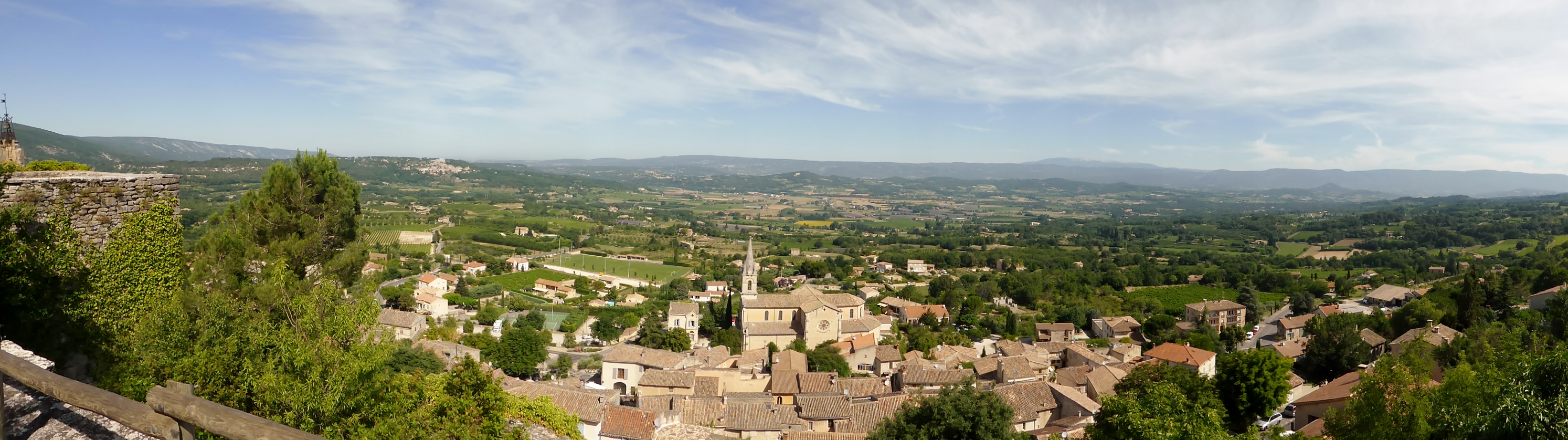
The view from above reveals just how beautiful this whole area really is. Personally, we prefer the Sud-Luberon and we can well understand why Peter Mayle chose to move here after his sojourn in America rather than return to the other side of the hills. Julia’s itinerary for our stay in this ‘neck of the woods’, however, includes a trip through the Luberon hills to the villages nearer to where Peter Mayle used to live when he first came to Provence. These include Bonnieux (reputed to be the most beautiful of the villages in the area) and Ménerbes (the nearest village to where Peter Mayle’s original house was situated). We have both read, and loved, A Year in Provence several times and want to see the area for ourselves.

We have an interesting, if somewhat precarious drive, through the Luberon hills. There are impatient French drivers in their Renaults an inch from our rear bumper attempting to overtake on blind bends, and cyclists, who insist on riding in the middle of the narrow roads. Eventually we arrive at our first ‘port of call’ Bonnieux, one of the many historic ‘hill villages’ in the region. Dating back to Roman times, it rests on top of the Luberon hills casting a watchful gaze across the rest of the valley. Next to the village is a Cedar forest that began with trees imported from North Africa during the Napoleonic era. It sits opposite Mont Ventoux, other notable villages in the area include Ménerbes, Lacoste, Roussillon, and Gordes. It really is as beautiful as people say. Thanks to an early start we find a parking place up near the top of the village. Everywhere we look there are amazing picturesque views. We spend a long time simply wandering around this beautiful village.

Eventually we move on to our second destination on Julia’s itinerary for the day, Lacoste. The famous château belonging to the Marquis de Sade is situated at Lacoste. The village itself has charming narrow streets and beautiful old stone houses, some of which are in the process of being restored. At the top of the village is a huge 11th  century château, partly in ruins, belonged to a professor who has been restoring it for more than 30 years. It is famous for its connection with the infamous 18th century Marquis de Sade who in 1771 fled from Paris, to escape the scandals created by his erotic writing and outlandish behaviour and sought refuge in the château which belonged to his grandfather. Today the only scandalous behaviour associated with the Marquis are the prices charged by the café that bears his name at the bottom of the village. It is a very hot day and we stop for a couple of cold drinks … for which we are charged 7.50€. The village today is the home of a branch of an American Art College. The place is full of lively, young Americans and older French Art Professors. The prices in the local shop selling ‘arty stuff’ is all in US$. Julia wants to buy something for her younger sister’s birthday. There is a nice bracelet in the shop … although to me it looks like a plastic washing up scrunchy with a hole cut in the middle to put your hand through? There is no price on it so Julia enquires from the shop assistant as to the cost? $40 she is told? We love Livy … but not that much!

We decide to stop in Lacoste in order to eat our picnic lunch. We find a nice shady spot … and are joined by a couple of American tourists who are also having a picnic. We get into conversation and make the mistake of asking them who they think the next American President is going to be? We are treated to an homily of all that is wrong with America at this time and who is to blame … the Republicans, the Democrats … and even eventually the Southern Baptists? Julia confesses that we too are ‘Baptist Christians’ … although the American Southern Baptists would probably consider us as ‘heretics’. This falls on deaf ears, however, but at least it is a ‘conversation killer’ and we can now resume our journey!

Our final village, on Julia’s itinerary, to be visited today is Ménerbes. This pretty little hilltop village in the Luberon is considered one of the finest in France. Surrounded by magnificent countryside it has a rich historic past that has been well-preserved. Ménerbes has been inhabited since prehistoric times and archaeological excavations have uncovered the remains of villas and an ancient cemetery dating back to Roman times. At the time of the religious wars in the 16th century, Ménerbes was the capital of the Protestant movement. Our Guide Book tells us that at this time the Protestants managed to take over the town by use of a ‘cunning ruse’. We would like to know more? Nicolas de Staël and Picasso both owned houses at Ménerbes, and they have been joined by other famous artists, musicians, comedians and writers  – including Peter Mayle – all of whom at one time or other have owned one of the houses or  farmhouses scattered around the village. We resist the temptation to go looking for Peter Mayle’s old house (featured in his book A Year in Provence) and settle for a walk round the town and an ice cream … it is a really, really hot day!

We have to make just one more stop on the way home. Monuments dating from Roman times exist near the village including the Pont Julien built in 3 BC. It truly is remarkable. Julia insists that she take my photograph standing on the bridge. ‘One old relic on top of another old relic!’ she says!

We are finally back at our campsite and I am sitting outside our tent drinking a cold beer. The sun is still shining and it is still very hot. The sound of the cigales ‘singing’ in the trees is momentarily interrupted by a small helicopter flying overhead towards Peter Mayle’s house near Vaugines. These days Peter lives in a lovely secluded house set off the road between Lourmarin and Vaugines. I guess, if I were in his shoes, a helicopter would be the way to get around! When you are as well known in the area as he is … the problem of being a famous author with a string of books to your name … you are a magnet for people wanting to shake your hand, get your autograph, be photographed with you. Peter’s books, more often than not, about Provence and the Luberon, are written in an attractive and amusing way that have resulted in thousands of people wanting to come and visit the area but there is a downside to being ‘famous’.

Peter moved away from near Ménerbes because of being ‘pestered’ by tourists. Apparently coach loads of people used to be ‘dropped off’ at his door as part of the ‘tourist circuit’. Even today he obviously still feels ‘vulnerable’. We were at a concert together at the church in Vaugines last Sunday evening. The church was full, and the ‘congregation’ was made up of mostly ‘locals’. The event was a ‘money raiser’ for the local church and the concert consisted of a number of musical items by the ‘Polyphonies’ – a-cappella choir – who were really very good. There were only a few ‘tourists’ present but – although Peter obviously enjoyed the concert – he was very aware of the ‘non-locals’ present and was continuously, sub-consciously, looking around, ducking away from anyone taking photographs, and fearing being approached by ‘yet another tourist’. Peter Mayle will probably never read this ‘blog’ but if he does I would simply want to say: Us tourists are not all insensitive to your need for space and privacy. We don’t want to impose. We don’t want your autograph, or  to have a ‘selfie’ taken with you. We do, however, want to say a big ‘Thank you’ for all your wonderful books and the fun, laughter, and inspiration that they have bought to us!

As I sit drinking my cold beer … long after ‘Peter Mayle’s helicopter’ has passed over … an eagle soars across the sky overhead. It is huge, regal, magnificent! I watch it in awe! I think of that verse in the Bible that tells us: ‘But they that wait upon the Lord shall renew their strength; they shall mount up with wings as eagles; they shall run, and not be weary; and they shall walk, and not faint’ (Isaiah 40:31).

Jim Binney

Leave a comment

THE MONEY MARKET (Tour de France 8)

The Market in Lourmarin

The Market in Lourmarin

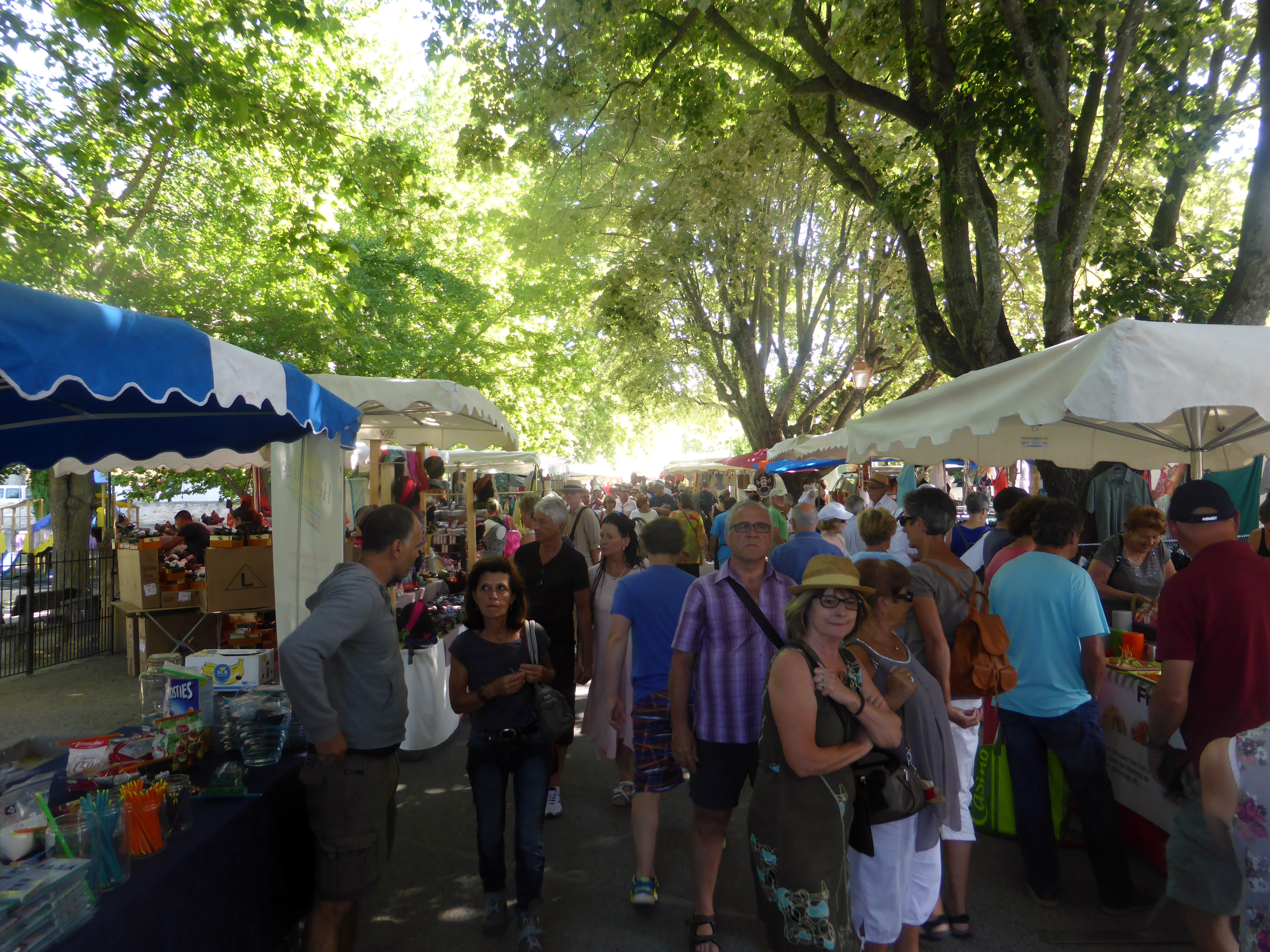
Today is ‘Market Day’ in Lourmarin! Virtually the whole town will be taken over by market stalls. You name it, and they will be selling it … everything from fruit and veg, through clothes galore, and weird and wonderful implements (that only the French know how to use) to new fangled ‘selfie sticks’! We know this because we have been to scores of French markets over the last 15 years or so and we have seen it all (although the ‘selfie sticks’ are new).

‘Today is Market Day in Lourmarin’ the German ‘Munster’ family tell us ‘you really must go!’ ‘We went last week and it is amazing!’ they tell us. They will not be going to the market today because their holiday is over and they are starting their journey home this morning. ‘Today is Market Day in Lourmarin’ the Swiss couple (on the next pitch to ours) tell us ‘you really must go!’ We have taken to calling them the ‘Swiss Family Robinson’ (readers of the book will understand). ‘We are going down as well!’ they say. They are Christians, by the way … Methodists … and what is more he is a Methodist Minister (although he is running his own taxi business at the moment). When they ‘sang grace’ again at their evening meal the other day, Julia and I both spontaneously responded ‘Amen’ at the finish (in loud voices). They were quite surprised and we had a good chat together. It turns out that they had guessed we were Christians as well (although they found it difficult to get their heads round the fact that we were both ordained Baptist Ministers, and not just me). ‘Today is Market Day in Lourmarin’ the ‘Oldies’ tell us ‘you really must go!’ The ‘Oldies’ are a British couple who have moved into one of the nearby mobile homes. They are really, really, really old … and frail with it! Julia says that it will be us (well me at least) in a few years time. ‘Today is Market Day in Lourmarin’ the Dutch ‘Professor’ and his wife tell us ‘you really must go!’ The ‘Professor’ looks every inch an academic … grey hair, goatee beard, horn rim specs, pipe, always reading a heavy tomb of a book, and he speaks several languages (including better English than I do).

Anyway, getting back to Market Day in Lourmarin … everybody seems to be telling us that ‘Today is Market Day in Lourmarin’ and that we ‘really must go!’ It seems that most of the campsite is going and so we decide to join the camp exodus to Lourmarin. We set off early to get to the market and back again before the midday heat really hits in. We dispense with breakfast … we will have a coffee and a pain au raisin at our favourite café. It is already getting really hot as we take the 15 minute walk from our campsite into the town. We need a coffee by the time we arrive. We go to the café where we were provided with such entertainment by the Mexicans on our first visit a few days ago. The same waiter is on duty. The café is packed and he seems to be the only one on duty. He is literally running between the tables in order to keep up with the various orders. We manage to find a table in the shade and wait for him to catch our eye. There is no rush on our part … perhaps we are slowly adjusting to the French laissez faire approach to life? Ten minutes later the waiter comes over to us and demands our order. We speak in French (which appears to be his only language). We tell him we would like coffee and I would like a pain au raisin please. He tells me that I can’t have a pain au raisin … if I want one I must join the queue at the Boulangerie just along the road. The queue is massive, and we hesitate about joining on the end of it. The waiter is impatient. He tells us that his café offers either a croissant, or a baguette with some jam … which do we want … hurry up and choose? His French is too quick for me … I don’t understand all that he is saying … I ask Julia to translate for me. The waiter loses patience and storms off muttering something about ‘I’ll come back when you have decided!’ Its obviously not just Mexicans he doesn’t like. Its not even the English … or the Dutch … or the Germans … or anyone ‘foreign’! He clearly doesn’t even like the French judging by his attitude! He probably doesn’t even like his wife … if he has one?

I decide that I will have a croissant and we try once again to catch the eye of the waiter. For the next 15 minutes he studiously avoids looking in our direction. We are being taught some kind of lesson. But we are ‘Brits’! We will not give in! Eventually Julia calls him over! He comes (albeit reluctantly) and takes our order. He returns 10 minutes later with our coffee and my croissant … except that it is not a croissant but a baguette with some jam? Fortunately another waiter arrives … a very nice, friendly French lady … who takes our money when it is time for us to pay and leave!

We follow the crowd to the market. It is packed. The sedate streets and pleasant quiet town square of a few days ago is heaving with people. There are hundreds of market stalls everywhere. The first stall we come to is by the food stalls … and it is selling Jack Russell puppies? ‘What!’ we both exclaim at the same time. We know that the French eat strange things – horses, snails, frogs – but have they now added puppy dogs to their diet? Fortunately, they haven’t! The stall is all about tackling the growing problem of cruelty to animals.

We wander from stall to stall buying mostly fresh fruit and veg, eggs, olives, garlic and the like. None of it is cheap as it used to be when we first started visiting French markets a number of years ago. You can still find the small, local markets selling locally grown produce … we come across them now and again … where the prices asked are reasonable. The market here in Lourmarin is not that sort of market, however. It is designed for the tourists. Lourmarin is on what is called the ‘American Trail’ and the American tourists seem prepared to pay anything? The market is still an amazing sight, however, with all the brightly coloured stalls selling an amazing variety of goods, with the tantalising smells of various things cooking, and the sounds of excited chatter mingling with the  music of the street artists. We don’t need any lunch because all the food stalls have ‘free samples’ for passers-by to taste.

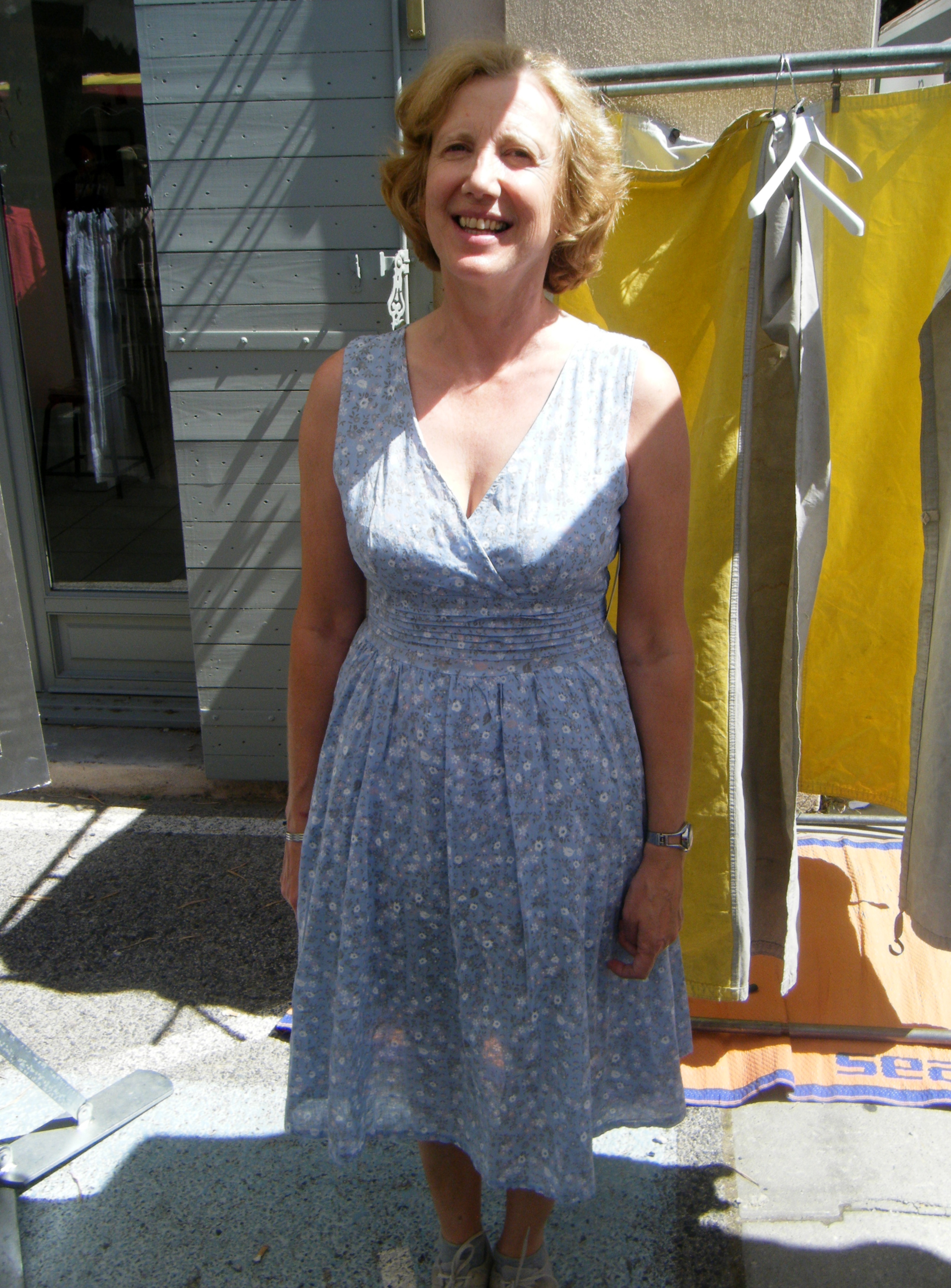
Julia is in her element. There are stalls selling bags, and hats, and scarves, and dresses everywhere. She is very good, however, and resists them all. She does try on several hats, however, before finally succumbing to a beautiful blue dress for sale on one of the stalls. With lots of encouragement from me she tries it on. It will be perfect for our ‘lunch date’ at La Source Restaurant on Sunday. She looks terrific in it. Julia is not so sure? ‘You look great!’ I tell her. ‘You look great!’ the stall holder tells her. ‘You look great!’ a rather sophisticated French lady passing by tells her. ‘You look great!’ the Professor and his wife tell her (they just happen to be passing by at the time). Julia buys the dress!

We realise that, with the purchase of said dress, we have run out of cash in the process and head for the ‘hole in the wall’ in order to get some more cash out. We find one in the middle of the market. The queue to use the cash machine is huge. We abandon the idea and dive into a local supermarket to buy something for supper (it is cheaper there than the proper market). We ask them if they do ‘cash back’? They don’t but they tell us that there is a cash machine just ‘round the corner’. We tell them we know about that one but that the queue to use it is very lengthy. They tell us that there is another cash machine back across the town, past our café and the annoying waiter. We have more or less finished our shopping so we find our way across town. The café is still packed, and the annoying waiter is still annoying his customers. We get to the bank and see the cash machine on the wall opposite. It is five minutes past 12 and the bank is closed … and so is the cash machine? There is a notice on the cash machine telling potential users that the cash dispenser is ferme! It would seem that in France it is not only the shops and banks that close between 12 noon and 2 p.m. … so do the cash machines!

The affluence of the market, and the whole way it is geared up to make as much money as possible, makes me feel very sad … and nostalgic for the less materialistic and more ‘value for money’ French markets of 10 years ago. I am reminded of some words of the Apostle John that we read in our morning Bible Reading recently: ‘If someone has enough money to live well and sees a brother or sister in need but shows no compassion – how can God’s love be in that person? Dear children, let’s not merely say that we love each other; let us show the truth by our actions (1 John 3:17,18).

We walk back to our campsite and collapse in the shade of the trees. The campsite seems strangely deserted. The Munsters have gone, the Oldies have gone … only ourselves and the Swiss Family Robinson are left in our corner of the campsite. We  are now the ‘only holy corner in the camping village’ (if you will excuse the pun)? Later in the evening a young lady on a bicycle rides on to the pitch next to ours and sets up for the night. She is very muscular and riding a very posh bike. Her tent is equally posh … and she has all the latest electronic equipment – phone, computer, etc..  It turns out that she is Russian … clearly an example of the new wealthy ‘Putin era’ type of Russian. We immediately nickname her ‘Svetlana Putin’ because she reminds us of the Russian President with her muscular stature. Perhaps she is his ‘love child’? She speaks several languages fluently and is on some kind of ‘mission’ (although we are not told what kind of ‘mission’ it is)? She has everything she needs she assures us when we ask if she needs any help. Five minutes later she comes over to us. ‘Have you a hammer?’ she asks ‘I have forgotten mine!’ We wonder if she has forgotten her sickle as well? We lend her one of our three hammers.

Svetlana has also hurt her knee cycling. It is swollen and bruised. I give her some of my ‘special’ ointment (I know all about dodgy knees from personal experience). I have brought several tubes with me from the UK. She rubs it into her knee … and is amazed at the instant relief she experiences. ‘Where did you get it from?’ she asks. ‘Well, not from the French market!’ I reply!

Jim Binney


Julia's new dress

Julia’s new dress


Leave a comment

THE MAYLE ON SUNDAY (Tour de France 7)

The Quest for Peter Mayle

The Quest for Peter Mayle

‘It was the sight of a man power-washing his underpants’ that really brought home to Peter Mayle that he was back in the Luberon after four years away living in America! And this observation of the eccentricity of living in this part of France we can well understand. Here we are in Lourmarin in the Sud Luberon, camping for the next two weeks. We enjoyed a wonderful stay in Alsace-Lorraine in the north-east of France, and now we have driven all the way down to the south … and hopefully some hot, sunny weather. After stops in Beaune (where we enjoyed an amazing meal at our very favourite restaurant, Le Conty), and Valence (where we wimped out and stopped in a Hotel BB instead of using our pop-up tent for another night), and a flying visit to Taizé (which we have grown to love so much down through the years) we finally arrive at the beautiful town of Lourmarin.

The Luberon is the home of Peter Mayle, the celebrated author of many books, perhaps the best known being A Year in Provence. In effect he is our next door neighbour for the next two weeks. He recently sold his 18th century house on the outskirts of the village – said to be one of the finest in the area, three storeys high, shaded by enormous plane trees, with several terraces overlooking formal gardens and a large infinity pool, standing in 5.7 hectares of grounds that include an olive grove, a rose garden, two ponds and a vegetable garden, an orangery, a dove cote, a summer dining room and a wine cellar – for €6 million. He has now moved to a new home near the sleepy village of Vaugines just off the main road from Lourmarin, only a couple of miles up the road from our campsite. In fact we are sure that we can see his new home from our pitch.

Peter Mayle is one of my literary heroes. Julia tells me that I write in a similar way to him – a story-teller, a people-watcher, an observer of life – although without the success he has enjoyed. His wit and love of the good life allow him to fully engage the reader in the location and stories in his books. His stories of life in the Luberon have sold millions of copies, although his personal story moved on long ago from the farmhouse he restored chapter by chapter in his 1989 book A Year in Provence. Julia and I are tempted to engage in ‘a quest for the historical Peter Mayle’ as we understand that he is still to be seen in the area. Perhaps we will ‘bump into him’ either in Lourmarin or Vaugines in the course of our stay in this beautiful area.

Our campsite at the Les Hautes Prairies (on the outskirts of Lourmarin) is somewhat removed from a €6 million mansion. It has recently been purchased by Campersun who are in the process of doing it all up. We arrive on a hot, sunny Saturday lunchtime (far too early to be admitted) to discover that the Accueil is open. A young girl, possibly in her early 20s, takes our details. She is a little uncertain – possibly new to the job – so Arthur takes over. He does not appear to be much older but informs us that he is the Manager … so immediately he is nicknamed by us ‘King Arthur’. His family own the site (and four other sites). King Arthur speaks very good English, and we like him immediately. He has reserved a nice pitch for us with great views over the surrounding countryside. The only problem is that the Mistral is beginning to blow … powerfully … and we are somewhat exposed. I am not happy about putting our tent up on this particular pitch so we wander round the site looking for another more suitable pitch. All the ones we like are either already occupied, booked, too small, or in blinding hot sun. We meet a nice elderly Scottish couple, who remind us of John and Wendy Runcie, our friends from Beckenham. So we nickname them ‘John and Wendy’ of course.

Eventually we return to our original pitch and erect our tent in the midst of a howling wind. Some nice Germans on the neighbouring pitch offer us the use of their hammer in order to hammer our tent pegs in more quickly (we actually already have two spare hammers but don’t like to appear ungrateful). The most vocal of the Germans tells us that his name is Herman … so we nickname them ‘the Munsters’ of course. King Arthur is gradually improving the site. Needless to say it is the usual blend of brilliant and ‘not so brilliant’? The toilets are amazing. Each cubicle has a self cleaning toilet seat? People go to the toilet just to watch the seats cleaning themselves? But … and there is always a downside … there is no free toilet paper. We have to bring our own. Fortunately …  as experienced campers … we understand the system. Equally the wash up areas for dirty crockery are brilliantly designed … but there are no plugs. Fortunately we have brought our own.  We eventually get our tent up and settle in (although we both put our ear plugs in, in order to get through the night without being continually woken by the noise of the Mistral).

We wake the next morning to discover that our tent is still standing, and that it is a beautifully hot and sunny day without a breath of wind. It is Sunday (and we do not know of any English speaking churches in the area) so we go to ‘worship’ at the local ‘Super U’. There is a packed congregation, the car park is full to overflowing, and people are queuing to ‘pay their weekly tithes and offerings’ rumoured to be in the region of thousands of euros. In the afternoon we ‘baptise’ (by full immersion of course) several bags of dirty clothes to the ‘heavenly music’ of a choir of cigales sitting in the trees around our pitch.

The next day we walk into the beautiful little town of Lourmarin itself. It is very ‘chocolate boxy’ and full of cafes and shops designed for tourists. We look around for Peter Mayle but he is nowhere to be seen, We think we know what he looks like … I have researched him on the internet and seen several photographs of him. We have it on good authority that although one of his favourite restaurants is the La Source in Cadanet, he is also known to frequent the cafes and restaurants in Lourmarin. Should we meet him, however, we intend to be somewhat circumspect because we know that one of the reasons why he left the area and moved to America for a few years was because of the incessant attention he was receiving from visitors to the area. As we leave a Swiss couple move into the pitch next to ours and park their caravan immediately next to a Belgian couple on the pitch next to theirs? We sense trouble?

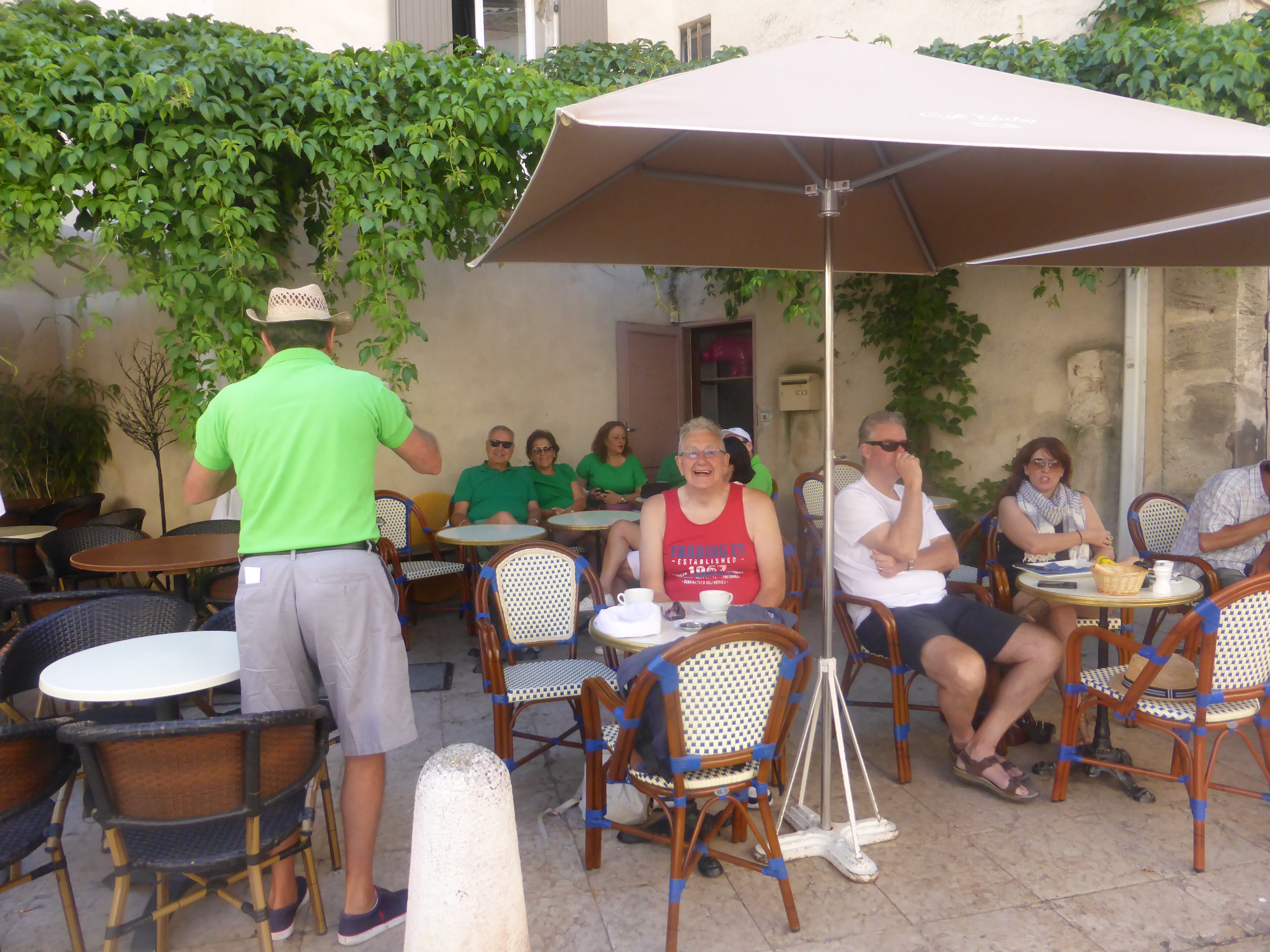
We wander round Lourmarin, surveying the town and getting a good sense of what there is to see here. The shops are very expensive. Julia wants to buy a bag for all our swimming stuff that she can take to the campsite pool … but they are so expensive. We stop for a coffee …which is surprisingly cheap … and are immediately confronted by a party of tourists all wearing green shirts!? The leader has a whistle which he repeatedly blows to call the party to order. Half way round his party rebel and come and sit in the same café as us. They need coffee … and omelettes! It turns out that they are from Mexico. They do not speak any French … and the waiter does not speak any Spanish? The ordering of the omelettes is hilarious … some want ham (ham not jambon), some want cheese, some want different types of cheese? The Mexicans find it all very funny … the waiter is tearing his hair out!

We return to our campsite to find that there has been an argument between the Belgians and the Swiss. The Swiss  have moved their caravan … nearer to us. When they have their evening meal … before they eat … they sing together? Are they singing grace? We notice that they also seem to be reading their Bibles in a morning just like we do? Are they Christians? We need to learn more?

In our daily Bible reading we are currently reading through 1 John … the first Letter of John (the beloved disciple of Jesus) who wrote this letter some 60 years after the ascension of Christ. This ‘son of thunder’ has by this time become ‘the apostle of love’ and writes intimately of his personal relationship with Jesus Christ – ‘that which was from the beginning, which we have heard, which we have seen with our eyes, which we have looked at and our hands have touched: this we proclaim concerning the Word of life!’ ( 1 John 1:1). We are reminded of something we read during our time in Alsace-Lorraine, written by Albert Schweitzer, where he suggested that the defining theology of the Apostle Paul was not ‘justification by faith’ but rather the mystical union of being a man or woman ‘in Christ’. We are also reading daily devotions by the Roman Catholic, Richard Rohr who suggests that ‘Christianity has as its central symbol … a naked, bleeding man who is the picture of failing, losing, and dying . . . and who is really winning – and revealing the secret pattern to those who will join him there. Everyone wins because if there’s one thing we all have in common, if we’re honest, it’s our weakness and powerlessness in one – but usually many – areas of our lives. There’s a broken, wounded part inside each of us.’  Rohr’s comments resonate very much with our own experience and convictions. I am much more ecumenically minded these days. It is not that I have ‘left the Baptist Church’ although I feel at times that perhaps ‘the Baptist Church has left me’?

The following day we set out to explore the various nearby villages which we are told are lovely. Firstly, we drive to Pertuis. We need to do some shopping at the hypermarket. As we are pushing our shopping trolley round the store we suddenly come face to face with Peter Mayle and his wife doing their weekly shop. At least we think that it is Peter Mayle? It certainly looks like him. We nod to each other in mutual recognition as authors but do not stop to converse. I know that Peter does not like to be ‘recognised’ by tourists and approached in this way. After doing our shopping we drive to La Tour d’Aigues where we stop for coffee. Amazingly we find ourselves sitting at a table next to Peter Mayle who is with members of his family and friends. Well we think it is the same man we saw in the supermarket? We once again nod to each other in mutual recognition but do not enter into conversation. It would be rude to interrupt a family party. Julia manages to buy a very nice bag at the market so she is very pleased.

We drive on to Ansouis where we have been told by ‘John and Wendy’ that at the centre of the town there is a lake? The town is actually up a hill … not a lake in sight … so we follow directions to a nearby lake where we plan to stop for a picnic lunch. When we arrive we discover – would you believe it – that Peter Mayle is having lunch at the very posh lakeside restaurant nearby. We again nod to each other … Peter is enjoying his five-course cordon-bleu lunch whilst we eat our sandwiches? After lunch we drive to Cucuron … where we find the ‘lake’ in the middle of the village? We obviously misunderstood ‘John and Wendy’s’ directions. Actually it is more like a large pond … but very picturesque. And, surprise, surprise, we come across Peter Mayle again … like us he has stopped en route for a cold beer on the way home. As ‘good Brits’ we do not impinge on each others privacy but give each other space. On our way back to our campsite we drive through Vaugines and pass Peter Mayle’s new home on the way. We think about calling in … we are sure that he would be pleased to see us  … but in the end decide against it.

We arrive back at our campsite and I have a little sleep while Julia prepares our evening meal. I am looking out across the fields towards Peter Mayle’s house in the distance. He is on the veranda and I see him pick up his mobile phone and begin to dial. A moment later my mobile phone rings. I answer it. ‘Hello’ I say. ‘Hi! Good to hear from you!’ ‘Yes!’ I am sure that we can make that!’ ‘Thanks for your call.’ I get out my diary and make a note. ‘Lunch, 12 noon, La Source in Cadanet, Mayle on Sunday!’

Jim Binney   

Leave a comment

THE QUEST FOR THE HYSTERICAL ALBERT (Tour de France 6)

Albert Schweitzer

Albert Schweitzer

On of the joys of travel – particularly staying in one particular area for any length of time – is that of coming across the unexpected. A couple of years ago we camped in Saint Remy in Provence, France, and were able to visit many of the places where Vincent van Gough lived and worked, as well as various museums dedicated to him. This year – for the first couple of weeks of our extended seven week camping holiday in France – we have been staying in Kaysersberg in the Alsace-Lorraine region. We came here because we have never been here before, and because there were lots of interesting places to visit in the region. We have not been disappointed.

One of the things we did not realise before we came here, however, was that Kaysersberg was the birthplace of Albert Schweitzer (1875-1965). Schweitzer was born into an Alsatian family which for generations had been devoted to religion, music, and education. His father and maternal grandfather were ministers, both of his grandfathers were talented organists, and many of his relatives were persons of scholarly attainments.

When I first began to study theology, more than 50 years ago now, Albert Schweitzer was one of the controversial theological figures of my youth. Schweitzer entered into his own intensive theological studies in 1893 at the University of Strasbourg where he obtained Doctorates in Philosophy and Theology, and became licensed to preach. He began preaching at St Nicholas’ Church in Strasbourg in 1899 and served in various high ranking administrative posts from 1901-1912 in the Theological College of St Thomas, the college he had attended at the University of Strasbourg. In 1906 he published his controversial book, The Quest of the Historical Jesus, a book on which much of his fame as a theological scholar rests.

At the same time Schweitzer continued with a distinguished musical career. Initiated at an early age with piano and organ lessons, Schweitzer was only nine years of age when he first performed in his father’s church. He became an internationally recognized concert organist and used the proceeds from his professional engagements to fund his education, later medical schooling, and his African hospital.

In 1905 Schweitzer decided to go to Africa as a medical missionary, rather than as a Pastor, and began the study of medicine at the University of Strasbourg. In 1913, having obtained his MD, he founded a hospital at Lambaréné in French Equatorial Africa. In 1917 Schweitzer and his wife were deemed to be German (technically they were ‘German’ as a result of being born at a time when Kaysersberg was a part of Germany) and were sent to a French internment camp as prisoners of war. Released in 1918, Schweitzer spent the next six years in Europe, preaching in his old church, giving lectures and concerts, taking medical courses, and writing various books.

Schweitzer returned to Lambaréné in 1924 and, except for relatively short periods of time, spent the remainder of his life there. With the funds earned from his own royalties and personal appearance fees and with those donated from all parts of the world, he expanded the hospital to seventy buildings which by the early 1960s could take care of over 500 patients in residence at any one time. At Lambaréné, Schweitzer was doctor and surgeon in the hospital, Pastor of a congregation, administrator of a village, superintendent of buildings and grounds, writer of scholarly books, commentator on contemporary history, musician, and host to countless visitors. The honours he received were numerous, including the Nobel Peace Prize for 1952, using the $33,000 prize money to start a Leprosarium at Lambaréné. Schweitzer died on September 4, 1965, and was buried at Lambaréné.

Albert Schweitzer, like a number of other controversial characters of whom I was theologically ‘wary’ in my youth, has subsequently become one of my ‘heroes’ not least because of the practical slant to his understanding of what it meant to be a Christian. He was not content to be ‘theologically sound’ – to ‘tick every reformed evangelical box’ but interpreted the saving work and teaching of Jesus Christ in very practical ways. So, for Julia and I to discover on our initial walk round Kaysersberg, that Albert Schweitzer was actually born here, initiated our own ‘quest for the historical Albert’.

We begin our search in the village of Gunsbach, just a few miles from Kaysersberg, where Albert grew up. Albert’s father was the Pastor of the Protestant Church in Gunsbach although the Protestants and Roman Catholics actually shared the same medieval Parish Church building, worshipping at different times, but enjoying a fraternal relationship. This left an indelible mark on the young Albert who, from that time on, believed that true Christianity should always work towards a unity of faith and purpose. We want to see this church building for ourselves … but when we get there it is locked. There is, however, an ‘Albert Schweitzer Museum’ just across the road, so we head for that … only to find that that is closed as well. The notice on the door tells us that, in fact, it is only ever open during the months of July and August? We should have known that of course. Our previous visits to France have taught us that ‘the rules (in this case the rule of common sense) only apply during July and August’?! We do find the old Schweitzer family home, however, where the young Albert enjoyed a happy childhood in the company of his parents and siblings … and a very nice looking house it is.

Our next port of call in our quest for the historical Albert is Kaysersberg itself. We know that there is a museum dedicated to him here, and we know the times when it is open. Our quest for the historical Albert started off somewhat badly in Gunsbach, but it quickly goes from unfortunate to the completely potty. No sooner do we get into the small museum in Kaysersberg itself than we are ‘cornered’ by what appears to be either ‘the local undertaker’ or ‘the spectre at the feast’?! A rather tall, thin, very elderly man – he looks about 150 years of age – traps us in a corner. He informs us that he served with Schweitzer in Africa, that he has written a book about it, which he just happens to have a copy with him, and would we like to buy it? We tell him that we are English and that our French is not really up to debating with him. ‘Not to worry’ he says, ‘he speaks perfect English, and German, and Spanish, etc., etc.’ He starts to tell us his life story … right from the beginning … and he really is very, very old! There is not much about Albert Schweitzer … it is all about him!? It is very difficult to break away. We want to see the various exhibits in the museum … it is due to close for lunch in an hour … and he won’t stop talking? He reminds me of a Deacon at my home church in my youth. She was equally verbose and seemingly impossible to stop when in full flight. The only person who could ever stop her was the Moderator we had at the time. I asked him how he managed to do it? ‘I watch her lips’ he replied ‘she has to pause for breath occasionally … and then I step in!’ He was very clever, and the next time she ‘went off on one’ I watched the Moderator carefully. And as soon as the Deacon momentarily paused for breath, he jumped in … ‘Thank you so much Mrs Soandso, that was very interesting … now (turning to another Deacon) Mr Thingymajig, what do you think?’ In desperation (there are now only 30 minutes left before the museum closes) I watch the Undertaker’s lips. As soon as he pauses for breath I am in ‘Thank you so much … your story is so interesting … but we really must see the rest of the exhibition … oh look, there are two Americans that have just come in … they would love to hear your story I’m sure … goodbye!’ And off we move.

To be honest we are slightly disappointed, however, because the museum seems to be almost exclusively devoted to Schweitzer’s work in Africa at the hospital he founded in Lambarene (now Gabon but then French Equatorial Africa). There is virtually nothing about Schweitzer’s own ‘faith journey’ and what it was that motivated his complete change of lifestyle, leaving a ‘successful’ career, both as an academic of repute and a famous musician, in order to retrain as a doctor and serve God, and the poor and needy, in Africa. It is almost time for the museum to close, so we slip away. The Undertaker is still talking to the Americans. In desperation they have bought one of his books … at an inflated price of 25€.

We wander round Kaysersberg looking at the numerous memorials to Albert Schweitzer. Fascinatingly there are various quotes from his sermons on huge posters everywhere. Our favourite is the one by the beautiful memorial garden dedicated to those from Kaysersberg who died in battle. It is in French of course, but a rough translation reads thus: ‘None of us are preoccupied properly with the problem of peace if we are not constantly assailed by the question: What are you doing for peace? Are you acting to the best of your resources? How are things in your heart? Do you allow the Spirit of peace to dominate the spirit of the world?’

Later in the week we go to Strasbourg to continue our quest for the historical Albert. We know that he both studied and taught at the University here, and that he was the Curate at St Nicholas’ Church, where he also played the organ. We find our way to the nearest car park to St Nicholas’ (courtesy of our wonderful new SatNav, Kate) and we even find the church easily enough. Needless to say it is closed. Well it isn’t July or August yet? I don’t know about this being a quest for the ‘historical’ Albert, it has turned out to have been more like a quest for the ‘hysterical’ Albert … although that very challenging quote about our need to be a ‘people of peace’ will continue to live with us for a long time!

Jim Binney

1 Comment

PAINS, TRAINS AND ALTARPIECES (Tour de France 5)


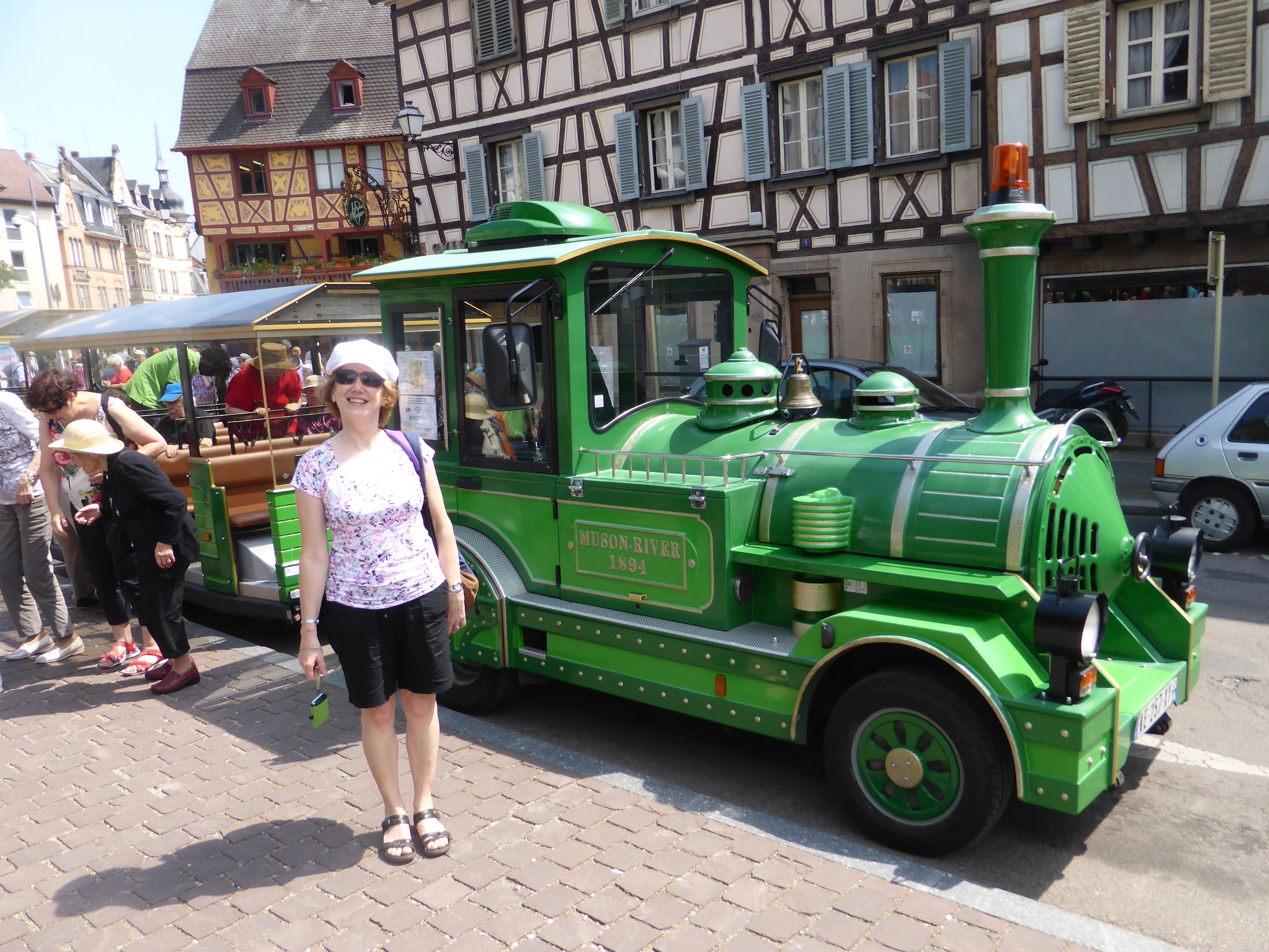
Julia and the Little Train

Julia and the Little Train

One of the main reasons for spending the first couple of weeks of an extended camping holiday in France this year is so that we can visit Colmar and especially the Musée d’Unterlinden in order to see the famous Issenheim Altarpiece. Painted by Matthias Grünewald at the beginning of the 16th century for the high altar of the monastery at Issenheim, this altarpiece is one of our favourite works of art, full of beauty, symbolism, and meaning. We have seen pictures of it many times, and Julia has a copy of the central painting, in her Quiet Room at home, which she often uses for meditation. But now we have an opportunity to see the actual altarpiece itself.

We leave our campsite in good time and drive to Colmar which is only a few miles away. Colmar itself is delightful – typically Alsatian in character with picturesque flower-decked houses, centred around its beautiful ‘Little Venice’ district unaltered by time and war. With her nose in our excellent guidebook Julia leads us through a maze of streets – frequently losing me en route as I stop to take numerous photographs – until we reach the Musée d’Unterlinden, a former 13th century convent building whose name means ‘under the lime trees’. Our plan is to spend the morning in the museum, particularly contemplating the Issenheim Altarpiece, and then do the guided walk around Colmar itself. And so begins a frustrating day that can only be described as one of ‘pains, trains and altarpieces’. Indeed it is so much so that by the end of the day we are surprised not to have bumped into Steve Martin and John Candy (film buffs will understand the reference)?

We walk over to the museum entrance only to find our way barred by a huge metal fence. ‘They must be doing some work on the entrance?’ we say to ourselves, and start to walk round the building looking for the temporary entrance. We walk right round the whole building … every possible entrance has a huge steel fence in front of it?! When we finally get back to (almost) where we started we find a notice telling us that the whole museum is closed for two years for ‘re-development’? ‘Oh no!’ we say to ourselves. ‘Not again!’ Two years ago we were in Saint Remy in Provence, hoping to see as much as we could of the places where Vincent van Gough lived and worked. Most of them were closed at the time for ‘re-development’ as well?!

I see the pained expression on Julia’s face … she was so much looking forward to seeing the Issenheim Altarpiece … and it looks like we won’t be able to see it after all!? We are about to give up when I suddenly see a small notice directing us to a nearby former Dominican Church only five minutes walk away. They have moved the Issenheim Altarpiece there for the duration of the re-development of the museum. ‘Hooray!’ we both cry (or words to that effect)  … and head off for the Dominican Church. There is more good news when we arrive. The cost of getting in to see the exhibition is half the normal price because it is essentially only the Issenheim Altarpiece (and some associated work) that is on display. This is fine by us because we didn’t want to see all the other stuff that would have been in the Musée d’Unterlinden anyway. What is more I also get a concessionary price for ‘being a really old person’ (which rarely happens in France). Julia is delighted … until they give her the same ‘concessionary entrance price’ as well? I am sure that it is because they thought she was a ‘student under 30 years of age’!

The Issenheim Altarpiece is all that we anticipate it being … and more!  By far Grünewald’s greatest and largest work, it was painted (as suggested earlier) for the Monastery of St. Anthony in Issenheim near Colmar, where the monks were known for their care of plague sufferers and their treatment of skin diseases, such as ergotism. The image of the crucified Christ is pitted with plague-type sores, showing patients that Jesus understood and shared their afflictions. This body covered with sores and riddled with thorns left no doubt about Christ’s suffering, thus comforting the sick in their communion with the Saviour, whose pain they shared. Mary, the mother of Jesus, is shown at Christ’s right, collapsing in anguish in the arms of John, the beloved disciple of Christ, and shrouded in a large piece of white cloth. On Christ’s left, John the Baptist, accompanied by a lamb, symbolising the sacrifice of Jesus, points to Jesus and announces ‘He must increase, but I must decrease’ (John 3:30) The inclusion of John the Baptist in this scene is symbolic, as the last of the prophets to announce the coming of the Messiah. We make good use of the free audio guide and take in every detail.

I take lots of photos (you can see many of these on my Facebook page). You are allowed to take photos as long as you do not use flash. My camera has its flash switched off but suddenly, for some inexplicable reason, the flash goes off?! I am immediately ‘confronted’ by one of the attendants – a very small Frenchman with a huge ego – who sternly rebukes me for ‘uzing ze flash’! I apologise profusely but find the whole thing rather comical. The ‘official’ is about 4’ 6” tall (and I am 6’ 4” tall) and he is peering into the distant heights as he tells me off. He is doing his ‘Herr Flick’ impersonation!? I am finding it very difficult not to laugh out loud. Julia manages to pacify him … but I now find that he is following me everywhere I go? For the next hour he is following me … just in case ‘ze flash, ‘e goze off again!’ What a pain!

We eventually leave the Dominican Church still ‘drinking in’ all that we have seen and heard. Fortunately ‘Herr Flick’ remains behind. And after a picnic lunch we decide to do the guided tour of Colmar. We pass the ‘Little Train’ on our way and think ‘Why not let the train take the strain?’ We manage to procure the last two available places although I find myself sitting over a wheel arch which means that my leg is soon hurting as it is so cramped a position. We are also clearly on the ‘wrong side’ of the train because virtually everything of interest in Colmar (that the audio commentary is telling us about) is on the other side of the train. Half way round the audio commentary stops completely. There are serious moans in 15 different languages. The driver stops the Little Train and resets the audio commentary. We get going … but the commentary has started from the very beginning again. It is like that Two Ronnies sketch on British TV where what is being described relates to a previous scene?! We are nearly back to where the train journey started, however, so it doesn’t really matter.

Our trip on the Little Train, however, has only served to make us aware of all the places in Colmar that we need to see properly … so we end up doing Guided Tour on foot anyway. At least walking is not as painful as sitting in that very cramped train seat for 45 minutes! We see all that we want to see and in the end feel that despite it being a day of ‘pains, trains and altarpieces’ in many ways … it has actually been a really good day!

Jim Binney    

Leave a comment

THE ONLY TENT IN THE VILLAGE (Tour de France 4)


The Only Tent in the Village

The Only Tent in the Village

We are approaching the end of our first week here at the Municipal Campsite in Kaysersberg, France, and most of our new friends have already moved on either to new campsites in other parts of France or Germany, or returning home at the end of their holiday. Hansel and Gretel (our German neighbours in the antique camper van) have gone. The McTavishes have gone (we don’t know if they have taken the ‘high road’ or the ‘low road’). The ‘Posh Brits’ have gone. William Tell and Heidi have gone. The Reallyelderlypersons and the Reallykindpersons have gone. The Frogzlegz are still here but the Escargots have gone (very slowly I might add)! They have all been replaced (for the most part) by the Dutch in their ‘all singing, all dancing’ caravans complete with the ‘magic’ caravan movers (operated by something similar to TV controls) that enable them to manoeuvre their caravans into the tightest corners. Walking round the site we think we should raise the Union Jack … we feel like we are the British Consulate in the midst of the Netherlands here … Little Britain if you like!  What is more … given that our campsite is kind of like a village … we are now officially ‘the only tent in the village’!?

We really like camping. The camaraderie of the different nationalities all finding common ground in the joys and frustrations of camping, speaking a common language made up of English, French, Dutch and German (usually about the weather) with a lot of sign language thrown in for good measure, the combination of both privacy and community finely but perfectly balanced without anyone teaching us how to do it. We also love the spontaneous fun that happens. For example, we have a baker who delivers bread to our campsite every morning … and he always comes ‘dressed up’ as something. On our first morning here he came dressed as a condom?! We wondered what we had come to? He has an impressive array of wigs of various colours – pink, purple and blue being his favourites. Last Monday (when the local children started back at the infants’ school next door) he wore a rather scary witchdoctor mask? The other day he turned up in his normal attire … which was even more scary! Julia went to buy some bread and asked him very cheekily in French where his wig was? With a sigh he went round to the other side of his van and came back wearing a huge black afro wig. He promptly embraced Julia in an equally huge Gallic hug, eliciting cries of ‘What’s the French for GET OFF’!’ from Julia. Fortunately he let go before he got a kick in the Ballons d’Alsace!

With all the vacant pitches suddenly appearing around our campsite we take ourselves off to Kaysersberg once again. We have a plan that involves an early breakfast, a walk down to Kaysersberg itself along the beautiful river side walk from our campsite to the town.  We then plan to climb up to the medieval castle that overlooks the town and the valley, visit a local museum, and then treat ourselves to a nice lunch at a posh restaurant that Julia has had her eye on since we first arrived! There is also an afternoon Farmers’ Market we are told … so we might have to fit that in as well!

The weather is very hot although the weather forecast suggests that it will break this afternoon some time. We climb up to the ancient castle and I even manage to climb up to the top of the tower … testimony to the success of my heart bypass operation just a year ago. The views are spectacular and we imagine what it must have been like back in the thirteenth century when the castle was built.  We are glad that we decided on an early start because the heat is oppressive. We take lots of photos and then descend to the town for a much needed coffee. We go back to a coffee shop we have been to before, The lady who runs it recognises us … probably because Julia wants decaffeinated coffee whilst I am ‘normal’?! We visit a nearby museum and then take ourselves off for lunch at a rather posh restaurant. The clientele are virtually all French … so we know we have made the right choice. The food is excellent and we justify the expense from the fact that we have made do with picnic lunches for the whole of the previous week! The waiter asks me if I enjoyed the meal? ‘Vachement magnifique!’ I reply … which reduces the waiter (and the rest of the restaurant) to hysterics!

The weather is beginning to close in so we decide to abandon the idea of visiting the Farmers’ Market and return to our campsite. A new German couple have set themselves up on the pitch next to ours. We call them ‘Willy’ and ‘Barbara’ (because that is their names!) They both speak very good English and are very friendly. They have a really posh caravan and a huge van to tow it. Very practical and sensible these Germans! And … wonder of wonders … another tent has appeared on site. It is the next best thing to a ‘pop up tent’ and belongs to a young German couple we immediately nickname ‘Elvis’ and ‘Wooden Heart’. He is tall and dark and handsome … and she is small and frail and blonde. The weather breaks as they arrive and the heavens open with torrential rain.  Elvis puts up their small tent while Wooden Heart (obviously extremely miffed) sits in their car, huddled up in jacket, coat, scarf and blanket, on her mobile phone to her mother!? We can just imagine the conversation? ‘He invited me away for a Romantic Weekend. I didn’t think that it would be a small tent in a campsite! And its cold and raining … and I want to come home!’ Elvis, very wisely keeps right out the way. Still … from our point of view … at least we are no longer ‘the only tent in the village’?!

Jim Binney

Leave a comment

JUST ONE MORE FOR THE ROAD (Tour de France 3)

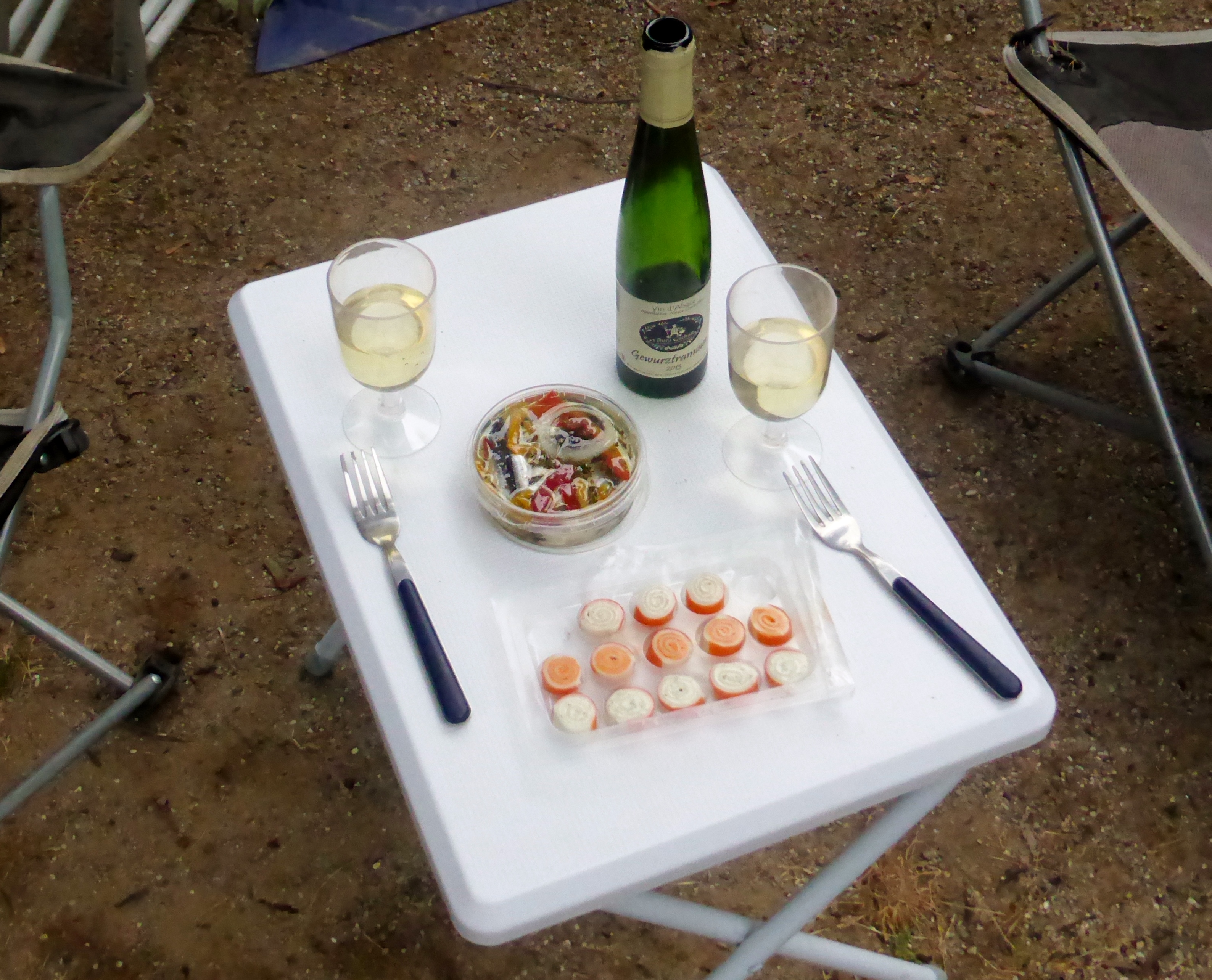
An Excellent Half Bottle of the 'Local Plonk'

An Excellent Half Bottle of the ‘Local Plonk’

There is a wine tasting event at our campsite here in Kaysersberg. It is being organised by our local Vineyard … obviously an opportunity to sell some of their wine to our motley collection of happy campers. Our immediate neighbours, Hansel and Gretel (the German couple in the antique ‘jerry-built’ camper van that is possibly even older then me) are going. They come back and hour or so later with several bottles of local wine. They have obviously sampled most of the wines on display … no ‘inhaling the fragrances, rolling the wine around the mouth, then spitting out’ for them? ‘It is really very good wine!’ they tell us, ‘You ought to go and try some for yourselves!’ Hansel (strangely, it seems to us) is a ‘wine man’ not a ‘beer man’ (unlike most German men I have met over the years). We politely refuse. ‘One of our brothers-in-law, Jack, is a wine expert!’ we tell them. ‘He has given us the names of several really good wines produced in this area (none of the ‘local plonk’ for us) … we are going to take two days to travel the ‘Route des Vins d’Alsace’ and we will buy some ‘quality wine’ en route!’

We set off early the next day and head for Eguiseim following the signs for the ‘Route des Vins d’Alsace’. We drive through mile after mile of vines. As far as the eye can see there are vines. They cover the entire landscape right up into the hills and trespassing right into the villages and towns dotted around here and there. There is no sign of anything else being grown … just vines. The locals must either import all their food … or survive on a diet of wine? We pass numerous Vineyards, all named after particular families. We even come across one called ‘Binner’ … the nearest we can get to our own vineyard, we guess? Julia has planned our route. Needless to say it takes in more towns and churches than vineyards, and places to stop for coffee and tea than places to sample a glass or two of wine?

We plan to stop at Eguisheim for coffee, but it is such a pretty little town that we end up spending an hour or so just walking around it taking in the beautiful houses and shops. There is a lovely church, which also has a lovely atmosphere, and a wonderful chapel nearby. As with other towns in the area many of the churches and buildings have wrought iron baskets on their steeples and roofs where storks can build their nests. The area is famous for its storks and we see them nesting everywhere … the parent birds standing watch and the baby birds peeping over the edges of the nests. We stop for coffee in a nice restaurant before moving on to a nearby Abbey Church that Julia is anxious to see at Murbach.

The Abbey Church is very impressive from a distance and we stop in the car park for a picnic lunch before visiting the Abbey itself. The site itself is very impressive with lovely herb gardens, some wonderful statues, and a lovely chapel overlooking the whole area. But the Abbey itself … well most of it is missing? The magnificent façade hides a miniscule interior. The whole thing is just … weird!

Time has flown by so we start to drive home. We still have not bought any wine so we look out for possible Vineyards on the way home. We eventually see one with a stall outside ostensibly selling wines from the vineyard. Although the stall is open and there are bottles of wine inside … there is no one there selling the wine. We drive up to the impressive looking house where we are greeted by two Alsatian dogs, and a party of Dutch cyclists who are also looking to buy some wine. There is no one obvious around so we ring the doorbell. After ringing the door bell several times a rather ferocious looking French woman answers the door. She is a female version of Herr Flick (from the TV series ‘Allo! ‘Allo!) and is none too pleased that we have dared call at the house. We tell her that we would like to buy some of their quality wine. ‘Shove off!’ she tells us in French! ‘But you have a stall by the roadside?’ we tell her, ‘Selling your wine!’ ‘But there is no one on duty there?’ we explain. ‘This is why we have come up to your house!’ ‘Shove off!’ she tells us once again. ‘We are not selling you any of our wine!’ and she slams the door in our faces. Julia and I shrug our shoulders, get back in our car, and resume our journey home. We pass the Dutch cyclists back at the unmanned wine stall by the road side. They are obviously contemplating helping themselves to some of the bottles of wine left lying about? If the wine is as bad as the reception we have just received I would leave well alone if I was them!

We are up early once again the next morning and resume our quest for good quality wine from one of the domains in the Alsace valley. Julia has a couple of villages she thinks we should see first so we head off to the first of these, Riquewihr. It is delightful with a great history and we end up spending far too long there. The day is running away from us and we still have not bought any quality wine from one of the posh Vineyards on the Wine Road. Eventually we manage to tear ourselves away because we have to visit the next village Julia has on her list, Ribeauville. Not only do we have to buy some wine, we have to go to the big Leclerc Supermarket to stock up with food. ‘We won’t stop for long in Ribeauville!’ says Julia, ‘Just long enough for a quick look and a cup of tea!’ When we get to Ribeauville, however, our new SatNav, Kate (so much politer than Jane our old SatNav) suddenly throws a complete wobbly and takes us right through the centre of the town? We are driving up cobbled streets, through pedestrian only zones, past quaint shops and historic houses? ‘Ah! Les Anglais!’ say the locals with the usual Gallic shrug of the shoulders. Obviously we are not the only Brits to have committed this faux pas! Travelling through the town seems to take for ever. We are expecting the Gendarmes to pounce any moment! We certainly get to see the whole of Ribeauville in the process!

Eventually we make it out the other side of the town. We are so stressed by the experience that we abandon our quest to buy some quality wine from one of the many Wine domains we pass on the way to the supermarket. We do our ‘big shop’ and then head back to our campsite sans wine. We are having fish for dinner … grilled on our wonderful new portable gas burner with fancy grill plate  that we bought for overnight stops but find ourselves using in addition to our normal larger gas cooker. ‘It would have been good to have had some really nice quality wine from Alsace to go with the fish?’ we think. So Julia walks up to the shop attached to the local Vineyard at the top of the road. She comes back with a half bottle of locally produced white wine … and very good it is, too!

Jim Binney

1 Comment

MOBILE HOMES UNDER THE HAMMER (Tour de France 2)


P1000675

I am sitting on our pitch in our campsite here at the Municipal Campsite Kaysersberg having my breakfast. An inveterate ‘people watcher’ I am thinking about all the other ‘happy campers’ around us. As per usual they are made up of various European nationalities, a fascinating combination of the wonderful and the eccentric, the really friendly and the absolutely awful. We immediately give them all ‘nicknames’ as usual, indicative of their personality types.

Back home in the UK Julia and I get up anywhere between 7.00 and 8.00 a.m. – one of the privileges of being ‘retired’ and living in a quiet hamlet where nothing much happens until the ‘paper boy’ (a man of around 50 years of age) arrives to deliver our morning paper. I have ‘first breakfast’ (readers of Tolkein’s The Hobbit and Lord of the Rings will understand) and then disappear into The Den (our study/office/prayer room) to pray, study, mark papers, etc. until around 10.00 a.m. when Julia calls me for ‘second breakfast’ (see earlier comment about Hobbits). We usually have this in the Snug and watch Homes Under the Hammer on TV while we eat (a programme about buying houses or flats at auction to ‘do up’ and either sell on, rent out, or live in).

Here on our campsite (unlike those in their caravans and camper vans) we have no TV. We are greatly amused by the Dutch and Germans who studiously visit every vacant pitch on the campsite when they arrive, armed with the apposite app on their mobile phones in order to determine which pitch will enable them to have perfect satellite reception for their TVs? One of our delights in going on our extended camping holidays is the prospect of being ‘TV free’ for several weeks on end. So, instead of watching Homes Under the Hammer on TV whilst enjoying our breakfast we watch Mobile Homes Under the Hammer with all the equally weird and wonderful people that you tend to find featured on the TV programme.

Mobile Homes Under the Hammer is not a bad description of our campsite. We are one of the few pitches that hosts a tent. Nearly all of the other campers are in either caravans or camper vans. Perhaps this is due to the time of the year. Come July and August, when there will be a lot more families, there will probably be more tents. But now, in June, when the campers are mostly ‘wealthy retired’ (apart form us, that is) there is a profusion of largely really nice caravans and camper vans. The campers are mostly elderly Dutch or German with a spattering of Belgians, Swiss, French and Brits. The elderly Dutch in particular arrive in the French campsites during May and stay until half way through July (when the prices go up) when they return home to the Netherlands. They then often return in September for another month.

We have owned a couple of caravans in times past (courtesy of Julia’s parents upgrading) but we have never taken one on to the Continent. We played around with the idea of buying ourselves a camper van … until we started looking at how much they cost. Even an old one would have cost us about £15,000, and a really ‘posh’ one can cost in excess of £100,000. Camper vans are very restrictive as well … we have seen some that tow a small car behind … because you have to use the van itself if you want to go anywhere? On the whole we prefer the idea of a caravan and maybe we will go for one of the smaller ones like an Eriba eventually. The caravans and camper vans on our campsite here in Kaysersberg are mostly rather posh … but it is the people who we find most interesting, and entertaining?!

Our immediate neighbours are a German couple whom we have nicknames Hansel and Gretel. They speak excellent English and are here for just a few days in order to celebrate Hansel’s birthday. In contrast to the other Germans on site they have a camper van that is possibly even older than I am? It wheezes on to their pitch and Hansel immediately connects the battery to the camp electricity so that it will charge up enough to get them back home to Freiburg again.

Next door to them are a Scottish couple, Mr and Mrs McTavish. They have an ‘Ecosse’ badge on their car and caravan (rather than a GB sticker) and they refuse to speak to us because we are English?! When they have a query about anything they would rather speak to the elderly German couple opposite them (who speak hardly any English) than speak to us? One wonders just how much this ‘Scottish Independence’ thing has permanently damaged British interdependence?

The elderly German couple in question – Herr and Fraulein Reallyelderlypersons – are wonderful. He must be about 90 years of age and she is probably the same age but look about 70. She does everything from cooking the meals to humping their chairs and tables around their pitch. She clearly loves her husband and does everything she can to help him enjoy camping – something that I guess they have done together for years. They are very friendly and smile at us a lot. The other day it was very cold and I was dressed in my warm camping trousers and coat with socks and walking boots. ‘You are cool?’ Herr Reallyelderlyperson said to me in hesitant English. ‘Yeah man!’ I replied!

Just along from these elderly Germans is a Swiss couple from Berne – William Tell and Heidi? They too (like our Scots friends) are very proud of their heritage. They fly the Berne flag outside their caravan, and every evening ceremoniously light a lantern on the flag pole at dusk? In contrast to the Scots, however, they are really friendly and helpful to all and sundry,

Opposite them are two French couples on neighbouring pitches. We call one couple Monsieur and Madam Frogzlegz (if you had seen him in shorts you would understand), and the other couple we call Monsieur and Madam Escargot (because they move very slowly). Monsieur Frogzlegz sports a huge moustache. Julia is not very keen on him because he leers at her every time she passes by? On Sunday the four French campers got together for Sunday lunch. The lunch commenced at 12.30 p.m. and was still going strong (several courses and bottles of wine later) at 4.30 p.m. They seemed to move their table around the Frogzlegz pitch with each course, depending on where the shade was?

Right down by the entrance, in obviously the most expensive campervan on site, are Mr and Mrs Poshbrits. They occasionally acknowledge us (as fellow Brits) but for the most part ignore everybody else. Their campervan is ‘all singing, all dancing’ and probably cost more than our house in Bewdley? They don’t seem to do anything all day, every day, other than sit outside their van in the sun reading?

My favourite family, however, is a German family just along from us … the Reallykindpersons. The family unit consists of Father, Mother and three children. The middle child, a girl, clearly has learning difficulties. She cannot speak and communicates with grunts and hand movements. She clearly loves her Father especially, and he obviously loves her. She will often simply just take his hand, and loves to be near him, watching what he does … fixing one their bikes or cooking on the barbecue … and enjoying just being there with him. They seem a very happy family. They tend to keep themselves to themselves but I have grown to admire them.

One of the churches Julia was in discussion with earlier in the year had as its ‘mission statement’ something along the lines of serving their community and endeavouring to  ‘see Christ in everyone’. Personally, I was never sure exactly what they meant by this … but observing the Reallyelderlypersons and the Reallykindpersons, albeit for just a few days, has helped me to understand it a little better!

Jim Binney