Leave a comment

SUFFER THE LITTLE CHILDREN (Views from the Abbey 32)

On the morning of 29 July 2024, three children were killed in a mass stabbing during a children’s event in a dance school in Southport, Merseyside, United Kingdom. Ten other people, eight of whom were children, were injured. Police arrested a 17-year-old male at the scene. A motive for the attack has not been identified, although police stated they are not currently treating the attack as terror-related. Prime Minister Keir Starmer described the incident as horrendous and shocking, and thanked emergency services for their swift response. Condolences were sent by King Charles III and Queen Camilla, as well as the Prince and Princess of Wales A vigil was held at Eastbank Street Square on the evening of 30 July, with hundreds of people in attendance. Flowers and handwritten notes were left near the scene of the attack.

Understandably the social media was full not only of the news of this tragic happening but the usual question that comes to the fore every time something like this happens: ‘Why? Why did God allow this?’ That ‘why’ question goes back thousands of years. It was asked in the Old Testament by Job and the writers of the Psalms. It was especially relevant during the 20th Century, where we witnessed two World Wars, the Holocaust, genocides in the Soviet Union and China, devastating famines in Africa, the killing fields of Cambodia, the emergence of AIDS, the genocide in Rwanda and the ethnic cleansing of Kosovo. The 21st Century didn’t start any better. There was 9/11, the Syrian slaughters, and now we have the horrendous invasion of Ukraine by Russia, the violent conflict between Israel and Hamas with the horrendous repercussions taking place in Gaza.  Why all this if there’s a loving and powerful God? Why do bad things happen to good people? If God is so good and loving, why does he allow evil and suffering to exist?

Bottom line to all this is the personal pain and suffering we experience as individuals – illness, abuse, broken relationships, betrayal, sorrow, injuries, disappointment, heartache, crime and death. Perhaps right now you are asking the question, ‘Why? Why me? Why now?’ Various national surveys suggest that if people were able to ask God just one question, that question would be ‘Why is there suffering in the world?’  Even if we have never asked why our world is infected with pain and suffering, we will when they strike us with full force or come to someone we love.

If you ask me directly, ‘Why did God allow a 17-year-old male to commit such a horrendous crime in Southport?’ the only answer I can honestly give you is ‘I don’t know.’ I have never been one for trite answers, especially (as a Christian myself) trite answers from professing Christians. In my latter years I have become a great believer in ‘slow wisdom.’ By this I mean, without standing still or marching on the spot, moving steadily forward but with thoughtful, prayerful reflection rather than instant reaction to issues and questions. Transitioning knowledge into wisdom is a marathon not a sprint race. Having said that, I believe it is important to attempt to engage meaningfully with the big questions – questions such as those posed above. The Apostle Peter encourages Christians everywhere to ‘always be ready to give an answer to anyone who asks you to give a reason for the hope that is within you’ (1 Peter 3:15). In other words, the Christian Faith is ‘reasonable’ – it can be reasoned, argued, discussed, debated, articulated. I would suggest these kind of debates always need to be open ended. As George Rawson (1807-1889) puts it in a verse from one of his hymns: ‘We limit not the truth of God, To our poor reach of mind, By notions of our day and sect, Crude, partial and confined. Now let a new and better hope Within our hearts be stirred: The Lord hath yet more light and truth To break forth from His Word.’ With this in mind, although I cannot provide you with a definitive answer, let me offer a few thoughts on the ‘whys’ and ‘wherefores’ of suffering as a contribution to the ongoing debate.

Brought up on the King James Version of the Bible (as many of my generation were) I recall being confused by Jesus’ comment recorded in the Synoptic Gospels: ‘Suffer the little children…’ (Matthew 19:14; Mark 10:14; Luke 18:16). Of course, by this Jesus meant ‘Let the little children (come to me)’ not that he wanted little children to suffer in any way. Jesus did, however, have quite a lot to say about ‘suffering.’ For example he saw suffering as a part of every human life. In conversation with his disciples one day he told them bluntly, ‘You will have suffering in this world’ (John 16:33). He didn’t say you might have suffering but you will have suffering. Suffering in life is inevitable in some form or other for all of us. Nowhere does the Bible give us a comprehensive explanation concerning the question of suffering although I believe there are some points of light provided along the way. Even though we can’t understand everything about it, we can understand some things. Let me give you an analogy. When I was a small child I recall my father and I getting caught in one of those thick London fogs we used to get back in the late 1940s. No buses were running so my father and I had to attempt to walk home even though it was virtually impossible to see your nose in front of your face. But then a truck appeared in front of us and we could clearly see his taillights through the fog. He apparently had fog lamps in front, because he was traveling at a confident if somewhat slow and steady pace. We knew that if we could just follow those taillights, we’d be headed in the right direction. The same is true in understanding why there is tragedy and suffering in our lives and in our world. We may not be able to make out all the peripheral details of why – they may be obscured from our view – but there are some key Biblical truths that can illuminate some points of light for us. And if we follow those lights, they will lead us in the right direction, toward some conclusions that I believe can help answer some of our questions. It is not my intention to unpack these few thoughts fully – you can explore them more fully yourselves – but simply attempt to point you in their direction. So, what are some of those points of light? Here are three of the most important.

Firstly, God is not the creator of evil and suffering. Quite often you hear the question: ‘Why didn’t God create a world where tragedy and suffering didn’t exist?’ The answer is: He did! The Creation Narrative we find in Genesis concludes ‘Then God looked over all that he had made, and he saw that it was very good’ (Genesis 1:31). But if God is not the author of suffering or tragedy or evil or death, where did they come from? The simple, blunt answer to that question is ‘us’ human beings. We do not have to read much further in the Creation Narrative in order to discover humanity’s rebellion against God and his ways (Genesis 3). Whether you take the Creation Narrative as literal or as myth, it makes no difference to the essential message of the story. Created with the God-given gift of free will, at some point in our existence, we humans abused our free will by rejecting God and walking away from him and his ways, thus unleashing into God’s perfect creation a flood of moral and natural evil. Whilst much good remains, including great beauty and good people, our world is indelibly affected by evil –  those forces that (according to the dictionary) cause ‘the suffering, misfortune, and wrongdoing that bring sorrow, distress, or calamity.’  

In passing, I also want to comment briefly on the role of ‘the serpent’ (Genesis 3:1-15) in all this. Rightly or wrongly early Jewish and Christian commentators identified the serpent with Satan or the devil, and it has certainly become popular today (even in Christian circles) to blame the devil rather than ourselves for bad things. I recall seeing a cartoon some years ago showing the devil standing outside a church crying. ‘Why are you crying?’ someone asked him. ‘Its those people in there’ the devil replied pointing at the church, ‘they blame me for everything!’ Our biggest enemy, however, is oftentimes not the devil, it is ourselves. We need to stop blaming everyone or anything else for everything and start taking responsibility for our own actions.

The distinction between natural evil and moral evil is an important concept in both philosophy and theology. Moral Evil results from human actions that are considered morally wrong such as murder, theft, and lying. Moral evil is directly linked to human free will and the choices individuals make. Moral evil is the decadence, suffering, tragedy and pain that we bring upon ourselves because we choose to be selfish, arrogant, uncaring, hateful and abusive. The Apostle Paul tells us this has all come about  ‘Ever since we’ve compiled this long and sorry record as sinners proving that we are utterly incapable of living the purposeful lives God wants for us’ (Romans 3:23). Natural Evil refers to suffering caused by natural events or processes that are not controlled by humans such as earthquakes, tsunamis, and diseases that cause suffering for people. Natural evil is often seen as a challenge to the idea of a benevolent and omnipotent God because it occurs independently of human actions. But these, too, are the indirect result of sin being allowed into the world. When humankind first sinned that act of rebellion against God not only affected them individually it affected the rest of God’s good creation. Nature began to revolt. The earth was cursed. Genetic breakdown and disease began. Pain and death became part of the human experience. Because of that sin nature was corrupted. The Writer of Genesis markedly tells us that ‘thorns and thistles’ entered the world (Genesis 3:18). Reflecting on this the Apostle Paul pertinently reminds us that since that time ‘the whole creation has been groaning as in the pains of childbirth right up to the present time’ (Romans 8:22). In other words, nature longs for redemption to come and for things to be set right. That’s the source of disorder and chaos.

Secondly, God has already set an unstoppable process of restoration in action in Jesus Christ.  The other question you often hear is: ‘If God is all-powerful why doesn’t he do something to end evil and suffering? The answer is: He has! Even for God, however, resolving the problem of evil and suffering takes considerable time. Let me use another analogy. It takes a kitten a comparatively short time to turn a pristine skein of wool into a complicated mess of tangles and knots that takes the knitter hours or even days to untangle. In much the same way, when we humans rebelled against God, it didn’t take us very long to make a real mess of creation and society (as we have seen). A mess that we seem to compound further rather than solve generation after generation despite all our advances in science and learning. Beguilingly the Creation Narrative contains clear hints that right from the beginning God set to, to resolve the sin problem and effect a restoration – well actually a restoration plus (but more of that later) – in both his search for humankind in our lostness (Genesis 3:9) and his (somewhat veiled) promise of a yet-to-be-revealed Saviour (Genesis 3:15).

The Old Testament records a long time-line of the salvation history of Israel (foreshadowing God’s greater intention to redeem the whole of his creation) climaxing perhaps in the various Servant Songs attributed to the Prophet Isaiah, particularly that portraying God’s Promised Messiah as the ‘Suffering Servant’ (Isaiah 52:13-53:12). Although written possibly some 700 years before the birth of Jesus Christ this Song powerfully describes all that God has done for humankind through Jesus – a focus that several of the New Testament Writers (Matthew, John, Luke, Peter, Paul) unashamedly pick up on. Each Writer has something significant to say about this but it is Peter who particularly underlines the link between Isaiah’s Suffering Servant to the ‘Christ who suffered’ on Calvary’s Cross: ‘(Christ) personally carried our sins in his body on the cross so that we can be dead to sin and live for what is right. By his wounds you are healed. Once you were like sheep who wandered away. But now you have returned to your Shepherd, the Guardian of your souls’ (1 Peter 2:21-25). Intriguingly Luke suggests that it was puzzling over the meaning of this passage in Isaiah 53 that led directly to the conversion of the Ethiopian Chancellor of the Exchequer (Acts 8:26-35).

Whilst clearly the Cross-Resurrection event is pivotal in God’s recovery/restoration plan, the fruit of that act of redemption remains ongoing – that skein of messy, knotted entangled wool is still being straightened out. As the Apostle Paul reminds us ‘the whole creation still waits with eager longing for the day of its full redemption’ (Romans 8:19). In any case, God’s purpose in redeeming us was never simply to restore humanity to what we were before ‘Adam’ downgraded us so to speak. His purpose was much higher than that. His purpose was to make us more like Jesus himself – to ‘raise us up with Christ and see us seated in heavenly places in Christ Jesus’ (Ephesians 2:6). And… ultimately all suffering will cease as that redemptive process comes to its fulfilment. The Apostle John prophetically foresees a day when ‘God will wipe away every tear from our eyes. [A day when] there shall be no more death, nor sorrow, nor crying. There shall be no more pain, for the former things have passed away’ (Revelation 21:4).

Thirdly, whatever the nature of our suffering right now, God is with us in that suffering.  Elie Wiesel’s renowned autobiography, Night, describes the numerous atrocities faced by concentration camp inmates during the holocaust. Like many others in these circumstances, Wiesel found it difficult to hold onto his faith in God when such cruelty surrounded him. In particular he recalls being forced to witness the gruesome execution of a child strung up on a wire noose which caused him to question the very existence of a loving God. ‘Behind me, I heard a man asking: “Where is God now?” And I heard a voice within me answer him: “Where is God? He is here… hanging on this same gallows!”’

In addition to reciting a long list of the various sufferings he has had to endure despite his faith in a loving God (2 Corinthians 11:23-28), the Apostle Paul acknowledges that throughout he found that ‘God’s grace was sufficient for his needs’ (2 Corinthians 12:9). Jesus himself promised the believer ‘Be sure of this: I am with you always, even to the end of the age’ (Matthew 28:20). Although in one sense Jesus is ascended into Heaven and seated at God the Father’s right hand (Acts 2:33) in another sense he is also present with us by his Spirit, that ‘other Comforter who will never leave you’ (John 14:16).

Having said all this, it is important for us Christians not to be too prescriptive on questions such as this. We don’t have the answer to every question and sometimes it is best to simply acknowledge this. If we had all the answers we would be God ourselves… and we are not. There is a lot to be said for retaining something of the mystery of God as well as a greater sense of humility on our part. Taking to heart the Apostle Paul’s wise words in his First Letter to the Corinthians, where he reminds us that at this moment we don’t have God’s mind or see things with God’s eyes: ‘Now we see things imperfectly, like puzzling reflections in a mirror, but then we will see everything with perfect clarity. All that we know now is partial and incomplete, but then we will know everything completely, just as God now knows us completely’ (1Corinthians 13:12). 

So when we ask about specific individual events and want to know why particular things happened, we won’t get the full answer in this life. One day we’ll see with clarity, but for now things are misty. We simply can’t understand everything from our finite perspective. And… to be quite blunt about it those people suffering right now as a result of what happened in Southport don’t need a big theological treatise right now. Any academic response is going to seem trite and inadequate. What they desperately need now is the very real and comforting presence of Jesus Christ in their lives. More often than not that sense of the presence of the living God is imparted through individuals – not by them quoting scripture at those who are hurting but simply by them being there, putting an arm round the shoulder, listening without necessarily saying anything.  I’m so grateful that so many churches and individuals in the immediate community in Southport are helping them experience that.

Jim Binney

Leave a comment

THERE IS NO ‘YES’ IN ‘YESTERDAY’ (Views from the Abbey 31)

Sitting in my garden the other evening, with a nice glass of wine and some rather delicious minor munchies, listening to some Barbra Streisand, I was struck by a line from one of Streisand’s songs (Here’s to Life if you really want to know): ‘There is no ‘Yes’ in yesterday’. It perfectly summed up my response to an article I had recently read in The Telegraph (6 July) entitled: I Voted Reform Because I Want My Country Back. Written by Charlie Bentley-Astor, a recent University of Cambridge graduate, the article deeply disturbed me but I couldn’t quite say exactly why… until I heard this particular line from the song.

Written by someone who voted Reform in the recent UK General Election because she ‘wants Britain to forge its own path again,’ Bentley-Astor believes this will happen under Reform but not Labour. I quote: ‘When I think of the England to whom I pledge my life, I think of the England of my childhood. I think of birthday parties in village halls and of summer fetes. I think of woodland and hours spent fashioning swings and sling shots. I think of the shade of churches. I think of rattling buses. I think of skinned knees and cricket played under the baking sun and red telephone boxes and duck ponds… it is in these remembrances that Reform has fashioned its vision for Britain’s future.’ For Bentley-Astor a vote for Reform ‘is a testimony to a different memory of Britain – when children could play in streets in security and freedom and there was a well-turned-out policeman on every street corner.’ Although Bentley-Astor must be considerably younger than I am she reflects an opinion that I have heard from a number of people of my generation (and others). An opinion that reflects a longing for the past, for days when everything seemed different, better, more comfortable, and so on.  Like George Bowling in George Orwell’s novel Coming Up for Air, they long nostalgically for days long gone, and situations that no longer exist, wistfully recalling perceived halcyon days that probably were never actually as they remembered them, and are certainly never coming back again.

I would suggest that there is a whole other side to Reform (and other right-wing parties gaining growing popularity in the Western Word), an extremely dangerous fascist side, that we all need to be aware of and not get succoured in by as many did in pre-WWII Germany. The following famous quote by Martin Niemöller, a German pastor and theologian, imprisoned for his opposition to Adolph Hitler, should be compulsory annual reading for all: ‘First they came for the Communists, and I did not speak out because I was not a Communist. Then they came for the Trade Unionists, and I did not speak out because I was not a Trade Unionist. Then they came for the Jews, but I did nothing because I’m not a Jew. Then they came for the socialists, but I did nothing because I’m not a socialist. Then they came for the Catholics, but I did nothing because I’m not a Catholic. Finally, they came for me… but by then there was no one left to help me.’

Accepting that there may be those (such as Charlie Bentley-Astor) who are genuinely attracted to Reform (and its like) by nostalgia rather than fascism, it remains that nostalgia – and in my view that is actually what Bentley-Astor’s article is all about – can be a very dangerous thing. The dictionary defines ‘nostalgia’ as ‘a sentimental longing or wistful affection for a period in the past’ or ‘a feeling of pleasure and also slight sadness when you think about things that happened in the past.’ Apparently, the term ‘nostalgia’ was coined by Swiss physicians in the late 1600s to signify a certain kind of homesickness among soldiers. Today we recognise that it encompasses more than just homesicknesss, and if we take nostalgia too far it becomes sentimental or indulgent. Whether triggered by a photograph, a memory, or a treasured possession, nostalgia evokes a particular sense of time or place. We all know the feeling: ‘a sweet sadness for what is gone, in colours that are invariably sepia-toned, rose-tinted, or stained with evening sunlight’ as someone once put it. At times such feelings can be genuinely comforting… but for the most part they are dangerous creating an illusion, a fantasy, of days that are long gone and never coming back again that hinders us from living positively in the real world.

Nostalgia is essentially the theme of George Orwell’s novel Coming Up for Air, the folly of trying to go back and recapture past glories, and the easy way the dreams and aspirations of youth can be smothered by the humdrum routine of work, marriage, and getting old.  In the novel George Bowling uses money he has stashed away to fund a ‘trip down memory lane’ revisiting the places of his childhood in Lower Binfield. He recalls the pond with giant fish, the lovely old pub in the town centre, his welcoming family home, and the girl he fell in love with all those years ago. But when he arrives, he finds the place unrecognisable. The pond is now a rubbish dump, the old pub a posh hotel, his family home a teashop, and the old girlfriend so ravaged by time that she is almost unrecognizable and utterly devoid of the qualities he had once adored. The days he fondly recalled were long gone and would never return. Intriguingly the only thing that remained unchanged in Lower Binfield for George Bowling was the Church and the Vicar (read into that what you will).

The truth of the matter is that despite Harold Macmillan’s opinion that ‘You’ve never had it so good!’ the 1950s that some of my generation long to return to were actually not that good… particularly for those of us who were not from middle-class homes. I know because I lived through those years. Memory has a tendency to play tricks on us and we have a propensity to remember the good and forget the bad. Nostalgia is the historian’s biggest enemy. Cultural memory more often than not relies on past media to inform the context of the things we think we remember. This can sanitise the past and reduce it to a mere shadow of its actual self.

Jesus exhorts us to ‘Remember Lot’s wife’ (Luke 17:32) citing the Old Testament story where Lot’s wife literally became petrified as a result of hankering after the past (Genesis 19:26). The Apostle Paul’s advice is to ‘forget the past and press on into the future’ (Philippians 3:13,14). Like an Olympian runner, he does not turn back to dwell on the past. Forgetting what is behind, Paul looks resolutely forward toward the future and a final victory lap.

Jim Binney

1 Comment

‘ONE LOT OF SINNERS OUT! ANOTHER LOT OF SINNERS IN!’ (Views from the Abbey 30)

Leave a comment

KEEP ON KEEPING ON (Views from the Abbey 29)

I left school aged 16 with only one GCE (in Art if you really want to know) much to the derision of family and friends. It was a very humiliating time for me. Fortunately I was persuaded to return to school and re-do my Fifth Year, which was also a very humiliating experience. Earlier this year, aged 80, I received my official letter from the University of Winchester confirming the Examiners’ recommendation that I be awarded a Doctor of Theology and Practice. This follows a number of other academic achievements over the years including BA in Theology; M.Th. in Applied Theology; M.Phil. in Divinity. Why do I recount this tale? Not to ‘blow my own trumpet’ but to encourage those who either feel a failure in life, or believe they are now too old to achieve anything, to never give up but to ‘keep on keeping on.’  

One of my grandsons is about to complete his final year at university. Another grandson is in the process of taking his GCSEs whilst his brother is in the process of selecting his options for his own GCSE subjects. How will they all fare? I don’t know but I wish them the best and pray they will achieve their potential. At the same time I am aware of all those who will not do so well and who will feel very much like I did all those years ago when I failed the majority of my GCEs. This world can be a cruel place… artificial, harsh, unforgiving, judgmental… and all too often dismissive of others who don’t quite ‘pass muster’. Admittedly the educational system in the 1950s/1960s was very much exam based which didn’t favour those of us who were blessed with a ‘good forgetery’ rather than a good memory. Remembering stuff was really difficult for me whereas researching stuff and writing it up was right on my wavelength. As a result I have really benefitted from the shift away from examinations to modular research. Having said that not everybody’s gifts are academic and I know a number of people who are the most amazing carpenters, mechanics, artists, musicians, and so on, who would never pass an academic exam but who bring amazing gifts to the table, so to speak.

To ‘press toward the mark’ is a phrase that comes from the Bible (specifically Philippians 3:13,14)  and means striving for greatness and excellence in all aspects of life. It involves making conscious choices and taking intentional actions in order to achieve our goals or purposes. Paul is using a sports competition metaphor. An athlete doesn’t run aimlessly, but straight towards the finish line in order to win the prize. He or she focuses on the finishing line to win the gold medal. Pressing toward the mark means living with purpose, determination, and a relentless pursuit of our highest potential. Paul does not define here what the coveted prize will be other than to indicate that it aligns in some way with the call of God that comes to each of us in and through Jesus Christ, a call to reach upwards for that which is currently beyond us. It is perhaps important to note here that – whether or not we believe in him – God has a plan and a purpose for each one of us and that the best way to get the best out of life is to align ourselves with that plan and purpose.

God tells us, through his prophet Jeremiah, that he has ‘plans for us, plans for good and not evil, plans to give us hope and a future’ (Jeremiah 29:11). Through the Apostle Paul God reminds us that he has a purpose for each one of us in life and that ‘in everything God works for the good of those who love him, those who have aligned themselves according to his purposes’ (Romans 8:28). Whatever else being ‘created in the image of God’ (Genesis 1:27) may mean (and it probably means a lot of things) it implies inherent potential within each one of us – potential which God wants us all to achieve. So… seek to learn what God’s plan and purpose for your life is, and never give up, never give in but keep pressing on, until that potential is achieved, whatever it may be, and however long it takes… keep keeping on!

I am not suggesting that the way forward is easy. There will always be those who will tell you the opposite of this, of course – you have probably already met some of them along the way in your own journey thus far. Those with a serpentine voice (Genesis 3) that subtly casts doubt on virtually everything in the attempt to undermine you achieving your potential. The ‘tatty old prophet’ types (1 Kings 13) who, having failed to live up to their own potential, and often consumed by jealousy, seek to drag others down with them rather than encouraging them to keep pressing on in the plan and purpose of God.  It was when I was in my mid-30s that I was first given the opportunity to study part-time for a Batchelor’s degree in Theology. The Elders of the church where I was the Pastor at that time refused me permission (even though it would not have cost the church anything in terms of time or money) in the belief that such theological education was unnecessary. It was another 10 years before I had the opportunity again. Over the intervening years between then and now, despite my academic progress, I have been mocked at times by contemporaries, told I was not clever enough to get a doctorate by prominent academics, and even (when I was only 65) told that I was too old for such study. Thankfully, despite the negative voices there have also been a lot of Barnabas’ (Acts 4:36) along the way who have encouraged me to keep on keeping on.

One final thing to throw into the pot at this stage – and something I think is really important – is the need to keep humble especially as you progress up the so-called ladder of achievement. Having spent the last 40 years or so mixing with the academic world I have observed that it is the habitat of a lot of oversized egos oftentimes all warring with each other for a higher place at the table (Luke 14:1-14). With this in mind there are two final passages from the Bible I would leave with you in your pursuit of your potential. Firstly, the advice of the Apostle Paul (someone deemed to have been someone of huge intellect) to the Roman Christians: ‘For by grace given me I say to every one of you: do not think of yourself more highly than you ought, but rather think of yourself with sober judgement, in accordance with the faith God has distributed to each of you’ (Romans 12:3). And in his Letter to the Philippian Christians Paul reveals the other side of the same coin: ‘do nothing out of selfish ambition or vain conceit. Rather, in humility value others above yourselves, not looking to your own interests but each of you to the interests of the others’ (Philippians 2:3,4).   

Jim Binney

Leave a comment

A ‘WEIGHTY’ QUAKER IN THE KING’S ARMS (Sabbatical Sundays 12)

Last Sunday Julia and I should have been in France enjoying a short holiday in the French sunshine in the delightful historic town of Chinon where we had booked a wonderful apartment overlooking the chateau on one side and the river on the other. Unfortunately, due to President Macron, we had to cancel that holiday at the last moment – we might have got there OK, but we were not at all sure that we would have got back OK with all the various strikes, petrol shortages, etc., etc. So instead. we are here in Cornwall, staying in an equally delightful house in Marazion overlooking St Michael’s Mount. Not much sunshine, however … but we are enjoying the wet, wild and windy Cornish weather … in a masochistic kind of way! So, instead of recounting a visit to a Roman Catholic Mass followed by lunch in a classy French restaurant, for our very final Sabbatical Sunday blog … I am writing about a visit to a Quaker Meeting House and another great Sunday roast at a local pub! 

We have tried to use our Sabbatical Sundays over the last three months to visit various different churches, sometimes to say a silent thank you to friends who have been so supportive to us since our arrival at Abbey, but sometimes simply because we were intrigued and wanted to know what those churches were like. I have never ever been to a Quaker Service before, although I kind of knew (or thought I did) what went on – everyone sitting around in silence for an hour or so, only occasional contributions from the floor (so to speak) when ‘moved by the Spirit’.  Marazion Quaker Meeting House is the oldest Quaker Meeting House in Cornwall. It is a Grade II listed building erected in 1688/89 and largely retains its original form, and some original and historic furnishings and fittings. It has strong associations with George Fox, who visited the town in 1655, just before his imprisonment in Launceston gaol. The Meeting House exists today, as it has for the past 332 years, in order to present the opportunity to take part in Quaker worship to all who wish to do so. From this worship there arises the inspiration for many different kinds of social action locally, nationally and internationally and many opportunities for individual and corporate spiritual growth. They have consciously sought to set an example of Christian discipleship within the local and wider community, aiding the initiatives that need to flourish in the creation of a peaceful and caring society founded on the equality of all humanity, regardless of gender, beliefs and social background. In 1960 the ‘Friends’ (as they like to call themselves) Meeting was held twice each month with an attendance of eight to ten, but by 1990 the Meeting House was becoming too small for the worshipping group, and it was decided to form a new meeting in Penzance which flourishes along with Marazion in providing a Quaker witness in West Cornwall. 

We walked from our lovely holiday house through the town – past the other two churches in Marazion, one Anglican and the other Methodist – and eventually found our way to the Friends Meeting House tucked away in the back streets but with an amazing view out over the sea to St Michael’s Mount. We arrived just before the 10.30 a.m. start to find a small group of worshippers already seated around a small central table in silence waiting for the meeting to begin. No welcome, no hymn books or orders of service given out, no nothing … just a small group of largely elderly people simply sitting there. We found a couple of comfy looking seats and joined the ‘crowd’. A few others wandered in after us, so we didn’t feel too much like intruders, and eventually there were 20 of us altogether. After about 15 minutes a lady stood up and read from a book of Quaker devotional readings and talked about the importance of listening. ‘Deep listening’ she called it, and I kind of liked that qualification. A few minutes later another lady stood up and talked about a TV programme she had watched and the inter-action of two characters in it – the gist of which was that God can use us despite all the mistakes we make in life, indeed it is often through these mistakes that he shapes us and forms us into the kind of people he can use to bless others. These two themes – deep listening to others and to God himself, and the fact that God still uses us despite our faults and failings – became the theme of the meeting as various people made interesting and helpful contributions from time to time. There were no hymns, set Bible Readings, formal prayer, as such but nevertheless there was a clear and helpful message that came across – something that seemed to us to be very Biblical and Christ-centred in its essence.

At one point, despite it being my first time in a Quaker Meeting I stood up (I hadn’t planned to do this) and contributed something that seemed to fit in with, and add to, the emerging theme of the meeting, and in doing so – as I was told later by one of the ‘Friends’ – I became what is know as a ‘Weighty Quaker’. This has nothing to do with my size but with the value of my contribution. Weighty Quakers or Friends are those whose contributions are considered to ‘carry weight’ or value.

After an hour exactly the ‘elders’ (or whatever they are called) who sat centrally around the small table stood up and formally shook hands … and then we all formally shook hands … and I really liked it. The meeting was over … but actually it wasn’t because after welcoming us all they started a short ‘after meeting’ where everyone present (who didn’t consider themselves to be ‘weighty Quakers’) were invited to contribute anything that might add to what had already been said. Several did, to the benefit of the rest of us. They then welcomed visitors and asked us to introduce ourselves – which Julia did on behalf of us both, arousing great interest that a couple of Baptist Ministers from Reading should be attending a Quaker Meeting in Marazion. They were a really friendly bunch, kindly, interesting, welcoming … and we really enjoyed our time with them. I read later a comment by another visitor to a Friends Meeting House that he had never ever heard a Quaker be critical of another Quaker. There seemed to be a ‘rule of thumb’ amongst them that accepted one another without cross-questioning everything that was said or believed. How different from many other churches today where the opposite seems to be sadly true.

After the Service we said our farewells and walked down to the seafront planning to return home for some lunch. It was a beautifully sunny day and so we walked along the beach and sauntered through the town … and then we spotted a welcoming looking pub that served Sunday lunches. The Kings Arms is a traditional Cornish pub, located in the centre of Marazion. Dating from the 18th century, it’s believed to be one of the oldest brick buildings in Cornwall. According to the blurb posted outside it has ‘an enviable reputation for serving restaurant-quality food in a friendly environment.’ Julia and I looked at each other. ‘We won’t get a table’ she said, ‘it will already be fully booked for lunch!’ I was already on my way in … and yes, amazingly, they did have a table for two since it was only 12.30 p.m. And what a wonderful Sunday Roast we both had, washed down with a couple of pints of bitter shandy! It was a good job we didn’t delay, however, because the pub soon filled up with customers and the staff had to turn people away. Julia was in her element – lots to reflect upon from a fascinating time of worship, great food in a quaint, historic pub in a quaint historic town, dog-friendly so lots of new four-pawed friends to say ‘hello’ to – and just a short walk home to our lovely holiday house.

Jim Binney

Leave a comment

MESSY CHURCH AND AN ALL-DAY BREAKFAST (Sabbatical Sundays 11)

In its heyday Abbey Baptist Church, Reading, where Julia is the Minister and I am the BOGOF, was responsible for planting somewhere in the region of 25 new churches in and around the Reading area. Last Sunday we visited Carey Baptist Church, planted by Abbey in 1867 on the western edge of the Reading of those days. This Sunday we went to the other geographical extreme and visited Wycliffe Baptist Church, planted by Abbey in 1881on the eastern edge of the Reading of those days. Both churches are flourishing, numerically large, busy, active churches today, doing great work in their respective localities and wider afield. Both churches are numerically much larger today than their ‘mother church’ at Abbey (formerly known as Kings Road Baptist Church when these two church plants were established) although Abbey itself is currently enjoying a renaissance having grown from a handful of largely elderly white Brits to around 120-140 ethnically diverse congregation in the last 18 months).

So, what did we make of the 10.45 a.m. Service we attended in the main sanctuary on Sunday – which Wycliffe now call ‘The Kings Room’? According to Wycliffe’s web page ‘This service is varied, lasts around an hour, comprising of live sung worship, testimony, interviews, prayer, and Bible learning. It is aimed at all ages, with Children, Youth and Families being encouraged to take part, with themed resources provided.’ In reality it lasted almost double that time wise, which meant that we had to rush off at the end because we only had two hours parking on the street where we had parked our car so missed out on the coffee and cake we were promised in the course of the Service. It would be wrong to judge any church on one Service and we know that Wycliffe have a multiple worship approach on a Sunday morning with an earlier more traditional Service at 9.00 a.m. plus a parallel more informal service for all the family in the Sports Hall Warehouse, also at 10.45 a.m., bi-weekly at the back of the main building in which those present worship with the band, discuss a Bible passage together, learn and encourage each other to apply God’s truth in our daily lives as Christians. The strength of the church seems to be in its system of Life Groups together with its amazing day to day work ministering to the surrounding community in a whole host of practical ways.

On Sundays Wycliffe are currently working their way through Paul’s Letter to the Romans under the overall title of Living the Good News. This Sunday the theme was apparently Effective Service (Romans 15:23-33). The Service itself was led by one of the Elders – Wycliffe are very strong on ‘Eldership’ – and it attempted to incorporate a whole host of activities. A nod to the fact it was Mothering Sunday (Julia and the other ladies present were given a single daffodil); an Infant Presentation (led by the Senior Minister); various songs (led by the music group – great drummer by the way safely locked away in his plastic cage); a Prayer of Petition (led by a member of the congregation); a Bible reading (Romans 15:23-33 read by another member of the congregation); an excellent 20 minute exposition of the passage by the Associate Minister (a newly appointed lady Minister) which for me was the highlight of the Service; the reception of several new church members; and Communion (served in the traditional Baptist way). There were probably around 150 people present incorporating a good scattering of ages and ethnicities. Half the congregation left after an hour to go to the various alternative activities on offer returning in time for Communion. We came away glad to have visited Wycliffe but feeling we needed to pay further visits in order to truly make an honest judgment on Wycliffe’s ministry and mission. An incident part way through the Service when a Rasta man caused a bit of a fracas at the door and had to be gently escorted away by the church ‘bouncers’ made me realise what an important work Wycliffe do at ‘the wrong end’ of town in and amongst an area of real need.

Since it was ‘Mothering Sunday’ we hadn’t managed to book a table at any of the local pubs or restaurants – dutiful kids taking well-loved mothers out for lunch – so on speck we drove to Woodley with the intention of grabbing a coffee and maybe a walk somewhere. We like Woodley shopping precinct – it has good parking, some nice shops including even a bank or two, several nice coffee shops, and a Waitrose. It also has a couple of nice-ish eateries and I had my eye on one that I had always wanted to visit, the Bosco Lounge. I don’t really know how to describe the Bosco Lounge – it is not exactly The Ivy, but it is a home-from-home café-bar, a bit scruffy but serves good food and has excellent helpful staff. We popped in for a coffee … and ended up staying for lunch. Julia had an excellent chicken, bacon and avocado salad and I had … a gigantic all-day breakfast would you believe … an all-day breakfast for Sunday lunch! It was yumacious! And afterwards … well we abandoned the idea of a walk and went home for an afternoon snooze!

Jim Binney    

Leave a comment

CAREY AND THE GRIFFIN (Sabbatical Sundays 10)

Last Sunday, in the latest of our Sabbatical Sunday jaunts, we paid a visit to Carey Baptist Church in Reading. The church was founded in 1867, a plant from our own church, Abbey Baptist Church, and was named after William Carey, a famous Baptist missionary from Northamptonshire, who went to India in 1793, and who is still highly revered in India to this day for all he did for that great country particularly in the field of education and social care. A scholarly man, Carey translated the Bible into numerous Indian languages. A Godly man he is known for that great saying: ‘Attempt great things for God, expect great things from God.‘ He played a significant part in the founding of the Baptist Missionary Society, or BMS World Mission as it is known today.

Today Carey Baptist Church is an independent, evangelical church that seceded from the Baptist Union following the infamous incident of the Michael Taylor address at the Baptist Assembly in 1971 in which he appeared to question the divinity of Jesus Christ. The church is now affiliated to the FIEC Fellowship of Independent Evangelical Churches. It is numerically one of the largest churches in Reading and is well known for its vibrant integral ministry and mission in Reading, and around the world. Although of Victorian origin the church premises have been beautifully modernised and extended to incorporate additional premises including the Carey Centre nearby, and what was the Oasis Public House next door. The church building is on Carey Street (Anstey Road) in central Reading, close to the Inner Distribution Road, Oxford Road, and The Hexagon.

We knew that the parking around the church was limited so we parked in the Hexagon Car Park and walked in from there for their 10.30 a.m. Service. We were amused to see a pub on the corner and joked about that obviously being the place where the Pastors went immediately after the Service. We didn’t know at that time that we were not that far from the truth, the church having bought the pub in 2009 to operate it as a drop-in for the local community (and not a pub) although still retaining the name, Oasis.  

To be honest we were a little nervous as to what kind of reception we would receive. Would it be another case of Daniella in the Lion’s Den? As a FIEC church, Carey Baptist Church hold a complementarian view of the male-female relationship which means that churches belonging to the FIEC should not have a woman Pastor-Teacher or women Elders. Sadly we have had some bad experiences in the past when visiting such churches simply because Julia is an ordained and accredited Baptist Minister. I would point out here that, in contrast to FIEC churches, most mainline denominations and other Christian groupings (including Baptist Union Baptist Churches) shifted from this position many years ago and hold what is called an egalitarian view which understands men and women to all be on an equal footing in the sight of God.

In reality we had nothing to worry about in this direction and were given a very warm welcome by everyone we met including several of the Carey Elders and their Pastors despite Julia’s role at Abbey. Indeed, we were even able to joke with some of them about how God could allow a church like Abbey to grow in 18 months from about 20 (mostly) elderly, white Brits to around 140 people of all ages from a variety of nations, under the leadership of a woman Pastor?!

We really enjoyed our time at Carey and it was really good to be in what we would call ‘a proper Baptist Service’. The church was packed, including the gallery, and I would estimate that there must have been about 300 people of all ages and ethnicities there. Especially impressive was to see about 30 teenagers sitting attentively in the gallery throughout the whole Service, including the 30 minute expository sermon. None of this mollycoddling of teenagers by allowing them to go out with the younger children to their own group halfway through a Service.

The Service was sensitively led by one of Carey’s two lead Pastors, David Magowan (the other Pastor James Muldoon was sitting in the congregation) and followed a very simple familiar pattern for those of us brought up in traditional Baptist Churches. The church itself was largely ‘unadorned’ without even a cross on display (although they were obviously very tech savvy and made good use of a large screen and a couple of TV sets to display the words of the hymns and songs and points from the sermon) and the Service followed suit. The church is currently working its way through 1 Peter on Sunday mornings and the theme for this Sunday morning was ‘Following Jesus in Doing Good, Whatever the Cost’ (1 Peter 3:8-17).

An opening extemporary prayer of praise was followed by a good old hymn beautifully played on the pipe organ, a great family talk – they call it a ‘Bible Bite’ at Carey – by one of the church members, a lovely lady called Paula, well-illustrated and engaging, all about following Jesus as our example. I had a wicked thought that this lovely lady was actually ‘preaching’ us a mini-sermon, but I didn’t dare suggest that too loudly – perhaps ‘teaching’ is OK and its really about women being in authority that’s taboo? This was followed by another song – beautifully played by the church’s excellent music group – and then the younger children left for their own groups. The only Bible Reading was the passage from 1 Peter, followed by a longish Prayer of Intercession (led by the Pastor), another song led by the music group (there were thankfully only four hymns/songs during the whole Service) and then it was sermon time. David Magowan proved to be a good preacher (you can catch the whole Service and/or just the Sermon on YouTube by the way) and we enjoyed his winsome and helpful exposition of 1 Peter 3:8-17). A closing hymn (back to the organ  for that), a final prayer, and it was time for coffee (instant coffee once again, I’m afraid) at the Oasis. The whole service lasted just an hour and a quarter.

Once again, we were warmly greeted by several members of the church and congregation including several of the Elders and by Pastor David Magowan himself. Despite our heretical approach to women in ministry we were made very welcome and enjoyed some stimulating conversation. Despite our differences we had a lot in common, and they seemed to know about what has been happening at Abbey over the last 18 months and appreciated what we were seeking to do. We have visited a whole variety of churches during our Sabbatical Sunday excursions and none of us (including Abbey) have got everything right. Every church we have visited is imperfect, has had its own funny ideas, beliefs, and ways of doing things, but God is good and still uses us despite our much valued idiosyncrasies. Carey continues to grow numerically and they are considering planting another church in Woodley because they already have a number of people who travel in to Carey from there on a Sunday. It is inevitable that a church like Carey, that has a particular identity as a conservative evangelical church, will draw from well outside its immediate locality. Carey recognise that this is both a problem and an opportunity.

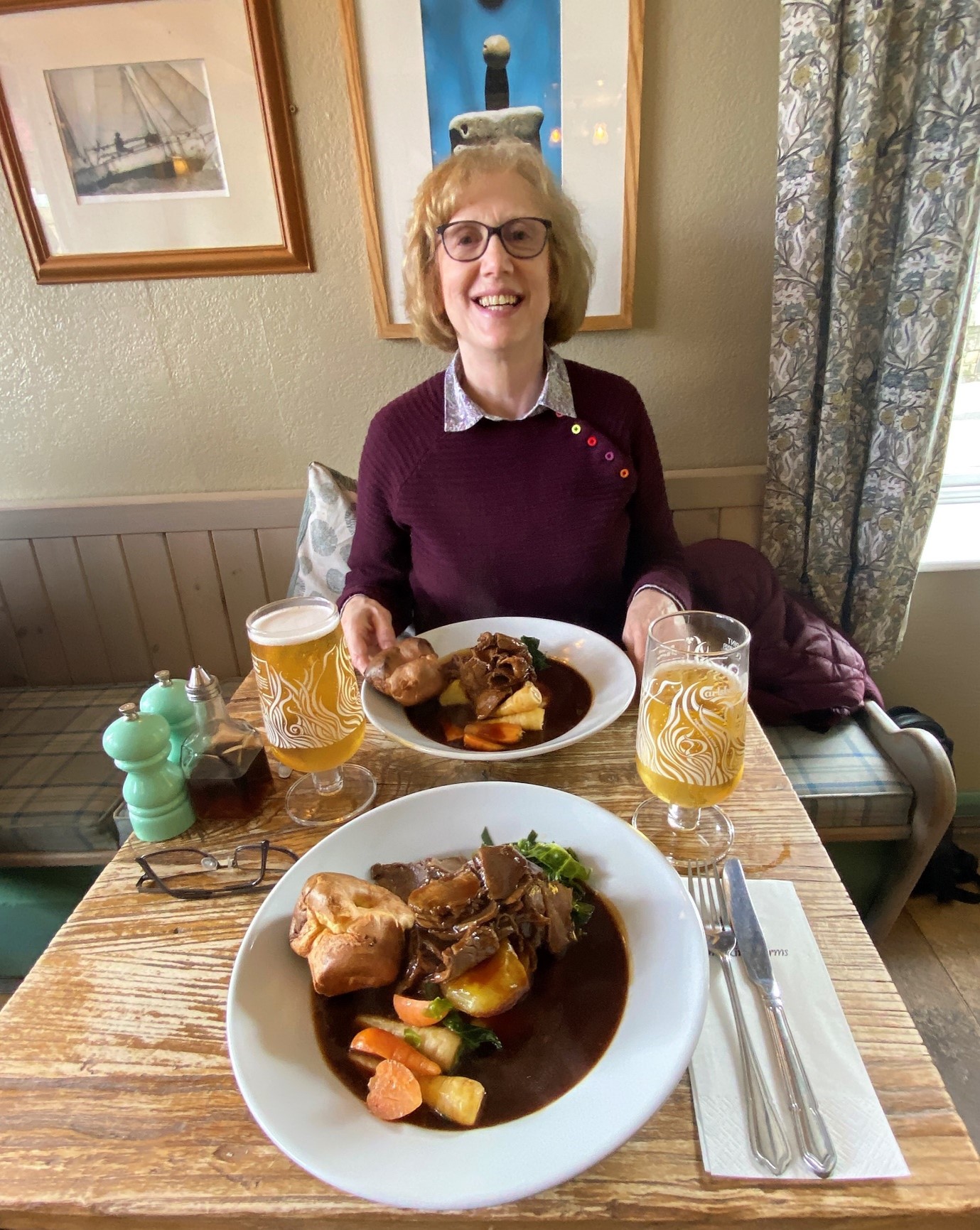
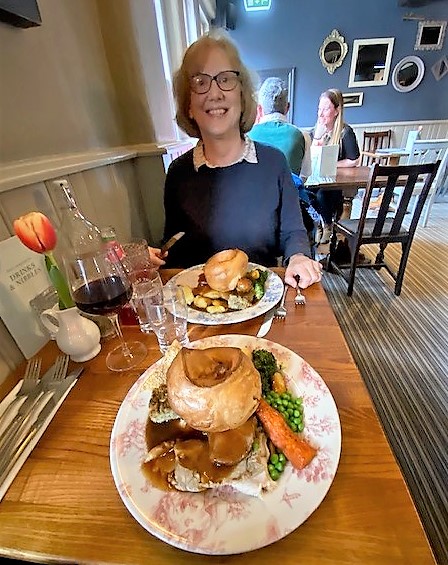
After our coffee and conversation, it was time for Sunday lunch, so it was off to The Griffin, a popular pub-restaurant in historic Caversham on the north bank of the River Thames close to Caversham Bridge where Julia had booked us a table. Pilgrims, merchants and even armies have crossed the Thames at Caversham Bridge for centuries, and there has been a tavern on the site of The Griffin since at least the 1800’s. Rebuilt to meet the needs of modern travellers in 1916, The Griffin is perfectly located for Thames travellers and Reading residents alike. Sometimes you just know what you want so it was time to try their traditional Sunday roasts with a huge a Yorkshire pudding and unlimited gravy … and yumacious it truly was!

Jim Binney    

Leave a comment

THE CHURCH ON THE HEATH, AND A FAVOURITE DAUGHTER (Sabbatical Sundays 09)

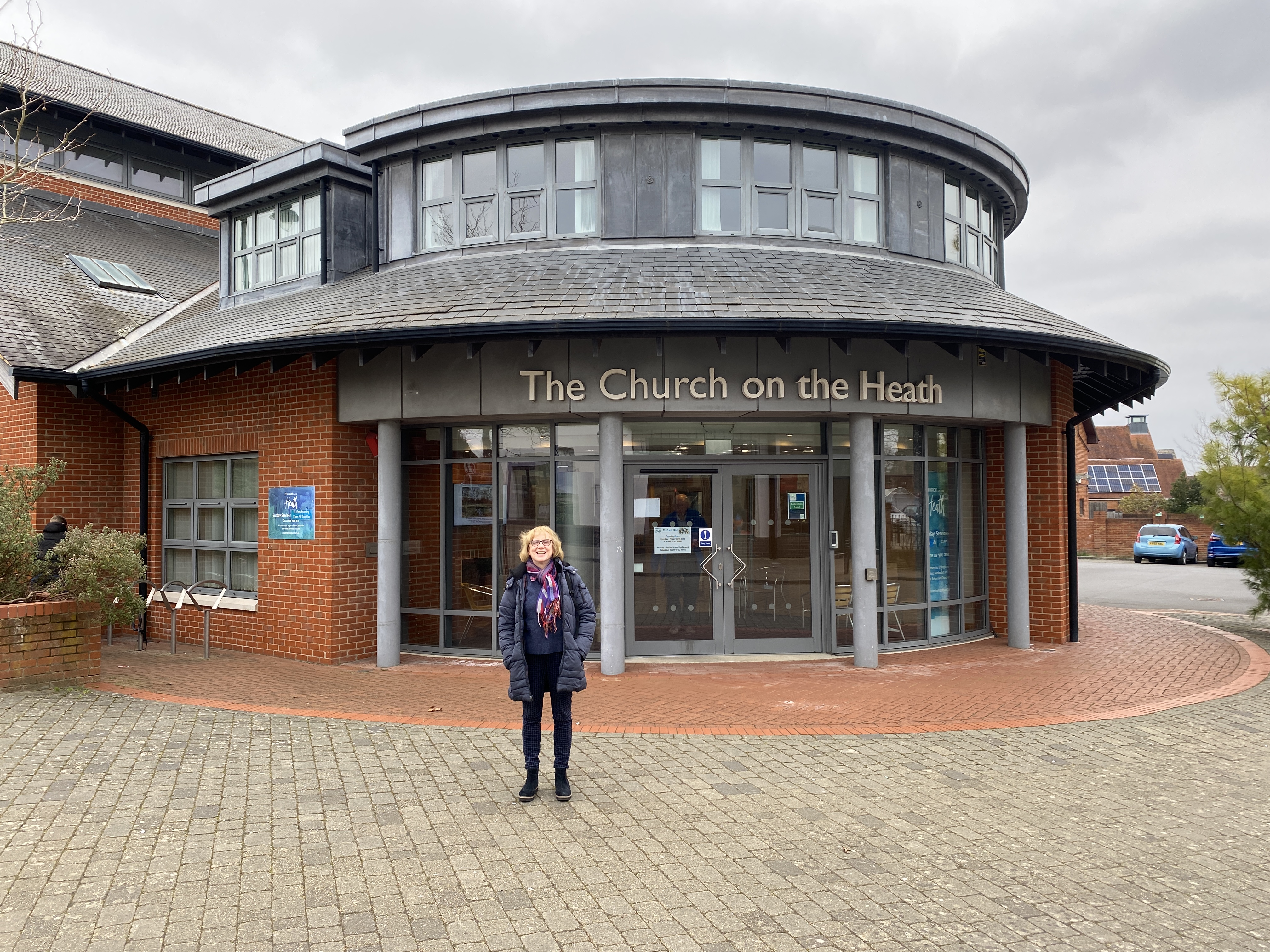
Last Sunday, for our latest Sabbatical Sunday jaunt, Julia and I had a lovely day visiting Elvetham Heath near Fleet in Hampshire. In the morning we attended The Church on the Heath for their 11.00 a.m. All Together Worship Service, and afterwards we went to my daughter Caroline’s house for Sunday Lunch. Caroline and her husband Simon are members of The Church on the Heath and, until fairly recently, Caroline was on the church’s Pastoral Staff.

The Church on the Heath is a partnership of Anglican, Methodist, Baptist, and United Reformed churches (which is pretty unusual) but just one church family learning to love God, serve others and live out their call to be a community where everyone can encounter the transforming love of Jesus. It started its life on, what was then the new housing development of Elvetham Heath, Fleet, twenty-three years ago. It is led by Patrick and Rosie Butler, Patrick is an ordained Anglican Minister and Rosie is a trained teacher by profession although she now works part-time at the church. The Church is around 300 strong and Patrick and Rosie have a small but dedicated staff to help them in the mission and ministry of the church.  They have a wonderful spacious modern building right at the centre of the community, near a large supermarket, the local school, and various other amenities and is a hive of activity throughout the week.

On Sunday mornings they have two Services – a more traditional Service at 9.15 a.m. followed by what they call an All Together Service at. 11.00 a.m. with coffee and cake in between the two. The earlier Service is livestreamed, but the second Service isn’t because of all the children being present. Both Services follow the same theme although they are radically different.  They are currently following a Lent Series entitled Nurturing Faith and Staying Connected, and this week the theme was The Practice of Spending Time with God Each Day. The first Service is more of a Preaching Service, but the second Service is a rather avant garde Family Service, open to all, but primarily for families with children. It is proving very popular, and attracting interest from other churches who are looking for ways to replace traditional Sunday School with something that appeals right across the board.

I have to say that it was excellent. It was different, in as much as there was no ‘preaching’ as such, but it was well planned with appropriate songs, thoughtful prayers, Bible searches, well-illustrated short talks, Bible readings, and some excellent contributions ‘from the floor’ so to speak that were very helpful to us all. There must have been around 80 people there and lots of children (who were remarkably well behaved throughout). The Service lasted about and hour and 20 minutes but was really well led by Rosie Butler and her team of helpers. There were lots of freebies available, that were excellently used to illustrate the various talks … so nice to be with a church (that has its financial struggles, as many churches do) but demonstrated such a generous spirit. We were made very welcome by everyone including the Minister and given a guided tour of their impressive premises by Caroline.

After the Service we drove back to Caroline and Simon’s lovely house in Elvetham Heath for an excellent Sunday lunch and a chance to catch up on family gossip as well as matters of faith and putting the world to rights! Sam, Caroline and Simon’s son, was there as well (they have a married daughter, Hannah, who now lives in London). Sam is studying at the University of Exeter but is living at home at the moment because his course requires him to have a year out on secondment, and he is working for L’Oréal for a year. Simon and Sam are Chelsea supporters so, as a Brentford supporter, I enjoyed bragging rights (Brentford being above Chelsea in the Premier League Table) for a change! We enjoyed an excellent lunch and Caroline had even made apple crumble with custard for pudding (a rare treat for me these days).

So, an excellent day all round. Great church, lovely worship, wonderful lunch … and quality time spent with my favourite daughter (well my only daughter in fact)!

Jim Binney    

Leave a comment

ALL SAINTS AND A SIMPLE MEAL (Sabbatical Sundays 08)

This weekend we are down in Ebbesbourne Wake in Wiltshire once again, visiting Julia’s 96-year-old mother, Olivia. Where to worship this coming Sunday? That is the question? We have to be back in Reading on Monday (although still on sabbatical, Julia has a couple of meetings in preparation for returning to work at the beginning of April) so we don’t want to venture into Salisbury again this visit. We are looking after Olivia this weekend so we don’t want to be out and about for too long anyway.

We decide to go local and visit one of the churches in the Chalke Valley. Julia’s younger sister, Livy (who lives next door but one to Olivia, and who is her principal carer) suggests All Saints at nearby Broad Chalke because they have a 9.30 a.m. Parish Communion. Livy is going to the 6.00 p.m. Evening Prayer at another of the Chalke Valley churches, Holy Trinity at Bower Chalke but that is too late for us because Julia has to make dinner for Olivia around that time. There is no Service this Sunday at St John the Baptist in Ebbesbourne Wake itself so we can’t go there. There was a Methodist Church in Ebbesbourne Wake (but that has recently closed) and there is a United Reform Church at Broad Chalke (but their Service is not until 10.30 a.m.). We would like to go there sometime because it is a great example of a very successful Community Hub Church operating as a village shop, Post Office and Community Café six days a weeks and a church on a Sunday … but this Sunday we have to be back home for 11.00 a.m. for Olivia. So … All Saints, Broad Chalke it is then!   

The Chalke Valley group of Anglican Churches is very interesting. We have actually visited them all at one time or another, but not always on a Sunday. They are a team of 12 communities spread along the Chalke Valley, near Salisbury, passionate about their local church communities, and the role that they play in rural village life, and on a mission to share God’s love and his kingdom both within those communities and further afield. Their declared aim is to ‘deliver high quality worship and develop a range of Christian worship so that all are welcomed and enriched in their faith; Love our neighbours and demonstrate this by giving our time and sharing our resources; Serve and support our village communities and especially those who are disadvantaged; Work with the schools in our valley to support them as they nurture young people early in their faith journey’. We wonder at the practical realities of these objectives given that there are church buildings in every community with all the demands that maintaining those churches brings, with limited human and financial resources.

We arrive at All Saints in good time, park in their large carpark with its magnificent views, find our way to the front of the church (with the aid of friendly parishioner who guides us through the graveyard covered with beautiful snowdrops). We are made very welcome by several people – all hopeful that we have moved permanently into the area, and slightly disappointed to discover we are only visiting – and find ourselves a nice pew where we can remain reasonably inconspicuous. I find my eyes drawn to a large painted text on the wall above the chancel – a quote from 1 Peter 2:17 – exhorting us to ‘Love the Brotherhood; Fear God; Honour the King’. We wonder which King we are supposed to be honouring with the Coronation of Charles III not that far away now?! We hope it is King Jesus!

The church is pleasantly warm (which is not always the case with Anglican Churches) and the Order of Service booklet we are given is easily understandable (which equally is not always the case with Anglican Churches). The Chalke Valley Churches don’t have a Team Rector at the moment, but they do have a couple of other Clergy Team Members who have the dubious task of looking after all these churches and communities. The Parish Communion is taken by one of these – the Rev Dr Ruth Howlett-Shipley – who is fairly new to the Chalke Valley. She is very pleasant, has a good voice and a good manner about her, and leads the Service very well.

There are 30 or so people present – virtually all elderly, white, British – but we all enter into proceedings with that level of enthusiasm one would expect from elderly, white British people. Members of the congregation read the various Lectionary Bible Passages for the day, and lead the Prayers for the Church and the World, and do so very well. The organist is excellent, although one or two of the hymns are somewhat staid, and there is a hilarious moment when we venture in to a sung response (clearly unknown and unexpected by most) where the organist plays one tune and the rest of us sing various totally unconnected tunes … all at the same time).

It is the First Sunday in Lent so the sermon (taken from Matthew 4:1-11) is about Jesus’ temptation in the wilderness. Ruth is very good – expounding the passage well and applying its lessons practically – encouraging us to resist temptation but accept testings, whilst keeping our eyes continually on Jesus. Communion is nicely done, and we feel blessed and encouraged by the time the Service ends exactly an hour after we started. Lots of people want to talk to us – still trying to persuade us to retire to the Chalke Valley – but we eventually manage to say our final goodbyes and drive home to Ebbesbourne Wake and Olivia.

So … there will be no huge Sunday Lunch this Sunday. We are here to help look after Olivia and spend some time with her, so no visit to a local eatery is on the cards today. I do think about nipping up the road to the Horseshoe Inn in Ebbesbourne Wake – they have an excellent reputation for good food – but I don’t think I would get away with it. And … I remember that I have to ‘resist temptation’! Besides, Julia is cooking dinner for us tonight, and she is an excellent cook, so I need to leave room for that! So, a simple meal it is … a bowl of delicious chicken soup and an egg mayonnaise roll, all washed down with a glass of … water!     

Jim Binney    

Leave a comment

SAINT ASDA AND THE BIRTHDAY BOY (Sabbatical Sundays 07)

This weekend we are staying local once again and visiting our Parish Church, Trinity Church in Lower Earley, for our latest Sabbatical Sunday.  Established in the mid-1950s as a partnership between the Methodist, United Reformed and Anglican church, Trinity is situated next door to the large Asda Supermarket complex in Lower Earley and is therefore affectionately known locally as St Asda rather than Trinity … but more about all that later!

In this blog I am reversing the normal order of my reflection – ‘spiritual food’ followed by ‘literal food’ – because Julia and I have decided to forego a large Sunday Lunch this Sunday. ‘Shock! Horror!’ I hear you say in amazement – a couple of ‘foodies’ like you two forsaking an opportunity to visit yet another ‘eatery’ to sample its wares?! Well, we haven’t suddenly repented of our love of good food … its simply that we went out last night, with my son David, his wife Amy, and their boys, George and Luke, to celebrate David’s 50th birthday. We went to the Horse and Groom, a Harvester Restaurant at Bracknell, halfway between where David and his family live in New Haw and where we live in Reading. We had a great evening, really good food, great service from the staff, and so nice to spend quality time with David, Amy, George and Luke … and they picked up the bill as well!? Well I also have a significant birthday this year. I will be 80 come November, so perhaps they are already into ‘help the aged’?

David’s story is a great one. He was born with a number of serious heart defects and we were warned to expect the worst. At the time he wasn’t expected to reach 5 years of age leave alone 50. A lot of prayer was offered up for him from all over the UK and beyond. His medical records report that quite unexpectedly ‘a spontaneous correction’ took place, and (obviously) he has survived for a good number of years. His healing was not complete – he has subsequently had heart surgery to close replace a dodgy valve and close the hole in in his heart – but at the time we felt that the Lord was saying that that would be the case because David himself would have (at some point in the future) to respond personally to what God was doing in his life. For me this has such a ring of truth about it. As per the testimony we heard last Sunday at All Nations Christian Centre, God is always more interested in us finding him to be present and true and with us in times of adversity than in the shallow triumphalism so popular in too many churches today. David still enjoys good health today, and has become a fine (youngish) man of whom (as his father) I am very proud. He is a good guy, a loving husband, and a great father to his two boys.

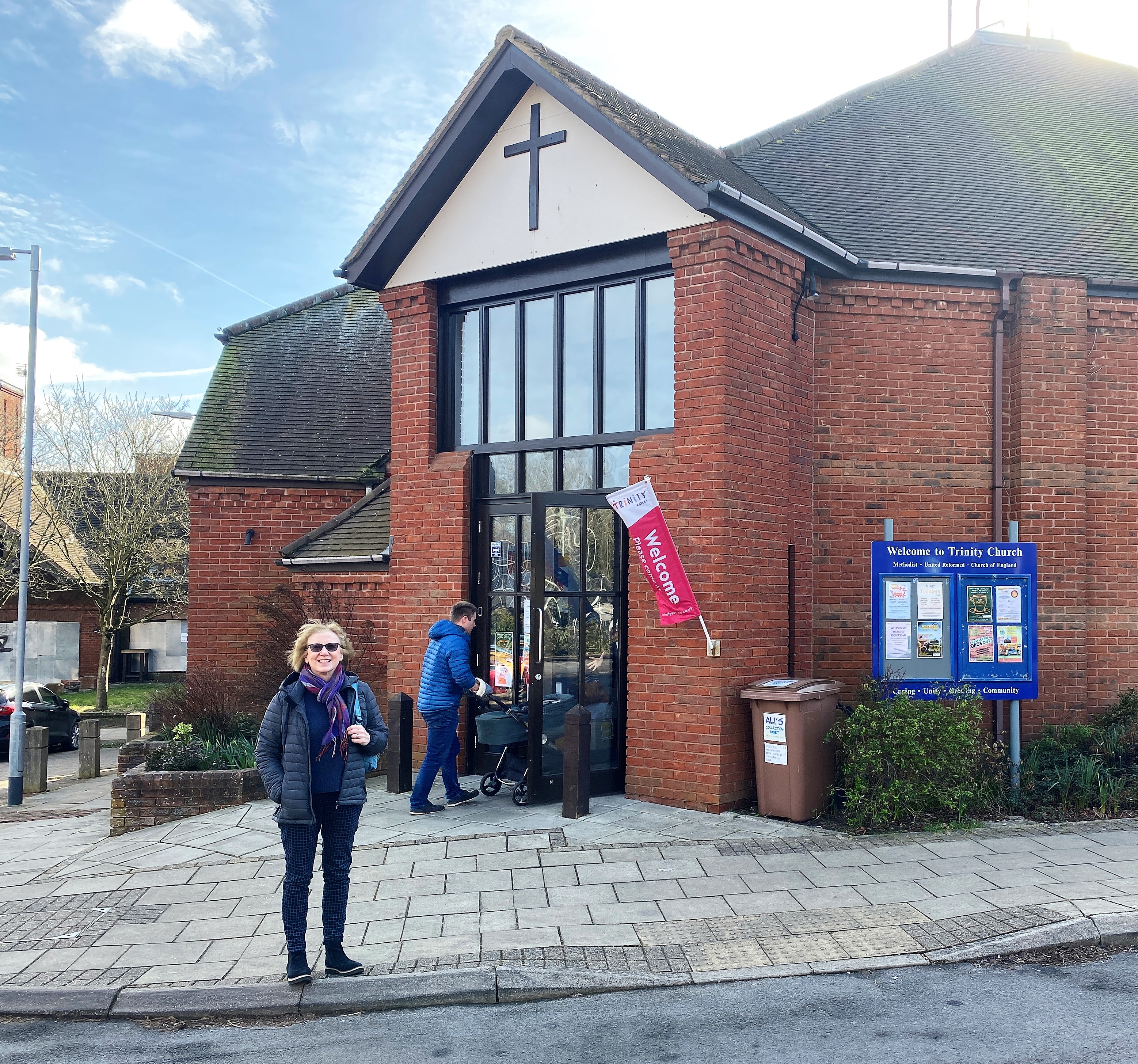
So … back to Sunday morning and our visit to St Asda. Although drawn from three denominations, Trinity worship together as one congregation. Anyone, with or without any kind of church background, is very welcome. They are a family church and seek to be truly international and intergenerational. They share a range of Christian experiences and church backgrounds and, as a church, believe in living life to the full – showing and sharing Jesus. An outward-looking church, working within their neighbourhood enjoying strong relationships and partnerships with other local churches, they see themselves increasingly as part of ‘one church’ in Lower Earley and Reading. Amongst their commendable core values are: loving God with all your heart, body and mind and loving your neighbour as yourself. As such they seek to serve the local neighbourhood usefully, practically and spiritually to that end.

St Asda have three Services on a Sunday. A more traditional Service at 9.30 a.m., and Family Service at 11.00 a.m., and a Cantonese Service at 2.30 p.m. We opt for the Family Service, a) because we don’t speak Cantonese, and b) opting for the 11.00 a.m. Service gives us the opportunity for a rare lay in on a Sunday morning (and a leisurely soak in the bath for Julia)! We arrive in good time and join the chaos in the Sanctuary as they dismantle the formal rows of chairs from the earlier Service and set up a more informal layout (with chairs grouped around small tables) for the Family Service and attempt to serve coffee and cake at the same time.

The Family Service starts roughly on time and is very informal. It is led by the Vicar, Jon Salmon. We like Jon. He is another of our fellow Pastors who has been so supportive of us since our arrival in Reading over fours years ago. We are pleased to also meet up with Rod and Laura Eades, two of our equally supportive friends from Transform Reading (formerly known as Reading Christian Network) who have also been so kind to us. There must be around 80 people there, with lots of kids, very mixed in age and nationalities. The Service is very informal but it has all the ingredients we hope for in a Service. There is lots of prayer, and some good songs (but not too many) and a great pianist to accompany them. There is a slot for the kids which they seem to enjoy. There is Communion (with grapes for the kids) and a mix of alcoholic and non-alcoholic wine (for the adults) to go with the bread (we are worried that since we are sitting towards the back of the church all the alcoholic wine will have gone before the servers reach us). There are Old Testament and New Testament Bible readings, and an excellent sermon (20 minutes long) by the Associate Pastor responsible for Youth and Young Adults, Sam Ruck Pender based mainly on Psalm 121 but drawing on John 1:1-5 as well.

The theme is God being our ever-present helper on a day-to-day basis. It was well preached and well-illustrated. I will certainly remind myself of what Sam shared on Monday morning when I get back to trying to write up my doctoral thesis again. At the moment I feel rather like God must have felt at the beginning of creation – surveying the chaos and hoping to create something positive out of it (Genesis 1:1) – only God managed to do just that and I am not God! Hopefully I will discover the reality that ‘My help comes from the Lord, the Maker of heaven and earth’ (Psalm 121:1) as I return to the chaos of books and papers everywhere and a mind full of chaotic thoughts and confused directions. There is time to reflect together in our small groups (gathered round our small tables) on what we learned from the sermon … and there is intercessory prayer for the church and for the world (if we Christians don’t intercede for our broken and hurting society who will?).

The whole Service lasts about an hour and a quarter and we enjoy it very much. Everyone is very friendly and we are pleased to see St Asda thriving and growing in numbers. We feel something of a kindred spirit with them because their journey in some ways mirrors that of our own church at Abbey with a recent upturn in numbers and a sense of positive change on the wind (the wind of God’s Spirit we trust).

So after Service it is a short drive to the University of Reading for a coffee in the sunshine and a walk around the marvellous Harris Gardens to see the snow drops before returning home for a light lunch … and an afternoon sleep. How pleasant it is to actually live a fairly ‘normal’ kind of life for a change?!

Jim Binney