Leave a comment

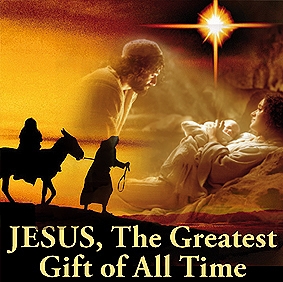
THE GREATEST GIFT (Advent Narrative 6)

1258118903

The British Ambassador was in Washington some years back. About fortnight before Christmas a local TV station rang him. ‘Ambassador’ said caller, ‘What would you like for Christmas?’ ‘I shouldn’t dream of accepting anything’ replied the Ambassador. ‘Seriously, we would like to know’ responded the caller, ‘and don’t be stuffy … you have, after all, been very kind to us during the year.’ ‘Oh well, if you absolutely insist’ replied the Ambassador, ‘I would like a small box of crystallised fruits’. The Ambassador thought no more about it until Christmas Eve when he switched on the TV. ‘We have been conducting a small Christmas survey’ said the announcer. ‘We asked three visiting Ambassadors what they would like for Christmas?’ ‘The French Ambassador said: “Peace on earth, greater compassion for human life and understanding, and an end to war and strife!” The German Ambassador said: “A great upsurge in international trade, ensuring growth and prosperity, particular in the underdeveloped countries’. And then we asked the British Ambassador… he said that he would like a small box of crystallised fruits!?’

So … what would you like for Christmas? The story above kind of changes our perspective? In Luke 2:8-11 we have the story of the Greatest Gift of all – the Gift of God’s Son, Jesus Christ. Luke tells us that, following the birth of Jesus in Bethlehem’s manger, a whole host of angelic beings appeared to shepherds caring for flocks of sheep in the region of Bethlehem. The strong probability is that these shepherds were pasturing flocks destined for the temple sacrifices. Flocks were supposed to be kept only in the wilderness and a rabbinic rule said that any animal found between Jerusalem and a spot near Bethlehem must be presumed to be a sacrificial victim.  As a class shepherds had a bad reputation. The nature of their calling kept them from observing the ceremonial law which meant so much to religious people. More regrettable was their unfortunate habit of confusing ‘thine’ with ‘mine’ as they moved about the country. They were considered unreliable and were not allowed to give testimony in the law courts. Nevertheless, it was to such people that God first revealed the good news, the Gospel [v.10]. Understandably they were naturally fearful of this divine visitation … until one of the angels tells them the Good News: ‘Don’t be afraid … I bring you good news that will bring great joy to all people. The Saviour – yes, the (promised) Messiah, the Lord – has been born today in Bethlehem, the city of David’ (v.11). God is no respecter of persons.  The good news was not revealed first to Priests and Pharisees but to despised, even sinful, shepherds. This means that there is hope for even the most hopeless amongst us … because of the Greatest Gift of all from God to his creation, the Gift of his one and only Son!

This is the Greatest Gift of all because it is the Gift of God Incarnate. Prior to his birth an angel appeared to Joseph and told him that the child Mary was about to give birth to was none other than ‘Emmanuel’ which means ‘God with us’ (Matthew 1:23). When we look at that tiny baby lying in Bethlehem’s manger we need to recognise that this is no ordinary child but none other than God himself come among us in human form! If we want to know what God is like all need to do is look at Jesus! See in him not just as a tiny baby but as a grown man who went about doing good, demonstrating through life and word what God was like and what he wants from each one of us!

This is the Greatest Gift of all because it is the Gift of a Saviour. The angel that came to Joseph spoke of this Special Child having another Name: ‘Jesus … because he will save his people from their sins’ (Matthew 1:21). When we look at that tiny baby we need to also recognise that he grew up not just to teach us what God was like, or what God requires of us, but to give his life on Calvary’s cross to remove the barrier of sin that separates us from God and open a new a living way back to God for all who will truly believe on him!

This is the Greatest Gift of all because (as the angels told the shepherds) it is ‘good news that will release great joy into the hearts of people everywhere’ (v.11). The Bible tells us that ‘God desires everyone to be saved and come to a knowledge of the truth’ (1 Timothy 2:4). Christ’s sacrifice on Cross is  ‘sufficient’ for everyone (although only ‘efficient’ for those who believe). The only limit we place on God’s grace is the limit we set upon it ourselves!

So here we are … celebrating Christ’s birthday … talking about God’s gift to us when we should be talking about giving our gifts to Jesus (after all it is his birthday not ours)? What does he want?

Ludwig von Zinzendorf was an 18th c. wealthy, German Count. He knew the Gospel Story well, but had never made any commitment of his life to Jesus Christ. One day, on a long journey, Zinzendorf stopped off in small town en route and, whilst the horses of his carriage were being changed, he wandered into small museum come art gallery, where he saw a painting (sadly since lost) of Jesus Christ on the Cross. Underneath this painting were the words: ‘This have I done for thee, what hast thou done for me?’ Zinzendorf realised that he had done nothing in response to that which God in Christ had done for him. In that moment, it is said, God broke into his life. He fell to his knees and there and then committed his life to Christ. He went on from that point to use his wealth and position to serve Jesus Christ, not least in establishing the Moravian Church … which was to prove to be so influential in the conversion of both John and Charles Wesley.

So … what does God want from us? What does Jesus want from us? Christina Rossetti (1830-1894) sums it up succinctly in the last verse of her carol:

What can I give him, poor as I am?
If I were a shepherd, I would bring a lamb;
If I were a Wise Man, I would do my part;
Yet what I can I give him …
Give him my heart.’

Jim Binney

Leave a comment

IF I HAD NOT COME? (Advent Narrative 5)

christmas-without-christ-is-just-a-mess

Very early one Christmas morning a small boy tiptoed downstairs. All night he had been dreaming of the gorgeously decorated Christmas tree groaning under the weight of presents. Imagine his shocked amazement at seeing none these things – just the same old furniture arranged in the same drab way. Yet there was a difference, an uncanny difference. It was the atmosphere – like fog, heavy, oppressive. The boy rushed out into the dark street. The same gloomy atmosphere greeted him. No smiles on the faces of passers-by, no one calling out ‘Merry Christmas’ to him – just people plodding along wearily, aimlessly. He looked at the shop windows. The bright lights and decorations of Christmas Eve had disappeared – nothing in shops now but food, clothing, implements, the essentials of living. He came to the church – at least to the vacant plot of ground where the church had once stood. No church now! No school either! Instead a prison – the biggest, grimmest prison he had ever seen. ‘What’s happened to everything?’ the boy cried out, ‘What’s wrong?’ Befuddled, the boy turned and started back for home. Suddenly he stumbled over something lying in snow. It was a man, blue with cold, lying there like a bundle rags. Urgently the boy began running to the nearby hospital for help … but even as he ran he realised that no hospital would be there! No hospital, no church, no school, no lighted shop windows, no Christmas tree, no cheeriness, no charity, no hope, no nothing! Sick at heart he trudged home, flung himself on a chair, and reached for the Bible to read the story now become a mockery. He thumbed through the Old Testament suddenly remembering that the Gospel story was in the New Testament. But this Bible ended with the Prophecy of Malachi?! After that he found nothing but blank pages – nothing but one verse of Scripture printed in a tiny footnote – the words of Jesus … ‘If I had not come!’

Thankfully, however, Jesus Christ did come! This ‘coming’ we celebrate every Christmas! The difference his coming has made is incalculable! So much of value and worth that we enjoy today stems from that coming – not least in realms of education and medical care!?

This should not surprise us because of the special nature of the One whose birth we celebrate at Christmas! Immediately prior to his birth an angelic messenger told Joseph that the son Mary was to bear would be known by two particular names: ‘Immanuel’ meaning ‘God with us’ and ‘Jesus’ because ‘he will save his people from their sins’ (Matthew 1:21,23)!

When we look at that tiny baby lying in Bethlehem’s manger we need to recognise that this is no ordinary child but none other than God himself come among in human form! If we want to know what God is like all we need to do is look at Jesus! Seeing him not just as a tiny baby, but as a grown man who went about doing good, demonstrating through life and word what God was like and what he wants from each one of us!

And when we look at that tiny baby we need also to recognise that Jesus grew up not just to teach us what God was like, or what God requires of us, but to give his life on Calvary’s cross to remove the barrier of sin that separates us from God and open a new a living way back to God for all who will truly believe on him!

These words of Jesus: ‘If I had not come’ (John 15:22) were spoken to his disciples after the ‘Parable of the Vine and the Branches’ where Jesus used an everyday scene to get across the importance of us having living relationship with God – a living relationship made possible through his Incarnation and Passion. Without a living relationship with God we are like a branch cut off from the vine – incapable of fulfilling our God-given purpose in life, living a fruitful life, or making a difference in this broken, hurting, and needy world!

Having a living relationship with God, however, makes all the difference! We ‘know’ God in a personal way, we find our God-given purpose in life, and we can now make a difference right here, right now!

Cardinal Jean-Marie Lustiger (a convert from Judaism who became the Roman Catholic Archbishop of Paris from 1981 until his retirement in 2005) tells how a group of boys in Orleans, France, back in 1939 wanted a bit of fun, and so they dared each other to go inside the church and confess a made-up list of terrible sins to the priest in the confessional. One of them, Lustiger says, was a Jewish boy named Aaron, who took up the challenge. The priest, who was both wise and holy, immediately knew what the boy was up to, challenged him to go up the altar, stand before the large image of Jesus crucified, and say three times, ‘Jesus, I know you died for me. But I don’t give a damn.’ Lustiger tells us that Aaron went up the altar and shouted: ‘Jesus, I know you died for me. But I don’t give a damn!’ ‘Jesus, I know you died for me. But I don’t give a damn! he shouted (even louder) a second time. And then, for a third time, he began: ‘Jesus, I know you died for me. But I don’t give a …’ Lustiger tells us that Aaron could not go on. He fell to his knees, committed his life to Christ right there and then. The following year Aaron was baptized and took the name ‘Jean-Marie’. The rest, as they say, is history.

‘History’ they also say, rightly understood, is ‘His Story’ – the story of Jesus Christ, the difference his coming has made, and around which the rest of history revolves. What, I wonder, will history have to say about you or me?

Jim Binney

Leave a comment

THE MESSAGE OF THE ANGELS (Advent Narrative 4)

fairy_on_top_of_the_christmas_tree

Do you have a Christmas tree up somewhere in your house at Christmas? Of course, you do! But … what do you have on the top of your Christmas tree?  Is it a star, or an angel, or a fairy?  This is a very important question?  As a child, we always had a Christmas tree at Christmas time. And on the top of our tree we always had a fairy. It was definitely a fairy and not an angel … angels might have wings but (as far as I know) but they don’t carry magic wands?   Being an inquisitive child, I always wanted to know how it was that we had a fairy on the top of our Christmas tree … after all ‘Christmas’ wasn’t a ‘fairy tale’ was it … but I was never given a satisfactory answer … until one day someone told me this story.

It was Christmas Eve and everything was going wrong for Santa.  To begin with he stubs his toe on the door frame as he goes into his workshop to pack all the presents he was due to deliver that night. He then runs out of wrapping paper for the gifts and is forced into using old newspaper.  Then he discovers that there is no sellotape and ends up squashing the badly wrapped gifts into his sack.  Tired and fed up, he throws his sack over his shoulder and limps out to his sleigh.  Putting his foot on the running board he hears a loud and his foot goes through wood. The sack falls off his shoulder and splits open as it hits the ground, throwing the now unwrapping presents out into the snow.  ‘It can’t get any worse than this, can it?’ he mumbles to himself.

Looking up, he notices that his reindeer have all gone.  When he looks for them he discovers that one is drunk, another is pregnant and the rest have all ‘done a runner’ as they say. ‘Oh no!’ he complains ‘Everything is going from bad to worse.  I need a drink.’  Heading back into the house Santa goes to his whisky cupboard … only to find it empty.  He hears giggling from the room next door, and opening the door sees all the Elves lying on their backs giggling, stoned out of their minds on Santa’s whisky.  ‘This is terrible!’ he says, ‘What else can go wrong now?’

At this point Mrs Santa walks in and says to him, ‘Oh, Santa, I forgot to tell you my mother is coming for Christmas.’  Santa looks up in despair, only to hear her add, ‘And she’s staying for six weeks!’  Just before Santa explodes in frustration and rage, there is a faint knock at the door.  He opens it, looks down and sees a beautiful little Fairy standing on the doorstep holding a Christmas tree.  ‘Hello’ she says brightly, ‘Happy Christmas, Santa. Isn’t it a wonderful day?  Isn’t it good to be alive? I have a Christmas tree for you. Where do you want me to stick it?’

And that is the story of how the Fairy came to be stuffed on the top of the Christmas tree!

In some versions of this joke, it is an angel the get stuffed rather than a fairy.  Although how you can get confused between an angel and a fairy I don’t know?

We have a star on top of our Christmas tree … seems somehow appropriate with its message of following that which leads us to Jesus. My mother-in-law has an angel on top of her tree … which is also appropriate because of the numerous angelic messages given to various people in various narratives surrounding the birth of Jesus. Let me say something briefly about just two of these:

The Gospel Writer Matthew tells us that when Joseph (Mary’s fiancé) understandably had doubts about Mary giving birth to someone else’s child (God is the Father, etc., etc.), and thought seriously about breaking things off with her, an angel of the Lord appeared to him and confirmed that God was indeed the Father of the child Mary was expecting (Matthew 1:18-20). Furthermore, the angel explained that the child she was to bear would be special … very special indeed. This ‘special-ness’ would be reflected in the two names he would bear!

Firstly, he would be called ‘Immanuel’ which means ‘God with us’ (Matthew 1:23)! This child was no ordinary child but none other than ‘God Incarnate’ – God come among us in human form! Another New Testament Writer – someone called ‘The Writer to the Hebrews’ (that is, not to God’s Old Testament people, but Jewish believers scattered throughout the Roman Empire in the 1st century AD) – because we don’t know his or her actual identity, tells us that God had repeatedly attempted to communicate with us over the generations ‘many times and in many ways’ (Hebrews 1:1). In the end, he gave up on sending us various prophets and came himself in the Person of his one and only ‘Son’ (Hebrews 1:2). That ‘Son’ was none other than Jesus Christ, born as a baby in Bethlehem’s manger. This was essentially the message of the angel to Joseph. When you look at this bay lying there in the hay, don’t see just an ordinary baby, see One who none other than God come among us in human form, see God’s fullest and final revelation to us of himself. This angelic message was not only for Joseph … it is for all of us. If we want to know what God is like … look at Jesus! Not just at a baby in a manger, weak and helpless … but as Someone who grew up to become a man … Someone who taught us through his life and words what God is really like and what God wants from each one of us!

Secondly, this child would be called ‘Jesus’ because ‘he will save his people from their sins’ (Matthew 1:21)! There is a painting by the American artist Bjorn Thorkelson which shows Jesus in the manger … but on the rear wall of the stable is an ominous shadow … the shadow of the cross!  It is important for us to see the direct link between the birth of Jesus Christ in Bethlehem’s manger … and his death 33 years later, on Calvary’s cross! As yet another New Testament writer, Peter, tells us: ‘(Jesus) personally bore all our sins in his body on the cross so that we can die to sin and live to do what is right … (he) suffered for our sins once and for all time … for sinners in order to bring us safely home to God’ (1 Peter 2:24; 3:18). According to one of the major Old Testament Prophets, Isaiah, ‘our sins have cut us off from God’ (Isaiah 59:2) … which is why the vast majority of us have no real personal experience of God. God seems ‘miles away from us’ … out there, up there, distant from us! According to my mother-in-law (the font of all wisdom) ‘Sin is either committing adultery or stealing from a supermarket! And … since she has never done either … she is therefore not a sinner?!’ According to the Bible, however, ‘sin’ simply means ‘missing the mark’ or ‘failing to live up to the standard God expects of us’ if you like. Furthermore, the Bible tells us that we have ‘all sinned and fallen short of God’s standard’ (Romans 3:23). Deep down we all know this. We know that we fail to live up to the standards we set for ourselves leave alone God’s standards. The consequences of this are calamitous for us. We journey through this life with ‘no invisible means of support’ (as someone once succinctly put it) and face life beyond the grave separated from the Living God! Thankfully, God’s advent amongst us in the Person of Jesus has changed all that for those who truly believe on him. Somehow or other (in a way beyond our comprehension), through his death on Calvary, Jesus removed the barrier of sin and opened a new and living way to God, for all who truly believe! As the angel told Joseph: “This child will be called ‘Jesus because ‘he will save his people from their sins’” (Matthew 1:21)!

Joseph, however, was not the only one to receive an angelic visit. Another Gospel Writer, Luke, tells us that when Jesus was born a whole host of angels appeared to shepherds watching over their flocks in the fields outside Bethlehem. Although they were naturally initially terrified by this they were calmed one of the angels who told them: ‘Don’t be afraid … we bring you good news that will release great joy into the hearts of people everywhere … the Saviour – yes, the promised Messiah, the Lord – has been born today in Bethlehem’ (Luke 2:10,11). These shepherds were so excited by this ‘good news’ – good news they had longed to hear – that they left their flocks in the fields, rushed off to Bethlehem to find the Child Messiah, worshipped him there, and then went and shared the ‘good news’ with all and sundry! And we too can rejoice because this ‘good news’ is for us too. As the angel told the shepherds, it is ‘good news … for people everywhere’!

Mark was out on the ‘razzle dazzle’ with his mates on Christmas Eve. When the church bells began to ring, calling people to the Christmas Eve Midnight Mass, someone suggested that it would be ‘a right laugh’ to all go to church. Slightly ‘the worse for wear’ they found some seats in the packed church just in time for the start of the Service. Mark knew a little about what Christians believed … his grandmother had tried to explain things to him when she had been alive … but even he was quite taken aback when an ‘angel’ got up at the front to lead worship!? Well, at least it looked like an angel … short and rotund, dressed in a long white dress, and very jolly. It took Mark a little while to realise that, in fact, this wasn’t an angel but the Vicar!? Mark and his pals joined in the carols and responses with loud, boisterous voices … much to the chagrin of some of the ‘regulars’ … and laughed far too loud at the Vicar’s amusing anecdotes in his short sermon. When the time came for Communion, the Vicar invited members of the congregation to come up to the altar rail to either receive the bread and wine or ask for a blessing. Suddenly, to his own astonishment, and the laughter of his friends (who thought it was a joke), Mark found himself on his feet and making his way to the altar rail. Mark knelt and, refusing the bread and wine, asked for a blessing. The Vicar laid his hand on Mark’s head and prayed God’s blessing on ‘this fine young man with the potential to do great things for God’ … and as he did so … something happened. Something deep inside of him – a kind of ‘inner light’, that drove away the darkness from his soul. An awareness that the Christmas Message was true, that Jesus Christ was not dead but was alive and right there with him … and that Mark himself could never, ever be the same again!

Jim Binney

Leave a comment

DON’T MISS CHRISTMAS? (Advent Narrative 3)

the-numbering-at-bethlehem

There is a painting by the Flemish Renaissance artist Pieter Bruegel the Elder called The Numbering in Bethlehem.  It is typical of Bruegel’s work – the picture is full of people.  The scene depicts the census which took place in Bethlehem at the time when Jesus was born.  In one corner, there is a frozen pond on which children are playing.  A man is fishing in a hole in the ice.  In the background a house is being built.  A long queue of people are lined up to be enrolled and to pay taxes.  People are tending their pigs and hens.  Life goes on in a flurry of activity.  No one notices the figure on the donkey or the man walking beside her.  In fact, only the tell-tale carpenter’s saw over Joseph’s shoulder gives him away.  You really have to search for them in the crowd.  Unless you know what to look for, you would probably miss them.  Certainly, none of the people in the painting are taking any notice of Joseph and Mary, still less the unborn Son of God within her.  In the hustle and bustle of everyday life, there were many in Bethlehem that first Christmas who had no idea that something very special was about to happen.

This painting parallels many people’s lives today.  They miss Christmas.  Caught up in a society which has largely forgotten about Jesus, there are many who will again ‘celebrate’ Christmas this December without a thought for the Saviour whose birth we commemorate. And yet … recognising what God has done for us all in sending his Son to be born amongst us that first Christmas has the power to transform our lives for the better. So … in all the hustle and bustle that Christmas has become today … take a few moments to ponder the fact that the One whose birth we celebrate at Christmas is none other than ‘Emmanuel – God with us!’ and that his ‘given name’ was ‘Jesus – because he will save his people from their sins’ (Matthew 1:21,23).

This month also sees the anniversary of the death of Thomas Merton, a Trappist monk, a mystic, and a pioneer of the interfaith movement. Born in France, baptized in the Church of England, raised in New York, and educated at Oakham and Cambridge, Merton lost his faith as a young man. However, a trip to Rome in 1933 led to an awakening of a more genuine faith in his heart, and he was eventually received into the Roman Catholic church in New York. Initially Merton was attracted to academic life, but he could not shake off a sense of call to a more committed life which eventually led to him becoming a Trappist monk at the Monastery of Gethsemane in Kentucky. In time Merton became one of the best known Christian writers of his day, living in seclusion in a hermitage in the Abbey grounds, where he wrote his autobiography, The Seven Storey Mountain – one of the great spiritual books of the 20th century. Sadly, Thomas Merton tragically died in 1968 as the result of an unfortunate accident.

In 1963 Thomas Merton wrote an essay entitled: Advent: Hope or Delusion? Although all of Merton’s work is good, this essay is a particularly good read, especially during the Advent Season. Unlike much of what’s available this time of year, Merton’s reflection is direct and substantial. His consideration of the meaning and place of the season of Advent is refreshingly insightful. Here is just one quote: ‘In Advent we celebrate the coming and indeed the presence of Christ in our world. We witness to His presence even in the midst of all its inscrutable problems and tragedies. Our Advent faith is not an escape from the world to a misty realm of slogans and comforts which declare our problems to be unreal, our tragedies inexistent … Our task is to seek and find Christ in our world as it is, and not as it might be. The fact that the world is other than it might be does not alter the truth that Christ is present in it and that His plan has been neither frustrated nor changed: indeed, all will be done according to His will. Our Advent is a celebration of this hope.’

Perhaps this Christmas, like Thomas Merton and countless millions of others, we too will ‘find’ Jesus Christ for ourselves – discover (or rediscover) the wonderful truth of the One born among us who is both ‘Emmanuel – God with us!’ and ‘Jesus – because he will save his people from their sins’ in personal experience!

Jim Binney

Leave a comment

GOOD NEWS FOR ALL! (Advent Narrative 2)

no-room-at-the-inn

Advent is that season at the beginning of the Christian Year when traditionally the Church prepares itself for ‘Christmas’ or ‘Christ’s Mass’ – the annual celebration of the birth of Jesus Christ. In this birth, we see God revealing himself to us in the Person of Jesus Christ. During this Advent Season we are seeking, in these Advent Blogs, to bring out certain aspects of the Advent Narrative, through a combination of story and Scripture to illustrate the wonderful truths to be found in the message of Advent. In this particular Advent Narrative we are thinking about the fact that the ‘Gospel’ really is ‘Good News’ … Good News for all … but Good News that needs to be ‘embodied’! We begin with an updated version of a story that we first read in the Reader’s Digest a good number of years ago.

Wallace Purling was nine years old but already a year or two behind the rest of the children in his school. Most people in the village knew that he ‘had difficulty keeping up’. He was big and clumsy, slow in movement and mind. Some unkind kids at his school called him ‘a right Wally’ behind his back – never to his face because he was rather big. Wallace was well-liked by the majority of children, however, although some of the boys had difficulty hiding their irritation when he asked to join in their ball games. Often, they would contrive a way to keep him out, but Wallace would hang around anyway, just hoping that someone would want him on their team. Wallace was a helpful boy, happy and willing, the natural protector of the underdog.  When the younger or smaller children felt threatened, or anyone felt lonely and needed someone to talk to, Wallace was the one they all went to.

When Christmas came around that year Wallace rather fancied the idea of being a shepherd with a flute in the School Nativity Play.  The teacher in charge, however, assigned him a more important role.  The Innkeeper did not have many lines, and Wallace’s size would make his refusal of lodging to Joseph more forceful. The usual large audience gather for the yearly extravaganza.

Wallace Purling stood in the wings, watching with fascination, completely absorbed with the story.  Joseph appeared, slowly, tenderly guiding Mary, and knocked hard on a wooden door set into the painted backdrop.  Wallace swung the door open and stepped on to the stage.  “What do you want?”  Wallace the Innkeeper said brusquely. “We seek lodging” replied Joseph.  “Seek it elsewhere!’ Wallace responding roughly, looking straight ahead, “The inn is full!” “Sir” replied Joseph, ‘we have asked everywhere in vain.  We have travelled far and we are weary!” “There is no room in this Inn for you!” responded Wallace, managing to look stern. “Please, good Innkeeper” continued Joseph, “this is my wife, Mary. She is heavy with child. Surely you must have somewhere for her to rest. Even a corner in your stable would do?”

Now, for the first time, Wallace the Innkeeper, looked down at Mary, instead of simply looking straight ahead. There was a long pause – long enough to make the audience tense with embarrassment. “No! Go away!” whispered the prompter from the wings. “No! Go away!’ whispered Wallace, hesitantly, in response to the prompting.  Joseph sadly placed his arm round Mary. Mary laid her head upon her husband’s shoulder. And the two of them started to move away. Wallace stood in the doorway of the Inn, watching the forlorn couple. His mouth was open, his brow creased with concern, his eyes filling unmistakably with tears. And suddenly this Christmas Nativity became different from all others. “Don’t go, Joseph!” Wallace called out. “Bring Mary back!” Wallace Purling broke into a bright smile as the idea that had been slowly forming in his mind became clear. “You can have my room!”  A few people thought that the Nativity Play had been ruined. Most considered it to have been the best Nativity Play they had ever seen!

At the heart of the Christian message is Good News! When the angels announced the birth of Jesus to the shepherds 2,000+ years ago, they did so by saying: “Do not be afraid. I bring you good news that will cause great joy for all the people” (Luke 2:10). It is Good News because the Child born in Bethlehem’s Manger, all those years ago, was none other than ‘Immanuel – God with us’ (Matthew 1:23), ‘Jesus – because he will save his people from their sins’ (Matthew 1:21)! Good News because this same Jesus grew up to become a man who not only taught us God’s way but gave his life for us on Calvary’s Cross – ‘the righteous for the unrighteous, to bring us to God’ (1 Peter 3:18).  Here is truth that can truly bring joy to the hearts of all because it is a message of ‘hope for the hopeless’ – especially for those of us who know that we can never be good enough to ‘earn’ our salvation.  It also reveals a God who is not just ‘up there, out there, distant from us’ but One who has come among us in the Person of Jesus Christ. If we want to know what God is really like, all we need to do is look to Jesus!

This ‘Good News’ however, needs to ‘embodied’ by those of us who profess to be Christians.Those early disciples were nicknamed ‘Christians’ (Acts 11:26) – ‘Christ’s ones’ or ‘ones like Christ’! And we who ‘name the Name of Christ’ today, like Wallace Purling, need to share the Good News of Jesus with smiles on our faces, an openness of heart to all and sundry … and maybe with a tear or two of compassion for the multitudes that seem to go through life, many of them broken and hurting, ignorant of this wonderful Good News to be found in Jesus! So, as we look soon to the New Year, may we, in Christ, more than ever before, be Good News for others!

Julia Binney

Leave a comment

THE GOD WHO COMES (Advent Narrative 1)

Back in the day some graffiti appeared on the wall of a certain theological college in south London. It read as follows: ‘Jesus said to them, “Who do you say that I am?” They replied, “You are the eschatological manifestation of the ground of our being, in which kerygma we find the ultimate meaning of our interpersonal relationships!” And Jesus responded: “Do what?”’

Advent is that season at the beginning of the Christian Year when traditionally the Church prepares itself for ‘Christmas’ or ‘Christ’s Mass’ – the annual celebration of the birth of Jesus Christ. In this birth, we see God revealing himself to us in the Person of Jesus Christ. Not in the ‘eschatological manifestation of the ground of our being’ but in human form as a baby born in a manger in Bethlehem. In that sense, he is the God who has already come … yet the Bible also speaks of him as the God who still comes to us today … and the God who is yet to come again at the end time to wrap everything up once and for all!

Advent celebrates the God who came! When Jesus commenced his public ministry at age 30 his cousin John the Baptist, who had initially pointed others to Jesus as the Promised Messiah, became doubtful and asked Jesus, ‘Are you indeed the One who was to come or should we expect another?’ (Luke 7:19). We can perhaps forgive John’s rather pathetic query … he was after all, at that time, in prison, in darkness, awaiting  execution so no wonder he was assailed by doubt. Jesus’ response to those who brought John’s message to him was, ‘Go back and tell John all you have seen and heard [that I have done]: the blind receive sight, the lame walk, lepers are cleansed, the deaf hear, dead people are raised to life, and the Good News is peached to the poor’ (Luke 7:22). The Advent Narrative reminds us that Jesus is indeed the God who came amongst us in human form!

Advent celebrates the God who is to come! When Jesus came the first time it was to be born in a manger and die on a cross to save us all from the power of Satan, sin, death, and an empty or wasted way of life. The Apostle Peter tells us that Jesus ‘bore our sins in his body on the cross so that we might die to sin and live righteous lives … he suffered once and for all for sin – the righteous for the unrighteous – to bring us to God’ (1 Peter 2:24; 3:18).  In the Old Testament, there are 353 verses foretelling the First Coming of Christ … coming as Messiah, coming as Saviour. Indeed, prior to his birth, an angel appeared to Joseph and foretold that the child who would be born to Mary would be special. He would bear two names – ‘Immanuel’ (meaning God with us)’ and ‘Jesus’ (because he will save his people from their sins) (Matthew 1:21,23). But throughout the whole Bible there are eight times that number of verses foretelling a Second Coming of Christ! When Jesus returns the second time, however, it will not be to be born in a manger of die on a cross … but as ‘King of kings and Lord of lords’ (Revelation 19:16) … coming to judge the living and the dead and take those who are his to be with him in Glory!

Advent celebrates the God who comes to us today! Perhaps the most wonderful thing, however, about the Advent Narrative – and something which makes the Good News of the Gospel so personal to us all – is that God still comes to us today in the Person of Jesus Christ. One of the greatest exponents of the Gospel was the Apostle Paul. Speaking to the Galatians about the message he proclaimed he says: ‘I want you to know that the Gospel I proclaim did not come from any human source … it came to me by direct revelation of Jesus Christ’ (Galatians 1:11,12). Paul became a Christian as a direct result of a personal encounter with Jesus Christ on Damascus Road. You can read the whole story in Acts 9. The point I am seeking to make here is that the Advent Narrative celebrates a God who comes to us in Jesus Christ today. Paul (as far as we know) never met Jesus Christ ‘in the flesh’ (so to speak). But here (as in Acts 9) he speaks of personal spiritual encounter with Jesus Christ. This is what he himself experienced, and this is what he wants the Galatians, and everyone else for that matter, to experience also. He is telling us that God (through the agency of his Spirit) still comes to us today in the Person of Jesus Christ!

Leonard Griffith tells a remarkable story about a young doctor who had been ill for a long time. Physically he seemed to have recovered, but emotionally he remained in a slough of depression, and nothing could shake him out of it. He displayed no interest in his work, refused to see his friends, and just stayed at home all day brooding.

His wife, who loved him dearly, fearful of what this would eventually mean to his career and to their marriage, did everything within her power to help him … all to no avail! Finally, in desperation, she devised a scheme. Would he go to church with her on Christmas Eve? The church would be deserted save for the organist playing soft music, and a distinguished actor who would step quietly into the gallery and recite the familiar Christmas Story from the Gospel of Luke. All of this she had arranged unknown to her husband. To her surprise, he agreed. He would go to the church by himself and wait for her there.

The doctor found it very peaceful sitting alone in the sacred silence … a silence suddenly broken by a cultured voice reciting verses, not from Luke but from the Gospel of John: ‘In the beginning was the Word, and the Word was with God, and the Word was God … and to those who received him, he gave power to become the children of God …’  Something happened to the young doctor as the words and music faded away. It was as though an evil spell had been broken. As though a healing and liberating influence had come into his life.

At the door of the church the doctor met his wife and took her into his arms. His incredulous wife who had just received an apologetic note from the distinguished actor to say that he would not be able to come to the church that evening!

Jim Binney

Leave a comment

SATURDAY NIGHT AND SUNDAY MORNING (Larking About in Larnaca 2)

image

Alan Stillitoe’s novel Saturday Night and Sunday Morning is the story of the adventures of Arthur Seaton, a somewhat wild and irresponsible 21 year old living in Nottingham in the late 1950s? Our Saturday night and Sunday morning during our short holiday in Larnaca is not so controversial but quite exciting nevertheless in its own way.

We are finally in our lovely apartment overlooking the Larnaca Marina, several floors up in the Nicolaides City Seaview building. It is around 6.00 p.m. on our first Saturday in Larnaca. After a nice long sleep (following the traumatic events of the previous day) we are sitting on our balcony having early evening drinks and nibbles as it is now wine o’clock. We sit watching the boats sailing into the Marina and the planes sweeping in over the bay as they come in to land at Larnaca Airport. We see the lines of cars travelling slowly along the promenade tooting their horns at regular intervals – it seems to be some kind of ‘ritual’ – and we hear the excited voices of the crowds walking along the streets below our apartment as they wend their way into the city centre for their Saturday night fun. We put on our best togs and join them. We are heading into the heart of Larnaca for dinner … a ‘Fish Meze’ is on the cards – 23 small fish dishes – making up a whole meal. It is a Greek speciality which we have enjoyed before and are looking forward to having again. There is a beach side fish restaurant at the end of the Promenade just by the old fort which we know well (having been there twice before) and which we are headed for once again

Larnaca is very busy with lots of people out on the town. We enjoy waking along the Promenade recalling familiar sites and enjoying the hustle and bustle of happy people out for a good night out? When we arrive at the old fort we suddenly realise that our Fish Restaurant – which was situated on the beach by the fort – is no longer there!? There has been some kind of ‘regeneration’ of the area and the beach has been cleared of all its old shops and restaurants. Happily we suddenly realise that our restaurant is still there – it has relocated across the road. It is also not too crowded, even though it is a Saturday night, so we dive in and find a nice table overlooking the beach. We order our Fish Meze, and a carafe of local white wine, and spend the next couple of hours vainly trying to eat our way through the constant stream of excellently cooked fish dishes that regularly appear before us. We fail hopelessly to eat all that is set before us – even with the aid of a second carafe of wine – but it is great fun and at least we fail valiantly!

After dinner we wander into the old Moslem district, round by the Mosque, and find our way to St Lazarus’ Church. We are planning to have a Meat Meze later in the week at a nice restaurant we have also visited before overlooking the church square. Sadly we discover that it is now closed for good … so we will have to find an alternative venue. We stop for an ice cream on the promenade on our way back to our apartment and a wander around the Marina as well. It is so good to be back here in Larnaca.

Sunday morning we are up early because we want to go to church. The big question is do we go to the rather Reformed Evangelical Church (where we have been before), or do we try the seemingly rather lively, and go-ahead, charismatic Community Church (which has an excellent webpage). Ideally we would probably prefer something somewhere between the two. A church that has the biblical emphasis of the Reformed tradition coupled with the life and energy of the charismatic tradition. We eventually plump for the Community Church. We walk through the back streets of Larnaca and finally find our way to a block of flats where the Community Church meet having taken over the entire bottom floor. A nice jolly lady comes to welcome me and wants to know all about us. The church is filling up quite quickly and soon there is not a seat to be found in the place. There must be 150-200 people, of all ages, here including lots of children and young people. There is a nice music group who are practicing in preparation for leading worship. They have flutes and a saxophone as well as guitars.

Before the service starts we are engaged in conversation with an older couple seated behind us. They are resident in Cyprus and tell us all about the problems and pleasures of living in Cyprus today. We are getting along famously until Julia observes that Cyprus at this time of year seems very much like Israel. The response is immediate: ‘Are you FOR Israel?’ we are asked. We sense that this is ‘the key question’! Whether or not we are accepted, deemed ‘sound’ (or otherwise), all depends on our answer to this question!? I pause just that moment too long! ‘Well’ I reply, ‘we are certainly not against Israel!’ It is too late, however, and my answer was not good enough, we have failed the test?! I ought to add at this point that we have been to Israel a couple of times. The last time was about three years ago and we went for a month specifically to ‘look behind the scenes’ and try and work out what is truly happening there between the Jewish-Israelies, the Arab-Israelies, and the Palestinians. We came away probably with more questions than answers? We are not ‘Zionists’ but we are not ‘anti-Semitic’ either. Israel has a right to exist although we must not confuse the modern state of Israel (which is actually quite secular) with God’s ancient biblical people (at their best). Israel as a nation has a right to exist and (whatever the rights and wrongs of the Balfour Agreement)  we cannot turn back the clock.

Fortunately we are saved by the bell … well saved by  a nice lady leading worship calling us to worship. She leads our worship sensitively and thoughtfully, the music group play well, and the congregation sing enthusiastically. All the time new people are arriving and the stewards have trouble finding seats for everyone. We sing lots and lots of worship songs – all the songs are up on a big screen over the platform area and on TV sets scattered around the auditorium where the views are constricted. After about 40 minutes the lady hands over to one the Church Elders to lead us in Communion. He seems a nice man but is somewhat methodical and ponderous as he officiates at the Lord’s Table. It is as if he is not too sure where he is going next … perhaps he hasn’t done this often or perhaps he is deliberately ‘waiting for the Holy Spirit’ to show him what to do next?! We have a long Bible reading from Isaiah 53, with some comments thrown in for good measure along the way, but at least we are having the Bible read out loud in church – the first time in the Service apart from a short quote near the beginning of worship. The whole thing descends into glorious chaos, however, when they run out of communion glasses half way through distributing the wine? Someone has underestimated the size of the congregation expected obviously. There is a moment of panic but then a couple of (clearly strong willed and authoritative) ladies take charge and the whole thing is soon sorted. The chaos is cheerily laughed off by the Elder leading Communion as ‘I wish we had this problem every week!’

Communion lasts about 30 minutes and then, after another couple of songs, it is time for the preaching. Pastor Dave is preaching this week. He turns out to be a nice young man who has been sitting just in front of us. His theme is ‘The Work of the Holy Spirit’ (John 16:4-15). He is quite a lively speaker and has a good rapport with his congregation. He wanders around quite a bit often pausing to ask particular sections of the congregation questions. He does it in a nice way, however, and is quite engaging. He doesn’t exactly ‘expound’ the passage of scripture his sermon is allegedly based on but draws out various aspects of the work of the Holy Spirit in the life of the believer. Apart from a glaring bit of heresy in which he clearly advocates a Complementarian view of the Trinity – the Son is subservient to the Father and the Spirit proceedes from the Son – Pastor Dave makes some good, helpful, and challenging points which we find helpful.

The Service concludes with another couple of songs after about two hours and we are invited to stay on for ‘prayer ministry’ or coffee … whichever we need most, I guess. Julia goes for prayer (she never misses an opportunity to be prayed for) and I go for coffee. There is no sign of our ‘pro-Israel’ friends … we obviously didn’t ‘pass muster’ … but the nice lady who first welcomed us comes up to talk to me again. ‘Well, what did you think of the Service then?’ she asks me. ‘It was very interesting!’ I respond. Her face falls! Clearly I have given the ‘wrong answer’ yet again! I wasn’t being critical. It really was an ‘interesting Service’ and it has left me with lots of questions and lots to think about. I have learned over the years to look for the positives not the negatives in life. I also like to ‘think things through’ rather than simply respond emotionally in the heat of the moment. To be sure there are some things here at the Community Church that I would do differently but there are also a lot of positive things to take home with us. There is nothing more annoying than someone who only sees the negatives. I remember years ago redecorating a room. Everything was perfect … apart from one small mistake with the wall papering in a distant corner. The first person to see the room commented on my decorating skills but instead of admiring all the things I had done correctly – the paintwork, the wall papering, etc. – the only thing they commented on was the only small mistake that I had made?!

We walk back to our apartment after the Service via the Greek Orthodox Church of Saint Lazarus. The Service there is still in progress. They too are crowded out, and the priest in singing the service with a beautiful tenor voice. It is just as ‘alive’ in its own way although completely different to what we experienced at the Community Church. We stop for coffee at a cafe en route. We discuss all that we have seen and heard and experienced over this Saturday night and Sunday morning. We continue our walk back home along the Promenade. A whole line of Minis drive past – there must be 20 of them at least – all sounding their horns to let us know that they are there. Posers! It is all quite exhausting being on holiday. Time for a light lunch … and a long afternoon sleep!

Jim Binney

Leave a comment

SOMETIMES ONLY A BEER WILL DO (Larking About in Larnaca 1)


image

We are off to sunny Cyprus for eight days holiday. We are going back to the seaside town of Larnaca where we first enjoyed a short break in 2007. We have been back to Cyprus since then … part of a church trip when we were at Beckenham Baptist Church following in the footsteps of the Apostle Paul … but we only had time for a ‘flying visit’ to Larnaca then. We like Larnaca because it is not too ‘touristy’ like much of coastal Cyprus today. And as a bonus the weather forecast is great with temperatures constantly around 28 to 30 degrees. After a hectic first nine months back in ministry at Knaphill Julia needs a good break, and for someone approaching his 73 birthday and supposedly ‘retired’ (although I seem to have ‘picked up’ numerous ‘jobs’ along the way) so do I.

We are flying out from Stansted Airport on the Friday afternoon at the reasonably civilised time for us of 3.30 p.m. We are flying by Cobalt Airlines (whoever they are) for that very reason. No more flights at 1.00 a.m. in the morning for us if we can help it! We are flying out on the Friday because I have been invited to preach at Nicosia Anglican Cathedral on the Sunday morning and we don’t want to feel ‘rushed’ by arriving late on the Saturday. Julia has made all the arrangements. She is good at that sort of thing. She has booked the flights, hired a car in Cyprus, and found a lovely flat overlooking the sea for us in Larnaca via AirBnB. The only downside is that we have not heard anything back from the Cathedral as to what is expected of us?

The day before we are due to leave I finally hear from the Cathedral. There has been a mix up over our visit … apparently various communications got ‘lost in the ether’ … and so I won’t be preaching there now. They would probably have preferred to have heard Julia anyway? Not to worry, however, it just means we have an extra day’s holiday. We leave home in good time and find our way to Stansted without any hitches. As per usual Kate, our SatNav, leads us a merry dance in finding our long stay car park. Sometimes it really is better to just follow the ‘signs’ rather than listen to a so-called ‘authoritative voice’. Drivers and church members take note!? We have plenty of time, however, and soon find our way into ‘Departures’.

We are pleasantly surprised by Stansted Airport. It really is rather nice. We check our luggage in and are directed to the departure lounge. The nice young man who checks our baggage in is very nice and forewarns me that the ‘Departure Lounge’ is actually a ‘shopping precinct’ with about 100 shops in it?! Although we have never met before someone has obviously told him all about Julia? Firstly, we have to go through customs, however. What a palaver! We have to put all our electrical items in a separate tray and align them in a special way. I have to remove my belt and put that in a separate tray. And then we have other separate trays for our coats etc. Julia is in fits of laughter watching me juggle all this lot as I wend my way through customs, precariously balancing all my trays, weaving through the ‘electric gate’ en route, whilst trying to hold my trousers up at the same time … and also managing to drop my passport and boarding ticket along the way.

When we get to the Departure Lounge, with all its wonderful shops, Julia leaves me to look after the luggage whilst she ‘does the shops’. Several scarves, bags, hats later … she returns! It’s OK, I am just kidding about the scarves, bags and hats … she is actually saving herself for Cyprus. We buy some food for the flight and make our way to the boarding section. Cobalt Airlines don’t provide food for their passengers (unless you want to pay extra for it that is). The same young man who took our luggage is also taking our boarding cards. We wonder if he is also flying the plane?

We eventually board our plane after a slight delay ‘due to the large numbers of incapacitated passengers on the previous trip’. The mind boggles? Was the plane full of drunken football hooligans returning from Cyprus after a match? No! We see the special transporter pull up at the plane gangway and about 20 people either in wheelchairs, or walking with the aid of crutches or sticks, leave the plane via this wonderful transporter. What a great invention! When we get on board we find our way to our seats. I have (rather cleverly, I must say) pre-booked seats by the emergency doors which means we have marvellous leg room and don’t have to unscrew our legs in order to sit down. Julia has the window seat, I am in the middle seat of three, and next to me is a nice older lady who immediately introduces herself. She is Cypriot but lives in the UK but regularly goes back to Cyprus to visit her elderly mother. She chats away to me for most of the flight. She tells me lots of interesting things about Cyprus. She tells me that Colbalt Air is the old Cypriot Airline (they have been ‘bought out’ by Colbalt). She translates the various ‘flight instructions’ we are given over the tannoy from the Greek for me (even though they are immediately repeated in English). She shows me a picture in the ‘inflight magazine’ of a lake in the Trudos mountains. ‘That’s my village!’ she proudly tells me! Village? It’s a photo of a lake? I obviously looked puzzled. ‘Yes,’ she says, ‘they built a dam there … my village is now under water!’ At the end of the flight she thanks me for listening to her! Perhaps she is lonely?

We arrive in Larnaca Airport about 9.40 p.m. local time and we get through customs very quickly so all we have to do now is pick up our hire car. We should be at our rented apartment in Larnaca by 10.15 p.m. at the latest. No problems then!? We find our way to the Hire Car section in the airport … but nobody knows anything about hiring us a car. Eventually we are directed to the other end of the concourses where there is … nothing! Julia goes off to find the ‘help desk’. While she is away a rather large lady with a ‘list’ approaches me and asks me if we have hired a car. ‘Yes’ I tell her and she consults her ‘list’ … and yes our names are on it! Julia eventually rejoins us and we wait for the lady to take us to our hire car. There are only a couple of problems to be sorted first, however. Firstly, our hire car is not at the airport but at the ‘hire car base’ which is ‘only five minutes away’ by shuttle bus? And secondly, the lady has several other names on her list and we have to wait for them to arrive so that the shuttle bus is full? Half an hour later we are still waiting for some of the ‘other passengers’ and the shuttle bus to arrive. Eventually we are taken to the ‘hire car a depot’ where everyone else piles in ahead of us to complete the numerous forms required in order to hire a car in Cyprus and pay for the privilege.

Despite the fact we have already done all this ‘on line’ we still have to wait our turn. After about an hour or so … it is now 11.30 p.m. local time we are taken to our car. We are starting to worry about our ‘host’. We know that he knows that we will be arriving late … but not this late? We would have phoned him from the airport if we had realised that we would have to go through all this palaver. Our car is quite nice with plenty of room for our luggage and we are anxious to be away. Oh no, it’s not as simple as that, of course. The fuel tank is empty and we have to fill her up with petrol. ‘There’s a petrol station just five minutes down the road!’ we are told. Oh yeah! Bet it’s the same ‘five minutes’ that the car hire depot was from the airport? Julia is anxious to get off … but I want to make sure our SatNav works first? Does it heck?! The ‘cigarette lighter socket’ is broken … and they have to find us another car? Eventually, after a lot of scurrying around, they produce another car. It is not as nice as the first car but it will have to do, and at least the SatNav works! The only thing is, is that the SatNav doesn’t recognise the address of our apartment? Eventually one of the car hire employees comes up with the Greek language alternative address and we get going … hopefully to the right address?

It is midnight by the time we find the apartment block … but there is nobody there to welcome us and let us in. Julia phones our host … and there is no reply. We try several times, text him, email him, and do everything humanly possible short of sending a carrier pigeon. The apartment block is shut up for the night and we can’t even get in to the building. Eventually one of the ‘residents’ comes along after a ‘night on the tiles’. He is very friendly … and drunk!? He lets us into the building and shows Julia up to our apartment. There is nobody there. Julia phones the landlord again. There is still no answer even though he told us to phone him when we arrive no matter how late it was. We are somewhat worried because his mobile phone is registered in Germany? Have we been ‘ripped off’? Is this one of those ‘holiday scams’ that you read about in the papers but just know it will ‘never happen to us’? Julia goes into a restaurant that is still open nearby to check that we have the correct phone number. They are very nice and phone the owner for us on their phones … but with the same negative result.

It is now 1.00 a.m. and we give up and try and find a hotel for the night. A nice man shows us the way to a ‘nice hotel’ he knows, but it is full. We try several other hotels and they are all full. Kate, our SatNav, provides us with a list of local hotels and we systematically work our way round them. Eventually we find our way to Les Palmiers Hotel, which has apartments … and they just happen to have one apartment going spare. We don’t care how much it’s costs … we take it. There is a nice young man on duty and only charges us 50€ for the night and throws breakfast in for free as he feels so sorry for us. The apartment is great. We are exhausted but we just dump our stuff and go across the road to a crowded bar overlooking the beach that is still open. Sometimes only a beer will do!

POSTSCRIPT:
We wake after a sweet but short night’s sleep. We have an excellent early breakfast – a ‘full Cypriot’ breakfast would you believe – and then Julia phones our our ‘host’ yet again! ‘Hello’ says a very sleepy voice ‘who is it?’ Hooray! We have finally got through to our host. He is very apologetic. Because we didn’t phone immediately at 10.00 p.m. he and his wife went to bed, fell asleep, and did not hear our other calls. He is German but lives in Cyprus. He agrees to meet us at the apartment at 9.30 a.m. He is there waiting for us when we arrive. He is very apologetic. He agrees to pay for our overnight in the hotel. And the apartment is great … with amazing views over the bay of Larnaca! Things can only get better from now on … surely!? If not … well, we are not too far from our nice, crowded, late night bar?

Jim Binney


1 Comment

I WANT TO BUY A PUB? (Notes from Knaphill 6)

Anchor-Knaphill

‘What a funny little church?’ said the nice new lady to me one Sunday morning recently as I greeted her on the steps of our chapel on her way in to worship. She meant the building of course, not the people? Actually, she really likes the people. This was her second Sunday with us and it looks like she is intent on making our Fellowship her spiritual home. My friend Craig (who was at the door with me at the time) explained that although our chapel does appear to be ‘squeezed in’ next to some big houses, the big houses came much later. In fact, when the chapel was built in 1882 Hope Chapel, as the new building was called, was something of a landmark in the small village and was described at the time as ‘the most modern building in Knaphill’. The chapel was surrounded by open spaces in those days … the houses all came much later. ‘But there is nowhere to park?’ our new lady responded … and of course she was quite correct about this. ‘Yes, we have lots of problems building wise’ I acknowledged ‘but the people are great … and in any case I would really like us to buy The Anchor pub in the centre of Knaphill, run it 24/7 as a Community Hub, and move the church in there!’ I don’t know who was more shocked at my comment … the nice new lady or Craig?

Now of course, this is just another one of my ‘crazy ideas’ at this stage, although I have ‘tested the waters’ by sharing the idea with a few people to see what their reaction would be. The Deacons haven’t discussed it. The Church Meeting haven’t discussed it. It is just one of those ‘daft notions’ like Noah building an Ark or Abraham leaving his ‘comfort zone’ in search of an unknown Promised Land? God could be in this … or it could simply be a ‘pipe dream’? What I am sure of, however, is that wherever possible local churches should become ‘Community Hubs’, and that our own little chapel (as cute and well maintained a building as it is) is actually holding us back from fulfilling the mission that God has called us to.

One of the things I really like about living in Knaphill is that although it is, in effect, a suburb of Woking, it has somehow or other managed to retain its identity as an ‘urban village’.  It has a clearly defined ‘centre’ with a good variety of local shops, banks, a post office, a library, cafes and restaurants, flourishing sports clubs, good schools, a surgery, dentists, a petrol station, four pubs, four mainstream churches that work well together, and an excellent Residents Association that works hard for the community. It has a good cross-section of housing and the people are, by and large, warm, friendly and welcoming. It has a large supermarket on its doorstep and good transport links into Woking (and from there to London). This is not to say that it is without any problems.

There are a growing number of ‘vacant’ shops in our village. The shop keepers of the various shops that have closed down tell me that the reason they have had to close is because their landlords have increased their rents and it has proved ‘unprofitable’ for them to continue as a result. I have no way of knowing if this is true or not but it does seem that when a shop closes the shop premises often re-open (under new ownership) as new ‘fast food’ take away establishments. We now have a glut of these kind of places and definitely don’t need anymore. The preschool (that was based at the Methodist Church in the centre of Knaphill) has also recently closed because it (and the Methodist Church) was unable to meet the demands placed on it by the education authorities for the sole use of designated toilet facilities. The very successful Youth Club at the Cabin has also recently had to close because of a combination of unruly behaviour (by young people not associated with the Youth Club) and a lack of dedicated volunteers to staff it.

The Anchor public house (in the centre of Knaphill) is also threatened with closure because it is not attracting enough custom to make it viable. There are four public houses in Knaphill and for a number of years The Anchor has been falling behind the others.  According to the Knaphillian (our excellent local website) Metbase Limited has recently purchased The Anchor from Premier and Merlin Inns. They are developing proposals for the site, and although their proposals have not been made clear at this stage it is thought that they would like to either convert the building into flats or even demolish the building altogether. Following an objection by CAMRA (Campaign for Real Ale) however (who wish to see The Anchor retained as a public house) Woking Borough Council gave notice in July that the case presented by CAMRA meant that The Anchor met the necessary criteria and has now been registered as an Asset of Community Value which means that it must be retained as a public house (or a similar vehicle for community use) for the next five years at least. It has been suggested to me that, as a result, Metbase would be happy to sell the business on as is?

Now in some ways I agree that The Anchor should not continue as a public house. We already have three other public houses in Knaphill and it makes a lot of sense for The Anchor site to be turned to better use. I am not convinced that converting it into flats, or turning it into a ‘high quality’ eatery (with flats above), or demolishing it and replacing it with a ‘purpose built’ block of flats (which architecturally would probably turn out to be a ‘visual monstrosity’ judging by some of the other recent developments in Knaphill), is the best way forward.

What I would like to do is purchase The Anchor and turn it into a Community Hub, change its name to the Anchor Centre, and use it 24/7 both as the new home of Knaphill Baptist Church (our present premises are too small and too limited now) and as a community hub for the good of the whole Knaphill community. We could house a new pre-school, the youth club, a food bank, counselling services (covering everything from debt to bereavement), provide space for some of the local shops that have recently had to close (e.g. the florists) to use (albeit on a smaller scale) at reasonable rents, open up the garden area for the use of existing cafeterias (such as Stef’s) during the day/evening, host suitable concerts and gigs … and a multiplicity of other possibilities that I haven’t thought of yet? I do not see such a venture as running in opposition to the existing Vyne Community Centre but something that would run in parallel (even collaborating) with it, albeit contributing in slightly different ways. It also makes sense for the whole project to be run by one organisation (i.e. Knaphill Baptist Church) rather than a ‘committee’ … especially as we are committed as a church to exercise a ‘ministry in the community not just to the community’. We really do want to be (as the ‘strap line’ on our church publicity suggests) ‘A Caring Christian Church at the Heart of the Community’. As the late Archbishop Temple once said: ‘The Church is the only society that exists for the benefit of those who are not its members!’

Our little chapel half way down the High Street in Knaphill is a lovely little building with a significant history. It has been beautifully and caringly maintained down through the years but limits us in a number of ways. It seats about 70 people comfortably but if everybody who worships with us on a reasonably regular basis actually all turned up on the same Sunday morning we would be hard pushed to get everybody in. There is nowhere to park on a Sunday morning, other than along the busy High Street, and we have virtually no ‘outside space’ to speak of. Our numerical growth as a church is, I believe severely limited by the size of our building (and has been for a number of years). It is a well-known fact that a fish only grows to the size of the pond that it lives in, and on Sunday mornings (our main Worship Service) we are comfortably full. What we seek to do currently in the community is also seriously limited by our building. On a Tuesday morning we run a very successful ‘Parent and Toddlers’ Group but quite often we have to limit attendance because we have more people wanting to attend than the capacity of our building allows. In any case (as I have indicated above) we want to do far more than we are doing to serve our community in Knaphill … and on a 24/7 basis! As a church we recognise that we have to change if we are to remain relevant in society – we have to ‘get out there’ and be truly ‘missional’ in the true sense of that word. Jesus calls his followers to be both ‘salt’ and ‘light’ in society (Matthew 5:13-16). There is also a lot to be said for having a building that a) does not actually look like a church, and b) a building that is well known by local people and a building they are used to having probably visited it at some time or other.

So what can be done to see this ‘dream’ become a reality? Well, I would love it if the leaders and members of my church ‘caught the vision’ … and I would be really delighted if the leaders and members of the other C4K (Church for Knaphill) churches wanted ‘in’ on this as well? But even if my mad idea proves to be a ‘step too far’ for my own church, I hope we Christians (whatever our church affiliation) will still see the sense and value of establishing a Community Hub somewhere in Knaphill. It would also be great if my fellow members of the Knaphill Residents Association, our local Councillors, and the people of Knaphill, saw that this ‘regeneration’ of The Anchor would be a brilliant ‘community’ use for the site and got behind the idea as well! My prayer is certainly that someone, somewhere will take up the idea of the regeneration of The Anchor and come up with an imaginative and purposeful use of the building. And just one final thing … the odd millionaire or two who would be prepared to help fund the project would not go amiss either!

Jim Binney

Leave a comment

BRING ME SUNSHINE (Voyage to Villemoustaussou 8)

51TiPYuT4VL._SX439_BO1,204,203,200_

Back in the 1970s compulsory TV viewing ‘in the day’ was the Morecambe and Wise Show. Who can forget their signature tune ‘Bring Me Sunshine’ accompanied by their silly dance? For the younger generation (and the uninitiated) Eric Morecambe (John Eric Bartholomew, 14 May 1926 – 28 May 1984) and Ernie Wise (Ernest Wiseman, 27 November 1925 – 21 March 1999), known as Morecambe and Wise (also Eric and Ernie), were a British comic double act, working in variety, radio, film and most successfully in television. Their partnership lasted from 1941 until Morecambe’s death in 1984. They have been described as ‘the most illustrious, and the best-loved, double-act that Britain has ever produced’. They had a series of shows that spanned over twenty years, during which time they developed and honed their act, most notably after moving to the BBC in 1968.

I found myself thinking about them … even smiling to myself as I recalled some of their hilarious sketches … during the spell of hot weather and lovely sunshine we recently enjoyed here in the UK. It took me back to our recent holiday in France in June and the lovely sunshine we enjoyed there whilst the weather back in the UK was pretty miserable. Reflecting on our time in France I found myself thinking about the number of people we came across whose prayer was essentially ‘Bring Me Sunshine’. To be honest, the reason why Julia and I go to France most years for our main holiday is in search of the sunshine. We always feel so much the better for a few weeks in the warmth and sunshine of the south of France. As a general rule we always go south of Limoges because otherwise we cannot guarantee to get the sunshine and warmth we crave, and we are rarely disappointed.

This year our holiday was earlier than we originally planned because our church in Knaphill is heavily involved in two local shows/fayres/fetes … whatever you want to call them … and we needed to be there. We also only had three weeks’ holiday in the summer for our annual visit to France … not the two/three months camping holiday we have enjoyed (during our ‘retirement years’) for the last five years or so? Although the weather forecast for France for the first three weeks of June was questionable the weather brightened up considerably more-or-less as soon as we got there. I was reminded of a story about Phillips Brooks (1835 – 1893), the saintly American Episcopal clergyman and the Rector of Boston’s Trinity Church. Apparently the local paper once reported something along the lines of: ‘The day began cloudy and overcast with a hint of rain … but about noon the Rev Philips Brooks came into town … and everything brightened up considerably!’

For the most part we enjoyed three weeks of very pleasant sunshine during our time in France. Julia would have liked it to have been somewhat hotter, but for me it was just perfect weather. It was pleasantly warm and sunny but not the kind of oppressive heat that we endured the previous year in the Camargue where between 12 noon and 4.00 p.m. you really couldn’t do anything but rest in the shade. Our main holiday was on a campsite near the medieval town of Carcassonne and during our first week there the weather was glorious. The weather forecast for our second week suggested rain, but ‘Madam’ (who ran the campsite) simply shrugged this gloomy prediction off with the words, ‘The weather here is local … and it will be fine!’ And she was absolutely right!

On our way back to the UK at the end of our three week visit to France we got into conversation at our hotel with a couple from the UK who were just beginning their holiday. We plan to ‘chase the sun’ they said, when we asked them where they were headed for. This attitude was not unusual. These were not the first people, by a long chalk, to say this kind of thing to us in the course of our holiday. When we stopped over in Beaulieu-sur-Dordogne for a couple of days on our way down to Carcassonne we met a pessimistic couple (convinced that it was going to be bad weather in France for evermore) who were already thinking of driving right through France and into Spain in search of the sunshine? Even when we were enjoying beautiful sunshine during our first week on our campsite near Carcassonne a couple of our fellow campers (believing the doom and gloom weather forecast on French TV rather than trust ‘Madam’s’ local knowledge) upped sticks and went off somewhere else ‘in search of the sun’. Out of interest we checked up on the weather in both Spain and other regions of France over the next week? Of course ‘the rain in Spain was mainly on the plain’ and most of France (apart from where we were) was under water? We ourselves did nothing? We did not ‘up sticks’ and go ‘in search of the sun’? We simply ‘stayed put’ … and let the sun come to us! And it did!

This frenetic ‘search for the sun’ mirrors the behaviour of many people in society and … let’s be honest here … in church circles?! In society many people are constantly changing jobs, careers, partners, locations, interests and activities, and so on, in search of something better, sunnier if you like? And for the most part it is to no avail. Christians also (who you would think would know better) change churches at a whim, rush form this ‘new thing’ to yet another ‘new thing’, desert previous long-term allegiances for the latest ‘trendy Christian personality’, and so on.  Sadly ‘chasing the wave’ of God’s (so-called) latest blessing does not seem to have achieved much for the majority of these ‘Christian surfers’?! In my opinion, God is far more likely to send ‘revival’ upon a people who demonstrate the genuineness of their love for, and commitment to, Jesus Christ by their steadfast, day in day out, consistency in Christian living, than by espousing a ‘fly by night’ emotional roller coaster style of Christian living?! The Bible tells us that the ‘light [of the sun] shines on the righteous, and joy on the upright in heart’ (Psalm 97:11) … not on those who are simply ‘experience seekers’. It is ‘those who wait for the Lord [who] will gain new strength; they will mount up with wings like eagles, they will run and not get tired, they will walk and not become weary’ (Isaiah 40:31).

As we leave our hotel and head for the port at Cherbourg in order to catch our ferry back to the UK … it starts to rain! Three weeks in France enjoying the warmth and sunshine and finally it rains! ‘O look!’ says Julia, ‘It is finally raining!’ ‘No!’ I reply, ‘It is France crying because it is sorry to see us leaving?’

Bring me Sunshine, in your smile,
Bring me Laughter, all the while,
In this world where we live, there should be more happiness,
So much joy you can give, to each brand new bright tomorrow,

Make me happy, through the years,
Never bring me, any tears,
Let your arms be as warm as the sun from up above,
Bring me fun, bring me sunshine, bring me love.

Bring me Sunshine, in your eyes,
Bring me rainbows, from the skies,
Life’s too short to be spent having anything but fun,
We can be so content, if we gather little sunbeams,

Be light-hearted, all day long,
Keep me singing, happy songs,
Let your arms be as warm as the sun from up above,
Bring me fun, bring me sunshine, bring me love.

~  Sylvia Dee

Jim Binney