Leave a comment

DOCTOR! DOCTOR! (Chania Chatter 1)

image

‘Is there anyone on board who is either a doctor or a nurse or someone who has had any kind of medical training at all?’ Immediately overhead indicator lights go on up and down the plane! It would appear that Julia and I are the only people on board who are not medically trained?!

The day had started so well! Up at 3.30 a.m. so that we can leave the house at 4.00 a.m. in order to get to Gatwick to catch our plane to Chania in Crete for a two-week holiday in the sun. Straightforward drive, despite the wind and the rain, and no problem parking in the long-stay carpark and getting the shuttle to airport. We check in our cases and get through security easily and even manage to fit in a final full English breakfast before boarding our plane. We have great seats with plenty of legroom for me and a window seat for Julia and the plane taxis to the runway right on time. We are halfway through the compulsory talk on what to do if the plane crashes when proceedings are halted and the message is broadcast on the tannoy, ‘Is there anyone on board ….’

The young lady sitting on the other seat next to me turns to her boyfriend or brother (I am not sure which), who is sitting behind us, and says, ‘Could be a job for you, George?’ Apparently someone at the back of the plane is feeling unwell and wants to see a doctor. A steward comes down the aisle with a nice lady in tow, but she turns out to only be a nurse and so is immediately swapped for George who is a proper Doctor even though he looks about 18? Nursie decides to go along as well … she is a nursing sister and has obviously worked with Junior Doctors before. Everything comes to a halt for 45 minutes while Dr George and Nursie sort out said patient. It turns out that the poor man or lady – we never found out which – was feeling a bit nervous about flying and was worried about having a heart attack. Dr George eventually sorts everything out and reassures the patient, staff, and us passengers that the patient is o.k. to fly. He recommends food as medicine if the patient gets anxious again during the flight – apparently a packet of crisps works wonders in such cases?

We finally take off and the captain tells us that flight control have radioed ahead and we are going to take some short cuts so that we won’t be too far behind schedule? About 30 minutes into the flight the chief steward comes round with a form for Dr George to sign which basically says that Dr George is properly qualified and if anything does go seriously wrong with the patient … it is his fault?! When I comment on this to Dr George’s girlfriend or sister she says its just as well that she is a lawyer then? I tell her that Julia and I are both ‘ministers of religion’. She smiles and says, ‘Well, between us that’s every eventuality covered!’

We arrive at Chania airport only about 15 minutes late and get through customs with no problems. We find a taxi straight away – all the taxis are big Mercedes by the way which is a good job because the car accident rate in Crete is amongst the highest in Europe – and we speed off to find our apartment in Chania. Our taxi driver is very helpful and tells us all about what to see in Chania whilst we are here. He tells us that his name is George, gives us his card, and arranges to pick us up from our apartment in two weeks time when we are due to return to the UK.

We meet the owner of the apartment we are renting. His name is Nikos (thankfully not ‘George’).  We are on the top floor five stories up but the lift is not working (in fact it has never been installed) but Nikos grabs both our big cases and runs up the umpteen flights of stairs no problem. Julia and I stagger up the stairs and eventually arrive at our top floor apartment. And, by George … it is great. Just what we wanted – with wonderful views out across Chania old town, the harbour, and the sea. Just what the doctor ordered!

Jim Binney


Leave a comment

MOVING ON (Fruit of the Vine 1)

P1100521

A man went on safari with his wife and mother-in-law. One night the couple woke to find the mother gone. In a clearing, not far from the camp they came upon a chilling sight … the mother-in-law face-to-face with a snarling lion. The man’s wife said: “What are we going to do?” “Nothing!” replied the husband, “The lion got himself into this mess, he can get himself out of it.”

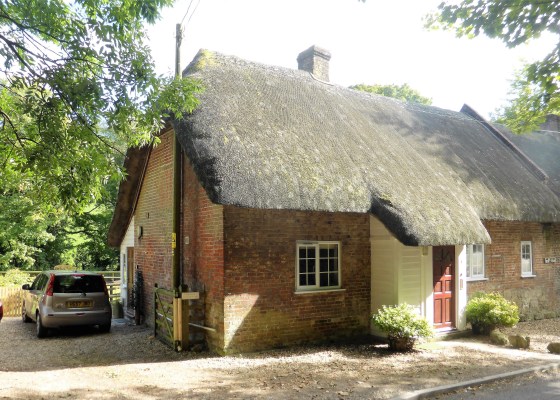
Mothers-in-law can be quite formidable it is true, but this is not necessarily a negative attribute. One of the things I respect about my mother-in-law, Olivia, is her ability to put things behind her and move on. We have recently helped move her out of her large detached five-bedroom cottage in Rodden, Dorset, to a much smaller cottage in Ebbesbourne Wake, Wiltshire … next door but one to Julia’s younger sister, Livy.

We were all rather anxious about this move … well everyone except Olivia herself as it turns out. Was it right to suggest to Olivia, in the first place, that she needed to move to be nearer one of us? How would she feel about leaving the lovely home she had lived in for 25 years? Could we have found a better alternative – hiring live in carers, for example – that would have enabled her to stay at Chipps Barton? What about all the hassle of selling the cottage, finding a new home, moving her out at her age, settling her into a new place, etc., etc.

In the end, it has all gone amazingly smoothly. The first couple to look at Chipps Barton bought it … although it took them three months to sell their own property. Miraculously, the cottage next door but one to Livy – Vine Cottage, the cottage Livy had always imagined her mother living in – suddenly became available. We could get all the work on Vine Cottage (mainly thanks to Livy’s organisational skills) done before Olivia moved in. The removal itself went well – apart from the fact that Olivia took far too much stuff with her, and we now have to ‘re-locate’ some of it – and Olivia is now very happily settled in to her new home, and she loves it.

What I have found personally both interesting and challenging, however – and evidence that a son-in-law has plenty to learn from his mother-in-law – is that whilst the rest of us were (and still are occasionally) worried that we have done the right thing in taking Olivia out of Chipps Barton, Olivia herself is not the least bit anxious. She has obviously ‘moved on’. She has never been one for ‘looking back’. She enjoyed living in Dorset but it was time to move on. There is a ‘new adventure’ ahead – a ‘new chapter’ in her life (even at 90) – and she is looking forward to it!

Thinking about my mother-in-law’s approach to life I found myself meditating on the story of Lot’s wife (Genesis 19) who suffered the fatal consequences of ‘looking back’ instead of moving forward, and the Apostle Paul’s exhortation to ‘forget the past and press on to what lies ahead’ (Philippians 3:13,14). We need to learn from the past, of course we do, but what a terrible thing it is to get stuck in the past! As an ‘old person’ myself (I shall be 75 next year) there is nothing worse in church life than old people who keep banging on about the past?  Sadly, to listen to some Christians, the last time God did anything significant in their lives was 30 years ago or more?   I am reminded of the old joke: ‘How many Baptists does it take to change a light bulb?’ ‘Change! Change! Who said anything about change!’

Society itself is not that much different, actually. The same disease of ‘backward-looking-ness’ can infect and cripple any individual, family, group, society, organisation, and so on. You don’t have to ‘be religious’ to catch this disease. If truth be told, at times, we all need a dose of what my mother-in-law has – the ability not to look back, and move on – to see life ahead as an exciting new adventure! If Olivia can do so at 90, surely we can do it whatever our age!

Jim Binney

Leave a comment

GOODBYE (MR) CHIPPS (BARTON) Dorset Tales 9

Chipps Barton

‘Has anyone seen my iPad?’ I ask. We are in the middle of packing up Chipps Barton – the family home for the last 25 years for Julia’s mother, Olivia. She is 90 years of age now and we all feel (including Olivia herself) that it is the right time for her to move from Chipps Barton, her large five-bedroom thatched cottage set in its own grounds in Rodden, to a much smaller cottage (a kind of ‘mini-Chipps’ if you like) just next door but one to Julia’s younger sister, Livy, in Ebbesbourne Wake. Olivia, Livy, Julia and myself are all here – trying to be ‘helpful’ – as the three removal men pack numerous boxes and load the big furniture van. The whole move is going to take three days what with packing, more packing, and even more packing.  

Chipps Barton has been on the market for three months and in all that time we have only had two ‘viewings’ but … the first people to view it fell in love with it and came back and made an offer (when they had sold their own property) which was accepted. At the same time, a lovely little cottage in the same village where Livy lives (and which she has had her eye on for some time), suddenly became available. Needless to say, Julia and I have been praying fervently about all this even before the possibility of Olivia moving was first mooted. We firmly believe that God has been, and is, in all this and both the sale of Chipps Barton and the acquiring of Vine Cottage have been little short of miraculous. Early on in this saga God spoke to us very powerfully and clearly one morning to assure us that Chipps Barton would be sold to ‘The right buyer, at the right price, at the right time!’ And we believe that (for numerous reasons) this promise has now been fulfilled.

Anyway, speaking of the need for miraculous intervention, my iPad has gone missing and nobody seems to have seen it anywhere? ‘Where did you last see it?’ Julia asks me. ‘In our bedroom!’ I reply. ‘Oh!’ says Livy, ‘I told the removal men to pack everything that was lying around in your bedroom … apart from the bed itself!’ I find Geoff, the removal man who packed up our bedroom. ‘No!’ he says, ‘I haven’t packed your iPad … I packed Olivia’s iPad … yours is downstairs in the living room!’ I run downstairs again and find Olivia’s iPad still on the coffee table in the living room. I run back upstairs again and find Geoff and explain that he has probably packed my iPad instead of Olivia’s and does he know which box he packed the contents of our bedroom in, and where said box is? There are scores of boxes! The removal van is already full of packed boxes! The chances of finding the right box are remote! But suddenly Geoff has a kairos moment and leads me to the very box. He opens it, searches the contents, and – miracle of miracles – finds my iPad! ‘Do you need your camera, as well?’ has asks, producing said camera from the same box!

Several hours later the furniture is all packed, and the furniture van has left for Ebbesbourne Wake. Olivia has said her ‘Goodbyes’ to Chipps Barton and she and Reggie Doggie have also left, being driven to their new home in Livy’s car. Only Julia and I are left. We are staying overnight because the removal men are coming back tomorrow to clear the garage and take all the garden tools, garden furniture, statues etc. We give the old house a good clean – Julia washes the kitchen and I hoover from top to bottom. When we have finished we go for a last walk up the lane – one of our regular and favourite walks – and reminisce.

We remember walking up this lane before my heart attack when I could scarcely get to the first gate into the first field we passed … and then after my successful heart surgery gradually increasing the length of the walk, gate by gate, until one day we actually manged to walk all the way to The Elm at Langton Herring (although we phoned Olivia for a lift back an hour or two later). Julia recalls how on that first walk (after the surgery) I took a deep breath and rejoiced at the ability to breathe deeply once again!

I recall our first Christmas at Chipps Barton with Ken and Olivia – they were younger then than I am now – when I spent the first few days before Christmas laying carpets (some of which are still there). I especially remember combining two old carpets they had brought with them from Blackladies Priory – a red carpet and a green carpet – in the large sitting room. The new carpets could not be laid before Christmas but the red and green combo somehow seemed fitting for Christmas. We reminisce about so many things, including our five years actually living at Chipps Barton when we left Beckenham and before we moved so Knaphill … so many happy memories and testimony to the kindness of family and friends, and the goodness of God.

We carry on our conversation sitting in the sunshine on the patio when we get back from our walk. We managed to ‘hide’ a bottle of wine from the removal men and Olivia and Livy, although we have to use our ‘tooth mugs’ to drink it with. There has been a short shower of rain and there is a beautiful rainbow over-arching Chipps Baprton – it is a kind of ‘benediction’ on our time spent there over 25 years plus. We are reminded of Paul’s words that ‘In everything God is working for the good of those who love him, those who seek to walk according to his purposes’ (Romans 8:28).

We wander up to The Elm for a final meal – scallops – our very favourite (well one of our many favourites) and the first meal we ever ate at The Elm 25 years ago. Eventually we go to bed. ‘Have you seen my hair brush?’ I ask Julia, ‘And my sleeping mask?’ ‘No!’ replies Julia, ‘And I can’t find my hair brush either!’ We look at each other, and burst out laughing. We both know exactly where everything is … in a box somewhere among the hundreds of other boxes at Vine Cottage!

Jim Binney      

Leave a comment

THE BUDDLEIA ARE DANCING (Notes from Knaphill 8)

IMG_4228

I am looking out of the window towards the bottom of our garden … and the buddleia are dancing! Our neighbours had the trees that back on to our garden lopped last year, and the buddleia that were already growing there took full advantage of the extra space and light and have grown up high and now stand tall and stately high above the fence – beautiful mauve and white flowers that greet me every morning now with a gentle wave when I draw the curtains.

Today, however, the buddleia are dancing! They are full of life and energy, lost in a frenetic dance, oblivious of me or anyone else who happens to be watching, deliriously happy. The weather outside is horrendous – the rain is sheeting down and the wind is blowing violently scattering the flower pots all over the place – but the buddleia are dancing!

In a strange way, I am reminded of the old Celtic Church illustration of inner peace as a bird, sitting on a broken branch, above a raging torrent, during a violent storm … singing! The ‘peace’ that Jesus spoke of when he told his disciples prior to his ascension: ‘I am leaving you with a gift – peace of mind and heart. And the peace I give is a gift the world cannot give. So, don’t be troubled or afraid’ (John 14:27); the peace the Apostle Paul spoke of when he promised the Philippian Church ‘you will experience God’s peace, which exceeds anything we can understand. His peace will guard your hearts and minds as you live in Christ Jesus’ (Philippians 4:7); is not something that is dependent upon the absence of stress and difficulty, but something that we can experience amid stress and difficulty.

David Suchet, the well-known actor, known primarily for his brilliant portrayal of Agatha Christie’s eccentric detective, Hercule Poirot, was recently asked about his philosophy of life. His response was, ‘I’m a Christian … it sees me through a great deal of my life. I very much believe in the principles of Christianity … that one must abandon oneself to a higher good. I think to accept the now and to live in the present is the most important thing for all of us to learn to do – to be able to live in the present and not let the quality of the present be coloured by the fear or anxiety of the future or the pain of the past.’

There is a fascinating story in the Old Testament (in 2 Samuel 6) where we are told that King David ‘danced ecstatically and enthusiastically with great abandon before God’ (v.14). Why did David suddenly do this? Well, many years before this time, the Ark of the Covenant had been captured from Israel by the Philistines, but now it had been recovered. The Ark was essentially a box which contained items like the Ten Commandments and some of the manna from the wilderness etc., … items from their history with God. This Ark was a symbol of the presence of God. For about 30 years under King Saul, the nation had been without the Ark as part of their national worship. But now David was King, the Ark of the Covenant had been recovered, and he wanted to bring it to Jerusalem, his new capital city which was to be the religious centre, as well as the political centre, of the nation. For the Israelites, the Ark of the Covenant symbolised the immediate presence of God with his people. This was more than just symbolism, however, because when the Ark of the Covenant was housed (during the journey to Jerusalem) for three months in the house Obed-Edom the Gittite ‘the Lord blessed him and his entire household’ (v.11). It was the sudden realisation of the fact that the Living God was with them in a tangible way – even though there were plenty of trials and testings ahead of them, as well as battles yet to be won – that caused David to throw off all his inhibitions and dance, dance, dance!

In much the same way we too, even if the ability to dance does not come naturally to us – ‘typical Dad dancing’ both my wife and daughter call my feeble attempts when occasionally on display at a party or wedding reception – can dance like the buddleia (on the inside at the very least) in the face of anything and everything life throws at us. As the Writer to the Hebrews reminds us, ‘God has said, “Never will I leave you – never will I forsake you!” so, in response, we can say with confidence, “The Lord is my helper – I will not be afraid – what can human beings do to me?”’ (Hebrews 13:5,6).

Jim Binney

Leave a comment

ONE LOT OF SINNERS OUT! ANOTHER LOT OF SINNERS IN! (General Election 2017)

78f04d7ae502b8547ebd385448a104c7

When the Rev Dr Howard Williams was the Minister of Blenheim Baptist Church, Leeds, just after the end of WWII, he caused quite a stir when, following the General Election of July 1945 in which Clement Attlee led the Labour Party to victory, he had a poster put up outside the church that read: ‘One lot of sinners out! Another lot of sinners in!’ It caused uproar in the City Council. Howard was away on holiday when the storm broke, so embarrassed Deacons of the church covered the poster with plain paper?! On his return, Howard wrote to the Yorkshire Post to explain that all he meant was that all men and women were sinners, and that the current national crisis was not just economic and political but also moral.

‘Politics’ is an interesting subject. The problem with politics is, that even at best, it can only ever be a framework that holds the building together, a skeleton that enables the body to have shape. This is very important, of course, but a framework does not make the building nor the skeleton a person. So much more is needed to make a house a home or a body a rounded human being! The key question for any politician, political party, government even, is what is it that provides the substance within the stance? What are the virtues and values that lie at the heart of that politician, that party, that government? It can never be enough to say, ‘Read the manifesto!’ We must go beyond that. Manifestos are basically, all too often, just words and words that are quickly forgotten after the election has taken place, promises there to be broken once the politician, party or government has gained power. I recently heard a former politician confess that during his years as an MP he never ever read his party’s manifesto, nor had he ever come across any other MP (in any political party) who had ever read one either?! As a Christian, the question I always want to ask professing Christian politicians is ‘What shapes you?’ Does your Christianity shape your politics? Or does your politics shape your Christianity?

‘Sin’ is also a very interesting subject. There are many different words for ‘sin’ in the Bible but the most common word means ‘to miss the mark or goal’. The thought here is of an archer missing the target with his or her arrow, or a student failing to reach the pass mark in an exam or assignment, or, as the Apostle Paul puts it, ‘falling short of the standard God sets for us’ (Romans 3:23). The Psalmist tells us that, in fact, we were ‘born in sin and conceived in iniquity’ (Psalm 51:5) and whatever else this may mean (or not mean) it does mean that we all – including politicians (and everybody else) – have a natural propensity for sin. Like the built-in bias of the bowling ball used in lawn bowls, we naturally swing away from doing good to doing bad, from going God’s way to going our own way! This is why Howard Williams was quite correct to say following the General Election in 1945, and why it will be equally true following this upcoming General Election in June 2017 (whoever triumphs): ‘One lot of sinners out! Another lot of sinners in!’

And this is why the Apostle Paul exhorts us to pray especially for our political leaders, rather than criticise them: ‘The first thing I want you to do is pray. Pray every way you know how, for everyone you know. Pray especially for rulers and their governments to rule well so we can go quietly about our business of living simply, in humble contemplation. This is the way our Saviour God wants us to live’ (1 Timothy 2:1-3). It is all too easy to criticise others, especially politicians, but it is much harder to pray for them. The phrase quoted above ‘pray every way you know how’ is actually made up four different words in Greek (the language of the New Testament) signifying ‘petition, fervent prayer, intercession, and thanksgiving’. The first three words imply a certain intensity in prayer – really praying for someone, if you like – whereas the final word implies looking for the best in someone.

I am not suggesting that we should not be ‘critical’ of our politicians. Whilst Jesus tells us not to be ‘judgmental’ of others (Matthew 7:1-3) that is not the same as ‘making astute judgments’. The Apostle actually tells us to ‘judge all things’ (1 Corinthians 2:15) and the Apostle John encourages us to ‘test the spirit of a person to see what it is that is motivating them’ (1 John 4:1). We must not be afraid to disagree with our politicians and even stand against what they themselves are advocating, although we should not ‘fight fire with fire’ nor stoop to using the same kind of inflammatory language and gutter tactics that are all too prevalent today. But – and it is a big ‘but’ – we need to even more so to look for the best in even those we strongly disagree with, and really, really pray for them. We need to pray that they will be motivated in all that they do and say and decide by those virtues and values that we see displayed in the life of Jesus Christ himself. Compassion, righteousness, practical love, peace seeking – in fact, everything that leads to a society where ‘rulers and their governments rule well so that we can all go quietly about our business … living simply, in humble contemplation of the way our Saviour God wants us to live’ (1 Timothy 2:2)!

Jim Binney

Leave a comment

OOOH! FANTASTIC! (Easter 2017)

Estate agent

We have finally persuaded my 90-year-old mother-in-law, Olivia, to sell up and move to a cottage next door but one to her youngest daughter, Livy (who is now the principal carer) in the delightful hamlet of Ebbesbourne Wake near Salisbury. We know that it will be a wrench for her but, since she has been living on her own in a large 5-bedroom detached cottage set in two acres of land, it is the sensible thing to do. Actually, she is really looking forward to it and sees it as another chapter in the adventure of life.

Julia and I (as former estate agents) have been given the task of selling Olivia’s current home and today we contacted various estate agents to come along and value the property. This proved to be great fun … especially one particular negotiator whose response to everything Julia told her about the property was, ‘Oooh! Fantastic!’ ‘It is thatched cottage in a quiet village, and part of the cottage dates back to the 17th century.’ ‘Oooh! Fantastic!’ It has five bedrooms, three reception rooms, nice kitchen, three bathrooms.’ ‘Oooh! Fantastic!’ ‘It is set in its own grounds, around 2 acres in all, gardens were designed by famous gardener, large double garage, studio, garden office, stream.’ ‘Oooh! Fantastic!’ ‘There is a paddock … suitable for keeping horses.’ ‘Oooh! Fantastic!’ Even the mention of the post code brought an equally ecstatic response … and when Julia gave her our phone number …?! At this point we wanted to say: ‘And next Sunday is Easter Sunday when we celebrate the fact that Jesus rose from the dead and is alive for evermore!’ We felt quite sure that her response would have been … ‘Oooh! Fantastic!’

‘Oooh! Fantastic!’ was not quite what the 120 or so disciples gathered together in that large Upper Room in Jerusalem said, when the news finally began to filter through to them that Jesus had risen from the dead and revealed himself to Simon Peter and a few others, but it was not that far off!? Luke tells us that their response to Cleopas, when Cleopas and his companion, shared the good news with them was ‘The Lord is risen indeed!’ (Luke 24:34) or as one translation puts it, ‘It’s really happened! The Master has been raised!’

This is the source of an ancient traditional Easter greeting in many branches of the Western Church where the Service begins with the exclamation, ‘He is risen!’ which in turn elicits the traditional response, ‘He is risen, indeed! Alleluia!’ These words are sometimes accompanied by the exchange of three kisses on alternate cheeks, depending on the church. In the Orthodox and Roman Catholic churches, the greeting is called the ‘Paschal Greeting’. We Baptist-Christians haven’t quite got to that stage yet although we have moved on from the ‘formal handshake’ to the ‘holy hug’ these days.

Exactly how the saying became a standard greeting in the church is not known, although there are various theories regarding how it came into common usage. We do know that, at first, the greeting was more common in Eastern and Byzantine liturgies than in the Western church. There is a tradition in the Eastern Orthodox Church that the saying was made popular by Mary Magdalene when she supposedly addressed Emperor Tiberius in Rome with the words ‘Christ is risen!’ Using this address should be more than an empty tradition, however. The words, ‘He is risen!’ remind us of the joyous news we celebrate at Easter – that Jesus’ death was not in vain, and that he has the power to overcome death. Saying ‘He is risen!’ allows us to share this incredible truth with each other and all and sundry for that matter. The resurrection of Christ reminds us that death is not the end – simply a ‘doorway’ into life beyond the grave. It also gives us hope for salvation, expectation of resurrection from the dead, and the gift of abundant and eternal life – life that begins the moment we ‘believe’ by the way, not just something to be received only when we die!

But did Jesus rise from the dead? Can we be sure? What is the ‘proof’?

There are many ways to answer this question but in this ‘blog’ I want to approach it from the angle of those many people who (as yet) do not believe, and who probably would rarely if ever darken the door of a church (unless it was for a ‘christening’ or a wedding or a funeral), or read the Bible, or even get into a meaningful conversation about spiritual things with a professing Christian. After all the ‘Easter Message’ is not primarily to make Christians feel happy but to enable unbelievers to believe (John 20:31). As Donald G Barnhouse puts it: ‘The angel rolled away the stone from Jesus’ tomb, not to let the living Lord out but, to let unconvinced outsiders in!’

It is impossible in a short ‘blog’ like this one to do justice to all that could be said about the resurrection of Jesus Christ, but with the ‘unconvinced’ in mind (whether they be unconvinced unbelievers or unconvinced believers for that matter) I want to suggest five ‘evidences’ for the resurrection of Jesus from the dead!

The Empty Tomb: I have been to Israel several times and visited all the alleged historical sites of the tomb of Jesus including the Holy Sepulchre (a dreadful place) and the Garden Tomb (a much more realistic spiritual place). I can assure you that every tomb was empty. In fact, there is a notice on the inside of the door of the Garden Tomb that reads: ‘He is not here for He is risen!’ Of course we cannot be sure that any of these sites is the correct one, but what we can be sure of is that the historical Jesus was crucified and was buried because the scribes and the Pharisees (Jesus’ political and religious enemies) were apoplectic at reports of the heavy stone, effectively acting as an immovable door, over Jesus’ heavily guarded tomb having been rolled away and the tomb being empty … coupled with numerous reports of the risen Jesus appearing to people in and around Jerusalem. In an attempt to ‘undermine’ the truth we are told that they hatched ‘a cunning plan’ to dissemble this remarkable event by putting out ‘fake news’ that Jesus had not really risen from the dead but that his disciples had stolen the body in the night (Matthew 28:11-15). My point is … why go to such trouble if Jesus had not actually risen from the dead?!

The Testimony of the Eyewitnesses: Even those who do not accept the Bible as the ‘inspired word of God’ (2 Timothy 3:16) accept it as having value as a ‘historical record’ of the times. As such the New Testament gives various accounts of those who met with Jesus following his resurrection – Mary Magdalene (Mark 16:9), Jesus’ remaining eleven disciples (Mark 16:14), Cleopas and his companion (Luke 23:13-35), doubting Thomas (John 20:24-31), several women (Matthew 28:8), even 500 or so disciples at one time (1 Corinthians 15:6), and so on. A pretty impressive list! Surely, they cannot all have been deluded?

Transformation of the Early Church: Following the crucifixion of Jesus, and prior to his resurrection, those first Christians were hiding away in the Upper Room scared to death that they were next on the Jewish/Roman ‘hit list’ for execution (John 20:19). And yet, just a short time late, we find them out on the streets of Jerusalem boldly proclaiming the Gospel to all who would listen to them (Acts 2:1-12)! What was it that had made such a big difference to them? What was it that had transformed them from a bunch of fearful wimps into a bold army of Christian soldiers? There can only be one explanation! They too (as we know from the Biblical record) had met with the Risen Christ and been filled with his Spirit!

The Impact of the Christian Church World-Wide:  With more than two billion adherents worldwide, Christianity is both the world’s largest and, in some regions, its fastest growing religion, with much of that growth taking place in the developing world. For the historian Robert Palmer, ‘It is impossible to exaggerate the importance of the coming of Christianity. It brought with it, for one thing, an altogether new sense of human life. For the Greeks had shown man his mind; but the Christians showed him his soul. They taught that in the sight of God, all souls were equal, that every human life was sacrosanct and inviolate. Where the Greeks had identified the beautiful and the good, had thought ugliness to be bad, had shrunk from disease and imperfection and from everything misshapen, horrible, and repulsive, the Christian sought out the diseased, the crippled, the mutilated, to give them help. Love, for the ancient Greek, was never quite distinguished from Venus. For the Christians held that God was love, it took on deep overtones of sacrifice and compassion.’ In fact, the history of Christianity is inseparable from the history of our Western culture and society. For over 2,000 years, Christian beliefs, principles, and ideals have coloured our thoughts and feelings. Christian traditions and practices have left an indelible mark not only on developments of purely religious interest, but on virtually everything good within society. Education and medicine, art and literature, science and law, politics and economics … even our approach to love and the conduct of war. Indeed, the indirect and unconscious influence that Christianity has often exercised even in secular matters – social, intellectual, and institutional – affords striking proof of the dynamic forces that have been generated by the Christian Faith over two millennia. Even those who have contested its claims and rejected its tenets have been affected by what they opposed. Whatever our beliefs, all of us today are inevitable heirs to this abundant legacy … and it is impossible to understand the cultural heritage that sustains and conditions our lives without considering the contribution of Christianity. And none of this would have happened unless Jesus rose from the dead!

Personal Experience of Receiving Jesus Christ as Saviour and Lord: In the penultimate chapter of his First Letter to the Corinthians, the Apostle Paul concludes a marvellous section, in which he lists Jesus numerous resurrection appearances to various people (1 Corinthians 15:3-7), by claiming to have also met with the Risen Christ – ‘And last of all (Jesus) appeared to me also, as to one born beyond due time’ (v.8). Paul is referring here to his conversion on Damascus Road (Acts 9) when he had a personal encounter with the Risen and Ascended Lord Jesus Christ. It was this experience which completely convinced the then virulently anti-Christian Pharisee Saul of Tarsus that he was totally in the wrong. Jesus had risen from the dead! He was who he had always claimed to be – the Son of God and Promised Saviour! It was this experience that transformed his life and turned him into Paul the (soon to be) Apostle and missionary-evangelist!

What is particularly wonderful about this statement of Paul’s is that it makes it abundantly clear that anyone and everyone, right down through time, can also come to know Jesus Christ for themselves as Saviour and Lord. Paul’s experience of Christ can be our experience. When Paul speaks of himself as having had a personal encounter with Jesus Christ as ‘one born beyond due time’ (v.8) he is referring to the fact that his conversion experience occurred some two to five years after Christ’s death, resurrection and ascension. Whilst it is possible that Paul heard Jesus teach during Jesus’ earthly ministry it is not definite, and in any case if he had heard Jesus teach it certainly had no positive impact on him at the time. It was only when he had his ‘Damascus Road experience’ of encounter with the Risen and Ascended Christ, some years later, that Paul’s life was changed significantly for the better.

My own personal experience of receiving Jesus Christ as Saviour and Lord some 57 years ago, though not perhaps as dramatic, was not too dissimilar from that of Paul and of every other true Christian. At some point in our experience God in Christ breaks into our lives and becomes ‘real’ to us. This is the testimony of millions of people down through the last two millennia and across the world today! And as such it is the full and final proof that Jesus Christ has indeed risen from the dead and is alive today!

Karl Heim (1874-1958), the German theologian, tells of a large meeting of the Russian proletariat following the revolution where various people addressed the vast crowd propounding various secular, socialist and atheistic views. Eventually the chairman asked if there was anyone else who wished to say something, and an elderly, somewhat undernourished, Russian Orthodox Priest mounted the platform. ‘You won’t speak for long will you?’ said the chairman cynically. ‘No!’ replied the Priest, and turning to the vast crowd called out in a loud voice, ‘Christ is risen!’ … and immediately, from the voices of thousands, the crowd spontaneously responded, ‘Christ is risen indeed!’ For all their outward secularism they all all knew the truth deep down in their hearts!

My friends, Christ is risen! If this is not true then all those who profess to be Christians are totally deceived, living a lie, and wasting our lives away seeking to follow a dead Saviour and false teaching! But if Jesus did rise from the dead …?

I serve a risen Saviour,
he’s in the world today;
I know that he is living,
whatever others say;
I see his hand of mercy,
I hear his voice of cheer,
and just the time I need him
he’s always near.

He lives, he lives,
Christ Jesus lives today!
He walks with me and talks with me
along life’s narrow way.
He lives, he lives, salvation to impart!
You ask me how I know he lives?
He lives within my heart.

In all the world around me
I see his loving care,
and though my heart grows weary,
I never will despair;
I know that he is leading
through all the stormy blast,
the day of his appearing
will come at last.

Rejoice, rejoice, O Christian,
lift up your voice and sing
eternal hallelujahs
to Jesus Christ the King!
The hope of all who seek him,
the help of all who find,
no other is so loving,
so good and kind.

~ A H Ackley (1887-1960)

Jim Binney      

Leave a comment

ANCHOR’S AWAY? (Notes from Knaphill 7)

Anchor's Away - Copy

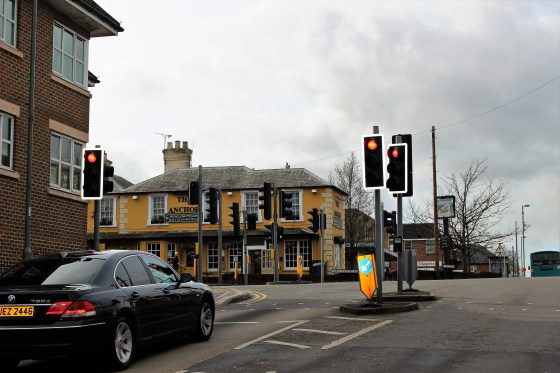
You know that you are in the centre of Knaphill Village when you arrive at the mustard coloured pub by the traffic lights on the corner of Lower Guildford Road and the High Street. Built in the 1700s as a hotel, The Anchor was one of the first buildings to be built when Knaphill grew rapidly due to the development of Brookwood Hospital. It was converted to a pub in the 1930s. According to local historians the land around where the pub stands today was possibly the site of the Knaphill annual fair, which was held every November for a period of around 200 years until the 1870s. As the only ‘hotel’ in the village it would probably also have been popular with commercial travellers selling their wares to the local shops, as well as general visitors to the area. As such, therefore The Anchor has a very important place in the history and heritage of Knaphill Village.

The future of The Anchor remains in doubt however if developers’ plans to turn the site into a mixture of residential and retail units are given the ‘go ahead’ by Woking Borough Council. Original proposals were thought to include 10 residential units with ground floor retail outlets to include ‘some sort of food and beverage outlet’ such as ‘a wine or tapas bar’ or even ‘a Costa Coffee’ shop? Despite considerable local opposition to such a development Woking Borough Council appeared to be giving the proposals serious consideration until CAMRA (Campaign for Real Ale) succeeded in having The Anchor made ‘an Asset of Community Value’ in August 2016. In effect this meant that The Anchor could not be developed for at least five years. This ruling was successfully challenged (on a technicality) by the developers towards the end of 2016 which in turn led to a real fear that the pub would not simply be re-designed but demolished and replaced with a mix of residential and retail outlets, plus parking and social housing.

At the beginning of 2017, however, CAMRA (having ‘ironed out’ the ‘technicality’) re-applied for The Anchor to be made ‘an Asset of Community Value’ and it appears that this application will be successful. So where does this leave the future of The Anchor? Most Knaphill residents agree that for it to continue to function as a pub (in its present format) is simply not viable, given that there are several other more successful pubs in Knaphill. What is for sure is that the brewery themselves appear to see no future for The Anchor as a pub. It would seem (given the probable award of a fresh ACV status) that the developers have shelved their plans. But even as a pub selling different brands of ‘real ale’ it is doubtful that The Anchor has a long-term future as a pub. The ‘worst case scenario’ could be that the building will eventually simply be boarded up and left to stand empty and allowed to decay and eventually be demolished. It would not be the first building in the area to suffer such a fate. But is Knaphill’s oldest pub doomed … or has it got an exciting new future?

It is an ‘open secret’ that Knaphill Baptist Church are behind a plan to purchase The Anchor and develop it into a Community Hub along similar lines to the very successful Lighthouse Project (www.lighthousewoking.org), run by Woking Vineyard Church, in the centre of Woking. Based in a renovated, formerly derelict shop, in the High Street near the railway station, the Lighthouse Project houses a variety of community initiatives staffed by a collective of volunteers seeking to transform the community around them including a foodbank, a social enterprise cafe, a job club, addiction recovery support, good quality second-hand children’s clothing and equipment, debt advice, cooking training, creative workshops, support for out-of-work women (including interview training, coaching and job-searching), youth work, live music, bread making, spiritual support, community meals, and much more. Most important of all The Lighthouse provides a place of authentic welcome – where people experience dignity, acceptance, restoration, and hope.

The vision Knaphill Baptist Church has would be to possibly purchase The Anchor outright, but are also open to working in partnership with others – Woking Borough Council, the brewery, other local church groups, or any other interested parties. We see such a use for the pub – to be renamed The Anchor Centre – as the best option for a renewed use of the building. It would both enable an important historic building to be retained and is an ideal way to stimulate the regeneration of Knaphill Village. The scheme would echo The Lighthouse’s aim of ‘transforming lives through kindness, belief and hope’ in many ways, but would differ according to perceived community needs. What is envisaged are alternative initiatives that would both fill current gaps but also help create a market and stimulate business activity in ways that would attract people to shop in Knaphill. As such, The Anchor Centre would complement, rather than oppose or undermine, the role of the existing Vyne Community Centre.

Ideas that have been suggested (in addition to those mentioned above) include: a Wellbeing Centre, a Paleo (Gluten Free) Café, a Happy Café (providing ‘social space’ for the clients of the nearby mental health care hospitals), an ethical Fairtrade clothing outlet, children and family centre, and short-term social housing accommodation. A revamped Anchor Centre could also be used to house music events, story-telling, a meeting venue, and a weekly ‘farmers’ market’, etc. Ideally the Church would like to work with the local community – other local churches, faith groups, community groups, local businesses, charities, etc – in seeing this project come to fruition, possibly expanding to incorporate some of the vacant shops nearby. The idea would be (wherever possible) to partner with existing shops, rather than replace them, and encourage new business ventures in Knaphill Village. Thus far, there has been enthusiastic support from the Knaphill Residents’ Association and our Local Councillors, and it is hoped that a meeting with the Chief Executive of the Woking Borough Council to discuss the possibilities will take place soon.

When Julia and I came to Knaphill 18 months ago we began, as a church, to ask ourselves two questions: ‘What kind of God?’ and ‘So what?’ What kind of God do we believe in, and how does this affect the way we live and behave? This gradually transmogrified during the year into another couple of questions: ‘What kind of church?’ and ‘So what?’ Our growing conviction, as a church, is that God we worship is primarily a God of love, who has a heart for the people of Knaphill and who wants to bless our community and renew it holistically, and that the ‘Gospel’ we proclaim is ‘good news that brings great joy for all people’ (Luke 2:10). Consequently, we need to change the way we ‘do church’ and be ‘salt and light’ (Matthew 5:13-16), and particularly ‘yeast’ (Matthew 13:33) making a real difference in our community by enabling it to ‘rise’ just as the addition of yeast to flour causes dough to rise.

We believe that God wants to ‘regenerate’ Knaphill Village, physically, mentally, socially, emotionally and spiritually, and that we need to be at the heart of this. The word ‘regenerate’ is an interesting word which literally means ‘to bring new life to that which is either dead or dying’. We see the establishing of a ‘Community Hub’, along the lines of that described above, right at the heart of our village, as being a significant first step in this direction. Our hope is that such a venture will receive the support of business people, politicians, residents … in fact, anyone who has a heart for Knaphill.

Surely anything is better than Knaphill Village being slowly but surely eroded – local shops disappearing and replaced by blocks of flats – and the former Anchor Pub becoming simply just another set of traffic lights on the way into Woking?

Jim Binney

Leave a comment

THE LEAST OF THESE?

least_of_these

What a year 2016 was! How was it for you? 2016 is over but the repercussions of the decisions that were made last year will be felt in this coming year, and in the years to come. There are possible seismic changes ahead. The world is in transition. There are question marks over our whole way of life. The ‘turbo capitalism’ of free trade, the so-called benefits of globalisation, together with the incipient security problems and terrorist threats have all lead to democratic instability where the very future of liberal western democracy itself hangs in the balance.

In a recent newspaper article Pankaj Mishra announced, ‘Welcome to the Age of Anger’. He suggests that we are now seeing ‘a tremendous increase in mutual hatred and a somewhat universal irritability of everybody against everybody else.’ This, according to Pankaj Mishra, is caused by, and leads to, ‘an intense mix of envy, humiliation and powerlessness’. The French have a word for it, ressentiment, which is considerably stronger than our word ‘resentment’ and implies a real sense of ‘hostility’.

This last year has seen a response from those described as ‘history’s forgotten, humiliated and silenced people’, also referred to as the ‘left behinds’ – those who have not reaped the expected and anticipated widespread prosperity that was the promise of globalisation. Pankaj Mishra also suggests that ‘to chart a path through the Age of Anger, or even just to get our bearings, we need, above all, a greater precision in matters of the soul’. But where is the soul of our society? Despite all our technological achievement, access to information and ability, society knows precious little about ‘matters of the soul.’

This is where we have the link between political, economic and sociological matters, and God’s people who make up the Church of Jesus Christ. We, who ‘name the Name of Christ’ are the ones who can safely, seriously and successfully navigate the murky waters of the human soul. We are the ones who are in touch with our Maker, the ones who know the God of love, justice, mercy, peace and rightness. Who know that Jesus Christ is indeed ‘the Way, the Truth and the Life’ (John 14:6) just as himself claimed to be. In Jesus Christ, we are the purveyors of truth and reality and hope. This is because we know the One who is, at one and the same time, fully and truly human, the God-man Jesus Christ, the One who shows us what it really means to be a human being, and what it is to be a human being in relationship with God and with others in families, communities, societies and among nations. Therefore, we are the ones who must speak out, must engage, must act. How else are people, in our society, going to be enabled to handle all that is coming?

God want us all, and particularly those of us who claim to be Christians, to live in a way that has authenticity and integrity as his people, with the responsibilities and accountability that that entails? So, we need to see the world from God’s perspective, to have his values and priorities, building our lives on the sure and certain foundation of Jesus Christ.

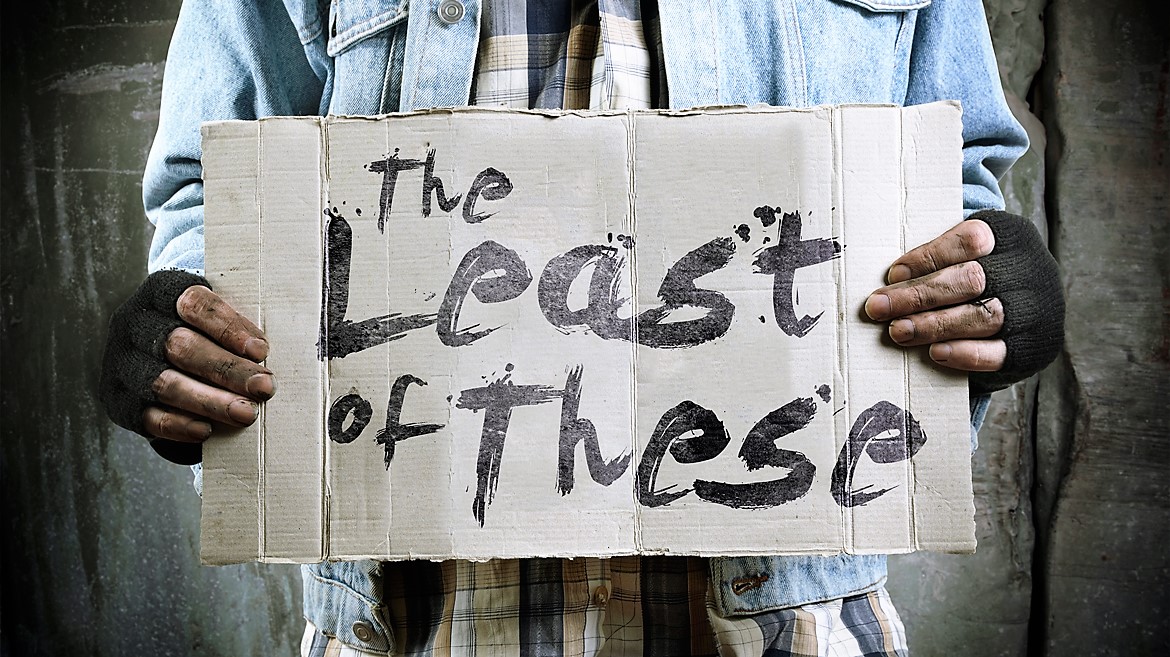
There is a passage of Scripture in the New Testament, known as The Parable of the Sheep and the Goats (Matthew 25:31-46), where Jesus clearly outlines what God considers to be of eternal value. In this most challenging of passages, Jesus tells us to ‘feed the hungry, give drink to the thirsty, welcome the stranger, clothe and provide for the poor, engage with people in need, in hospital, prison, or anywhere’. We are to help alleviate poverty and suffering in whatever form it is found. Jesus, the One who is the King of Kingdom, shows us that this is how we serve him. He says to us here, ‘I tell you the truth, whatever you did for one of the least of these, you did for me’ (Matthew 25:40). The Message translates this verse as, ‘I’m telling you the truth: whenever you did these things to someone overlooked or ignored that was me – you did it to me’. Jesus turns everything on its head. If you will pardon the mixed metaphor, what we see here is that the King, the top of tree, is saying, you will find me at the bottom of the ladder! That is where I am – at the opposite end to worldly supremacy and domination!

And this is our ministry, our calling, as Christians – to care for the least and lowest, the victims of the system, those our ‘turbo capitalism’ has ‘left behind’ and left humiliated, powerless and silenced. Included in this are the elderly, the weak, the infirm, the mentally and physically sick, those who just can’t cope, those in debt, the addict, the homeless, the helpless, the hopeless, the marginalised, the ignored, and so on.

Here at Knaphill Baptist Church we start 2017 with a new ‘strapline’ – agreed unanimously at one of our recent well-attended church meetings after much thought and prayer – in which we express our strong desire to be, individually and corporately, ‘Caring Christians at the Heart of the Community’. Of course, agreeing the new strapline was the easy part – putting it into practice is going to be the hard part!

This is where Jesus’s exhortation and encouragement here in Matthew 25:40 is helpful.  We do all this – ‘feeding the hungry, giving drink to the thirsty, welcoming the stranger, providing for the poor, engaging with people in need, in hospital, prison, or anywhere’ as if are doing it directly for Jesus himself. Mother Theresa, who was canonised in 2016, lived among the poorest of the poor in Calcutta, India, to care for them because, as she said, ‘Each one of them is Jesus in disguise!’

The only way to overcome the ‘Age of Anger’ is with the power of love – God’s love, the love we find in Jesus Christ, ‘poured into our hearts by the Holy Spirit’ (Romans 5:5), serving the Lord from a heart of genuine compassion that is born in us by him. The Greek of Romans 5:5 is indicative of God’s love being poured into our hearts, much as someone might pour wine into a goblet or vessel of some kind, but whereas the pourer might stop pouring when the vessel is full, in this case the pourer deliberately keeps on pouring so that the vessel overflows!? A friend of our suggested that ‘the fullness is for us, but the overflow is for others’!

So here is the key question: In 2017 will we deliberately and intentionally go in the opposite direction to a society of ‘mutual hatred and universal irritability’ and seek to love God and others by choosing to see Christ in the least and lowest? Deliberately choosing to serve ‘the least of these’ whoever they may be, and wherever we may find them?

Will you come and follow me
if I but call your name?
Will you go where you don’t know
and never be the same?
Will you let my love be shown,
will you let my name be known,
will you let my life be grown
in you and you in me?

Will you leave yourself behind
if I but call your name?
Will you care for cruel and kind
and never be the same?
Will you risk the hostile stare
should your life attract or scare?
Will you let me answer prayer
in you and you in me?

Will you let the blinded see
if I but call your name?
Will you set the prisoners free
and never be the same?
Will you kiss the leper clean
and do such as this unseen,
and admit to what I mean
in you and you in me?

Will you love the ‘you’ you hide
if I but call your name?
Will you quell the fear inside
and never be the same?
Will you use the faith you’ve found
to reshape the world around
through my sight and touch and sound
in you and you in me?

Lord, your summons echoes true
when you but call my name.
Let me turn and follow you
and never be the same.
In your company I’ll go
where your love and footsteps show.
Thus I’ll move and live and grow
in you and you in me.

~ John Bell (1949-)

Julia Binney

Leave a comment

‘OLOGIES AND ‘ISMS

beattiebook1989

What’s your favourite TV ad of all time? Mine has got to be the British Telecom ‘Beattie Ads’ launched around December 1987 starring the wonderful Maureen Lipman (and a red BT Tribune phone) as Mrs Beattie Bellman, a Jewish granny. Having just been told by her grandson Anthony that he’s flunked his exams, passing only pottery and sociology, Beattie says: ‘He gets an ology and he says he’s failed … you got an ology … you’re a scientist!’ As a result, a star is born and Beattie takes the British nation by storm. Maureen Lipman goes on to star in 32 TV commercials and contributes the word ‘ology’ to the English language.

The dictionary defines an ‘ology’ as ‘a subject of study; a branch of knowledge’, as against an ‘ism’, which the dictionary defines as ‘a distinctive practice, system, or philosophy, typically a religious or political ideology or an artistic movement’. We have become very familiar (albeit subliminally) with both ‘ologies and ‘isms today … they are everywhere. From ‘biology’ (the study of physical life) to ‘melissopalynology’ (the study of honey) to ‘scelerology’ (the study of the outer coat of the eye ball), there are more ‘ologies in the English language than you ever thought possible. And much the same can be said of ‘isms. ‘Relativism’, for example, is the idea that everything is relative, while ‘socialism’, ‘communism’, and ‘capitalism’ all refer to different theories of government.

But are ‘ologies and ‘isms of any actual real value? Are they ‘helpful’ to us … or a ‘hindrance’? Do they ‘free us up’ … or do they ‘chain us down’? In Serri’s allegorical science fiction novel The Restoration – a story about a world subjugated by a powerful empire and how the people of that world fight to take it back – one of the characters, Magdalena, poses the question: “‘Isms’ and ‘ologies’ …  haven’t we enough of them?’” Good question! Researching this subject, I came across a book that I just had to buy: Ologies and Isms: A Dictionary of Word Beginnings and Endings (Oxford Paperback Reference) by Michael Quinion. Second hand (from Amazon) it cost me the exorbitant amount of £0.01p (but then it was the latest revised edition) … the postage (£2.80) cost more than the book itself?! Perhaps this says more about our opinion today on ‘ologies and ‘isms than anything else?  But is this right?

I would suggest that, as a rough ‘rule of thumb’, ‘ologies’ are good but ‘isms’ are to be avoided at all costs! ‘Ology’ is a suffix derived from a Greek root indicating ‘words’ or ‘speech’ or ‘reason’ etc. It implies ‘knowledge of’ and refers to the ‘study of’ or the ‘science of’ a subject. Thus, any genuine ‘ology’ should increase our knowledge and understanding and help us to be more ‘formed’ or ‘rounded’ people. ‘Isms’, on the other hand, refer to a particular set of distinctive doctrines or dogmatic beliefs, conditions or characteristics, system or practice. By its very nature an ‘ism,’ kills its subject ‘by hugging it to death!’

For me ‘theology’ is ‘the queen of sciences’. It is that branch of knowledge that underpins all other branches of knowledge. At its simplest ‘theology’ means ‘the study of God’ or ‘the word of God’ (from two Greek words: theos (God) and logos (word).  It has become ‘popular’ in some evangelical circles to deride the importance of ‘theology’. ‘Theology is perceived to be too ‘highbrow’, ‘intellectual’, ‘academic’ and the enemy of a simple, biblical faith. I recall one Baptist Minister I knew, who joked about ‘the church being slowly emptied by degrees’ (by which he meant Ministers with university degrees)?! Strangely enough, when he finally got a degree in theology himself he stopped saying this?! But ‘theology’ is simply ‘the study of God’ and, as that very wise man Solomon tells us: ‘Instruct a wise person and they will become even wiser, teach a righteous person and they will increase in learning. To be in awe of the Lord is the beginning of wisdom, and the knowledge of the Holy One brings understanding’ (Proverbs 9:9,10). To include ‘God’ in the equation (whatever the subject may be) is therefore eminently sensible if we wish to gain any understanding. An ‘ology’ therefore creates freedom. As Jesus once said ‘you will know the truth and the truth sets you free’ (John 8:32).

‘Isms, however, have the completely opposite effect! Unless we are very careful indeed they tend to ‘tie us up in knots’ or ‘hug us to death’ because essentially, they are full of dogma that wants to ‘throttle the life out of us’. My advice is to avoid anything that has an ‘ism’ in it like the plague. Take ‘Calvinism’ for example. Calvinism is a major branch of Protestantism which follows the theological system developed by the followers of John Calvin (the 16th century French Reformer) marked by a strong emphasis on the sovereignty of God, the depravity of humankind, and the doctrine of predestination. Personally, I am much indebted to ‘Reformed Faith’, still subscribe to its more basic tenets, and find its thoughtful, biblical, reasoned approach to understanding the Christian Faith much more satisfying that much of the ‘lightweight’ theological thinking found elsewhere. Having said that, I am only too aware that it is very easy to adopt ‘Calvinism’ as just a ‘system of belief’ rather than something that inspires a living faith and a compassionate declaration of the Gospel message!? Sadly, I know too many Calvinists who, whilst outwardly sharing my indebtedness to Reformed Faith, come across as more interested in getting across to others the ‘five points of Calvinism’ rather than the ‘good news of the Gospel of Jesus Christ’. Their version of ‘Calvinism’ appears to have ‘hugged them to death’ spiritually speaking.

It was because he saw this danger that the most influential exponent of Reformed Faith during the 20th century, Dr Martyn Lloyd-Jones, was always careful to describe himself as a ‘Bible Calvinist’ rather than a ‘system Calvinist’. Moreover, ‘system Calvinism’ ties us in to, what in effect is, a closed set of dogmas that – rather than seeing the Reformation period as one of those vital ‘epochs’ that helps shape the Church for the future – prevents us from questioning its precepts or exploring its possible developments. For example: ‘Was John Calvin actually a Calvinist or were the essential points of Calvinism a creation of his followers?’ or, ‘Are the teachings of Karl Barth (the 20th century Swiss Reformed theologian) a natural development of Calvinism?’ Thus, those of us tempted to adopt ‘system Calvinism’ need to constantly bear in mind the parting exhortation of John Robinson to the Pilgrim Fathers (as they were about to set sail for America aboard the Mayflower) in 1620: ‘I am verily persuaded that the Lord hath more truth yet to break forth out of His Holy Word. For my part, I cannot sufficiently bewail the condition of those reformed churches which … will go, at present, no further than the instruments of their reformation. The Lutherans cannot be drawn to go beyond what Luther saw; whatever part of His will our God had revealed to Calvin, they will rather die than embrace it; and the Calvinists, you see, stick fast where they were left by that great man of God, who yet saw not all things. This is a misery much to be lamented …’  

What I say here of ‘Calvinism’ however, could equally be said of many other ‘isms’ found in Christian circles – everything from denominationalism such as Roman Catholicism and Episcopalianism, etc., through various movements such as Pentecostalism and Restorationism, to differing views pertaining to the Second Coming of Christ such as Post-, Pre- and A-Millenialism. And what is true of the Christian religion is equally true of other world religions such as Hinduism and Buddhism, etc., and political movements such as Capitalism, Socialism, and Communism, and so on, and a host of other philosophical approaches to life. The point that I am trying to make is that as soon as something simply becomes a ‘system’ for us, instead of a living reality it inevitably ends up crushing us and damaging those around us instead of being an energising and life-giving force. This is especially true for us professing Christians when we replace a living personal relationship with Jesus Christ with, what in effect, is just a ‘religious system’?! Left to our own devices the ‘old selfish, sinful nature’ will automatically rise to the fore, and corporately we will naturally degenerate to some form of ‘institutionalism’ approach rather than following the ‘relational model’.

Of course, naturally speaking, it is much easier to follow some kind of ‘system’ that has already been put in place rather than ‘think for ourselves’. I am constantly amazed at the number of highly educated, capable people I come across, who hold down high powered jobs that require constant thought and application, who, when it comes to matters of faith or religion, seem to leave their brains at the door and submit themselves to dogma and leadership requirements that in normal circumstances they would dismiss out of hand! This is why I would suggest that, as a rough ‘rule of thumb’, ‘ologies’ are good but ‘isms’ are to be avoided at all costs, and why the words of George Rawson (the 19th century Congregationalist hymn writer), based on John Robinson’s sermon, remain worth pondering today:

We limit not the truth of God
to our poor reach of mind,
to notions of our day and place,
crude, partial, and confined:
No, let a new and better hope
within our hearts be stirred:
O God, grant yet more light and truth
to break forth from your Word.

Who dares to bind to one’s own sense
the oracles of heaven,
for all the nations, tongues, and climes
and all the ages given?
That universe, how much unknown!
that ocean unexplored!
O God, grant yet more light and truth
to break forth from your Word.

Eternal God, incarnate Word,
Spirit of flame and dove: enlarge, expand all living souls
to comprehend your love;
And help us all to seek your will
with wiser powers conferred:
O God, grant yet more light and truth
to break forth from your Word.

~ George Rawson (1807-1889)

Jim Binney

Leave a comment

GOD NEVER HURRIES (New Year 2017)

hourglass-clock-copy

A young lady poked her head round the door of my office at the church and asked if she could have a word with me. I had never met her before – she came along to our Parents and Toddlers Group, and she wasn’t a ‘regular church goer’ she informed me – but she wanted to talk. It was a really good ‘Parents and Toddlers Group’ that group. About 120 parents – mostly ‘mums’ came along to it – fortunately not all at once (apart from the Christmas Party) or we would never have coped. It was run by members of the church on a ‘soft-sell’ Christian basis who, when they discovered that quite a few of the women who came along didn’t know how to prepare or cook healthy meals, or sow or knit or mend, etc., put on special classes for those who wanted to learn during the time the Group met. I was usually down at the church on those mornings and operated an ‘open door policy’ that meant that if my office door was open anyone could pop in for a chat if they wanted.

Anyway … back to my lady visitor … seemingly she was finding life very difficult to cope with and wanted to ‘talk to the Minister’ about her problem. I listened to her story and – cutting a long story short – suggested that she try and live one day at a time instead of feeling guilty about not having done things correctly in the past or worrying about what further troubles tomorrow might bring her way? She seemed to find this advice helpful and went away to try and put what I had suggested into practice. We just talked together at this time – I didn’t do anything ostensibly ‘religious’ or refer to the Bible or pray with her? She came to see me again about three weeks later. She looked very different – more relaxed, much calmer. ‘This taking life just one day at a time is brilliant’ she told me, ‘it took a bit of getting into but I am now finding it so much easier to cope with everything – the children, my husband, life in general!’ And then she went on to say to me: ‘Your advice was ‘spot on’ … you are a very wise man!’ At that point in the conversation I confessed that the concept of ‘taking life one day at a time’ was not original to me but was something Jesus taught us – and then I read her the words of Jesus from the Sermon on the Mount: ‘Do not worry about your life, what you will eat or drink; or about your body, what you will wear. Is not life more than food, and the body more than clothes? Look at the birds of the air; they do not sow or reap or store away in barns, and yet your heavenly Father feeds them. Are you not much more valuable than they? Can any one of you by worrying add a single hour to your life? And why do you worry about clothes? See how the flowers of the field grow. They do not labour or spin. Yet I tell you that not even Solomon in all his splendour was dressed like one of these. If that is how God clothes the grass of the field, which is here today and tomorrow is thrown into the fire, will he not much more clothe you – you of little faith? So, do not worry, saying, “What shall we eat?” or “What shall we drink?” or “What shall we wear?” For the pagans run after all these things, and your heavenly Father knows that you need them. But seek first his kingdom and his righteousness, and all these things will be given to you as well. Therefore, do not worry about tomorrow, for tomorrow will worry about itself. Each day has enough trouble of its own’ (Matthew 6:25-34).

I was reminded of this story, and the principle Jesus advocated here in this passage from the Sermon on the Mount, just the other day when I was reading something by one of my favourite devotional writers, A W Tozer. It has been said that prayer was of vital personal importance for Tozer. His biographer, James Snyder, suggests that Tozer’s ‘preaching as well as his writings, were but extensions of his prayer life’. Moreover, Tozer has ‘the ability to make his listeners face themselves in the light of what God was saying to them’. This is one reason why I like reading Tozer – he was someone blessed with that rare gift of ‘spiritual common sense’, a God-given wisdom that you don’t find much of today, something that is learned from being found regularly in the Presence of God, not from books.

Aiden Wilson Tozer (1897-1963) was an American Christian pastor, preacher, author, magazine editor, and spiritual mentor who hailed from a tiny farming community in Pennsylvania. He became a Christian as a teenager after hearing a street preacher say, ‘If you don’t know how to be saved … just call on God, saying, “Lord, be merciful to me a sinner!”’ Returning home, he climbed into his attic room and did just what the street preacher had suggested! Five years after his conversion (and without formal theological training) Tozer accepted a call to pastor his first church, and thus begun 44 years of ministry, with the Christian and Missionary Alliance, a Protestant Evangelical denomination, 33 years served as a pastor in several churches in both the USA and Canada. Born into poverty, Tozer was self-educated (due to his home situation) and he taught himself what he missed in high school and college, going on to receive two honorary doctoral degrees. Among more than 60 books that bear his name at least two are regarded as Christian classics: The Pursuit of God and The Knowledge of the Holy. Many of his books impress on the reader the possibility and necessity for a deeper relationship with God. Tozer had seven children (six boys and one girl). Living a simple and non-materialistic lifestyle, he and his wife, Ada, never owned a car (preferring bus and train travel) and even after becoming a well-known Christian author, he signed away much of his royalties to those who were in need.

What blessed me, and reminded me again of Jesus’ teaching at the end of Matthew 6 were these words from another of Tozer’s books, The Further Pursuit of God: ‘God never hurries. There are no deadlines against which he must work. Only to know this is to quiet our spirits and relax our nerves!’ When Jesus advocated the principle of ‘living one day at a time’ he was (in some ways) simply modelling a divine attribute.  ‘The Preacher’ (as the author of the Old Testament Book of Ecclesiastes is known) reminds us that in God’s great scheme of things ‘There is a time for everything, and a season for every activity under the heavens: a time to be born and a time to die, a time to plant and a time to uproot, a time to kill and a time to heal, a time to tear down and a time to build, a time to weep and a time to laugh, a time to mourn and a time to dance, a time to scatter stones and a time to gather them, a time to embrace and a time to refrain from embracing,  a time to search and a time to give up, a time to keep and a time to throw away, a time to tear and a time to mend, a time to be silent and a time to speak, a time to love and a time to hate, a time for war and a time for peace (Ecclesiastes 3:1-8). In the Creation Narratives (Genesis 1-3) we see God bringing the whole of creation into being in a series of unhurried steps … with regular pauses in which to stand back and contemplate the goodness of each step, and time to rest from his labours. Writing about the Incarnation Event, the Apostle Paul tells us that it was at exactly ‘the right time that God sent forth his Son’ (Galatians 4:4). As Tozer suggests, ‘God never hurries. There are no deadlines against which he must work’.

Clearly, in God’s mind, there is ‘a rhythm to life’ that we need to recognise, get into and flow with. We see this most obviously in the seasons of the year but we need to also implement this in our own lives. We live in a world (at least here in the West) where we are ‘driven’ by an ‘ought-ness’ (‘I ought to do this’ or ‘I ought to do that’) which is imposed upon us by others (in society or at work or school or college, etc.) and even by ourselves upon ourselves at times. Everything seems to have to be ‘instant’ these days … not just our coffee!?  Even in church, especially in Evangelical circles sadly, we can be guilty of this sort of thinking. Two of the most popular Christian best-sellers in recent years have (unwittingly) added to this with the publication of Rick Warren’s The Purpose Driven Church and The Purpose Driven Life (despite the fact that Holy Spirit leads rather than drives us). And yet, as Jesus tells us in this passage from the Sermon on the Mount, ‘Can any one of you by worrying add a single hour to your life?’ (Matthew 6:27).

Contrary to the opinion of the (rather theologically dodgy) premillennialist Cyrus Scofield (expressed in his infamous Scofield Reference Bible) Jesus’ teaching in the Sermon on the Mount is very applicable for today (and not simply something that only comes into force after the Second Coming of Christ).  Jesus’ teaching here in Matthew 6:25-34, therefore, on the importance of living one day at a time instead of feeling guilty about not having done things correctly in the past or worrying about what further troubles tomorrow might bring, is very helpful and relevant for us all today … especially in a society where ‘ought-ness’ and ‘driven-ness’ reign! In Jesus’ view, all that is contained in just one day is about the maximum any of us can realistically cope with. And Jesus himself ‘practised what he preached’. Again, and again, in the Gospels, we find him deliberately ‘taking time out’ to rest and pray – particularly prior to all the main events of his life – and the overall sense we have of Jesus is that of someone who never seems to ‘hurried’ along by anything. In this sense – unsurprisingly since he is the Son of the Father – he reflects the God-given rhythm of life already mentioned.

In much the same way, then, we too need to (literally) take a leaf out of Jesus’ book and recognise that our sole (soul?) requirement in life is simply to ‘keep in step with the Spirit’ (Galatians 5:25). Recognising, as Tozer suggests, that ‘God never hurries. There are no deadlines against which he must work … to know this is to quiet our spirits and relax our nerves!So here’s to a peaceful, restful, relaxed … and productive New Year for us all!

Jim Binney