Leave a comment

THE GOD WHO DISTURBS (Advent 3, 2017) November

FB_IMG_14894849304047005

So, there I was, preaching in a local Methodist Church one Sunday morning, giving it my all, when suddenly this lady in the congregation jumps up and starts shouting at me! Well … that woke some of them up, I can tell you! ‘I am a Christian’ she said, ‘but I still feel so sinful. What can I do about it?’ So, I abandoned my sermon and tried to answer her question. We had a very interesting conversation/discussion/debate … whatever you want to call it! It was a bit like being at Wimbledon for the tennis with the congregation turning first to the lady, and then to me, and then back to the lady, and so on. Occasionally, somebody else would contribute as well as we found ourselves discussing the fact that we were all sinners (including all Christians) but that there was a great difference between being ‘a sinner saved by grace’ and ‘a sinner still lost in his or her sin’. None of us will ever forget that Service I am sure! The lady told me afterwards that she was very sorry for disturbing the Service, but she had felt so burdened about her condition, and she thanked me for helping her to find a way through her dilemma.

Advent is that time in the Christian Year when we prepare ourselves for the wonder of Christmas itself – the birth of the Saviour, the Messiah, the Lord! One who was given two distinct names: ‘Jesus … because he will save people from their sin’ and ‘Immanuel … meaning God with us’ (Matthew 1:21,23). Each Sunday in Advent (comprising of four Sundays in all) has a different preparatory theme, and on the Third Sunday in Advent we are reminded that, in the birth of John the Baptist, the cousin of Jesus and the one who was to prepare the way for him, we see The God Who Disturbs!

Luke tells us that when Mary went to visit her relative Elizabeth, who was also pregnant with her first child, ‘the baby leaped in her womb’ (Luke 1:41) in recognition that the promised Saviour was soon to be born. The child that Elizabeth was carrying would grow up to be John the Baptist, and that uncomfortable moment Elizabeth experienced as the child leaped in her womb was a forerunner of that which John the Baptist would do throughout his life and ministry – disturb people! Even the events surrounding John the Baptist’s birth made waves for everyone in the vicinity! The fact that Elizabeth got pregnant in the first place given the fact that she ‘was not able to conceive, and [was] well advanced in years’ (Luke 1:7). The fact that Zechariah, a prominent Jewish Priest, was struck dumb during a most prominent religious ritual because he refused to believe what God told him about Elizabeth bearing them a child (Luke 1:8-22). The fact that when Elizabeth did give birth Zechariah was miraculously healed of his muteness and, not only broke with all tradition in naming his son ‘John’ but, immediately spoke powerfully and prophetically to the nation concerning the imminent coming of the promised Saviour (Luke 1:67-79).

John the Baptist continued to make waves as he grew up. Luke again tells us that as he grew up he ‘became strong in spirit and he lived in the wilderness’ (Luke 1:80) which implies that he had a strong personality coupled with an unorthodox lifestyle. Matthew adds to the overall impression of John the Baptist’s eccentric behaviour by telling us that his ‘clothes were made of camel’s hair, and … his food was locusts and wild honey’ (Matthew 3:4). If his chosen way of life and his behaviour were disturbing for some, that was nothing to the effect he had on the people of Judea when he started preaching publicly, attracting huge crowds, blatantly telling people they were all sinners and needed to repent, and calling on them to be publicly baptised as a sign that they were turning back to God. Matthew tells us that ‘People went out to him from Jerusalem, and all Judea, and the whole region of the Jordan. Confessing their sins, they were baptised by him in the River Jordan’ (Matthew 3:5,6). Even the very religious people responded to John’s message, and he caused such a tremendous disturbance – even declaring his now adult cousin Jesus to be the long-promised Saviour (John 1:29) – that eventually the authorities arrested him and threw him into prison (Matthew 4:12).

Of course, the reality behind the events concerning John the Baptist was that it was not really John doing the disturbing, but it was God doing the disturbing through John! Keith is a good friend of mine who I have known for more than 40 years now. We first met when I was a young Pastor in my first church where Keith was a somewhat reluctant member of the congregation, dragged there by his wife Sunday after Sunday. He really didn’t enjoy my preaching, apparently, and every Sunday he would go home muttering under his breath that it wasn’t worth going because all I did was ‘have a go at him’ sermon after sermon. It disturbed him and made him feel uncomfortable … and it was all my fault!? I was completely unaware of this, and it is certainly not my style to deliberately ‘have a go’ at people. One Sunday, however, Keith suddenly realised that it was not me who was disturbing him … it was God! I was being blamed, but all I was, was ‘God’s ‘messenger boy’. That realisation marked a real turning point in Keith’s life. And John the Baptist was just like that – a vehicle through whom God disturbed people out of their spiritual ignorance, indifference, lethargy, hypocrisy, and so on.

The God of the Bible is the God who disturbs! He is the God who graciously refuses to allow us to walk through life indifferent to him – his claim for our allegiance; his ways, his plans and purposes for us – all that which ultimately would enable us to find our real purpose in life. He is not content to allow us to sleepwalk our way through life. If love’s appeal fails to draw us to himself, then he will shake us up. Like John the Baptist bluntly telling people that on the inside we are all no better than ‘poisonous snakes’ (Matthew 3:7), or like Jesus Christ ‘overturning the materialistic tables’ in the temple of our hearts and minds (John 2:13-16), God will use all kinds of things to disturb us, to shake us out of our spiritual apathy and indifference. And why does he do this? Because he loves us, and does not want any of us to waste the precious gift of life he has given us – to fritter a lifetime away on a 70-80-year journey to an eternal nothingness! Rather, he ‘wants all people to be saved and to come to a knowledge of the truth’ (1 Timothy 2:4), which is why he gave us his Son, Jesus, to both the Manger and the Cross! In fact there is nothing so disturbing as God dying on a Cross for people like us. It is, as Paul puts it, a message that is ‘offensive’ to some and ‘foolishness’ to other (1 Corinthians 1:23) but, at the same time, disturbing to all! Nonetheless, it was through this disturbing event that God made ‘peace’ for the whole world possible (if we will but respond), reflecting the Christmas promise of peace (Luke 2:14), albeit that it was ‘peace that came to us through the blood of Christ shed on the cross’ (Colossians 1:20) 

May the peace of God thoroughly disturb you!

God of love and truth, you call women and men both to a living relationship with yourself, and to the proclamation of your Gospel and the building up of your Church. We pray that we might respond to all that you have done for us in and through Jesus Christ, and to your gracious loving invitation to commit our lives to you, and to your purposes for us, in Christ. Open our inner eyes to see your great love for us and, if necessary, disturb us from any apathy of indifference that would rob us from finding you and your plans for our lives and for our world.  

God of grace, you call us, and you equip us for our calling. Open our ears to hear your call. Open our eyes to read your Word and to see your world as Christ sees it. Open our hands to give what we have and what we are, back to you for your service. Open our hearts to the wonder and the glory of your love, that we might all minister in the way of Christ. In his name we pray. Amen

Jim Binney

Leave a comment

THE GOD WHO SPEAKS (Advent 2, 2017)

listening-to-god

Augustine of Hippo (354-430 AD) was possibly the greatest person in the Church between New Testament times and the Reformation. The story of his conversion is both extraordinary and wonderful. Augustine was, by any standards, a remarkable man. He was a university professor, possessed a brilliant mind, was a profound philosopher … yet at the same time he lived an immoral, dissolute life! He had a godly mother, Monica, who taught him the things of Christ when he was a child, only for Augustine to reject them. Nevertheless, she continued to love her son and pray for him. In 386 A.D., when he was 32 years of age, Augustine reached a ‘crisis point’ in his life when he became increasingly disturbed as to his ‘spiritual state’. He began to ask searching questions, and felt himself to be ‘in agony of soul’.

One day, Augustine was sitting in a garden, still feeling very disturbed within, when he heard, what he thought to be a child’s voice, calling out from the other side of the garden wall: ‘Tolle lege! Tolle lege!’ – ‘Take up and read! Take up and read!’. Augustine initially wondered if this was a children’s game that was being played, but could think of none that had these words in it? Suddenly he realised that this was no child’s voice, but the voice of God himself – the God who speaks – instructing him to open his Bible and read from it! Augustine rushed home, picked up his Bible, and read the first passage of Scripture that he came to. It was a few verses from Paul’s Letter to the Romans: ‘Not in orgies and drunkenness, not in sexual immorality and debauchery, not in dissension and jealousy. Rather, clothe yourselves with the Lord Jesus Christ and do not think about how to gratify the desires of the sinful nature’ (Romans 13:13,14).

Augustine was converted on the spot! ‘I had no wish to read more, and no need to do so’ he tells us in his Confessions, ‘for in an instant, as I came to the end of the sentence, it was as though the light of faith flooded into my heart and all the darkness of doubt was dispelled!’   

Advent is that time in the Christian Year when we prepare ourselves for the wonder of Christmas itself – the birth of the Saviour, the Messiah, the Lord! One who was given two distinct names: ‘Jesus … because he will save people from their sin’ and ‘Immanuel … meaning God with us’ (Matthew 1:21,23). Each Sunday in Advent (comprising of four Sundays in all) has a different preparatory theme, and on the Second Sunday in Advent we are reminded that, especially in the birth of Jesus Christ we see The God Who Speaks!

God speaks to us firstly, through the Bible! For many years, the Second Sunday in Advent was observed as ‘Bible Sunday’ – an opportunity to talk and think about the special place that the Bible has in the Christian Church – but nowadays ‘Bible Sunday’ (where still observed) seems to be more of a ‘moveable feast’ depending on which ‘denomination’ or ‘spirituality’ individual Christians belong to? And for evangelical Christians the Bible is most certainly the supreme place where we hear God’s voice. A major tenet of evangelical faith is a belief in the ‘inspiration and authority’ of Scripture as fundamental in all matters of faith and conduct, belief and behaviour. When the Apostle Paul reminds his protégé, Timothy (and all the rest of us down through the ages) that ‘all Scripture is given by inspiration of God and profitable’ (2 Timothy 3:16) he is not just thinking of the Old Testament Scriptures but of the whole Bible, Old and New Testaments alike. As someone once suggested, ‘If the Old Testament is inspired by God, then how much more so, the New Testament!’. The Bible not only provides ‘rails to run on’ for us, but can speak to us in a personal and powerful way even today (as Augustine of Hippo and many others have discovered over the years). When the Apostle Paul likens ‘the Word of God’ (i.e. the Scriptures) to ‘the sword of the Spirit’ (Ephesians 6:17) he uses the Greek word rhema which implies ‘a specific word that comes underlined by the Holy Spirit’. When God called me to the ministry many years ago as an 18-year-old he used a sermon by a visiting speaker to my home church in Greenford. It was based on Isaiah 6 – Isaiah’s Commission – and when I heard those familiar words: ‘Whom shall I send? And who will go for us?’ (v.8a), I felt that I was the only person present and that this call from God was just for me? The only fitting response that I could make was ‘Here am I, Send me!’ (v.8b).

God also speaks to us secondly, directly through his Spirit! When the Old Testament Prophet Elijah, in fear of his life, was hiding from the wicked Queen Jezebel in a cave, we are told that ‘the word of the Lord came to him’ (1 Kings 19:9). Just how God spoke to him is clarified in the next few verses, where we are told that as Elijah stood by the entrance to the cave ‘A hurricane wind ripped through the mountains and shattered the rocks before God, but God wasn’t to be found in the wind; after the wind an earthquake, but God wasn’t in the earthquake; and after the earthquake fire, but God wasn’t in the fire; and after the fire a gentle and quiet whisper’ (1 Kings 19:11,12). In that moment (as the Apostle Paul would have put it) God’s Spirit bore witness with Elijah’s spirit – ‘God’s Spirit touching our spirits and confirming who we really are’ (Romans 8:16). Of course, we need to recognise that when God does speak to us in this way – directly into our lives by his Spirit – the Holy Spirit will never say anything that contradicts the Scriptures. The Holy Spirit who lives in us is the same Spirit that inspired men and women of old to write the Scriptures (2 Peter 1:21) and he can never contradict himself.

Supremely, however, God has spoken to us in Jesus Christ! The Writer to the Hebrews tells us that having attempted to communicate with us in various ways in the past, particularly through those he had raised up as Prophets, ‘now in these final days, he has spoken to us through his Son’ (Hebrews 1:1,2). The Bible is in many ways a book all about Jesus. I recall a popular book from my youth (by A M Hodgkin) entitled ‘Christ in All the Scriptures’ and we find him everywhere, in one way or another, from Genesis to Revelation. Equally, the Holy Spirit does not draw attention to himself but continually points us to Jesus: ‘When the Spirit of the Truth comes’ Jesus told us, ‘he won’t draw attention to himself … he will honour me’ (John 16:13,14). As has often been said, ‘If we want to know what God is like, all we have to do is look at Jesus!’

So, if we want to hear from God, where do we begin? I would suggest that we need to begin with the Bible! Don’t start with the Old Testament, start with the New Testament, and with something straightforward like the Gospel According to Mark. It is short, pithy, to the point … and it tells us about Jesus! In one of my previous churches there was a lady who, every time I saw her, wanted to know if I ‘had a word from the Lord for her’? One day, I got so frustrated with her seemingly endless quest for ‘special revelation’ that I responded, ‘Yes … I do have a word from the Lord for you!’ and I gave her my Bible … ‘Here … read this!’ 

God of revelation, we thank you that you are not a silent God, isolated from humanity, leaving us to guess and speculate about the things that matter. We pray for those who serve you by studying manuscripts and clarifying texts; for scholars and preachers who wrestle with the words of life for the building up of your Church; for linguists, translators, and publishers who continue to serve the cause of your gospel by making the Bible available to more and more people. Lord, create in us a hunger for your Word, a thankfulness for your gospel, and a faithfulness to your commands; through Jesus Christ our Lord. Amen

Jim Binney

Leave a comment

THE GOD WHO COMES (Advent 1, 2017)

greggs-sausage-roll - Copy

The British bakery chain Greggs has apologised after an advert – which depicted a Nativity Scene in which the baby Jesus was replaced by a sausage roll in the manger – didn’t go down too well with its customers. The advert was intended to promote the bakery’s Advent calendar, Merry Greggmas, which offers coupons, gift cards and food vouchers every day in December. The stunt was meant to be taken in a light-hearted way, but numerous people were apparently offended – not primarily because the advert was considered blasphemous or offensive to Christians – but because this fresh take on the 2,000-year old scene could cause offence to Jews because Jesus was Jewish and eating pork is forbidden in the Jewish faith?! For a time, the media were full of the usual vitriol that such nonsense encourages. The best response – and humour is nearly always the best way to counter such things – was from a Christian who did point out that ‘Lord Jesus’ backwards does actually spell ‘susejd rol’!

Personally, I always get a bit ‘browned off’ with people – especially my fellow Christians – who get so ‘steamed up’ about this kind of thing. After all, what do we expect from people who have no real understanding of the Christian Faith? People who do not know who Jesus Christ is? People who do not understand why he came among us in human form 2,000 years ago – born in comparative obscurity, dying an ignoble death on some Roman gallows? People who have never had any real experience of coming to know God in Jesus Christ for themselves. People who have never had a life changing encounter with the Living God as a direct result of God’s Holy Spirit breaking supernaturally into their hearts and lives. Instead of ‘having a go’ at such people and condemning them – substituting a caustic message of ‘legalism’ and ‘morality’ for the ‘good news of great joy that is for all people … [for] a Saviour has been born to you … the Messiah, the Lord’ (Luke 2:10,11) – we should be praying for them, talking sensibly to them about who Jesus is and the claim he makes upon their lives, helping them to find their real purpose in life.   

Advent is that time in the Christian Year when we start to prepare ourselves for the wonder of Christmas itself – the birth of this Saviour, this Messiah, this Lord! One who was given two distinct names: ‘Jesus … because he will save people from their sin’ and ‘Immanuel … meaning God with us’ (Matthew 1:21,23). Each Sunday in Advent (comprising of four Sundays in all) has a different preparatory theme, and on the First Sunday in Advent we are reminded that in the birth of Jesus Christ we see The God Who Comes! The God who came 2,000 plus years ago, born in Bethlehem’s manger to eventually die 33 years later, on Calvary’s Cross, to set us free from the power of Satan, sin, and death and open up a new and living way back to God for all who will turn to God through him. As the Apostle Peter bluntly puts it: ‘Jesus himself bore our sins in his body on the cross, so that we might die to sin and live for righteousness … for Christ suffered once and for all for sin – the righteous for the unrighteous – to bring us to God’ (1 Peter 2:24; 3:18). He is also the God who will come again at some point in the future – not to be born in a manger and die on a cross again – but as ‘King of kings, and Lord of lords’ (1 Timothy 6:15) accompanied by all the heavenly host, coming to ‘judge the living and the dead’ (2 Timothy 4:1).

Thankfully, Jesus Christ is also the God who still comes to us today to set us free from the power of Satan, sin and death, and bring us into a very real personal and powerful ‘conversion’ experience of knowing God for ourselves through his Spirit because (as the Apostle Paul tells us) ‘the Gospel is still the power of God that brings salvation to everyone who believes’ (Romans 1:16). John Wesley (1703-1791), the founder of the Methodist Church, was almost in despair because, although an Anglican Clergyman at the time, he did not know God in a personal, vital way. He was assured by other Christian friends that a living relationship with God was possible – indeed necessary, if one was to be a true Christian – and he found himself crying out to God, ‘Lord, help my unbelief!’ He tells us in his Journal that on 24 May 1738 he opened his Bible at about five in the morning and came across these words: ‘There are given unto us exceeding great and precious promises, even that ye should be partakers of the divine nature’ (2 Peter 1:4). Wesley goes on to tell us that that same evening he reluctantly attended a meeting in Aldersgate. Someone read from Luther’s Preface to the Epistle to Romans. About 8:45 p.m., Wesley tells us, ‘while he was describing the change which God works in the heart through faith in Christ, I felt my heart strangely warmed. I felt I did trust in Christ, Christ alone for salvation; and an assurance was given me that He had taken away my sins, even mine, and saved me from the law of sin and death!’ It took Wesley some time to learn how to live the life of faith, to see that it is not Christ and good works, but Christ alone who saves, resulting in good works. Despite various ups and downs, he never lost the sense of God’s presence found in that experience in Aldersgate.

It is time to stop talking about vague belief in God being sufficient to make us a Christian. What we really need is the kind of dynamic encounter that the Bible speaks of, and John Wesley (and others like him down through the ages right up to the present) experienced. We need the God who comes, to come into our hearts and lives in dynamic, life-changing power.

Advent God, we worship you – the God who comes. You are not remote from the world you have made, but each day you come to us, blessing us with your presence. You came in creation itself, as your Spirit moved over the waters of chaos. You came in Jesus Christ, made flesh in our world of weakness and need. You came in power to raise him from death, a mighty promise for all creation. Each day you come, by your Spirit, gently and powerfully working in the lives of men and women. At the end of time you will come, in power and righteousness, in mercy and redeeming love. Grant us the grace to welcome your coming. Inflame our love to yearn for your presence. Enlarge our vision to recognise your coming day by day. We greet you, Advent God! Amen

Jim Binney

Leave a comment

DARE TO BE DIFFERENT (Notes from Knaphill 10)

untitled13

My first ‘serious’ girlfriend was a girl called Pat. I was 18 and she was 17 and we went out together for a whole year … and then she knitted me a jumper for Christmas and I started to panic?! I mean us boys back in the 60s all knew that when a girl knitted you a jumper it meant that she was getting really, really ‘serious’ and it was time to ‘do a runner’ … so I did. She was actually a really nice girl and I was just a ‘silly boy’ still wet behind the ears.

But why do I begin this blog with a snippet from my ancient past, you rightly ask? Well, the thing I most remember about Pat was that she was a student at Ealing Art College specialising in fashion and design. Consequently, she was always at least one step ahead when it came to the latest fashions. To be honest this could be a little embarrassing for me. When all the other girls were wearing long skirts, Pat was wearing miniskirts. By the time the other girls had caught up and were all wearing miniskirts, Pat was wearing pencil skirts that ended just below the knee? These are just a couple examples of Pat ‘daring to be different’ … and in a way, I admired her for this.

I have been a Christian getting on for nearly 60 years now, and an ordained and accredited Baptist Minister for almost 50 years. In that time, although my commitment to Jesus Christ and the essentials of evangelical faith have remained much the same, my understanding of exactly what this really means has grown and developed considerably, as has my awareness of how these things need to be worked out in practical ways for today. This is particularly so when it comes down to me becoming more ‘missional’ as both a Christian and a Minister, and for local churches to become ‘missional communities’ rather than a ‘self-preservation societies’. Whilst there are some encouraging signs – ‘beacons of hope or light’, if you like – in some places, the overall picture for the ‘Church’ in the UK is one of decline. I am no way a ‘marsh-wiggle’ (readers of C S Lewis’ Narnia stories will understand) but neither do I live in ‘cloud cuckoo land’. The story is yet only ‘part-written’ and the journey we are on remains ‘unfinished’. God is at work here in the UK I am convinced … but if we are to experience that ‘spiritual awakening’ we all want to see, we must change. We must ‘dare to be different’!

Much of what we do as church is designed primarily to preserve the status quo, to keep various organisations and activities going regardless of whether they are past their ‘sell-by date’ or not. At one of our recent ‘open church meetings’ we had considerable discussion – initiated by our Pastor – on the question ‘What can we do as a church to reach out to the local community in meaningful ways?’ In response members of the church and congregation came up with lots of suggestions and ideas. In reality, however, probably 80% of these suggestions were essentially about how we could get people into our church (and therefore maintain a ‘Baptist presence’ in our village) rather than reach out to our community in practical service in Christ’s name? Amongst the suggestions put forward were the ‘usual suspects’: coffee morning, women’s meeting, young wives’ group, church youth club, etc, etc.

Contrast this with the kind of ministry being exercised at the Lighthouse Project (www.lighthousewoking.org) in Woking (initially a church plant by the Vineyard Churches in 2011, but now part of the Emmaus Fellowship) who acquired the lease of a wonderful but derelict building in the heart of the town and seeing its beauty and potential, a vision was born to create a sanctuary in the centre of Woking with the sole purpose of serving and enhancing the surrounding community, showing God’s love in practical ways. Virtually all that the church does (often in partnership with other sympathetic helpers and agencies) is deliberately designed to be outward looking and serving the local community where the need is greatest. Whilst maintaining a ‘spiritual heart’ at the centre, the church engages with the local community in numerous practical ways such as a food bank, clothing bank, debt counselling, job club, cookery school, support for recovering addicts, craft centre, family support, coffee shop, and so much more. In this way they have developed into a Community Hub Church and engaged in genuine Integral Mission. As a consequence, they are growing both spiritually and numerically compared to more inward-looking local churches who continue to decline. This has all come about because a group of Christians, back in 2011, ‘dared to be different’.

There is, of course, clear biblical warrant for such daring:  In response to God’s call, Abraham was brave enough to leave his comfortable life in Ur of the Chaldeans (Genesis 11:27-12:9) and head for God’s ‘Promised Land’ ‘even though he did not know where he was going’ (Hebrews 11:8). It would have been much easier to stay where he was in the comparative luxury of Ur of the Chaldeans, or even to have moved ‘just a little bit’ in God’s direction (to show that he wasn’t really a spiritual ‘stick in the mud’) and opt for a ‘settled’ life in Haran. But Abraham dared to be different and stepped out in faith in response to the call of God!

In much the same way the Apostle Peter, in response to the call of Christ, stepped out of the boat and ‘walked on water’ (Matthew 14:22-33). As John Ortberg suggests: ‘Peter may have been the first one out of the boat, but Jesus’ invitation to walk on water is for [us] as well!’ If we want to walk on water, we must get out of the boat. We must deliberately walk away from the of our own comfort zones, from settling for less than God’s best for us, from being ‘self-preservation societies’ rather than ‘missional communities’. We must be brave enough to move beyond our fears and discover God’s unique calling for our individual lives and for our churches. We must ‘dare to be different’! Oh! And by the way … do note that Peter did much more walking than sinking. He got all the way from the boat to Jesus before he started to falter … and when he did falter, Jesus reached out and caught him!

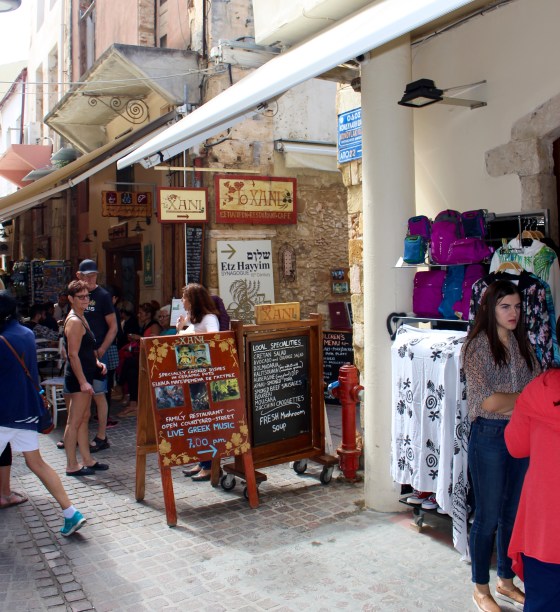
When Julia and I were on holiday in Chania, Crete recently, we had a favourite café, in one of the side streets leading up from the Venetian harbour to the maze of lanes, shops and ancient buildings that make up Chania Old Town. Our café was half way up the street, opposite a rather nice clothes shop, and many a morning would find us just sitting at one of the outside tables, drinking our coffees, eating cake, and watching the world go by. Both Julia and I are inveterate ‘people watchers’ and many a pleasant hour or two was whiled away whilst sitting in a café or bar or restaurant simply watching people – people of all shapes and sizes, nationalities and personality types – many of them simply enjoying walking about in the sun enjoying their holiday in this beautiful place. We were both amused and intrigued one morning when, sitting outside our favourite café, we saw a couple come up the road from the harbour.

The wife immediately disappeared into the clothes shop opposite whilst her husband stood outside looking at his watch every few minutes. After about 10 minutes he went into the shop and dragged her out before she spent too much money. There was then a lively debate between the two of them as to which direction to go in next. The wife wanted to explore, to continue up the road (which, to be honest, didn’t look particularly exciting and appeared to end in a brick wall about 50 yards further on). The husband clearly thought that the way his wife wanted to go was a dead end and insisted that they went back to the harbour. In the end the wife gave in to her husband’s intransigence and plodded back to the harbour clearly dragging her feet in frustration. What the husband didn’t realise, but Julia and I both knew (having walked the whole of Chania Old Town umpteen times), was that the direction his wife wanted to go in wasn’t a dead end but a sharp turn to the left which led to a beautiful and intriguing maze of shops and ancient buildings, stairs and alleyways, twists and turns, with a surprise around every corner.

Reflecting on this later, we thought how much this incident illustrated the two contrasting approaches to both the way we often live our lives, and the way as Christians and local churches many of us approach the challenge of living in these days. It is so easy to quench any sense of adventure or challenge from God to step out in faith, and settle for the familiar, the known, the safe option, rather than ‘dare to be different!’

Jim Binney        

1 Comment

TRICK OR TREAT? (Notes from Knaphill 9)

22815545_10154686876181371_8131298092471830786_n

Yesterday was Halloween and I am reflecting on whether, as Christians and local churches, we need to take a more positive response to what has today in the UK become largely a secular (and some would say unhealthy even Satanic) event? For me, this was highlighted recently by a local Pre-School, who rent premises in a local Church, widely advertising their intent to throw a Halloween Party (with ghosts, ghouls, and all the rest) much to the consternation of the Minister and many of his church members who knew nothing of this until it was advertised and who are very opposed to Halloween for the reasons stated above.   

Halloween or Hallowe’en (a contraction of All Hallows’ Evening) and (according to that font of all knowledge, Wikipedia) ‘is a celebration observed in a number of countries on 31 October, the eve of the Western Christian feast of All Hallows’ Day … [that] time in the liturgical year dedicated to remembering the dead, including saints (hallows), martyrs, and all the faithful departed.’ The probability is that Halloween has its roots in the ancient pagan festival of Samhain (marking the end of the harvest season and the beginning of winter or the ‘darker half’ of the year) and was eventually ‘Christianised’ as Halloween by the Church (like some other major Christian Festivals).

In some parts of the world, Christian observances of All Hallows’ Eve (including attending church services and lighting candles on the graves of the dead) remain popular but here in the UK, however, any Christian association with the Festival has virtually disappeared and Halloween (following the USA) is primarily a more commercial and secular celebration with young and old alike engaging in trick-or-treating, attending Halloween costume parties, carving pumpkins into jack-o’-lanterns, lighting bonfires, apple bobbing, divination games, playing pranks, visiting haunted attractions, telling scary stories, and watching horror films.

For the majority of Evangelical Christians here in the UK (although not in the USA seemingly) the way Halloween has developed and is observed today is seen as unhelpful, unhealthy, and even Satanic. Most UK Churches of evangelical persuasion openly condemn Halloween and discourage members of their church and congregation from taking any part in the secular activities associated with Halloween. Many churches, or groups of churches, put on Light Parties (or the equivalent), to both rival and provide an alternative to Halloween Parties for children, although I am intrigued to see that in many cases such parties usually start about 4.00 p.m. and end around 6.00 p.m. presumably so that the children have time to go back home, put on their Halloween costumes and then go out trick-or-treating?!

Being convinced myself of the need for individual Christians and local churches to drastically change ‘the way we do church’ and become ‘missional congregations’ (rather than self-preservation societies) I have found myself reflecting on whether, as Christians and local churches, we need to take a more positive response to Halloween rather than the negative, condemnatory approach that most evangelicals in the UK seem currently to embrace. Thankfully I am clearly not the only evangelical Christian thinking this way.

For example, one of our Christian friends set up a gazebo and stall outside her house manned by Patch the Pumpkin and his team of helpers, giving away hot chocolate, marshmallows, free goody bags, and the like, to all the ‘trick-or-treaters’ passing by. Lots of people stopped by and lots of good conversations ensued as a result.   

In addition, this year a number of churches in Woking and the surrounding area staged Light Beacons in their communities on October 31st. They set up gazebos, lit them up in a number of imaginative ways (other than literally setting fire to them, of course) and whilst each of the beacons was different, they did some or all of the following: gave out tasty treats, glow sticks and leaflets; held children’s activities; and offered a listening ear/prayer to anyone who wanted to talk or share a matter of concern.

The emphasis in both cases was about redeeming Halloween – a day the Lord has made – by spreading light in the darkness; going out to give not to get; sowing love in place of fear. People are drawn to the beacons and recognise them as safe places. It was a great opportunity to connect with their communities. Halloween is getting bigger (it is already the third largest retail event in the year). Our Christian friend (and Patch the Pumpkin) already are planning to repeat their venture again next year, and the organisers of the Woking events would love to see all of Woking and the surrounding villages lit up in 2018.

For me, it all depends on how we see our role as Christians and churches in a post-Christian society? Do we see our role as ‘putting people right’ by ‘exercising a ministry of condemnation’ (as one preacher styled his own ministry to me once) or by sharing a message of ‘good news of great joy for all people’ (Luke 2:10)? What do we offer this needy, broken, hurting generation – Trick or Treat?

Jim Binney   


Leave a comment

FISHERS OF … FISH? (Chania Chatter 6)

image

Our second week here in Chania is going much faster than our first week and we still have a lot to pack in before we go back to the UK. We are both hampered by heavy colds which is rather annoying since the weather, after a couple of showery days, is hot and sunny once again. But … Julia has a ‘things to do list’ which means that we won’t miss out on anything!?

First on the list is another visit to the beach five minutes walk from our apartment just along the coast from the old port. We decide against going for a swim because of our colds (although Julia has ‘a cunning plan’ to fit at least one other swim in the Mediterranean in before we go home). We have heard a lot about the beautiful sunsets to be seen from our favourite beach so we wait until late afternoon before leaving our apartment. To get to our beach we have to walk through one of the fishing ports which is great fun as we see the local fishermen baiting their nets and lines ready to go out for an evening’s fishing in their small boats. There are quite a few restaurants here all serving freshly caught local fish and on the spur of the moment we decide to have an early dinner out and watch the sun go down as we dine. We go to restaurant that has tables on a small pier and order a couple of dishes of sea food to share and some local beer to wash it all down with. Actually, we only meant to have one dish … but it kind of turned into a party as the evening unfolded.

We have a nice young waiter who introduces himself to us. ‘My name is George’ he says … well it was bound to be wasn’t it!? He is greatly amused by the way Julia orders everything both for herself and for me … Greek culture seems to still be very man centred it would seem … and that I allow her to do so. I try and explain that it is fine by me because we are equals and after 26 years of marriage Julia understands me better than I understand myself. He is shocked … not so much by the fact that I allow Julia to organise me … but because we have been married longer than he has been alive?!

The food is great, the sunset is spectacular, and we have a great evening. George gives me the bill … and then realises that he has made a mistake and gives it to Julia instead!

The next morning Julia’s ‘cunning plan’ to get another swim in is revealed. She has booked us in for a trip on one of the Glass Bottom Boats that leave the harbour at regular intervals and take their passengers out to a small island – a former leper colony – about 20 minutes away. There we can watch the numerous fish swimming in the sea via the glass panels in the bottom of the boat. There are about 10 of us in the boat including the Captain and the Tour Guide (who also doubles up as a diver to ’round up’ the fish for us when we get to the island). He tells us that his name is … wait for it … Nikos! Got you there didn’t I?!

It is great fun. Julia goes snorkelling. Nikos puts on all his gear – wet suit, weighted belt, huge frog flippers, posh snorkel, etc. and jumps in and attracts loads of fish with the special ‘fish food’ he has brought with him. He swims under the boat and blows bubbles at us from under the glass bottom. On the return journey Julia does her impression of a certain scene from the movie Titanic … well, ‘My heart will go on’ does make a change from ‘Blackbird’? Nikos tells us something of the history of Chania Old Town. And it all makes for a very enjoyable trip.

Today we are shopping … buying various gifts, mementos, bits and pieces we want to take back to the UK with us. We pass one of our favourite clothes shops where we have already bought several tee shirts. There is a tee shirt on display that has numerous fish symbols – similar to the ancient fish symbol that the early Christians used as a secret sign that they were indeed Christians – which I am tempted to buy but don’t in the end because, on reflection, I think it is pretty naff. I don’t think the designer had any religious motivation behind his or her design – I think it was just a design they liked.

We also use the time to visit one or two museums we have not seen yet. At the Byzantine Museum I get in for half price because I am over 65. At the Archeological Museum we both get in for free since we are both students! I suggest that because I am both a student and beyond pensionable age they should actually pay me to go in and look around?! Other tourists in the queue think this is a good idea … and everybody thinks that it is wonderful that someone of my advanced age should actually go back to university and try and get a degree. I maintain a dignified, humble silence.

After shopping we are sitting in a cafe having a coffee when a tourist walks by wearing a tee shirt with ‘Reading New Life Church’ emblazoned on the front of it. He sees a man sitting near us wearing one of the fish symbol tee shirts. He approaches him and says, ‘I like your fish symbol tee shirt … are you a Christian?’ ‘No!’ replies the man, ‘I just like fishing!’

Jim Binney

Leave a comment

BON NUIT, MONSIEUR GEORGES (Chania Chatter 5)

image

We are going out to dinner … to a rather nice courtyard restaurant situated in the maze of side streets in the old town … but first an early evening drink at one of the numerous harbour side cafes and restaurants. We go to one we have not been to before because it has comfortable sofa seats with a great view. We are thinking about a glass or two of sangria but the very nice waiter suggests mavrodaphne which is apparently nicer and cheaper. We are persuaded and he brings us our drinks and lots of nice nibbles … and he is quite correct about the mavrodaphne.

Two nice ladies of a certain age come and sit on the table next to us. We fall into conversation. They do not know what to drink so we recommend the mavrodaphne. Our waiter is impressed by our sales technique and whispers in my ear that we can have 10% off the bill, which is a good thing because we liked ours so much we have just ordered two more glasses?! He brings us all our drinks, lots more nibbles, and four shots of complementary cocoanut flavoured raki as well. The conversation flows!

The ladies tell us that they are from Sweden … and we have an interesting conversation about what life is like in Sweden. I confess that the only significant thing that I know about Sweden is that apparently it has no rules?! The ladies think that this is hilarious … but they don’t disagree with me. We ask them if they like the mavrodaphne? One does, but the other is not so sure. She swigs down the complementary raki. ‘That’s better!’ she says.

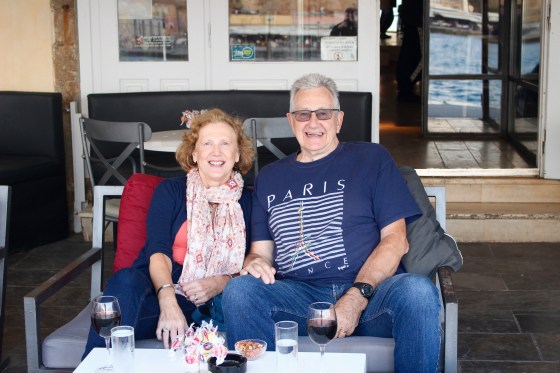
We pay our bill, leave our nice Swedish ladies with no rules … who are now on their second glasses of mavrodaphne and second shots of raki … and head for our nice courtyard restaurant. On the way we pass George’s restaurant, where we had dinner on our first evening in Chania. George is out front trying to hook punters in as usual. He doesn’t recognise us but steps out in front of me. ‘Bonsoir, Monsieur …’ he says, and then goes off into a lengthy spiel, in French, about the merits of his restaurant. ‘Why is he speaking to me in French?’ I wonder … but then I realise that I am wearing a French tee shirt with ‘Paris’ emblazoned on the front and therefore George thinks that I am French. You do have to admire these Greek waiters command of languages, by the way. They seem to be able to speak umpteen languages fluently.

Fortunately (thanks to my intensive Dualingo French Course which tells me that I am now 49% fluent in French) I can understand most of what George (or should I now call him Georges) is saying. I patiently wait for him to eventually pause for breath … and then I step in. ‘Nous sommes Anglais’ I tell him. The shock slowly registers … and while he is silent for once I gently take him by the arm and point to the harbour. ‘Let me tell you about my grandfather’ I say, ‘my grandfather used to say that you have to have this harbour in your heart!’ ‘And now is the best time of the day, and here we have the best view of the harbour, and here (pointing to the table we sat at a week ago) is the best seat in the restaurant!’ Julia is falling about laughing as I repeat the sales patter Georges beguiled us with that first evening back to him word for word. Georges gives me a rueful smile.

We have a great evening at our nice courtyard restaurant in the old town. The food is great, the music is wonderful, and we have a thoroughly enjoyable time. Julia goes missing at one point and suddenly I see her up near the stage talking to the Greek musicians. ‘Oh! No!’ I think, ‘She is going to try and play Blackbird on one of their funny Greek instruments with umpteen strings and various knobs and things?’ But she is just thanking them for their contribution to a great evening and giving them an extra tip.

We walk back to our apartment along by the harbour. It is much quieter now but Georges is still outside his restaurant trying to hook a few more punters in. He sees us and smiles. ‘Bon nuit!’ he calls out to us. ‘Bon nuit, Monsieur Georges!’ we reply … and we all fall about laughing.

Jim Binney

Leave a comment

BUSKERS AND BEGGARS (Chania Chatter 4)

image

Most evenings we wander down into the old town either for an early evening drink by the harbour or for dinner … sometimes both! It is so lovely just sitting in the sun watching the world go by, whether that is the Glass Bottomed Boat going out for the sunset cruise, or the horse drawn carriages taking their customers for a tour around the old town, or simply locals and tourists walking by. Julia and I are both inveterate ‘people watchers’ … what stories must lie behind some of the people we see … and we love to ‘get into conversation’ with people.

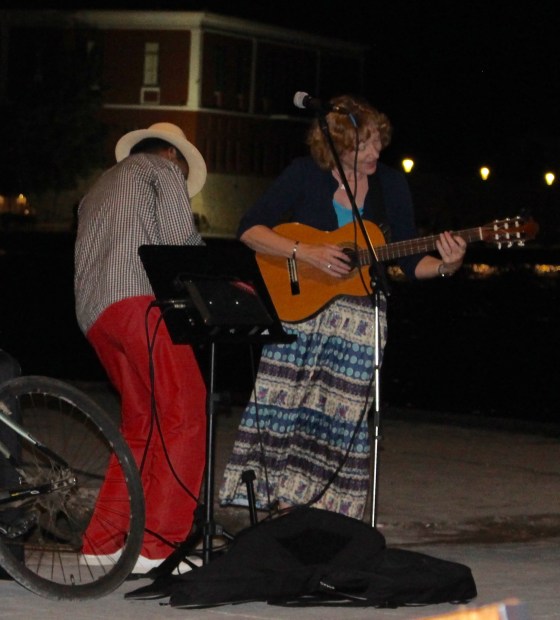
There are lots of street musicians dotted around the harbour, and playing outside and inside several of the restaurants throughout the old town. Most of them are very good. We especially like the traditional Greek music – the Zorba the Greek style stuff – although plate smashing doesn’t seem to be much in vogue these days (probably to do with the fragile Greek economy). Julia has been having guitar lessons for the last few months and has become quite good – she plays much better than me these days – and so she is much taken by the guitarists especially.

We are sitting in a harbour side restaurant one evening and there is chap playing a guitar just across from us. He is not very good actually and I can sense Julia itching to take over and have a go. Suddenly she is up out of her seat and talking to him. ‘Do you know Blackbird by Paul McCartney?’ she asks him. It is one of the songs Julia has learned and which she plays very well – proper notes and all, not just strumming like what I do?! He has never heard of Blackbird or Paul McCartney. ‘You know,’ Julia says, ‘one of the Beatles!’ He has never heard of them either? Julia takes his guitar from him (nobody ever argues with Julia when she is in full flight) and proceeds to play Blackbird for him. His takings immediately double!

Not only are there a good few buskers in the old town, there are also a good number of beggars. There are quite a few children begging – who also play instruments such as small accordions and drums or who sell bangles and necklaces, etc. They can be quite aggressive and have to be chased away from the restaurants by the staff. I never know how to respond to beggars. On one hand I feel very sad for them … there is one old lady, dressed from head to toe in black, who sits and begs for money with her dog. She only has two words/phrases in English: ‘Hello’ and ‘Give money’. There is young woman with a baby in her arms … but I notice she also has very expensive highlights in her hair? There is a guy who sleeps rough … with several dogs who always sleep next to him. I think perhaps, at the end of our holiday, we will go round the old town and give some of them money … it seems to be the right thing and something Jesus himself would probably do?

Jim Binney

Leave a comment

SURPRISE! SURPRISE! (Chania Chatter 3)

image

We have been here in Chania Old Town for just over a week now … and this holiday seems to be lasting forever. We know that this second week will go much more quickly than the first, but that is how it is with holidays. We wondered when we decided to come on holiday here for two whole weeks, without hiring a car, if we would get bored – I mean there is only a certain amount of walking around the same place day after day that you can do without seeing the same things again and again? But … we just love it here! And as for getting bored being in the one place for two weeks … it is proving impossible. As one of our guide books informs us, ‘No matter how many times you walk round the old town there seems to be yet another delightful surprise around every corner.’

Everything about this holiday so far has been full of pleasant surprises. Our wonderful well-appointed fifth floor apartment with its spacious balcony, sun terrace, and delightful views over the harbour, the Mediterranean, and the mountains. Our first walk into the old town on our first evening when we suddenly turned the corner and saw the stunning old Venetian harbour bathed in glorious evening sunlight. The wonderful restaurants and shops along the harbour itself and in the maze of side streets leading inland from the harbour. The amazing architecture, houses, museums, archeological sites and places of interest. There is so much to do and see here … and you don’t have to drive, catch a bus, take a taxi to see it all. The old synagogue, the Cretan house, the Minoan excavations, the Venetian lighthouse, and so much more. As dear Cilla would have said, ‘Surprise! Surprise!’ There are wonderful surprises everywhere.

We love the small local shops – everything from crafts to clothes – and the cafes and restaurants – with wonderful musicians playing traditional Greek music live. We love the people – locals and tourists alike – and we have enjoyed some great conversations. We love the little evangelical, charismatic church we discovered (just down the road from our apartment) doing genuine salt and light and leaven stuff amongst the locals and the north African migrants.

When we were back in Knaphill the Lord recently spoke to Julia and myself in prayer one day and told us that the future for us would be full of twists and turns but not to worry about this because every twist and turn would be good and beneficial for us. We were reminded of Paul’s words to the church in Rome (and for Christians of every age and generation) that ‘In everything God is working for the good of those who love him, the good of those who are seeking to walk in his plans and purposes’ (Romans 8:28). Being here in Chania Old Town is a constant visible reminder of God’s word to us. The place is full of twists and turns but, as the guide book said, ‘No matter how many times you walk round the old town there seems to be yet another delightful surprise around every corner.’ And if this is true for us here in Chania, it will certainly be true for us in the future as we seek to live in the centre stream of God’s will for our lives.

Jim Binney

.

Leave a comment

GEORGE! DON’T DO THAT! (Chania Chatter 2)

image

It is our first evening in Chania, Crete. We have unpacked our cases. Stocked up on food, etc. from the local supermarket just down the road. Struggled back up the five flights of stairs to our top floor apartment with its stunning views over the old town, harbour, and the Mediterranean. Had a couple of hours rest and a celebratory drink or two on our wonderful balcony. And now we are off to explore the harbour area and find somewhere for dinner.

The weather is gloriously warm and sunny. The weather forecast we looked at back in the UK before we left was not promising. Crete has been enjoying consistent sunshine for the last umpteen weeks with temperatures in the 30s, but it is supposed to change for the worst this week. But this evening it is warm and sunny and, even though it is ‘out of season’ supposedly, the old town is full of people out for the evening. Chania old town is only five minutes walk away from our apartment and when we turn the corner into the harbour area … well, it is just stunning. Chania old town immediately becomes our new favourite place! It is alive with people, cafes, restaurants, shops, street entertainers, conversation, laughter, life! The place is simply beautiful … glowing in the early evening sun.

We walk most of the way around the harbour simply reconnoitring what is here. We don’t go all the way round, or venture into the various lanes that make up the rest of the old town – we have two weeks ahead of us to thoroughly explore. Primarily we are looking for somewhere to eat dinner. We are spoilt for choice. There are so many different venues and menus on offer. There are lots and lots of restaurants, all with tables and chairs spilling out on to the pavements around the harbour, several offering live music in the Greek style. We are not sure exactly what we feel like eating. There are lots of fish restaurants but that’s o.k. because we both like fish.

Having had a good look at what’s on offer we work our way back around the harbour looking more closely at the various menus. We are engaged in conversation outside one restaurant by a rather pleasant ‘meeter and greeter’ person. Obviously it is his job (along with a couple of others) to persuade passers-by like us (who are looking for somewhere to eat dinner) to visit this restaurant. Julia and I (as former salespeople ourselves) are suckers for other good salespeople … and this guy is good … interesting, humorous, tells a good story.

‘Let me tell you about my grandfather’ he begins, ‘my grandfather used to say that you have to have this harbour in your heart!’ ‘And now is the best time of the day, and here we have the best view of the harbour, and here is the best seat in the restaurant!’ he continues. ‘But we only want an aperitif’ we reply, ‘we haven’t decided what we want to eat yet!’ ‘Well, welcome to Chania’ our meeter and greeter responds with a warm smile. ‘This is such a romantic place, and you are obviously a lovely couple, so do sit here just for a moment … and have a free drink on the house!’ He shakes hands with us, and introduces himself. ‘My name is George’ he says, ‘and my father’s name was George, and my grandfather was also called George!’

Before we know it we are sitting in George’s restaurant enjoying a free glass of chilled white wine … and of course we do end up staying there for dinner … and very nice it is! Whilst we are eating we watch the world go by: the tourists looking for somewhere to have dinner, the locals out for an early evening stroll, the buskers and musicians looking for somewhere to set up. We also watch George and his fellow ‘meeters and greeters’ at work. Two elegantly dressed ladies of a certain age walk by. ‘Let me tell you about my grandfather’ says George, and soon the ladies in question are sitting at the table next to ours, a table which has now miraculously also become the ‘best seat in the restaurant!’

We get into conversation with the two elegantly dressed ladies who introduce themselves to us as Thelma and Louise. Like their more famous namesakes they are here for an adventure. They have left partner/husband at home and escaped to Chania for a week’s fun they tell us. Apparently Louise’s husband doesn’t like flying and Thelma’s partner is ‘boring’. They flew by Ryanair so it will certainly be an adventure! They come from the West Midlands – an area we know well – so we have a nice conversation. George has obviously taken a shine to Thelma and frequently comes over to their table to share more of his grandfather’s wisdom with her?

Thelma and Louise finish their meal before we do, pay their bill, reject George’s offer of a free bottle of Raki, and start to wander off into the crowd. Thelma and George, however, seem somewhat reluctant to let the evening end this way and continue chatting together. Louise leaves them to it and comes and sits at our table. ‘Good luck with that!’ she says, nodding in Thelma’s direction,’She’s a real man eater!’ Thoughts of Joyce Grenfell suddenly come to mind: ‘George! Don’t do that!’

Jim Binney

Postscript: The following evening we are once again out for dinner in Chania Old Town, this time at a Fish Restaurant we set our sights on earlier in the day, further round the harbour. When the waiter comes to take our order I cheekily ask him if his name is ‘George’ (since everybody here seems to be called ‘George’). ‘No!’ he replies, ‘My name is Nikolai. You want my brother?’ ‘George!’ he shouts, and another waiter comes over to our table … wondering why these two strange British tourists are falling about laughing?