
One of our Regional Ministers (a kind of Baptist ‘Bishop’) was meeting with the leadership team of a reasonably large Baptist Church in his area who were in a time of ‘Pastoral Vacancy’. During the preamble to the meeting proper the casual conversation had covered some of the enquiries fielded by the church in recent days: a woman who had wanted her baby ‘done’ and who had been told bluntly that ‘Baptists don’t baptise babies’ and that she needed the C of E ‘for that kind of thing’; a man whose fiancée had been divorced and who wondered if they could get married at the Baptist Church, and who was told in no uncertain terms that this particular church ‘didn’t marry divorced people’ and that he should either try the ‘liberal’ Methodist Church down the road or, even better, just go to the Registry Office; the rather tearful elderly lady, who lived down the road from the church and whose husband had died that week, wondering if it would be possible to hold the funeral service at the church, who was told that ‘since neither of them had attended the church she should look elsewhere.’
The Regional Minister made no response to this sad sequence of events until later in the proper meeting when he was told that one of the difficulties facing this church (and any prospective Minister going there) was a ‘lack of opportunities to reach out missionally to the local community’? At this point the Regional Minister ‘exploded’. ‘Lack of missional opportunity!’ he queried. ‘A young mother wanting to give thanks to God for the birth of her child, and asking for a ‘blessing’? A man wanting to get married in church, albeit to someone who had had a previous broken marriage? An elderly lady wanting to hold her late husband’s funeral in your church even though she has never visited you before? Were these not all ‘missional opportunities’? The very least you could have done is to have met these needy people and talked with them?’
In my previous two ‘blogs’ (in this short series of three) I explained that the kind of ministry Julia and I have been involved in down through the years has primarily meant going to declining churches and helping them (under God) find a new direction, find a future, when there appeared to be none. For the most part these churches knew that they needed to change and believed that God had a new direction and purpose for them, but they were unsure as to what that direction and purpose was. We did not come with any pre-conceived ideas but simply with the intent to prayerfully explore the way forward together with the church leadership and congregation. What developed from this prayerful process (quite unplanned by us) was three vital questions we all needed to answer (individually and corporately as church). What kind of God… and so what? What kind of Church… and so what? What kind of mission… and so what? It was important not to rush through in seeking to answer these questions. We needed to take our time and work through them, prayerfully and sensitively, seeking to know ‘the mind of Christ’ (Philippians 2:5).
Having previously considered the first two of these questions: What kind of God… and so what? and What kind of Church… and so what?’ we now move on to the third question: What kind of Mission… and so what? Having spent time looking up, and then looking in, we now need to spend time looking out.
Some years ago the Baptist Union of Great Britain rightly began urging member churches to ‘move from maintenance to mission’. To some degree this was born out of a sense of desperation given the steady rate of numerical decline amongst the ‘historic’ churches in the UK (including many Baptist Churches). Whether or not this has now become part of our Baptist DNA, or disappeared entirely from the agenda of most Baptist Churches, is a matter of debate. I guess we still pay ‘lip service’ to the idea but I am not at all sure how ‘active’ we are in this direction?
Hopefully there was a ‘higher’ (more Biblical and theological) reason behind this call to the churches to engage in ‘mission’ other than desperation at declining numbers. The Missio Dei (mission of God) is a prominent theme in Scripture – indeed some Christian scholars such as Christopher Wright suggest that to unlock the Bible’s grand narrative we need a ‘missional hermeneutic’ i.e. we need to read the Bible from a missional perspective rather than simply get our ideas about mission from the Bible. For Wright, the whole Bible is all about ‘the mission of God’ and how we need to see the ‘big picture’ of God’s mission and how again and again the familiar stories and teachings confirm and clarify that the Missio Dei is the major theme of the Bible.
Quite rightly the mission of God has, for a good number of years now, been understood in broad terms as being holistic in nature covering our physical, mental, social, emotional and environmental needs as well as our spiritual needs. In recent years, however, there has been a renewed emphasis on the spiritual need in recognition that the bottom line is that we are all ‘rebels against God’ (Romans 3:23) – by nature as well as action – who need (in the words of Jesus) to ‘turn away from our selfish rebellious ways, and turn back to God and his far better way’ (Mark 1:14,15). We live in a badly broken and hurting world (our fault not God’s) and the blunt fact of the matter is that the only way to change society is to change the hearts of individual men and women.
I sometimes wonder, however, if our emphasis on the priority of being ‘converted’ has actually worked against us in many ways. It has sadly become indelibly associated with a certain ‘brand’ of Christianity promulgated particularly by ‘evangelical churches’ in the USA. In contemporary US public life, ‘evangelical’ has become heavily politicised, polarised, and – outside the movement itself – often carries negative associations. This shift is well‑documented in recent research and reporting. Several major surveys show that the term has taken on meanings far beyond its theological roots and has become closely associated with particular political stances, especially through its strong identification with supporters of Donald Trump. Many Americans now hear ‘evangelical’ as a political bloc rather than a theological belief. Traditions most strongly linked with evangelicalism (e.g., Pentecostalism, Southern Baptist Convention) tend to score more negatively in public perception than mainline denominations.
This negativism and suspicion of ‘evangelicalism’ has spread to many other parts of the world. This doesn’t mean evangelicals are universally disliked but outside the movement, the word has accumulated cultural baggage. One of the ‘spin offs’ of all this is that, because of the many US evangelicals despite their claims to be Christian do not demonstrate the fruitfulness of a genuine Christlike character (Matthew 7:15-20), their emphasis on the need for ‘conversion’ lacks authenticity. Intriguingly, although the concept of conversion is deeply biblical, the actual word ‘conversion’ itself is not used in most modern translations. Scripture instead uses a cluster of verbs and images that together express what Christians mean by ‘conversion’ which together indicate lives transformed as a result of individuals coming into a meaningful relationship with God through a personal encounter with Jesus Christ… an experience which transcends every Christian denomination.
Having said all this however, we must not limit the Missio Dei just to evangelism (as important as that is). Thus, we rightly tend to speak of integral mission these days rather than holistic mission – a term coined in Spanish as ‘misión integral’ in the 1970s by members of the evangelical group Latin American Theological Fellowship to describe an understanding of Christian mission which embraces both social responsibility and evangelism. The word ‘integral’ is used in Spanish to describe wholeness (as in wholemeal bread or whole wheat). The concept of integral mission is nothing new – rather, it is rooted in Scripture and wonderfully exemplified in Jesus’ own ministry.
Another way of talking about this is what we call ‘Incarnational Mission’. Incarnational mission is the conviction that the church participates in God’s mission by embodying Christ’s presence within a particular place, culture, and community. When Jesus commissioned his disciples to continue his mission he told them to carry on doing what Jesus himself had always done: ‘As the Father sent me, so I am sending you’ (John 20:21). And what did Jesus do? He ‘went around doing good’ (Acts 10:38).
Incarnational mission, however, is not simply doing things for people but identifying with them – sharing life, listening deeply, and allowing the gospel to take flesh in local realities. At its core Incarnational Mission echoes God’s movement toward the world. Rooted in the incarnation itself, the fact that ‘the Word became flesh and dwelt among us’ (John 1:14). Incarnational Mission begins with God’s self-giving presence, not our strategies. It is about being embedded in the rhythms, hopes, and wounds of a community. Geography, relationships, and shared life matter. It is also about mutual transformation. We (as individuals and as a church) are changed by the encounter as much as the community is. Incarnational mission resists a one‑directional approach. We are not there to do something to our community but rather to be something within our community. Being ‘salt’ and ‘light’ and ‘yeast’ (Matthew 5:13-16; 13:33). Thus the Gospel we seek to share is expressed in ways that make sense within the cultural, social, and economic realities of a place. Incarnational mission differs from other models of mission in that it doesn’t rely on drawing people into church spaces; it begins where people already are. It is not colonial nor programmatic. It avoids importing pre‑packaged solutions. Instead, it listens for what God is already doing locally. At the same time it is always more than merely social action. Whilst it includes justice and compassion, its centre is Christ’s presence embodied through his people.
Right from the very beginning – God searching for Adam and Eve when they were hiding from God among the trees in the Garden of Eden (Genesis 3:8,9) – God has been seeking to draw rebellious men and women back to himself and to a way of living that glorifies God and makes us a blessing to others around us. It is important for us to understand that the Missio Dei is God’s mission – not something that we ‘do’ for God – and that God graciously invites us to share in his mission with him! Because this mission to reconcile men and women to God, and in turn for them to be used by God to fulfil his plans and purposes, is fundamentally God’s mission it cannot fail. Our involvement in the Missio Dei is a privilege not a chore. ‘Mission’ only becomes a chore when we wrongly see it as ‘something we are obliged to do for God’ rather than ‘something God is already doing’ and in which we are invited to share.
At the heart of the mission of God is the centrality of the Cross. As the Apostle John tells us in the Fourth Gospel: ‘God loved the world so much that he gave us his one and only Son, that whoever believes in him shall not perish but have eternal life. For God did not send his Son into the world to condemn the world, but to save the world through him’ (John 3:16,17). Biblically, ‘salvation’ is rather a broad term covering material as well as spiritual needs, and is applied corporately as well as personally at times. Hence, the emphasis on the different facets of holistic or integral mission: physical, mental, social, emotional, environmental and spiritual. For me, Mary Bowler Peters (1813-56) sums it up poignantly in a line from one of her hymns: ‘Ours is such a full salvation’!
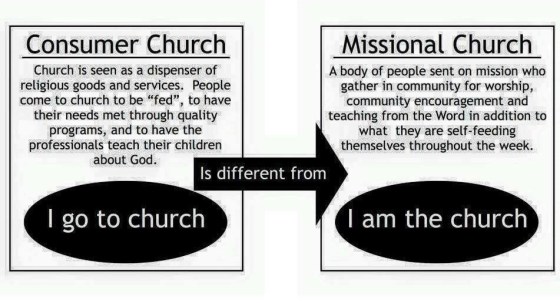
My conviction, therefore, is that we need to deliberately change our priorities both as individual Christians and as local churches. We need to move from maintenance to mission, from being self-preservation societies to missional communities, from seeing mission simply in terms of leaving the church doors open during Sunday Worship hoping outsiders will somehow wander in to being community hub churches ministering to the holistic needs of our community 24/7.
When Julia and I went to Abbey Baptist Church, Reading, in 2018 we went to a numerically small church, made up of around 20-25 mainly elderly, white-British, middle-class, educated, home-owning people, situated at the centre of a large, bustling multicultural town. Despite having a nice building, a lot of money in the bank, and sharing their building with three other culture specific churches, they were fighting a desperate rear-guard battle for survival… a white-British enclave in the midst of a sea of multiculturalism. They knew they had to change… the problem was how to change.
The amazing story of how (under God), over the following few years, Abbey embraced change and transitioned into a thriving cross-cultural, all-ages, church of between 150-200 is too long to record here. Sufficient to say that this small group of elderly people grasped the nettle and bought up the various opportunities for integral and incarnational mission that came their way. Engaging (with a few other churches) in Bed4Night (a night shelter for the homeless); partnering with secular organisations such as Reading Red Kitchen and Care4Calais in feeding, clothing, accommodating Reading’s numerous refugees and asylum seekers; setting up an English Language Conversation Café for those wishing to learn/improve their English language; providing a warm/safe space where it was ‘OK not to be OK’ for anyone and everyone; revamping Sunday Worship to accommodate the scores of people from a variety of cultures who started to attend the church… these are just a few of the innovations that Abbey engaged with. And whilst the majority of these activities were not blatantly ‘evangelistic’ scores of people began to attend the church, were converted, baptised, and became members of the church in the process.
At the heart of it all was a lively, committed, Christian church who (unlike the church mentioned at the beginning of this blog) bought into the opportunities that (under God) came their way. A church which today (even though Julia and I have now ‘retired’ and relocated) continues to grow both numerically and spiritually (under new leadership) as a result of engaging authentically with the Missio Dei.
Jim Binney
 therevdrjs